
Blossoms blooming
Small birds chirruping sweetly:
We should enjoy fresh air
Photo taken at Kyoto Garden in Holland Park, London

Blossoms blooming
Small birds chirruping sweetly:
We should enjoy fresh air
Photo taken at Kyoto Garden in Holland Park, London

Notting Hill Gate, not to be confused with ‘Notting Hill’ as in the Hugh Grant film, on the western edge of central London is not lacking in mediochre modern architecture, mostly constructed in the 1960s and 1970s. One building stands out as being aesthetically a cut above the rest. This is the former Czechoslovak Centre, the Embassy of Czechoslovakia, a fine (if that is an appropriate adjective) example of ‘Brutalist’ concrete architecture.
The Centre was built between 1965 and 1970, and was designed by “…Šrámek, Stephansplatz and Jan Bočan, from the Atelier Beta Prague Project Institute, were the architects of the embassy, working in cooperation with British architect Robert Matthew and based in his office” (see HERE for detail). The building won an architectural award from RIBA in 1971. Unlike many buildings built at te same time, the Czechoslovak Centre building has not suffered from ageing. It stll looks in great condition.
In 1993, Czechoslovakia ceased to exist. It split into the Czech Republic and the Republic of Slovakia. Despite this, the Czechoslovak Centre building continued to have diplomati cfunctions. The building was divided into a Czech Embassy and a Slovak Embassy.
Before and after the separation of the two parts of what was once Czechoslovakia, I was a member of the Dvorak Society, an English organisation for promoting interest in music from the Czech and Slovak lands. The Czechoslovak, and then later the Czech and Slovak embassies used to host occasional congenial recitals of music for the Dvorak Society.
On one occasion after 1993, my wife and I attended a recital at the Slovak Embassy. After the music was over, we were treated to delicious food and Slovakian wine. The ambassador mingled amongst the guests. My wife asked him how the Czechs and Slovaks were coping with sharing the same building. Smiling, he replied:
“We have to cope well because we have to share the central heating and hot water system that was installed to serve the building when it was a single embassy.”
Many of the smarter social clubs in India have rules about how one should be attired when visiting them. The same is true for ‘elite’ clubs in London.

For example, at the Ootacamund (‘Ooty’) Club in southern India men cannot think oof having a drink at the bar if they are not wearing a formal suit and tie. And, at the Bangalore Club, men can where sandals in the Club House providing the sandals have a back strap. Even worse, at the same club the wearing of smart Indian national outfits is frowned upon if not forbidden. This is surely a hangover from the days when the club only admitted ‘white’ Europeans and a few high-ranking Indian military personel.
Once, I was staying at the Kodaikanal Club in Tamil Nadu state. Dress rules were extremely casual there. Many guests wore shorts and sandals even in the bar and dining room. One day, I entered the club’s small library, and the librarian promptly asked me to leave. I was wearing sandals (with backstraps). Apparently, in the library gentlemen are required to wear formal lace-up shoes. I cannot say why this was required unless the Kodaikanal holds literature in high esteem, and wants it to be respected by library users who have taken the trouble not to be dressed casually.

Rain has fallen early
Wet footpaths glistening
Strollers walk briskly

Doggies out walking
On Kensington streets
Saturday early morning
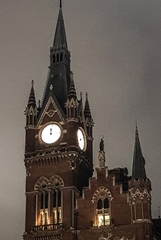
Gothic towers glow
In the grey midnight gloom
London sleeps silently

Ev’ry rain drop
Creates a ring of rippling
Wet but of quite short life
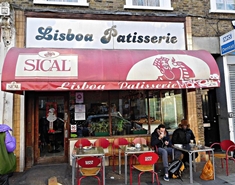
Back in about 1995, I decided to leave the dental practice where I was working. I went to one or two job interviews, but did not feel that I would have been happy working in them had I been offered a job in any of them.
Then, I visited a dental practice next to the Portuguese Lisboa Patisserie in Golborne Road (near London’s famous Portobello Road). The owner of the practice, who has long since retired, knew me, but I could not remember him even though we had studied at the same dental school.
The interview began well after my future boss had gone next door to get each of us an espresso coffee from the Lisboa. It was one of the best espresso coffees I had ever tasted in London. We got on well, speaking for hours, for so long that I was late for a pre-arranged dinner engagement.
I took the job and worked in the practice for five interesting years, fixing and/or extracting many of the local’s teeth. I do not believe it was only the espresso coffee that persuaded me to join the practice, but it certainly helped.
I have long since retired from that practice in Golborne Road and also from dentistry, but still visit the Lisboa Patisserie regularly. The quality of the coffee and Portuguese snacks, both sweet and savoury, has not faltered over the years, and some of the staff are those who were there back in the late 1990s.
I can strongly recommend a visit to Lisboa and its coffee, which was so perfect that it helped direct my career pathway.
57 Golborne Rd, London W10 5NR
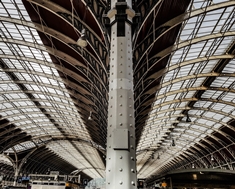
Huge steel hoops
Over tracks leading westwards:
Paddington rail terminus

A bird flies past the Bard
No sonnet for the gull
Will thaw this statue
Statue of William Shakespeare at Leicester Square, London
 yamey
yamey 