By road and by rail through rural Gujarat

WE HAD DECIDED TO travel to Mandvi (in Kutch, a part of Gujarat) by taking a train to Gandidham, then going by road the 98 kilometres between there and Mandvi.

The Indore to Gandidham Express arrived 30 minutes late on Ahmedabad Junction’s platform 4. Getting on to our carriage was a veritable scrum. The problem was that people, including us, wanted to board before those alighting at Ahmedabad had reached the carriage entrance. Someone behind us shouted “Hurry up and get inside.” When a passenger who was trying to leave the train replied “We want to get off”, the irritating lout behind us shouted “You should have started getting out quicker.” We struggled along the carriage and found our window seats eventually.

We had reserved seats numbers 73 and 76. A man was sitting in seat 76. When we said it was one of ours, he said that he was occupying his alloted seat, namely seat 77. It took some considerable persuasion before he understood that seat 77 did not have the number ‘76’ above it. This incident reminded me when I used to travel by train in Italy during the 1960s.

Whenever we travelled by intercity trains in Italy long ago, my parents always reserved seats – always in the first class carriages – in advance. Invariably, our reserved seats would be occupied by passengers who should not have been in them. It was o lying after the train conductor had been summoned that the people yielded our seats to us. Moments later, these obstinate people would engage in friendly conversation with us.

Returning to the Indore to Gandidham Express, before it started, vendors selling fruit and bottled water roamed along the platform looking for customers. Meanwhile, a hot tea seller moved along the interior of the train. He and others remained on board during the journey, as did a couple of snack vendors.

Once we got going, the train sped along. There was only one intermediate station where we stopped briefly during the 4 and a 1/2 hour journey. As we traversed the flat plains of Gujarat, we saw many neatly cultivated fields and numerous industrial units of varying sizes. In the area where eastern Kutch begins, we passed vast expanses of land being used as salt pans. Every now and then, we saw conical mounds of grayish white harvested salt.

Many trains passed us, travelling in the opposite direction. Almost all of them were freight trains. The line along which were moving leads to and from the busy port of Kandla on the south coast of Kutch. What little we saw of Gandidham and its outskirts was unattractive.

The air temperature at Gandidham station was well over 30 degrees Celsius and there was little shade. To exit the station, we had to use an escalator. Once again it was a scrum trying board it. Some passengers were too frightened to step on it which made using it even more difficult.
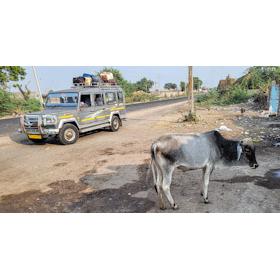
Our host in Mandvi had kindly booked us seats in a shared taxi to travel from Gandidham to Mandvi. This vehicle was like a jeep. It had a front row of seats – sofa like – and behind that there was another similar seating arrangement. Behind that, there was a far less comfortable seating space that accommodated any number of people that could be squeezed in. We were booked into the seating behind the front seats and in front of the rear ‘compartment’.

Although the middle seating had been booked for my wife and me, Lopa invited one of the three passengers who had squeezed in the front seat next to the driver to join us. He turned out to be a friendly chap. He and his friends were returning home from several days of a religious pilgrimage. Our new companion was a trader in rice, sugar, etc. He bought commodities and sold them for export. During our journey, he received a telephone call. He told us that soon after getting home, he had to go to Bombay for some urgent work. He and his business partner would have to drive for 11 hours through the night to reach Bombay from near Mandvi.

Our driver decided not use the 4 lane highway between Gandidham and Mandvi because of heavy traffic. Instead – and it made the journey far more interesting – he took us along a “short cut”, using country roads, some of them minor. This added fascination because we passed through rustic villages. At one of these, we were stopped by an elderly lady standing beside the road. She wanted to go to Mandvi, and was invited on board.

At another place, we stopped and the driver picked up a bundle tied in cloth, which he delivered to someone in another village we passed through later. After about an hour, to my great relief because my mouth was parched, we stopped for about 20 minutes at a stall where snacks and cold drinks were available.

At one point early during our journey, someone in the rear compartment asked our new companion to dial a certain number on his phone. Some conversation in Gujarati ensued. It turned out that there were some labourers travelling in the rear compartment. As they had not yet been paid by their employer, they claimed that they did not have the 300 Rupees needed to pay for the ride. Our friendly sugar trader allowed the employer to electronically transfer the required amount to his account. Our neighbour then suggested that he could electronically transfer that fare money to the driver’s account. However, the driver wanted to be paid in cash, which the trader kindly agreed to do.

Most of the way, the driver used one hand to steer, and the other to hold his mobile phone to his ear. Despite this hazardous practice, there were no scary moments along the way. We arrived at our destination safely, but somewhat cramped.

When we sat inside our host’s air-conditioned large saloon car to drive to his house, it felt as if we had moved from a stone seat into a feather bed. Never before has a modern saloon car felt so comfortable.

Despite moments of discomfort, our rail and road trip was enjoyably interesting. By the end of the journey we felt as if we had been truly travelling – a feeling that air travel often fails to provide.
Kutch from kingdom to district

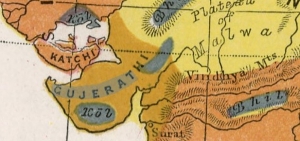
MY WIFE’S COUSIN lives in a part of the Indian state of Gujarat called Kutch (‘Kachchh’). He and his wife have a lovely farmhouse near the port city of Mandvi, where you can watch huge wooden dhows being constructed along the riverbank. Although Kutch is now a part of the state of Gujarat, it has not always been. The people of Kutch (‘Kutchis’) speak a language quite distinct from Gujarati. The Kutchi language has closer similarity to Sindhi than to any other Indian language (Kutch is bordered to its north by Sindhi speaking people*). It is a spoken language, but not written. Even though Kutchi people can speak and write in Gujarati, they will proudly inform you that they are Kutchis and definitely not Gujaratis. During our several visits to Kutch, my wife’s cousin’s driver, who can speak good Gujarati, insists on speaking to my wife in Kutchi, which she cannot speak as well as Gujarati.

Many people with whom I have discussed my travels, look puzzled when I say that we have been to Kutch. Just in case you are wondering, it is the furthest west part of India. Most of the north of the region is bordered by Pakistan, from which it is separated by the arid Rann of Kutch. To the south and separated from it by the Gulf of Kutch (a part of the Arabian Sea) is the peninsula of Saurashtra – now also a part of Gujarat.

Until 1947, Kutch was a kingdom founded by unifying three separate kingdoms, ruled by branches of the Jadeja family, in the 16th century. In 1819, having suffered a military defeat (at The Battle of Bhuj in March 1819), the Kingdom of Kutch accepted the sovereignty of the British East India Company. Under the watchful eyes of the British, members of the Jadeja family continued to rule Kutch – it became one of India’s many ‘Princely States’. On the 16th of August 1947, one day after India became independent, Kutch voluntarily acceded to the new Indian state.

Kutch became a state of India. In November 1956, as a result of the State Reorganisation Act (1956), Kutch ceased to be a state in its own right, but became a part of the then huge Bombay State. The latter was effectively a bilingual region, most people were either speakers of Marathi or of Gujarati. The Marathis and the Gujaratis began to clash. In 1956, the Mahagujarat Movement began campaigning for a state for Gujaratis, which was separated from that for Marathis. The movement was spearheaded by Indulal Yagnik (1892-1972). His nephew, who lives in Bangalore is a family friend, whom we meet whenever we are in the city. As the Gujaratis clamoured for their own state, so did the Marathis, Blood was shed, and much property was damaged. On the 1st of May 1960, the old Bombay state was divided along linguistic grounds. The states of Maharashtra and Gujarat were formed. The latter includes the Gujarati speaking district of Saurashtra as well as the northern part of the former Bombay State, and also Kutch. And that is how it remains today.

Since 2017, we have made several enjoyable visits to Kutch, from which my wife’s maternal ancestors hail, and enjoyed many fascinating experiences there. Some of these can be found in my new book – a collection of true stories about life in India seen through my eyes. The book (also Kindle) is available from Amazon websites including https://www.amazon.co.uk/HITLER-LOCK-OTHER-TALES-INDIA/dp/B0CFM5JNX5/

*When Lord Napier conquered Sindh *which neighbours Kutch) in 1843, he is reputed to have sent a single word message to London in Latin “Peccavi”, which means ‘I have sinned’.

A temple in Mandvi: architectural revival or survival?

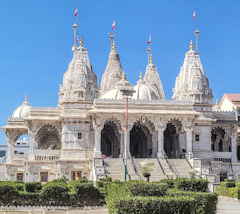
THE SWAMINARAYAN TEMPLE in Mandvi (Kutch, Gujarat) was constructed between 1991 and 1999 to replace a smaller Mandir on the site. Without going into the details of its very fine architectural and decorative features, this edifice was financed by local Kutchi followers of Swaminarayan. The Rajasthani Marble that forms the temple’s structure was hand carved by workmen, all of whom were followers of Swaminarayan. The stones that make up the building were carved in Rajasthan, transported to Mandvi where they were put together to make the edifice. This is similar to how the great temple in London’s Neasden was constructed.

Swaminarayan Mandir in Mandvi

The temple at Mandvi looks very similar to ancient Hindu temples I have seen elsewhere in India. As you look around it, you can see how the very old temples looked when they had just been built many centuries ago. Apart from the fact that Mandvi’s Swaminarayan Mandir looks recently built, a layman like myself, would find it difficult to age the building.

In 19th century England, many new churches were built in the gothic style. Like the newish temple at Mandvi, may of them faithfully reproduce the churches built in mediaeval times. The only thing that differentiates the 19th century Gothic Revival churches from their mediaeval predecessors is that they look too new to be as old as them.

In a book about Gothic Revival written by the art historian Kenneth Clark (1903-1983), he suggests that in England the use of gothic style in architecture never actually died out, and this suggested to me the Gothic Revival was really gothic survival. As far as I can gather, the same is the case for Hindu mandir architecture. If this is really the case, new temples such as Mandvi’s Swaminarayan Mandir is not the revival of the use of an ancient style of architecture, but an example of its survival. Put another way, the new temple at Mandvi is a reincarnation of its predecessor.

Catching a ‘plane in Kutch (Gujarat)

AIR TRAVELLERS CAN FLY to the former Kingdom of Kutch (Kachchh), now part of Gujarat, by two routes. There is a scheduled flight between Ahmedabad and Bhuj, and another between Mumbai and Kandla, whose airport is close to Anjar.

Kandla, was developed as a seaport on the early 1950s at the instigation of a member of the by then former royal family of Kutch. It lies on the coast of Kutch southeast of Karachi, a port that was incorporated into Pakistan in 1947, and northwest of Mumbai. It is now the largest port in India when measured by the volume of cargo handled there.

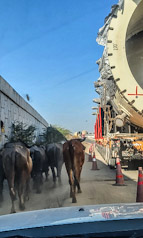
Cattle on the road

From Mandvi to Kandla Airport is 95 Km by road. We set off from Mandvi three hours before our flight to Mumbai was due to depart from Kandla. Our hosts, who use the airport frequently, told us that on average the road journey is 1 ½ hours. For the first hour of our journey, the highway was almost devoid of traffic. Along the way, we frequently switched lanes because heavy vehicles often move slowly along the outside lane without giving way to faster vehicles. We wove our way between slower vehicles, constantly overtaking and ‘undertaking’. Then after speeding along steadily, we headed towards a static queue of heavy lorries.

QuIck as a flash, our driver made a three point turn and we drove in the opposite direction tobthe rest of the traffic until we reached a gap in the central divider of the dual carriageway. We were not alone in making this manoeuvre. There were even some of the heavy goods vehicles making cumbersome manoeuvres to head away from the traffic jam. We continued our journey on the wrong side of the divider until we reached a turn off that allowed us to go under the highway and back into the correct lane.

Soon, we encountered another jam. A transporter carrying a tank as wide as one side of the motorway was inching its way onto the main road. Our driver took us off the road onto a dirt track, but this was also blocked. Another u-turn and we drove beneath the highway to a narrow, poorly tarmacced road that ran parallel to the highway. This led to a bridge beneath the main thoroughfare to reach another narrow lane that ran alongside the part of the highway running towards Kandla.

This lane offered other obstructions including large trucks and a herd of slow moving cattle. We squeezed past them and eventually rejoined the highway.

Meanwhile, the time was ticking away, and we wondered whether we would miss our flight. My spirits rose when we turned off the highway and on to a road leading to the airport. Soon, my hopes were dashed. We encountered yet another jam. However, our skilful driver managed weave his way between them. Soon, we arrived in front of the tiny airport terminal building.

Kandla Airport is primarily a military air base. Passengers use it for the one flight a day to and from Mumbai. When we disembarked there a few years ago, we walked from the aircraft to a shelter, where passengers’ check-in baggage was ready to be retrieved.

The check-in and security check is carried out in a part of a small room, the rest of which is part of the departure lounge (with a snacks stall). This hall leads to another room with seating. It is here that the departure gate is located. This simple departure lounge reminded me of Venice’s Marco Polo Airport as it was in the early 1960s.

We boarded the Spicejet two engined propellor plane after walking across the apron. The aircraft (a Q400 made by the Bombadier Company) has its own retractable staircase that we used to enter and later leave the ‘plane. After an uneventful flight lasting 1 hour and 15 minutes, we disembarked at Mumbai.

We were lucky only to have arrived a few minutes later than the scheduled time. Only three days earlier, my wife’ cousin’s flight from Mumbai to Kandla was delayed by almost 5 hours because of a technical problem discovered on the ‘plane minutes before it was due to take off. We were also fortunate because our quick-witted driver skilfully reduced the time spent stuck at significantly awful traffic jams.

A palace by the sea

IN OCTOBER 2022, we visited the Isle of Wight and went around Osborne House, which Queen Victoria and her consort Prince Albert had constructed as a holiday home near the seaside on the north coast of the island. A largely unattractive Victorian pile, its saving grace is the Durbar Hall, which is a near perfect example of the Indo-Saracenic style of architecture that can be found in many places in India. Recently (in February 2023), we visited another royal summer palace located close to the sea. It is the Vijaya Vilas Palace close to Mandvi in the former Kingdom of Kutch, now a part of the Indian State of Gujarat.

The Vijaya Vilas was completed in 1927. It was built by Kutch’s ruler Maharao Kengarji III as a summer resort for his son and heir, the Yuvraj Shri Jayarajii.

Architecturally, it resembles older Rajput palaces, and is a fine example of the Indo-Saracenic style. It and its various oriental decorative and structural features were made by craftsmen from Bengal, Jaipur and other places in Rajasthan, Saurashtra, and Kutch. The predominant material used is sandstone , of which there is no shortage in Kutch. It seems that the palace suffered little damage during the 2001 earthquake, which badly affected the Maharao’s palaces in nearby Bhuj (the capital of Kutch).

Inside the palace there are rooms with furniture that would not look out of place in many English stately homes. There are many framed photographs of the royal family, their guests, and the many wild animals that were shot. One of these was a leopard that was shot by someone inside the palace. One of the window panes has a bullet hole that is said to have been made by the bullet that killed the creature. There are also photographs that record the many times that scenes in Bollywood movies were shot in the Palace.

One photograph shows the US General Dwight Eisenhower seated in a jeep. This picture was taken in Europe during WW2. I have yet to discover what, if any, connection existed between Eisenhower and the royal family of Kutch.

Visitors can visit the rooms on the ground floor, and can ascend to the roof from which there are superb views of the sea and the flat countryside around the palace. The first floor, which is private, is the residence of members of the former royal family.

Although not as old as it looks, Vijaya Vilas, is a superb example of the kind of palace typical of those older ones that can be seen in Rajasthan. To my taste, Vijaya Vilas is a much more lovely and harmonious edifice than Victoria and Albert’s seaside home on the Isle of Wight.

A grand canyon in India

I HAVE VISITED the famous Grand Canyon in the USA, and seen it after a heavy snow fall. I have also seen a fabulous canyon in New York State, a few hours drive away from Buffalo. However, it was not until the first of February 2023, that I heard of, and then visited a grand canyon in Kutch, which is now part of the Indian State of Gujarat.

The canyon, named Kadiya (aka Kaliya) Dhro, is 73 Km north of the coastal city of Mandvi, and 33 Km northwest of Bhuj. Although the canyon is many, many thousands of years old and had been known to locals forever, its existence only became widely known in 2020. It was then that Varin Suchday, founder of the Kutch Travel Club stumbled across it. He had heard it discussed by local tribes people, whilst he was assisting them during the covid19 crisis, and with considerable difficulty, he managed to find it in the midst if the poorly mapped, arid semi-desert countryside.

We drove from Mandvi to a dusty parking area about 4 Km from the canyon. Several battered jeeps wait there to take visitors to the site. We boarded a well-worn Mahindra jeep, which was driven by a young fellow who looked to be about 15 years old; his voice had not yet broken. He drove us skilfully along sandy tracks strewn with rocks, precarious slopes, potholes, and other hazards. We held on to the Mahindra’s metal structural elements to avoid being thrown out of the constantly jolting and tilting vehicle, which had neither doors nor seatbelts. The tortuous track threads its way across dried up beds of streams; over boulders and sharp projecting stones; and past branching cacti and thorny bushes. Every now and then, other faster jeeps overtook us on this perilous, winding path. Other vehicles travelling in the opposite direction either waited for us to pass or vice-versa. After about thirty minutes of this exciting journey, we reached a parking area near the canyon.

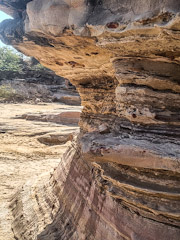
The canyon is in the district of Ulat village, which we did not visit. A fast-flowing river, in which our driver spotted a crocodile, has over the millennia formed the canyon. Like the Grand Canyon, but far smaller, its walls are horizontally striated. The striations vary in colour. Here and there, you can see roundish rock formations that look like huge mushrooms. Their stalks are also striated. Parts of the riverbed that are not submerged are rocky platforms with patterns of grooves resembling crazy paving. The striations result from the alternate layers of shale and sandstone combined with the effects of sea air (for more detail, see: https://zeezest.com/travel/kaliya-dhrow-in-kutch-is-a-geological-wonder-to-behold-zee-zest-1054).

We visited the canyon on a Wednesday morning during the school term, so the place was not crowded. I have been told that on Weekends and during school holidays, large crowds of people come to view the interesting geological formations. We saw less than twenty other tourists, mostly Indian. Many were standing precariously on the rocks close to the water, posing for pictures probably destined to appear on Facebook and/or Instagram. I took many photographs of this lovely place.

I am extremely grateful that my wife’s cousin, who lives in Mandvi, arranged for us to visit the canyon, a geological jewel hidden deep in the Kutch desert. Although far off the ‘beaten track’, it is a highly worthwhile destination. A word of advice: the ride in the jeep is not a good idea for those with unhealthy backs!

An exciting Bollywood film

DURING MY TWENTIES AND THIRTIES, I enjoyed slow moving, European ‘art house’ movies, in which little or nothing happened. Good examples of these included “Claire’s Knee” and “Kings of the Road”.

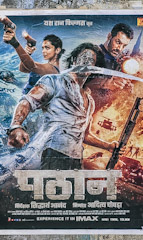
Poster for the film PATHAAN

After marrying my Indian wife in 1993, my tastes in film changed radically. She introduced me to Bollywood films. These visually dazzling productions are brilliant. Most of them incorporate moral and political messages; romance; religion; adventure; tragedy; comedy; music and song; dancing; daredevil acts; and much more. As they are designed to be seen all over India by people who speak a wide variety of differing languages, they are produced in such a way that they can be followed by audiences who cannot understand even one word of Hindustani. In fact, because of this and their visual appeal, they are popular all over the world.

Recently, we saw the new Bollywood film PATHAAN in Bhuj. It is one of the most exciting action films I have ever seen; it makes James Bond films seem static in comparison. The audience in the Surmandir cinema screamed and yelled at every possible moment, especially when the principal male star Shah Rukh Khan appeared on the screen. Both the film and the audience were fun to experience. The film was so gripping that we left the cinema feeling exhausted.

Running in the family

WHILE WANDERING THROUGH the large rambling bazaar in Mandvi, which is in the former Kingdom of Kutch (now part of Gujarat), we came across a workshop where bandhani textiles for clothing were being made.

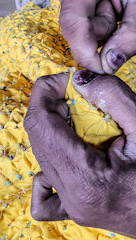
Making a knot for bandhani dyeing

Bandhani is a method of producing patterned dyed silks and cotton. Put simply, a piece of cloth, already dyed one colour or not at all, is prepared as follows. Parts of the cloth are gathered up to form tight bundles fastened by fine threads. The bundles, which look like small pimples are distributed to form patterns. The tied cloth is then dyed. The dye reaches all parts of the cloth except those enclosed in the tiny bundles. When the bundles are untied the patches of the cloth that had been shielded from the dye remain the original colour. This process can be repeated several times using different dyes to create an interesting pattern.

The shop the looked at, Khatri Ibrahim Siddik & Co, is the oldest bandhani workshop in Mandvi. It has been run by the same family for fifteen generations .

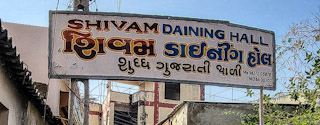
During our recent visit (January 2023), we have come across several businesses that have passed from generation to generation. In Bhuj, the Shivam Daining (sic) restaurant is run by chefs whose great grandfathers, grandfathers, and fathers, have all been cooks to the Maharaos of Kutch. Likewise, there is a bakery in Bhuj with an ancient wood fired stove. This business has passed through at least four generations. Nearby, there is a knife, scissors, and sword maker, who is the fourth or fifth generation of a family, which has been in this trade for over more than a century.

I am certain that there are plenty more examples of families in Kutch specialising in skills that have been passed from one generation to the next. I wonder whether these skills are in the genes, or simply taught by one generation to the next, and so on.

A cook from Kutch in Norway

THE SHARAD BAUG HOMESTAY is in the extensive, luxuriant, verdant grounds of the Sharad Baug Palace. Badly damaged in the 2001 earthquake, the palace is a short walk from the excellent homestay. This accommodation is owned and run by members of the royal family of the former Kingdom of Kutch.

Close to the homestay in the middle of a field, there is another ruined edifice. This was formerly used as a guesthouse by important guests of the ruler, the Maharao. For some time, the poet Dara Shiko (1615-1659) hid from his brother (the future emperor Aurangzeb) in this building.

Near the ruined palace, there is a building, which was the last Maharao of Kutch’s sitting room and dining hall. Now, the building houses a small museum filled with exhibits relating to the royal Jadeja family. Amongst these, there are several items connected with the last ruler of independent Kutch when he spent some time in Norway.

After Kutch had joined India soon after 1947, its last Maharao, Madansinhji (1909-1991), was appointed India’s ambassador to Norway. There are photographs relating to his stay in Norway in the museum. There is also a Christmas card in Norwegian and a certificate issued by the Oslo Tennis Club. He served in Norway between 1957 and 1960.

While in Norway, Madansinhji was served by his chef from Bhuj, a member of the Yadav family. For many generations, the Yadavs have been chefs, specialising in non-veg food.

When we first visited Bhuj, in 2018, we were recommended to eat in a simple, small restaurant in the bazaar of Bhuj. Named Shivam Daining (sic), it serves very tasty pure vegetarian food. We returned to eat there several times during our recent (January 2023) stay in Bhuj. While chatting with its chef and his relatives, we learned that the man who produces the excellent food is a grandson of the Mr Yadav, who cooked for Madansinhji in Norway. Although the family have a tradition of cooking meat and fish, they do not offer it at Shivams because they rightly feel that there is little demand for non-veg food in the mainly vegetarian city of Bhuj.

Without knowing it when I booked the Sharad Baug homestay, it turned out that it and one of our favourite restaurants in Bhuj had at least one common connection, and that is Norway.

An illustrious ancestor

QUEEN VICTORIA’S SON Prince Alfred (1844-1900) visited India in December 1869. In his honour several schools in India were founded in his name. In the present State of Gujarat, there are at least 3 still in existence. One is in Rajkot, another in Bhavnagar, and one in Bhuj (formerly the capital of the Princely State of Kutch).

Alfred High School in Bhuj

In Bhuj, we have a friend, Pramod Jethi, who is a historian of Kutch. Some of what I am about to relate is based on information kindly provided by him. Much of the rest is gleaned from what my wife’s family have told me.

My wife’s mother’s great grandfather was one Laxmidas Ravji Sapat (aka Sampat), who was born in the mid-19th century, or a bit earlier. Along with Gokaldas Parekh, Laxmidas was one of the first teachers in the Alfred High School in Bhuj (founded by Rao of Cutch, Pragmalji II in 1870). It is likely that he was its headmaster for a time. I have yet to see it, but his portrait hangs in the school. One of my wife’s relatives, also a descendant of Laxmidas, arranged to have it restored a few years ago.

In 1890, Laxmidas left the school. Later, along with his son-in-law, Cullyanji Murarji Thacker, he went to London (UK) to become a barrister. He studied for the Bar at Middle Temple and was called to the Bar on the 27th of June 1900, along with his son-in-law. Mr Thacker, who was my wife’s mother’s grandfather. The two men received financial help for their studies from the Kutch Royal family.
Both men were members of the Bhatia community in Kutch. Back at the end of the 19th and the early 20th it would have been unusual for a man and his son-in-law to travel out of India together to study.

Laxmidas, after leaving the Alfred School, became appointed as police chief of Bhuj, then diwan (Prime Minister) of Jaisalmer, and after that Chief Justice of Jodhpur. Apparently, he was very successful in reducing dacoitry in the Kingdom of Kutch and also Jaisalmer.

Recognising that the dacoits robbed because they were impoverished and starving, he helped make arrangements that reduced these poor peoples’ need to steal. It was this success that attracted other rulers of Princely States to offer him employment.

Regarding Jaisalmer, I discovered this quote:
“On his retirement, one Laxmi Das Raoji Sapat, who had lately served as Police Commissioner in the Kutch State, was appointed as Dewan of Jaisalmer”
This was in 1903.

As for Mr Thacker, he was successful enough to have owned a large house with two separate kitchens (one veg, the other for meat), and to have employed an English governess for my wife’s maternal grandmother, Benabhai, who married the surgeon Haridas Bhatia FRCS (died of septicaemia whilst on duty in 1926).

Incidentally, Benabhai was sent to London to study at the former Bedford College at the same time as her husband was studying for his FRCS. This contrasts with Mahatma Gandhi, who went to study in London, leaving his wife behind in India.

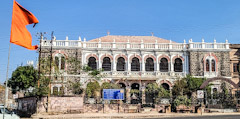
In January 2023, whilst spending a short time in Bhuj, we took a look at the elegant exterior of the city’s Alfred High School, which adjoins the Bhuj Museum. Badly damaged in the earthquake of 2001, the school building has been well restored. A less attractive, newer building was built to enlarge the school. On a future and lengthier visit to Bhuj, we hope to be able to view the portrait of Laxmidas that hangs inside the school.