We usually use booking dot com’s website to find accommodation on our travels in India. In November 2025, I booked at a place, a homestay in Bikaner, Rajasthan, which had a rating of over 8 out of the maximum 10. Every one of the reviews of this place was great – both those submitted by Indians and foreigners. I will not reveal the name of the homestay, but will tell you about it. The following is an extract from my book “88 Days in India: A Journey of Memory and Discovery”.
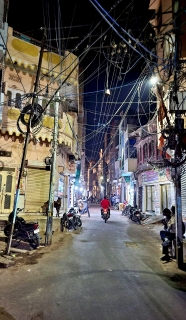 As the sun began setting, we entered the sprawling outskirts of Bikaner. The accommodation we had booked in advance was in the maze of tight thoroughfares in Bikaner’s old walled city. The guest house was difficult to find using Google mapping. Eventually, we fought our way through the dense traffic on the narrow Teliwara Road, one the old city’s main streets, until we got within about 100 yards from the guest house. Our driver looked at the lane which led to our accommodation. It was more like an alleyway than a road. He refused to drive any further. We rang the landlord of the guesthouse, a young man named Saleem. This cheerful fellow came rushing to meet us, and carried our baggage from the car to his tall, slender building.
I had selected the guest house because it had numerous excellent reviews on the Booking.com website. Maybe, I should have been suspicious when I saw the price of an air-conditioned double room with its own bathroom. Including breakfasts, it was only £28 for five nights. Saleem took us up two treacherous staircases with wobbly handrails, and showed us our tiny room. Most of it was occupied with an ageing double bed with a blanket and a single sheet fitted around the mattress. The sheet was, we discovered later, torn in places and either well-worn or not very clean. There was a small, attached bathroom – actually, a tiny toilet with a shower.
After ‘settling’ in our room, which was devoid of cupboards or anywhere to hang clothes, we were told that dinner was ready and that we could eat it either in our room or on the roof terrace. As the outside temperature was well below 10 degrees Celsius and we did not want food on our bed, we persuaded Saleem to let us eat on the ground floor, where we had to squat on what must have been one of his family’s beds. To be fair, although he charged us a lot for the dinner, his mother cooked delicious food.
Throughout most of the night, I heard a roaring sound coming from somewhere above our room, and in the morning, there was no hot water. We informed Saleem, who casually remarked that he had forgotten to turn on the geyser (hot water heater). That morning, we noticed that one side of the bathroom, had no wall. Instead, there was a deep cavity that extended beneath the staircase. This was filled with litter, including discarded cosmetics containers, plastic shampoo bottles, wastepaper, and other dust covered rubbish. We did not spot any rodents lurking there. The included breakfast, which we ate in another bedroom, windowless and even more spartan than ours, consisted of a greasy paper napkin containing an omelette wrapped in a piece of soggy toast.
We decided to leave Saleem and his guest house, and find accommodation elsewhere. Saleem, who seemed upset that we had not enjoyed staying in his family home, reluctantly directed us down his lane to a much more comfortable guest house, the Moon Haveli, where for £10 per night we had a large, clean, well-lit room with a satisfactory, spacious bathroom. To this day, I cannot understand why so many people (from all over the world) gave Saleem’s establishment so many glowing recommendations.
There are at least two conclusions I can draw from this dismal experience. First, is not to place too much decision making on the basis of other guests’ reviews of an accommodation. Secondly, as the saying goes, there is no such thing as a free lunch. Or in the case of Saleem’s place, I should have been suspicious of its exceedingly low price, which seemed too good to be true.
Almost two years have passed since we spent a night at Saleem’s place. Today, 4 October 2026, I took another look at his entry on booking dot com’s website. His average rating has raised from 8/10 to 9/10, and all the latest reviews are still highly complimentary. After our experience, this mystifies me. We were not after luxury, but had expected something better than what we found.