
Ah, Neptune has his trident
As do violent
Hindu extremists

Ah, Neptune has his trident
As do violent
Hindu extremists

The ending of the old year and beginning of the new one is celebrated all over the world in a variety of ways and at different times of the modern calendar. For example, the Chinese, the Gujaratis, the Parsis, the Jewish people, and the Russian Orthodox all celebrate the start of a new year on different dates. People, whatever their personal beliefs, also celebrate the end of the year on the 31st of December.
Cochin, which is a historic port in the southern Indian state of Kerala, was a Portuguese colony for a while in the 16th and 17th centuries. The Papaanji (spelling varies!) is named after a Portuguese word meaning ‘old man’.
Every year, a giant Papaanji is erected in a centrally located open space in historic Fort Cochin. During the afternoon of New Year’s Eve, the Papaanji is stuffed full of dry straw and fireworks. The roads around the open space are closed to motorised traffic. Despite this, a few youths on motor bikes manage to enter illegally.
After sunset and during the evening of the 31st of December, the area around the Papaanji fills with vendors and ever increasing numbers of people. Some of these merrymakers wear masks and others wear glowing red devil’s horns.
During the few minutes before midnight on the 31st, unbelievable numbers of people gather. The strong tide of people resembles a powerful surge of water such as you might expect if a large dam has just been breached. The crowd adds much noise to the cacophony of sound being relayed over various loudspeakers. Several times, I was almost knocked over by this human tsunami.
At midnight, the crowd became even noisier when flames began leaping from the ignited Papaanji. First, I could only see billowing clouds of smoke. Soon, frightening flames became visible. Then, bursts of stars appeared as the fireworks exploded.
Within minutes, the conflagration and fireworks ended. The old year, represented by the Papaanji, had been burnt out to make way for the new one. The crowds began to thin out a little, but despite that, it was quite hazardous trying to leave the area.
For an hour or two after midnight, boisterous revellers created much noise in the streets. The whole affair seemed to be generally good natured.
I am glad that I have seen the Papaanji aflame, but once in a lifetime is enough for me.
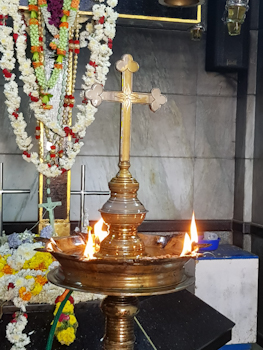
Over and over again, I am impressed by the “Indian-ness” of worshipping in India. I will illustrate what I mean by this by describing a small Orthodox Christian chapel I visited on Bazaar Road in the Mattancherry district of Cochin (“Kochi”) in Kerala.
Outside the chapel, there stands a carved stone stand with indentations for oil lamps (diyas). It looks just like any diya stand that you could find in a Hindu temple, except that it is surmounted by a Christian cross.
The crucifix that stood above a small high altar within the chapel was draped with flower garlands (malas). Again, these are commonly found draped around effigies of Hindu deities.
I saw a brass diya stand with burning oil lamps directly in front of the crucifix. Like the lamp stand by the entrance, this one was also topped with a Christian cross.
If one were to replace the crucifix with an effigy of a Hindu deity and were to remove the crosses from the diya stands, the chapel would become identical to a Hindu temple.
The use of diyas and also agarbati sticks (incense sticks) is not confined to Hindu temples. I have seen them used in Christian as well as Islamic (especially Sufi) and Jain places of worship.
At a Sufi shrine at Sarkej Rauza on the edge of Ahmedabad in Gujarat, I have seen tulsi leaves being sold. These are commonly associated with Hinduism, but the vendor in the Sufi shrine told me that they were also used by worshippers who came to the shrine.
I have seen threads tied around the trunks of peepal trees by pious Hindu women hoping to have their wishes granted. I have also seen threads tied by women around pillars in Moslem shrines for the same reason.
Hinduism was probably one of the earliest religious belief systems to become evident in the Indian subcontinent. Christianity and Islam were relatively recent arrivals. Many Hindus converted to these two religions, but, I imagine, they were reluctant to abandon their Hindu heritage completely. Hence, the Hindu-ness or Indian-ness of some aspects of other religions in India.

As in the UK, Japan, South Africa, and Ireland, the rule in India is that one drives on the left side of the road. The steering wheel in four (or more) wheeled vehicles is on the right side of the car, truck, bus etc. In the case of two or three wheeled vehicles, the driver is centrally located. So far so good.
Although the driving on the left rule exists in India, it is regularly ignored.
Unless there is an un-crossable median barrier, turning right is often done as follows in India. The driver eases his or her vehicle into the stream of traffic on the right (I.e. wrong) side of the road into which the turn is being made. With a sea of vehicles approaching in the opposite direction, the driver drifts carefully towards the middle of the road, and then joins the lanes of traffic moving in the same direction as his or her vehicle. Sounds hazardous, does it not?
If you are travelling in an autorickshaw, your driver will often drive down a one way street in the wrong direction in order to make the trip shorter.
On the dual carriageway highway, things get more exciting. The highway provides an opportunity to speed up. But beware; it is not uncommon to come across trucks and other vehicles driving in the wrong direction towards the traffic speeding in the correct direction. Once, I asked a professional driver about this. He told me that it was quite normal for this to happen. By driving down the incorrect lane, a driver can avoid having to travel in the direction opposite to that in which he wishes to travel in order to make a U-turn. That seems quite reasonable but rather dangerous. It is just as dangerous as the herdsmen who choose to move flocks of goats and other animals along the traffic filled lanes of a highway.
Whereas a driver in the UK would be startled by any of the above, Indian drivers take these curious practices in their stride. They expect the unexpected and understand that the rules of the road are, like rules in general, made to be broken.

Arranged marriages where parents choose the bride and groom are still very common in India. Often the girl and boy hardly know each other, or may have never met, before the wedding ceremony.
In India when a marriage is not ‘arranged’ except by Cupid’s arrow, it is called a ‘love marriage ‘. My wife and I had a love marriage. When our daughter was very young she must have learned about arranged marriages from someone or at school because one day she said to us, assuming that we had had an arranged marriage :
“When I grow up, I am going to marry whoever I like unlike you.” We told her that we had chosen each other.
I am not qualified to discuss the relative merits of love and arranged marriages but both of them can be quite successful. To westerners, arranged marriages might seem strange. The reverse is true for many Indians, for whom the idea of love marriages often seem alien.
Once, I was talking to some young men in a bookshop in Bangalore. When I told them that my wife is Indian, one of them asked me if we had had a love marriage. I said we did have one. They asked me how I felt about love marriage. I told them that I can recommend it.
My in-laws, both Indians, married in India in the late 1940s. In those days, the majority of marriages were arranged. My in-laws were very unusual for that era because they had a love marriage. My father in law and his bride came from different communities. At first, the marriage could not occur because the bride’s family did not want their daughter to marry out of her community. After some time, they softened their views and a very successful married life began.
My wife and I come from different continents, but no objection to us marrying came from any quarter.
Recently, we were chatting with an elderly Indian gentleman, whose story illustrates how little say the participants in an arranged marriage might have. He told us that he had married in the late 1940s. He said that he did not meet his bride until the day he got married. He was working away from his home town when he received a telegram from his mother. It contained the words:
“SEEN GIRL BRING RING”

In India, I prefer to wear sandals because in so many places it is necessary to remove footwear, and putting on and off sandals is so much easier than doing the same for lace up shoes.
Just in case you are wondering why there is the requirement to bare one’s feet, the reason is to prevent bringing dirt from outside into the place being entered. It is also a mark of respect when entering a religious place such as a mosque, church, temple, or gurdwara.
In some homes, footwear is left by the entrance. This is also the case for some homes that I have visited in the UK. When I went to a junior school in London’s Belsize Park, The Hall School, we left the shoes we had arrived in at the entrance and then replaced them by another pair reserved for use within the school.
When we visited Gulbarga (in North Karnataka, India) recently, we visited what purported to be an Arabic restaurant, Al Makki by name. Its floor was covered with carpets, and guests had to sit on cushions that surrounded very low tables. The owner took one look at my wife and me, and took pity on us. He provided us with a normal height table and chairs. The food was delicious. We ate a mutton “handi”, which is a pilaff flavoured with dried fruit, fried onions, nuts, and mild spices. By now, if you are still reading this, you might well be thinking that I have strayed from my topic. But, you are mistaken. We were not allowed to enter Al Makki until we had removed our footwear.
To conclude, my advice to people visiting India is: wear footwear that is easy to remove and replace.
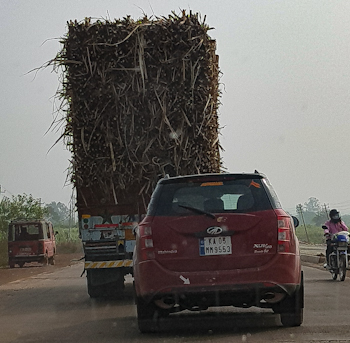
“Incredible India” is a tourist promotion slogan. And, it is totally justifiable.
The truck in my picture is not unique. We saw many similarly loaded trucks on a short journey through northern Karnataka, and on many other road trips.
India is not simply incredible because of sights such as overloaded trucks, the wealth of colour, bustle, fantastic food, and the Taj Mahal. It is incredible because of its unending variety and generally very friendly people. Rich in history, the country has a very vibrant present.
Please note that I write this not as a promoter of tourism, but as a lover of a great country that survives despite itself.
Death is a morbid but fascinating topic, as is disposal of the dead. Many people living outside India, including myself, believe that the corpses of Hindus are only cremated. At least, I believed this until about 15 years ago, when I visited a Hindu burial ground in Bangalore.

In a Hindu Burial Ground in Bangalore
I have visited two Hindu cemeteries in Bangalore, one of them being next door to a major electric crematorium in the city centre. When I have asked about Hindu burials, I have been told that some sects of Hindus favour burial rather than cremation.
Recently, I read an article about Hindu burials (in Calcutta) by A Acharya and S Sanyal in the “Mint” newspaper (Bangalore), dated 24 Nov 2018. Here is a brief digest of the points contained within it.
1. Certain groups of Hindus are traditionally immersed or buried.
2. These groups include:
A. Saddhus or ascetics who perform their own mortuary rites when they become saddhus, and are considered to be dead to the social world, living ghosts one might say.
B. Some young children, especially those who have not yet developed visible teeth. Also, some parents prefer to bury their dead offspring, rather than watching them being cremated.
C. Lepers. It used to be feared that a leper’s body might release an infectious vapour during cremation.
D. Some members of the following communities prefer to bury their dead to avoid the dominating behaviour of the Hinduism of the Brahmins: dalits, Vaishnav, Hela, and Kaburpanthi.
3. Sometimes, burial is cheaper than cremation. In Calcutta, burial can cost half of the charge of cremation.
4. Burial of Marwaris and Vaishnavites is more costly than for others because these two groups bury their dead with lots of salt, which they believe speeds disolving the flesh off the bones.
This newspaper piece has helped me to understand the existence of cemeteries where Hindus are buried. I assume that at least some of what has been written about Calcutta also applies to Bangalore.
On a parting note, I used to believe that the traditional method of corpse disposal amongst the Parsis was to feed their dead to the vultures. A Parsi friend of ours died in Bangalore, which has Towers of Silence for the corpses of Parsis, was buried in a Parsi cemetery in Bangalore. I have visited that cemetery, which is located in the district if Malleswaram and is for Parsis only.
All of this goes to show that making generalisations about India is inadvisable. So, before you assert that Hindus do not eat beef, hold your tongue! Some sects of Hindus have eaten beef since time immemorial. If the present government in India bans the consumption of beef, it will not be only Christians and Muslims who will be affected, but also several million Hindus.
This war written in mid-2016, following Adam Yamey’s visit to Albania
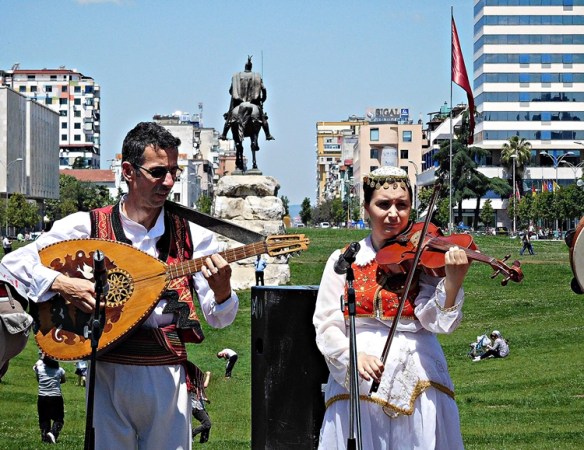
Tirana
Between 1944 and 1990, the tiny Balkan country Albania was governed by a Stalinist dictatorship. During that period, it was more isolated from the outside world than North Korea is today. My Indian wife, Lopa, and I visited the country in June 2016. We were open to surprises, but never imagined that we would discover what I am about to describe, namely some Indian connections.
The small town of Pukë is in the north of the country. Hardly visited by tourists, it is a pleasant place at a high altitude. During our visit there, we entered a small gift shop to buy a notebook. The shop-keeper looked at Lopa, and asked where she was from. When we said India, she pointed at a small television screen beneath the counter. We saw that she was watching something from Bollywood, but with Albanian sub-titles.
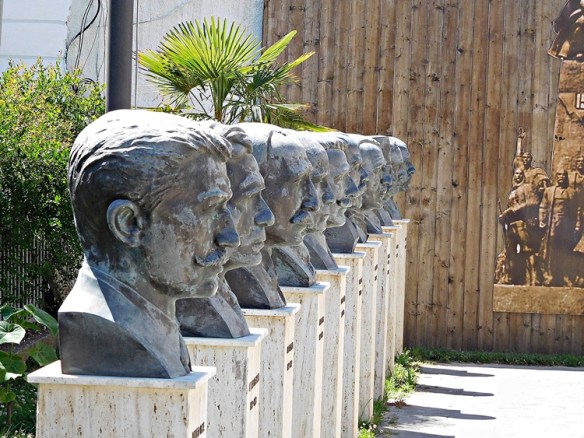
Vlore museu,
Some days later, we were in the coastal city of Vlorë, visiting the house where on the 28th November 1912, the independence of Albania (after about 500 years of Ottoman domination) was declared. We were shown around the building, which is now a museum, by a lady who spoke only Albanian. An Albanian friend translated. As we moved from room to room, we noticed that the lady was becoming more interested in Lopa than the Independence of Albania. She kept touching Lopa and even hugged her from time to time. At the end of the tour, she asked Lopa why she was not wearing something like a sari as the actors in the Bollywood films do on the television shows that she loved. A devotee of Bollywood soap operas, she was thrilled to have a real live Indian in her museum. She told us that Lopa was the first Indian women to visit her museum in the 11 years that she had been working there.
Later, we learnt that Bollywood television soap operas are extremely popular in Albania, especially amongst women viewers. The shows are usually broadcast in the afternoon, so a ‘savvy’ person knows better than to ring an Albanian woman during the hour that such shows are on-air.
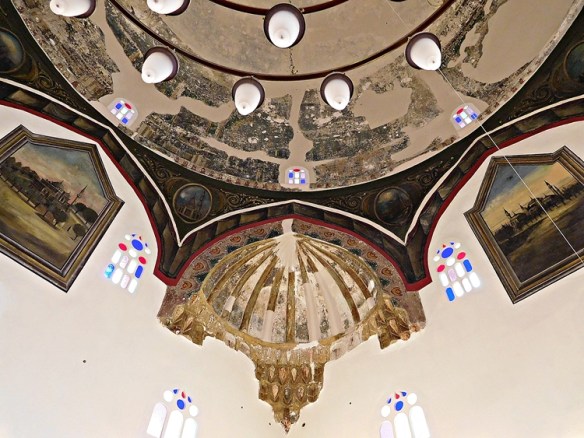
Mosque in Korce
Love of Bollywood is not confined to Albanian women. In the southern city of Korçë, we were visiting an old (15th century) mosque, when an elderly man, who was just about to enter to do ‘namaaz’, saw Lopa, and asked if she was Indian. On hearing the answer, he exclaimed: “Rye Kapur”, which was his way of pronouncing Raj Kapoor.
Judging from the excitement that Lopa evoked when meeting Albanians, we guessed that there were probably few or even no Indians in Albania. Our guesswork ended when we met Vijay in the foyer of the National Museum in Albania’s capital Tirana. Vijay, who hails from southern India, lives and works in Albania with his family. He was waiting for his son to return from cricket practice. We were surprised to hear that cricket is being played in a country which has not ‘enjoyed’ the effects of British colonial influence. Vijay told us that not only were ‘ex-pats’ involved in cricket in Tirana, but also Albanians. There is an Englishman who has been training members of Tirana’s rugby club to play cricket. In late June this year, the Albanian team beat the ex-pat’s team by one run.
On the next day, we met Vijay, who teaches computing to Albanians in Albanian, with his family at a café. His wife had specially prepared some Indian snacks for us: chicken tikka and some aloo bhajjis. While we were sitting chatting, another Indian, Vicki, wandered past and joined us. Vicki was working for an Indian mining company, but has recently returned to India having spent a few years in Albania. When we had spent time with our new Indian friends, we got up but before saying farewell, they invited us for lunch the next day.
Apart from having been very fortunate to have ‘bumped’ into Vijay and his family and friends, we were very lucky to have met any Indians at all in Albania. This is because there are currently only about 50 Indians in Albania, and some of them are Mother Teresa nuns.
The following day, we met Vijay and Vicky in the centre of Tirana. A car pulled up, and we all piled in. The car was driven by yet another Indian, Father Oscar who runs Tirana’s large Roman Catholic Don Bosco establishment. He drove us out to Vijay’s flat on the edge of the city. There, we were confronted with a superb warm buffet prepared by Vijay’s wife. As I served myself with chicken biryani, dal, chappatis, channa, and so on, I had to pinch myself to believe that I was not imagining eating home-cooked Indian food in Albania.
PS: Finally, for those with Indian passports who wish to visit Albania, the nearest Albanian embassy to India, we were told by an Albanian diplomat, is in Beijing (China).
 yamey
yamey 