Hitler for children

hitler


In a previous blog (see: https://adam-yamey-writes.com/2019/01/15/hitler-on-the-shelf/ ), I have written about the prevalence of copies of Hitler’s Mein Kampf in bookshops all over India. Here is an article I wrote a few years ago about a book about Hitler aimed at Indian children.

I was browsing the shelves in Gangaram’s Bookshop in Bangalore (India) when I found a book about Hitler, which was published in 2007 (ISBN: 9788131002520). It is part of a series called “Biographies of Great Personalities”, aimed at younger Indian readers . The garishly covered book caught my eye in that large well-known bookshop in Bangalore. When I flicked through it, I noticed that it was illustrated with line drawings, many of which showed Adolf Hitler in Indian settings with palm trees. At 40 Rupees (less than half a Pound Sterling), I could not resist buying the 93 page book.

 The author, Igen B, is a prolific writer. He has published well over 70 short books including biographies of personalities as diverse as Jesus Christ, Bhagat Singh, Mother Teresa, Ashoka the Great, Chhatrapati Shivaji, Shakuntala, and Netaji Chandra Bose. As well as these he has written versions of great Indian classics such as the Vedas, the incarnations of Lord Vishnu, and the Mahabharata. That these books are probably aimed at children is evident from the format and appearance of the books and also the fact that one of his titles is “Illustrated Model Book of School Essay etc.” Therefore, his potential audience is the innocent and impressionable younger mind. This should be remembered whilst paging through his children’s biography of Adolf Hitler.

More than half of the text is dedicated to Hitler’s childhood about which not much is known in detail, his career as an artist, and his rise to power. The author of this book, Igen B, blames a disturbed childhood in a dysfunctional family for much of what Hitler was to become.  The future dictator’s disillusionment with the lack of German national pride and his disappointment with the country’s leadership during WW1 were, according to this book, also important formative factors. As, are also the Jews: unquestioningly, Igen B repeats the kind of dangerous nonsense about the Jews that Hitler and many Germans believed.

Having gained power, we learn of Hitler’s campaign to relieve the Jews of any role in public life, and his hatred of the communists. We also learn of his desire to tear up the Treaty of Versailles, and how he went about doing so. So far, the reader is presented with something that faintly resembles what is now common knowledge about the history of Germany just before and during the brief, but long enough, era of Nazi rule. The penultimate 4 pages of the book describe some aspects of WW2. The last page of text is dedicated the last days of Hitler and his new bride Eva Braun.

Nowhere in the book are the mass murders perpetrated by the Nazis even hinted at, let alone mentioned. This worries me greatly considering that the book is sold in bookshops in India, and most of these also sell Hitler’s pernicious ‘autobiography’ “Mein Kampf”.

Igen B’s book is aimed at an Indian audience. It is appropriate in a way that the illustrations are drawn with an Indian ‘flavour’, as many readers are unlikely to have visited Europe or are ever likely to do so. The spelling of many German words and names is peculiar. For example we read of ‘Hebzburg’ (Habsburg), ‘Strum Abtiling’ (Sturmabteilung), ‘fonn’ (von), ‘Versai’ (Versailles), and ‘Hoffbraha’ (Hofbrauhaus). Whilst these original spellings are used more than once and are thus unlikely to be typographic errors, they may also be purposeful. It is possible that the author, realising that most of his readers are likely to be unfamiliar with German pronunciation, has transliterated them so as to make them pronounceable by readers of English.

I picked up this book as a curio, and read it. The author appears to have done some research, but his or her interpretation and presentation of the facts is somewhat unusual. His lack of emphasis of Hitler’s evil influences and deeds in a book aimed at impressionable youngsters is worrying to say the least.  The impression I had after reading it was that Hitler was portrayed as an unfortunate child, who grew up with the aim of making Germany a great nation. I was not given the impression that he was even a fraction of the monster that he was in reality. I had rather the same impression after watching the end of the film Downfall made in 2004. Hitler’s final moments during that film were almost heart-rending; the power of film and literature cannot be underrated. This is why Igen B’s book on Hitler might well be considered malevolent, even if the author’s intention was otherwise, to be purely informative.


Identity crisis

Don’t worry! This is not really a crisis. I used the word ‘crisis’ in the title to catch your attention! And, now that I have caught your attention, you might as well read on for a fewminutes because what I am about to tell you has a good chance of being interesting for you.

ALDWYCH

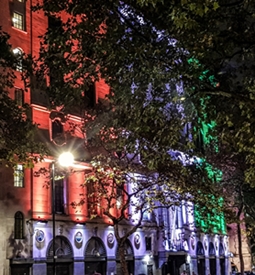
Since marrying a lady born in India, I have had many opportunities to visit India House on the western arm of the Aldwych in central London. Built 1928-30 and designed by Herbert Baker (1862-1946) with AT Scott, this stone building is profusely decorated with Ashoka lions and many circular, coloured emblems, which were those of the pre-Independence (and pre-Partition) colonial provinces (e.g. ‘Baluchistan’, ‘United Provinces’, ‘Burma’, ‘Madras’ and ‘North West Frontier’).

ALDWYCH 2

Looking upwards, there are two elaborate crests each topped with heraldic lions and including the mottos: “Honi soit qui mal y pense” and “Dieu et mon droit”. These are ‘souvenirs’ of the era when India was a British colony. Just as in post-Independence India there are still some statues of Queen Victoria standing– there is a fine example in Bangalore, these reminders of British imperialism remain attached to the building.

One side of India House faces India Place, which contains a bust of the Indian leader Jawaharlal Nehru (1889-1964), who became a barrister at the nearby Inner Temple. Close to a side entrance of India House, there is a monument to an off-duty policeman Jim Morrison, who was stabbed in December 1991 whilst chasing a handbag thief, who has never been caught. A ‘Friendship Tree’ was planted nearby in 1994 to commemorate the 125th anniversary of the birth of Mahatma Gandhi.

The India House, which now stands in the Aldwych, was NOT the first ‘India House’ in London. It had a predecessor in the north London suburb of Highgate. The earlier India House  stood at 65 Cromwell Avenue was a Victorian house that still exists. The Victorian house was named India House between 1905 and 1910 when it  was owned by Shyamji Krishnavarma who made it a hostel for Indian students and other Indians staying in London. The north London India House had a brief existence because it was under constant police surveillance on account of the anti-imperialist activities that went on within its walls (including producing anti-British propaganda, anti-British meetings, bomb-making, and arms smuggling).

Many Indian patriots, who wanted to force Britain to give its then colony India freedom, lived and congregated in Highgate’s India House. Their activities and often daring deeds are described in my new book about a lesser-known period in the history of India’s independence struggle: “Ideas, Bombs, and Bullets”.


“IDEAS, BOMBS, and BULLETS”

by Adam Yamey is available from on-line stores including:

Amazon, Bookfinder.com, Bookdepository.com, Kindle, and Lulu.com

Mahatma Gandhi ate in Notting Hill

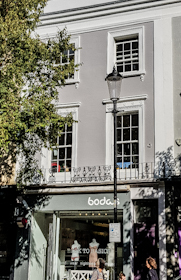
Today, 36 Ledbury Road (illustrated) in London’s trendy Notting Hill district (made famous by the 1999 film Notting Hill starring Hugh Grant and Julia Roberts) gives nothing away about its colourful past. It was once the home of the Indian Catering Company, a restaurant run by Nizam-ud-Din, who also owned the Eastern Café near Chancery Lane.

The Indian Catering Company, which was serving customers during the reign of Edward VII (1901-10) was not the first Indian restaurant to have been opened in London. The first curry house in London was opened by Sake Dean Mahomet (born in India in the 18th century). An employee of the East India Company, which he joined in 1769, he arrived in London in 1807. Two years later, he opened his Hindostanee Coffee House at 34 George Street near Portman Square. Although it was called a ‘coffee house’, it was actually a restaurant serving curries and other examples of Indian cuisine. The restaurant thrived until 1833, when it was closed. There is much more information about this establishment in Star of India, a book by Jo Monroe.

By the time that the restaurant at 36 Ledbury Road was serving customers, the Indian Catering Company was one of many Indian restaurants in early twentieth century London. The reason for my interest in this former eatery is that it was a meeting place for extremist Indian independence fighters in Edwardian London. I discovered this while researching my recently published book IDEAS, BOMBS, and BULLETS.

Although he cannot be considered an ‘extremist’, the famous Mahatma Gandhi partook of a meal at the Indian Catering Company in Ledbury Road in October 1909. Here is an excerpt from my book:

In October, the festival of Dussehra was celebrated at Nizam-ud-Din’s restaurant, The Indian Catering Company, at 36 Ledbury Road in Bayswater. Gandhi had been invited to chair the proceedings. He had accepted the invitation on condition that the food would be pure vegetarian and that discussion of controversial politics was avoided. The food was served by Savarkar’s followers: VVS Aiyar, Tirimul Acharya, and TSS Rajan, all sometime members of India House.”

Whereas Gandhi both preached and practised non-violence, the same cannot be said of VVS Aiyar, Tirimul Acharya, and Vinayak Damodar Savarkar ( a ‘father’ of Hindu Nationalism and Hindutva), who also attended the meal.

Although there is no plaque recording the interesting history of 36 Ledbury Road so near to Portobello Road, whenever I pass this house I feel a tingle when I remember the famous Indian freedom fighters who once entered it and ate there.

A SMALL house cover

“IDEAS, BOMBS, and BULLETS” is by Adam YAMEY

ISBN: 9780244203870

The book is available from on-line stores including:

Amazon, Bookdepository.com, and lulu.com

It may also be ordered from bookshops

There is an e-book edition on Kindle


From Norway to Bengal

Doll hse


We were attracted to the latest theatrical production at the Lyric Theatre in Hammersmith (West London) because it was a play set in Calcuttta (Kolkata) in the late 1870s. It was not any old play set in Victorian Bengal, but a new adaptation of Henrik Ibsen’s the Dolls House (first performed 1879), which was originally set in a Norwegian town in the 19th century.

What we saw at the Lyric was a new version of Ibsen’s play created by the playwright Tanika Gupta. In Ibsen’s play the main protagonists are Nora Helmer, her husband Torwald Helmer, Dr Rank, Nora’s school friend Kristine Linde, and one of  the employees in Torwald’s bank, a desperate widowed father, Nils Krogstad. In Gupta’s play Torwald becomes Tom Helmer, an Englishman, who has married Niru,  a Bengali beauty, and has become a senior official in the British administration of India. Dr Rank remains Dr Rank, but is also an Englishman. Kristine becomes Krishna Lahiri, an impoverished widow and schoolfriend of Niru. Nils Krogstad is transformed into Mr Kaushik Das, a widowed Bengali father of four children and a lowly employee in Tom’s office.

In its new guise, Gupta’s Dolls House sticks to the spirit and main ideas in Ibsen’s plot but causes it to be played out in the steamy tropical climate of Calcutta. Gupta explores the relationship between the representative of British imperialism and his very sweet Indian wife. The arrival of Krishna and then Mr Das on the scene soon unsettles the happy home life that the Helmers had been enjoying. Without giving the story away, Mr Das, whom Tom does not like, holds a secret that could bring about Tom’s downfall if revealed. Tom is blisfully ignorant of the threat that Das poses, but the opposite is the case for Niru, whose great anxiety Das stimulates.

Although I had some reservations about the new version of the play, I enjoyed it and the often excellent performances of the actors. What fascinated me was how successfully Ibsen’s play had been ‘relocated’ from the gloom of Norway to the colourfulness of Bengal without losing the feeling that it was a play inspired by Ibsen. By translating the play from one cultural milieu to another, Gupta has preserved and enhanced Ibsen’s messages about the role of women and social class. She has added another fascinating ingredient: the portrayal of British racism towards Indians in pre-independence India. I feel that many of the Anglo-Saxon members of the audience might have been blissfully unaware of their ancestors’ unpalatable attitude to Indians they ruled. They would have left the theatre better informed about this blot on Britain’s history.


The play is on at the Lyric until 5th October 2019.

See: https://lyric.co.uk/shows/a-dolls-house/


Image adapted from lovetheatre.com

PHD on arrival

Arriving_240


A few years ago, the new airport at Devanahalli just north of Bangalore (Bengaluru) was opened for use. It was already too small when it opened and in recent years there has been much new construction to more than double its size and passenger handling capacity. 

On arrival passengers from some flights enter the airport by airbridges that connect the aeroplanes to the terminal building. Passengers proceed up escalators to the first floor where they walk along a gallery overlooking the departure lounge. We have spent many hours in the departure lounges awaiting the departures of flights which often depart in the dark early hours of the early morning. For a few years, there used to be a branch of the Pizza Hut chain available for passengers awaiting departure.

One year, I was truly surprised to reach the gallery overlooking the departure lounge because there was a large sign above the Pizza Hut counter, which bore the letters ‘PHD’. What, I wondered connected the Pizza Hut with the academic degree of Doctorate of Philosophy (‘PhD’)? ‘Surely some mistake’, as the British satirical magazine Private Eye often says.

Very soon I learnt that according to Pizza Hut, PHD stood for ‘Pizza Home Delivery’. Sadly, the Pizza Hut outlet has long since closed. It has been replaced by costlier eateries hoping for wealthy foreign travellers.


PHD-offer

Bachelor of Arts

booknarayan


Rasipuram Krishnaswamier (‘RK’) Iyer Narayan (1905-2001) was born in Madras (now ‘Chennai’) in southern India. He was a prolific writer of fiction and non-fiction. Many of his fictional works are set in the imaginary southern Indian town called Malgudi. Until recently when I bought a copy of “Bachelor of Arts” (first published in 1937 when India was ruled by the British), I had never read any of Narayan’s works. 

“Bachelor of Arts” is a delightful simply told tale about a young man, Chandran, whom we meet while he is completing his BA degree. We follow his life’s strangely interesting path after he graduates until he … well, I won’t give away the story. Despite the simplicity and clarity of the story telling, Narayan subtly changes the mood of the story as it progresses. I liked the way he did this. Another interesting aspect of this novel is the gentle way in which the author criticises the British imprerialistic attitude. I was also excited by the way Narayan, an Indian, portrays the ‘Indian-ness’ of his characters. As Grahame Greene wrote of Narayan in the introduction to the edition I read:

Without him I could never have known what it is like to be Indian.”

I agree wholeheartedly with what Greene wrote. I plan to read more of Narayan’s works as “Bachelor of Arts” has whetted my apetite successfully.

Memory of a great man

AMB 4


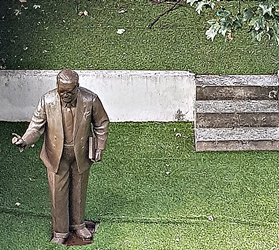
Almost wherever you go in India, you are bound to see the statue of a man wearing spectacles with round lens frames and a suit. He is always carrying a large book under his left arm. These statues depict Bhimrao Ramji Ambedkar, who was born in Mhow (now Dr Ambedkar Nagar in Madhya Pradesh) in 1891, son of an Indian army officer. He died in New Delhi in 1956. This remarkable man was a jurist, economist, politician and social reformer. He was a founding father of the Republic of India and helped formulate the Indian Constitution. He is best known for his work on promoting the rights of the ‘dalits’ (‘untouchables’) and reducing discrimination against them.

Ambedkar was awarded a doctorate by Columbia University (USA) in 1927, and another by the London School of Economics (‘LSE’) in 1922. He was called to the London Bar in 1922 as a member of Gray’s Inn. Later, he was awarded further degrees by Columbia University and Osmania University (in Hyderabad, India).

Between 1920 and 1922 while he was studying at the LSE and for the Bar, Ambedkar lived in a house at 10 King Henrys Road near Chalk Farm in north-west London. In 2015, the house was bought by the Government of Maharashtra and was then converted into a memorial to Ambedkar. It is open to the public. Visitors can learn about Ambedkar from the well-captioned photographs on the wall of the rooms that they can wander through. The upper floor contains a re-construction of Ambedkar’s bedroom including a four-poster bed, some of the great man’s books, and an old pair of spectacles, which might have belonged to him. Other rooms contain shelves of books and various memorials to Ambedkar. There is also a commemorative plaque to India’s present Prime Minister Narendra Modi, who inaugurated the memorial house in November 2015. The garden contains a typical statue of the type I have described above.

Sadly, this monument to such a great man is under threat. Some local residents have been complaining that it is annoying to have a museum amidst their overpriced bourgeois residences (see: https://www.bbc.co.uk/news/world-asia-india-49411985 ). Camden Council, in whose borough the Ambedkar house is located, are to decide on its fate at a hearing to be held in September 2019. I hope that the (racist???) objecting residents of King Henry’s Road will not be permitted to help to erase the memory of a truly great man’s stay in London.


FOR A FEW PHOTOS OF THE AMBEDKAR MEMORIAL HOUSE, CLICK HERE:

http://www.ipernity.com/doc/adam/album/1244852

A house in west London

140 small SINCLAIR


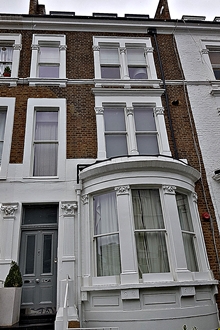
Number 140 Sinclair Road in west London, not far from Shepherds Bush Green, looks like an ordinary Victorian terraced house, which it is. However, in the first decade of the twentieth century it was home to a few Indian freedom fighters. When the seventeen year old David Garnett, the writer and a future member of the Bloomsbury Group, visited the house in 1909, he met Bipin Chandra Pal (1858-1932) the Bengali nationalist and a father of the Swadeshi movement, which promoted Indian economic independence. He shared the house with his son Niranjan Pal (1889-1959), a young Indian freedom fighter who was to become a founder of the Bombay Talkies film company. Sukhsagar Dutt (1890-1967), a young Indian revolutionary and brother of Ullaskar Dutt who was involved in the use of bombs in Bengal and Bihar and tried at Alipore (Calcutta), also lived at number 140.

In mid to late 1909, VD (‘Veer’) Savarkar (1883-1966) also lived at 140 Sinclair Road as a lodger of Bipin Chandra Pal. Savarkar, who was studying law at the time, was deeply involved in activities aimed at attempting to cause the British to leave India in order that the country became a sovereign nation. Savarkar is now best known for his contributions to the encouragement of Hindu nationalism. His book “Essentials of Hindutva”, published in 1923, is considered a seminal work by promoters of Hindu nationalism.

Savarkar moved from India House in Highgate, a centre of revolutionary Indian independence activists, to 140 Sinclair Road sometime in 1909 before the assassination in London’s Kensington of a senior Indian administrative figure, Sir WH Curzon Wyllie, in July 1909. The victim was shot at close range by Madan Lal Dhingra, a close associate of Savarkar. Savarkar was suspected of having some involvement in the plotting of Curzon Wyllie’s demise. Savarkar’s host in Sinclair Road, Bipin Chandra Pal, was firmly against what Dhingra had done, but accommodated Savarkar, who was pleased that the assassination had been successful until, as I wrote in my book “Ideas, Bombs, and Bullets”:

“… an angry crowd gathered outside, the house, Pal had to tell them that apart from being a paying guest, Veer had no other association with him. Another resident at this address, Pal’s son Niranjan, was a close friend of Veer’s and a regular visitor to India House. Niranjan’s association with India House worried Bipin greatly…

Soon after this, Savarkar shifted his home in London to a flat above an Indian restaurant in a now non-existent alleyway in Holborn.

From what I have described, the seemingly ordinary terrace house at 140 Sinclair Road has played a small role in the history of India’s struggle for freedom from the British, which was eventually gained in August 1947.

For much more information about Indian patriots in Edwardian London, I invite you to read my recently published book, “Ideas, Bombs, and Bullets”, which focusses on the Indian patriots who congregated at India House in Highgate between 1905 and 1910.


A SMALL house cover


This publication is available at:

http://www.lulu.com/shop/adam-yamey/ideas-bombs-and-bullets/paperback/product-24198568.html

or:

https://www.bookdepository.com/IDEAS-BOMBS-BULLETS-Adam-YAMEY/9780244203870

(paperback)

and

https://www.amazon.com/dp/B07W7CYKPG/

(Kindle)

Slow down

taxi

My late mother lost two front teeth in a car crash in South Africa during the 1930s. Ever since then, she was both a nervous driver and an apprehensive passenger.

In the early 1960s, my mother was one of the first drivers in the UK to have seat belts installed in our car, which, like all other cars at the time, was sold without seat belts.

When I used to go on holidays with my parents, we used taxis wherever we were: water taxis in Venice and automobiles elsewhere. The places we visited most often were Italy and Greece. In both places, drivers manoeuvred at higher speeds than in the UK and far more adventurously. I remember one occasion in Milan (Italy) in the 1960s where our taxi driver drove along the tram lines on the wrong side of the road, so that trams headed straight towards us. And, in Athens (Greece), if a driver saw a space on the road some hundred yards ahead, he would take all kinds of risks to reach it. In all the years that I travelled with my parents in taxis we were only involved in one accident – no injuries, fortunately.

Well, all this dangerous dashing about in dare-devil taxis did not do anything positive for my mother’s nerves. Consequently, wherever we went she made sure that she knew how to say ‘slow down’ in the local language. Whenever I am being driven in India, where traffic is very exciting to say the least, I often think that had my mother experienced it, she would have died of fright. Oh, by the way, the Hindustani word for ‘slow down’ is ‘aasthe‘.