IN THE LATE 1930s, my mother studied commercial art at the Michaelis School of Art in Cape Town (South Africa). One of her earliest jobs after leaving college was hand-painting posters advertising cinema films. Many years later, long after her death, I began visiting India and have been making regular visits there since January 1994. During the first few years of making trips to India, I used to notice the huge hand-painted cinema posters both in and out of towns. I recall seeing men perched on precarious looking bamboo scaffolding painting these enormous images. To someone, like myself, used to seeing printed cinema posters, seeing these men in action was an eye-opener.
A few years ago, I was walking near Shepherds Bush in west London when I saw a group of men colouring in details of a poster beneath a railway bridge. Like the painters in India, their scaffolding also looked slightly precarious, given the current preoccupation with health and safety in this country.
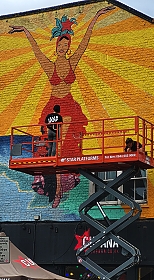
These memories of hand-painted posters came to mind a couple of days ago (late July 2002) while we were walking towards Lower Marsh (near Waterloo Station) from the Young Vic Theatre, where we had just watched a poorly acted, and badly written play called “Chasing Hares”. We spotted two ladies perched on a very adequate scaffolding device painting a colourful mural on a large expanse of brick wall above the Cubana Restaurant. It was good to see that in an age where machine produced images are common (and have largely replaced hand-painted adverts in India), traditional methods are still being used to create large images for attracting the public.
THE PAINTER MAHESH BALIGA was born in the south Indian state of Karnataka in 1982. He studied painting at The Chamarajendra Academy of Visual Arts (CAVA) in Mysore, and then received a postgraduate qualification at the prestigious Faculty of Fine Arts, MSU, in Baroda (Vadodara in Gujarat). He has taught at various art schools in India and exhibited in several countries including India. Currently, he lives and works in Baroda. Between the 12th of April 2022 and the 28th of May 2022, some of his works are being exhibited in a solo exhibition, “Drawn to Remember”, at the David Zwirner Gallery in Grafton Street (in London’s West End).
The paintings on display were created using casein tempera. This kind of paint has a glue-like consistency, but it can be thinned with water. According to Wikipedia, artists like this kind of paint because:
“… unlike gouache, it dries to an even consistency, making it ideal for murals. Also, it can visually resemble oil painting more than most other water-based paints …”
At first glance, it is difficult to discern whether the Baliga’s paintings on display at Zwirner’s resemble water colours or oil paintings; some of them seem to look halfway between the two mediums. All of them, except one, are quite small canvases and without exception they are all attractive. The subject matter depicted in the works is varied, from studies of plants and animals to everyday scenes (often with depictions of Indian life) to the slightly unusual. An example of the latter is in the only large canvas of the show in which there is an image of a man with sticky plasters over his left eye. Another odd subject shows a man with flowers growing out of his shirt. This is appropriately named “Flowering Self”.
The small size of most of the paintings, which the artist described as ‘lap-sized’, has a reason. Many of them were executed on the journeys the artist made when commuting to and from Surat (in the south of Gujarat), where he held a teaching position for a while. Though they are not large paintings, each one of them provides a window on the artist’s experiences and and his take on them. Although the paintings are far from mundane, they are not over-dramatic or excessively visually challenging. The exhibition is well worth seeing. I would be happy to hang any one of the works I saw at his exhibition on my walls at home.
SOUTHALL LIES NOT far from Heathrow Airport. Despite its architecture being mostly typical of dull London suburbs that developed between the two World Wars, it is far from being a run-of-the mill west London suburb. Recently, in March 2022, we visited Southall after several years since we last went there.
The centre of what was once the tiny village of Southall is about 1.7 miles north of Osterley Park house. The manor of Southall was owned by the Archbishop of Canterbury in the 14th century. Separated by countryside from its neighbours, it lay on the road from London to Uxbridge and Oxford. It was only in the 1870s that the village began expanding southwards to the Great Western Railway line. Today, the place has been fully incorporated into London and retains little or nothing of its former rustic nature.
Detail of the roof of the Himalaya Palace in Southall
On arriving by train at Southall station, the observant traveller will notice that the station name signs are bilingual; they are in both Latin and Punjabi scripts. Southall is sometimes aptly referred to as ‘Chota Punjab’ (Little Punjab). The three Punjabi brothers, Charan Singh Bilga, Jagar Singh Bilga, and Lave Singh Bilga, began living in Southall in 1938. They were followed by Pritam Singh Sangha, who opened a shop in Southall in 1954, having arrived in the area in 1951. His shop was then the only shop in west London, if not in the whole of the metropolis, purveying Indian provisions. Pritam Singh Sangha in partnership with his friend and business associate, Jarnail Singh Hura (also known as “Ghura”), established the first known business in Southall and Fakir Singh purchased numerous houses which he rented out to his countrymen.”
Vivek Chaudhary, writing in the Guardian in April 2018, recorded:
“By the time my own father arrived in 1960, local authority records show that there were approximately 1,000 Punjabis living in Southall, nearly all men. He would joke that one of the reasons why they settled here was because of its proximity to Heathrow airport, only three miles away, and “if the gooras [whites] ever kicked us out, it would be easy to get on a plane and return home”. It was a light-hearted reference to the uncertainty that was generated by the chronic racism of the time. It was the R Woolf rubber factory in neighbouring Hayes that attracted Punjabis to Southall – the general manager had served with Sikh soldiers during the second world war and was only too happy to recruit them…”
He added:
“Punjab was partitioned by the British in 1947; part of it fell within Pakistan with the remainder in India. Punjabis can be Sikh, Hindu or Muslim, and while all three demographics settled in this outpost of west London, it was the Sikhs who came in the largest numbers and gave Southall its distinct identity.”
Chaudhary mentioned that at the time he wrote his article, although at one stage Southall’s population was 70% Punjabi, this has decreased to about 50% and the descendants of many of the original settlers:
“…have prospered and moved to wealthier pastures, replaced by new communities from Afghanistan, Sri Lanka and Somalia. At its heart, though, this corner of west London remains an indelibly Punjabi town.”
And so, it is. Southall is like the Punjab and other places in India or Pakistan, but with the often-dull English weather and rather pedestrian suburban architecture. The main streets, South Road and the Broadway (Uxbridge Road), are lined with shops, small bazaars consisting of several tiny shops, and eateries. Judging by the profusion of colourful, often glittering, Indian (and Pakistani) style party clothing on sale, one might be excused for thinking that the people of Southall do nothing apart from attending ‘glitzy’ weddings. If you wish to sample shopping as it is in India without leaving the country, then Southall is the place to do it in London. It seemed to my wife and me that the quality of the clothing on sale was high, better than much that is available in India. A Sikh salesman explained that what is on sale in Southall is made in India but unlike what is on sale over there, this is export quality.
One building is worthy of special mention in Southall, apart from the area’s gold-coloured domed Sikh gurdwaras. This is the former Himalaya Palace cinema. Built in 1929, it is unique in Britain in that its façade is in the form of a Chinese Temple. It has a pagoda roof which is flanked by dragons. It used to screen films from India’s Bollywood studios until it closed in 2010. It has now become an indoor market called Palace Shopping Centre. Fortunately, the building is protected by a preservation order and the façade is likely to remain a wonderful landmark in the foreseeable future. Not far away in a less distinguished building is another mall, the Himalaya Shopping Centre. Entering these malls, and the others in Southall, is like stepping into a typical indoor shopping bazaar anywhere in India. The air in these Southall shopping centres has the special fragrantly perfumed odour I associate with India.
Near the former cinema, stands the former Southall Town Hall, which was constructed in 1898. On its wall, there are commemorative three plaques placed by an anti-racism group called Southall Resists 40. They are dedicated to Gurdip Singh Chaggar, who was killed in 1976; Blair Peach who was killed in 1979; and ‘Misty in Roots & People Unite Musicians Cooperative’. Each of the three bears the words “Unity against Racism”.
THE WALLS OF Bath Abbey are lined with memorials to the dead, many of whom are buried within the church. A remarkably large percentage of the funerary memorials commemorate the lives of people who worked in Britain’s colonies. There are monuments to people who lived and worked in the Caribbean, North America, and Asia, especially for the East India Company, which ‘ran’ and exploited India until 1858.
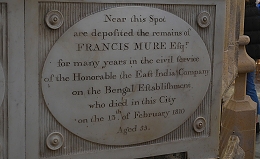
For example, Francis Mure Esq worked for many years in the civil service of “the Honourable the East India Company on the Bengal Establishment”. He died in Bath in 1810 aged 53. Henry Lynch Esq MD “of the island of Barbadoes” died in Bath in 1823, aged 49. Also from this place in the Caribbean was Benjamin Alleyne Cox Esq who died in Bath in 1802 aged 74. In 1812, 78-year-old Rawson Hart Boddam also died in Bath, after having served as the Governor of Bombay in 1784. Robert Brooke Esq, who had served in the Bengal Civil Service died in 1843 aged 72 is also interred in Bath Abbey. Peter Read Cazalet, “of the Honourable East India Madras Civil Service”, who died in 1859, aged 37, is yet another old ‘India hand’, who is buried in Bath. Also in the abbey are the remains of Major General Sir Henry White KCB, part of whose inscription reads chillingly like some of the news bulletins in the current Ukraine crisis: “The judicious Position taken by his Division in the Attack on Agra Which accelerated its fall And the Reduction of The Strong Hill Fort at Gwalior By Siege Are Proofs of Zeal and Military Skill…” He died in 1822.
What puzzled me was why did so many of these men from the colonies ended their lives in Bath. Was it because they were sick and had come to the place to take the curative spa waters, which failed to cure them? Or had they retired to Bath? Or, as someone suggested, Bath is close to Bristol, which was in many ways involved with colonial affairs.
The answers to these questions must remain uncertain at present. However, I wondered why the wealthy American Senator William Bingham died in Bath in 1804, aged 49. He was involved with the Barings Brothers bank in London, which might have been a reason for him being in England at the time of his death. He left for England in 1801, when his wife was taken ill. What he was doing in Bath remains unclear.
Amongst the many fascinating memorials in the Abbey are several commemorating people who died abroad. Some of these people had been in India when their lives ended. An interesting example of this, which illustrates the hazards of warfare and the difficulties in subduing people, who have no wish to be colonized, is the monument to 1st Lieutenant George Dobson Willoughby, of the Bengal Artillery and the Commisary of Ordnance at Delhi, who died in 1857. His inscription includes the following details: “As a brave and zealous soldier he stood firm in the defence of the post intrusted to him, and when resistance failed blew up the Delhi Magazine on 11: May 1857 to prevent it falling into the hands of the mutineers and rebels. Burnt and wounded he subsequently fell a prey to the insurgents …”
Maybe, this is a lesson from which the dutiful Russian soldiers in Ukraine should take heed.
AFTER OUR HONEYMOON in the south of India, we returned to Bangalore, where we disembarked from an overnight bus from Ernakulam (in Kerala) at about 4 am on the 26th of January 1994. Several hours later and incredibly bleary-eyed, we joined many other residents at a gathering in a courtyard of the apartment block in the city’s southern suburb of Koramangala. Mr Zafar Futehally (1920-2013), a noted naturalist and one of the senior tenants, stood by a flagpole and made a brief speech. Then, the flag of India was raised, and everyone dispersed. It was Republic Day, the significance of which was unknown to me back in 1994, when I made my first visit to India.
Ambedkar in Bangalore
Now, I know that on the 26th of January 1950, two and a half years after India became independent, the Constitution of India came into effect and India became a republic, having briefly been a Dominion since the 15th of August 1947. The Constitution was drafted by a committee that was led by Dr Bhimrao Ramji Ambedkar (1891-1956). After leaving school, he was educated at the University of Bombay, then at Columbia University in NYC, and then at the London School of Economics (‘LSE’). While in London, he qualified as a barrister as a member of Gray’s Inn.
Long after 1994, I learned that Ambedkar had lived in a part of London with which I am familiar. He resided in a house near Primrose Hill and Chalk Farm, where the Roundhouse is located. In my recently published book “Beneath a Wide Sky: Hampstead and its Environs”, I wrote:
“Another reformer and patriot lived near Regents Park Road. He was Dr Bhimrao Ramji Ambedkar (1891-1956), who championed India’s Dalits (‘untouchables’) and formulated the Constitution of India. Between 1920 and 1922 while he was studying at the London School of Economics and for the Bar, Ambedkar lived in a house at 10 King Henrys Road near Regents Park Road. In 2015, the house was bought by the Government of Maharashtra and was then converted into a memorial to Ambedkar. It is open to the public. Visitors can learn about Ambedkar from the well-captioned photographs on the walls of the rooms that they can wander through. The upper floor contains a re-construction of Ambedkar’s bedroom including a four-poster bed, some of the great man’s books, and an old pair of spectacles, which might have belonged to him. Other rooms contain shelves of books and various memorials to Ambedkar. There is also a commemorative plaque to India’s present Prime Minister Narendra Modi, who inaugurated the memorial house in November 2015. The garden contains statue of Ambedkar clutching a book (the Constitution) in his left hand. A few years ago, neighbours of the Ambedkar house complained about it, concerned that it would attract swarms of tourists.”
Although he could never have met him, Ambedkar’s home in King Henry’s Road was not far from the house in which Friedrich Engels (1820-1895) lived for several years.
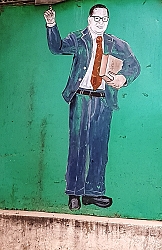
The statue portraying Ambedkar statue in the garden of his former London home is typical of those found all over India. Apart from helping to give birth to India’s Constitution, Ambedkar campaigned for the rights of the Dalits (the ‘Untouchables’), as mentioned in the quote above. The Dalits were excluded from the four caste Varna system of Hinduism and considered by many Hindus as the lowest of the low, fit only for menial tasks that members of other castes would not deign to consider doing. Ambedkar, born into a Dalit caste, campaigned actively for the ending of social discrimination against this class of people. Mochis (cobblers/shoe repairers), who handle leather, are often Dalits. The best place to find a mochi is on the pavement beside a road. Sometimes, they sit on the ground surrounded by their tools and footwear awaiting repair. In other cases, they work from little stalls that can be locked up when they are not at work. These stalls often bear images of Ambedkar in honour of the man who did much to help the Dalits. What with the huge numbers of statues of him and of portraits on the stalls of mochis, Ambedkar must rival Gandhi as being one of the most frequently portrayed politicians of modern India.
So, every Republic Day, it is appropriate to celebrate the birth of the republic and the adoption of the Constitution, but we should not forget to raise our hats and flags to Ambedkar, the brilliant man who did far more than father the Constitution.
I HAVE NEVER LEFT a barber’s shop without leaving a tip. This is a habit that was instilled in me by my mother during my childhood. Whether the cut was good or bad, I have always left my hairdresser with a gratuity.
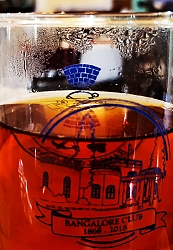
In January 1994, I first visited the Bangalore Club in southern India. A few days before my wedding to a member, my in-laws decided that my hair needed a trim. Back in those days, the Club barber shop was located in a hut behind the Men’s Bar, which until a few years ago did not allow the entry of women and girls. Now renamed, this former bastion of maleness permits all drinkers regardless of their genders.
My haircut was at the very least satisfactory and cost all of 20 Indian Rupees, which was debited to my wife’s club account. In those days one pound Sterling was, if I recall correctly, about 40 Rupees. So, my haircut was remarkably good value compared with what I would have paid for it in London.
At the end of my session with the barber, I fumbled in my pocket to find some money for the tip. All I could find was a 50 Rupees note, which I handed to the man who had looked after my coiffure.
When I related my experience to my wife-to-be, she was horrified that I had tipped more than twice the fee. I suspect that the barber was delighted.
WHEN I USED TO visit Hampstead with my parents in the early 1960s, we always walked past a place that intrigued me when I was a youngster. It was the still standing Hampstead Quaker Meeting House, which has a lovely front garden. The latter is overlooked by its neighbour, the late 18th centuryMansfield Cottage, which in the 1960s housed a tearoom or restaurant. The Meeting House with art nouveau (Arts and Crafts) features was built in about 1907 to the designs of Fred Rowntree (1860-1927). According to James D Hunt in his detailed book “Gandhi in London”, Mohandas K Gandhi (1869-1948), the future Mahatma, spoke in this meeting house on the 13th of October 1909:
“… perhaps travelling there by the recently opened underground line … The Society of Friends (Quakers) were not at this time much interested in Indian affairs … The 1909 meeting was sponsored by the Hampstead Peace and Arbitration Society”
The speech, as recorded by Robert Payne in his “The Life and Death of Mahatma Gandhi”, was entitled “East and West” and outlined the evils of the British occupation of India and the sufferings of Indians in South Africa. I knew nothing of this or about the house when we used to stroll down Heath Street.
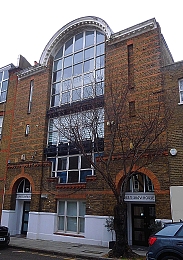
CAMPDEN STREET IN Kensington is a short thoroughfare running between Kensington Church Street and Campden Hill Road. On it, there is a distinctive building called Byam Shaw House. Until 1990, this edifice with its large centrally placed, north facing window was the Byam Shaw School of Art, which opened in 1910. Named at first as ‘Byam Shaw and Vicat Cole School of Art’, after its founders, Rex Vicat Cole (1870-1940) and John Liston Byam Shaw (1872-1919), it soon became known as the Byam Shaw school.
John Liston Byam Shaw is also known as ‘Byam Shaw’. He was born in British India, in Madras (now ‘Chennai’), where his father was registrar of the High Court at Madras. In 1878, the Shaws moved back to England, where they lived in Kensington. At an early age, he showed artistic promise and at the advice of the artist John Everett Millais (1829-1896), he entered an art school in London’s St Johns Wood. As he grew older, Byam’s works attracted less interest and he turned to teaching to earn a living. In 1910, he and Cole founded the art school in Campden Street. Sadly, Byam Shaw died during the great influenza epidemic that followed WW1.
The school in Campden Street has produced several significant artists including Winifred Nicholson (first wife of Ben Nicholson), Bernard Dunstan, Yinka Shonibare, Mona Hatoum, as well as stage designers, stained-glass makers, and actors. The inventor James Dyson also studied there. In 1990, the school moved to larger premises in Archway, and in 2003, the school was absorbed into the Central Saint Martins College of Arts and Design. Byam Shaw would have been pleased to know that his school produced such fine alumni. Guy Burch, who studied at the school between 1981 and 1984, wrote:
“The innovative independent Art School founded in the early 1900s, Byam Shaw had an open studio policy that suited my inability to fit into categories marked ‘painter’ or ‘sculptor’. Most art schools at the time made you choose one or other with cross-media working tending to be discouraged. Their studios allowed you to move between them. I was in the ‘Image Studio’, and worked on collage, painting and mixed media installations.” (http://www.guyburch.co.uk/?p=4358)
I feel it is a shame that the building in Campden Street, which has now become a block of flats, is without any notice commemorating its former use.
THAXTED IS A PICTURESQUE small town in Essex, about six and a half miles northeast of Stansted Airport. Apart from its numerous quaint old buildings, the town has three notable landmarks: an old windmill, a 15th century guildhall, and a large parish church, which was built between 1340 and 1510 during the time when Thaxted was an important centre for the manufacturing cutlery. Also, Thaxted is home to an annual music festival, whose existence derives from the discovery of the town by a composer, Gustav Holst (1874-1934), creator of “The Planets” and many other musical compositions, who was on a walking tour in Essex during the winter of 1913.
Gustav Holst in Thaxted
Holst, who was born in Cheltenham, was living in London by 1913 and teaching music at St Pauls School for Girls in Hammersmith, James Allen’s Girls School in Dulwich, and Morley College for adults in Lambeth. At the same time, he was busy composing.
Holst had come to study at The Royal College of Music in London in 1893. Soon after arriving in London, he became acquainted with William Morris (1834-1896) and attended meetings at the latter’s house in Hammersmith, where he would have heard lectures on socialism given by George Bernard Shaw (1856-1950) and others. Holst joined the Hammersmith Socialist Society (‘HSS’), which was led by Morris. Many of the socialists he met including Shaw were vegetarians, as was the composer Wagner, whom Holst greatly admired. As a student and a regular attender of meetings of the HSS, he became a vegetarian and at the same time developed a great interest in Hinduism (www.ivu.org/people/music/holst.html). He began studying Sanskrit at The School of Oriental and African Studies (https://www.bl.uk/20th-century-music/articles/holst-and-india) and several of his compositions bear Indian-sounding titles, such as “Savitri” and another opera called “Sita”, and songs based on the Rig Veda.
According to Nalini Ghuman:
“In contrast to the vague musical orientalism in vogue during the height of the British Empire, Holst’s hymns, with their bona fide Indian texts, subjects, and musical elements, have often seemed decidedly ‘un-Indian’ to the uninformed ear: ‘Sound firm impressions of the East from a sane Western perspective’ declared The Musical Times; ‘They do not suggest a point further East than Leicester-square’ (Daily Telegraph); after all, explained the Manchester Guardian ‘many real Eastern musical ideas are frankly ugly and uninteresting’. Their Indian musical roots have long been denied by the composer’s biographers.” (https://www.bl.uk/20th-century-music/articles/holst-and-india).
However, Ghuman points out in her article that Holst did incorporate elements of Indian music, including emulating Vedic chanting and a South Indian mode, the namanarayani. You would need to be a serious musician with specialist interest in Indian music to be aware of these features whilst listening to Holst’s Indian inspired compositions.
Returning to his political leanings, major biographies of Holst tend not to focus much on his connections with socialism, but an informative article, “Gustav HoIst, William Morris and the Socialist Movement” by Andrew Heywood (Journal of the William Morris Society, vol 11, no. 4: 1996), shows that his involvement was far from inconsiderable. In addition to attending meetings of the HSS, Holst conducted its socialist choir, played the harmonium on the ‘official socialist’ cart, and was involved in the administration of the society. Heywood wrote that:
“In the light of his clear commitment to the socialist movement through 1896 it would seem likely that his involvement with the musical activity of the society did not stem from a lack of political commitment; rather it was an opportunity to serve the movement in a way which utilised his musical talents and interest.”
It was through the HSS that Gustav met his wife Isobel, who not only sang in the socialist choir but also, according to Heywood, was politically active in the society.
So, it was with a background of involvement with socialism that Holst walked into Thaxted in late 1913 and took such a great liking to the place that he rented a 17th century cottage there (actually, in Monk Street, 1 ½ miles from Thaxted) from its owner, the Jewish author Samuel Levy Bensusan (1872-1958). Thus began Holst’s several year’s association with the town. It was not long before he made the acquaintance of Thaxted’s vicar, Conrad le Despenser Roden Noel (1869-1942). After the cottage in Monk Street burnt down, Holst and his family lived in a house, The Manse (formerly known as ‘The Steps’), in the centre of Thaxted. Today, this is marked by a commemorative plaque.
Noel was not a run-of-the-mill country cleric. He was a Christian Socialist and a member of Social Democratic Federation, a founder member of the British Socialist Party, and for some time the Chairman of the Anti-Imperialist League, supporting the struggle for independence both in Ireland and India. Deeply committed to Christian socialism, social justice, and egalitarianism, Noel made sure that what went on in his parish church promoted these ideals. Noel’s biographer, Reg Groves, wrote that Conrad:
“…emphasised always that there was much more to making a new society than the acquisition of political power and the transfer of some property from the rich to the state, from one set of rulers to another. In this as in so many things, he was at one with the wisest of English socialists, William Morris, and much of what Morris said in prose and poetry and in the work of his hand, Noel tried to say in the group life he had developed at Thaxted”.
Noel and Holst shared socialist sympathies and more.
During Holst’s sojourn’s in Thaxted in between his heavy teaching and other musical commitments, he attended services led by Noel. It was after one of these held at Whitsun in 1915, that Holst, having heard the great potential of singers in the church, approached Noel and offered to give the choir the benefit of his professional skills as a trainer of vocalists. Noel, recognizing the splendid opportunity, soon had Holst become his church’s ‘master of music.’
Heywood explains that Holst’s:
“…first job was to train the choir for the church. Its members were drawn from the local population, and they achieved high standards with Holst. One member, Lily Harvey from the local sweet factory, was sent to London for professional training because of her exceptional vocal talents. In addition to his activities with the choir and playing the organ, Holst organised three major music festivals in Thaxted between 1916 and 1918.”
Lily was not the only person sent to London for musical training. The then young curate Jack Putterill, who was politically turbulent and played the organ, became one of Holst’s students at Morley College. Jack, who married Noel’s daughter, succeeded Noel as Vicar in 1942.
The festivals organised by Holst involved not only performers from Thaxted but also some of his students from Morley College and St Pauls as well as other musicians from outside the town. Each festival lasted several days, on each of which there were many hours of music making, both rehearsed concert pieces and much spontaneous music.
Holst not only helped make music in Thaxted but also composed there. The plaque on the The Manse, where he lived, is positioned on the outside of the wall of the room in which he composed. While living at Monk Street, he composed much of what was to become the well-known piece, “The Planets”. The “Jupiter” section of “The Planets” contains a tune or theme that Holst named “Thaxted” (you can listen to this familiar tune here: https://youtu.be/GdTpBSg7_8E). In 1921, “Thaxted” was used as the tune for the patriotic song “I vow to Thee, My Country”, whose words were written by the British diplomat Cecil Spring Rice (1859-1918). Holst also composed pieces specially for Thaxted and its people. These works include a special version of Byrd’s “Mass for Three Voices”, “Three Hymns for Thaxted” (later known as “Three Festival Choruses”), and a setting of the Cornish carol “Tomorrow shall be My Dancing Day” (hear it on https://youtu.be/Cz_0j__FDuc).
Although the last festival in Thaxted with which Holst was intimately involved was in 1918, he never lost touch with music making in the town, even after he moved from it to nearby Little Easton in 1925. Holst’s pupil Jack Putterill, an accomplished musician who was Thaxted’s assistant curate from 1925 to 1937 and its vicar from 1942 until 1973, helped keep the town’s musical life alive and vibrant. In the 1950s and 1960s, concerts with great orchestras such as The London Philharmonic and audiences in excess of 1000 were held in the parish church. In 1974, the hundredth anniversary of Holst’s birth, the first of what was eventually to become an annual music festival was held in Thaxted. By the 1980s, the Thaxted Festival had become a regular and respected part of the British musical calendar (www.thaxtedfestival.co.uk/).
Apart from the Festival and the house with the plaque in Thaxted, most souvenirs of Holst’s time in the town can be found within the cathedral-like parish church, which, incidentally, was once a candidate for becoming Essex’s cathedral (this honour was granted to the parish church in the centre of much larger Chelmsford). The church in Thaxted contains a photograph of Holst with singers and musicians at the Whitsuntide Festival held in 1916. Near this, there is some calligraphy with the words of “Tomorrow shall be My Dancing Day”. The church’s Lincoln organ built in 1821 by Henry Cephas Lincoln (who worked between c1810 and c1855) was played by Gustav Holst and has been recently restored. Not far from the organ is a cloth banner, sewn by Conrad Noel’s wife, which was used in the 1917 Whitsuntide Festival. It bears the words “The aim of music is the glory of God and pleasant recreation”. These words were written by the composer JS Bach (1685-1750) and were chosen for use on the banner by Holst. Near this banner, there is a bust of Holst’s friend and collaborator, Conrad Noel.
Both Holst and his student Putterill fell in love with Thaxted at first sight and were so strongly drawn to it that the town came to occupy important places in their hearts and minds. We first visited Thaxted in the early summer of 2020 soon after covid19 restrictions began to be relaxed sufficiently to permit travelling out of one’s immediate neighbourhood. Like Holst and Putterill, Thaxted made a special impression on us, so much so that we have visited it at least twice since our first encounter with it. Next year, we hope to be able to attend concert(s) at the Thaxted Festival inside a church that we have grown to love.
IN CENTRAL AHMEDABAD, a large city in India’s state of Gujarat, there is a curious café called Lucky. This popular eatery is not unusual because it does not serve coffee but because its tables and chairs are placed between Moslem graves. Lucky’s is sited on an old Moslem graveyard, but this does not put off a steady flow of customers from enjoying a wide variety of vegetarian snacks in this eatery. Closer to home, near the south side of London’s Lambeth Bridge, there is another café sited on a former graveyard. Unlike Lucky in Ahmedabad, which is housed in an architecturally unremarkable building, the café in Lambeth, The Garden Museum Café, is a marvellous example of contemporary architecture.
Café at The Garden Museum in London
The café, completed in 2018, is at the east end of the Church of St Marys, Lambeth, which now serves as the home of The Garden Museum. The church stands next to the main Tudor entrance of Lambeth Palace. The tower was built in about 1378. The rest of the church contains structural elements that were built in later eras. Appropriately for a museum dedicated to gardening history, the repurposed Church of St Mary’s is the burial place of the famous gardener and plant collector, John Tradescant the Elder (c1570s-1638). It is also the final resting place of Captain William Bligh (1754-1817) of The Bounty Mutiny (1789) fame. This famous mariner owned a house in Lambeth. Customers of the café do not sit on the graves of these two well-known persons, but on gravestones that, unlike the graves at Lucky in Ahmedabad which are raised above the ground, are level with the rest of the café’s floor.
The graves at Lucky in Ahmedabad are coffin shaped and probably contain the remains of the deceased. I am not sure whether there are human remains beneath the grave slabs in the floor of the café in Lambeth. A young waiter, whom I asked, was concerned to reassure me that he believed that there are no skeletons beneath the gravestones upon which customers walk and sit. I wonder whether this is really the case.
The Garden Museum was founded in 1977 by Rosemary and John Nicholson in order to preserve the church, which was due for demolition (https://gardenmuseum.org.uk/the-museum/history/). In 2015, the museum was closed for a year and a half whilst it was being redeveloped. Part of the improvements made was the construction of an extension at the eastern end of the retired church. The new construction, designed by Christopher Bradley-Hole and Dan Pearson, includes the café and other structures that together surround a new courtyard that contains a lovely garden, The Sackler Garden designed by Dan Pearson. It contains several tombs including that of the Tradescant family and of Captain Bligh.
The café borders the western side of the courtyard. Its mainly glass walls provide good views of the garden, the buildings across the river and the leafy remains of the churchyard west of the café. Where there is no glass, the walls are covered with overlapping brown coloured metal panels. Serving great coffee and both snacks and meals, the legs of the chairs and tables rest on the gravestones that form part of the floor.
Compared with Lucky, which is in a very busy part of Ahmedabad, the Garden Museum café, although close to a busy main road, is far more peaceful. However, both are delightful places to enjoy refreshments.






 yamey
yamey 