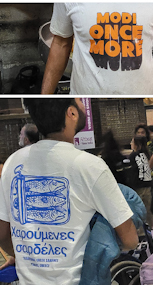
RECENTLY I SAW two eye-catching T-shirts. One that was seen in Indore, speaks for itself.
Top shirt seen in Indore, bottom one in Bombay
The other, spotted while waiting for our luggage at Terminal 2 in Bombay Airport, might look Greek to you, and indeed it is. The rear of the shirt reads when translated into Latin script ‘karimenes sardeles’, and beneath it, written in Latin script “Traditional Greek sardines, Pyrgos, Greece”. This refers to a brand of sardines from Pyrgos on the Greek Aegean island of Santorini.
I asked the man wearing this shirt whether he had got it in Greece. He said that he had bought it at a branch of H&M in India. I asked him what the Greek words on his shirt meant. He had no idea, neither had he ever heard of sardines. Well, I had no idea that this shirt was a best-selling item sold at H&M.
TODAY THE TEMPERATURE in Athens (Greece) will exceed 35 degrees Celsius, and in Rome it is predicted to reach 42 degrees in two days’ time. Two years ago, a temperature of 48 degrees was recorded in Sicily. So, it seems that so-called Global Warming is happening with vigour. Meanwhile, this Sunday (16th of July 2023) in London, we enjoyed a breezy morning with temperatures not greater than a pleasant 21.
While walking along Portobello Road this Sunday, we spotted a beautifully cared for open-topped Ford Zodiac. These vehicles were manufactured between 1950 and 1972. I remember seeing them in my childhood and teenage years. In those days, I was not much interested in cars, but now when I see one that used to be common in my earlier years, I find them worthy of examination. I took several photographs of the Zodiac and then headed for the bus stop from which we were returning home.
Despite the external temperature being 21 degrees or less, it was far warmer inside the bus although its windows being open. The higher temperatures that we have been experiencing here in London and are now affecting places near the Mediterranean are commonly believed to be at least partly due to emissions produced by fossil fuels, such as petrol. As we moved homewards, a thought struck me. The beautiful Ford Zodiac, which we had just seen, is aesthetically pleasing and a souvenir of one of the great eras of automobile engineering, but it is also an ‘ancestor’ of Global Warming. Beautiful as it is, it too burns fossil fuel and makes its own contribution to what is believed to be causing dangerously high air temperatures in many parts of the world.
OFTEN WHEN ONE IS SEARCHING for something, something, which you were not looking for, comes to light. A day or so ago, one of my old passports was discovered. It is an old-fashioned, blue-covered book with barely a trace of the wording and crest that used to be on the cover. I used to carry my passport in a trouser pocket, which rubbed against it and gradually denuded the cover. The ten-year document expired on the 19th of March 1990. This was a couple of months before I made my last trip to what was still known as ‘Yugoslavia’. Soon after that, civil wars erupted, and the country became divided into smaller independent units.
The passport gives my height but not my eye colour, which used to be recorded in earlier passports. It contains eight Hungarian visa stamps (one is illustrated above), all issued in London except for one which was affixed in Belgrade. There is also a Bulgarian visa stamp, which was issued in March 1983. In addition to these visa stamps, for which I was charged roughly $10 each, there are many border stamps – entry and exit. Most of these are for Hungary and Yugoslavia, which I visited frequently throughout the 1980s. In those days, Brits did not need a visa to enter Yugoslavia.
One of the border stamps is of special interest. It was issued when I entered Yugoslavia at Bozaj on the 5th of June 1984. Bozaj, now in the Republic of Montenegro, was a Yugoslav border post on the shore of Lake Shkodra. The stamp was placed in my passport a few minutes after leaving the Albanian border post, also beside the lake, at Han-i-Hotit. It was here that an Albanian entry stamp was put in my passport two weeks earlier when I visited the country, which was then even far more mysterious than North Korea is to us today. In 1984, the Stalinist regime headed by Enver Hoxha was still in place. The two weeks spent in Albania were both fascinating and unusual to say the least. I have described that holiday in my book “Albania on My Mind.”
In addition to the visas and stamps issued by socialist countries, there is one Greek entry and one exit stamp, both issued at Athens airport in August 1981. It seems that I was in Greece from the 11th to the 17th. Another stamp issued on the 13th by the Piraeus branch of the National Bank of Greece takes up most of one page and has something to do with money and traveller’s cheques, but my Greek is not up to translating it.
The accidental finding of this old passport brings back many happy memories of travelling in parts of Europe that have now changed beyond recognition – for better or for worse.
S was born in a small port in the Peloponnese long before WW2. It was a place that tourists disembarked from their boats to visit the Ancient Greek archaeological site of Olympia. S left school at an early age (by the age of about 12 to earn money by working on the docks of the small town. When cruise ships called in at the port, he offered services as a tourist guide to earn a few extra Drachmas.
Most of the tourists swallowed the tales that S told them as they wandered around Olympia. However, one day he met his match. An English gentleman accepted his offer to act as his guide. Soon after they reached the site and S had begun giving his customer his ‘spiel’, the Englishman stopped him, saying
“Listen, young man. It is clear that you know nothing about this site and its history. Let me tell you the correct story.”
S listened to his well-informed customer with interest and amazement. It turned out that the knowledgeable gentleman was no other than the future Prime Minister of the UK, Winston Churchill.
Many years later during one of my several visits to Olympia, I was standing in the lobby of a hotel near the site on a warm afternoon. The place was filled with members of an American tourist group. One lady asked her friend if she was going to take a tour around the famous site. The friend replied:
“Aw, no. It’s too damned hot to see more of those old rocks.”
THE SHORT-LIVED POET Rupert Brooke (1887-1915) lived outside Cambridge in the nearby village of Grantchester, where he rented a room in The Old Vicarage between 1909 and 1912. In May of 1912, Brooke was sitting in the Café des Westens in Berlin and feeling nostalgic about his life in Grantchester. He put pen to paper and composed his poem “The Old Vicarage, Grantchester.” Clearly fed up with Berlin, the poet begins the final verse of his poem with:
“God! I will pack, and take a train,
And get me to England once again!
For England’s the one land, I know,
Where men with Splendid Hearts may go;
And Cambridgeshire, of all England,
The shire for Men who Understand;
And of that district I prefer
The lovely hamlet Grantchester…”
The final verse ends with the famous lines:
“The lies, and truths, and pain?… oh! yet
Stands the Church clock at ten to three?
And is there honey still for tea?”
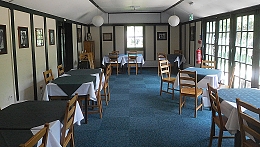
Inside the old pavilion at the Orchard in Grantchester
Having recently visited Grantchester, I can sympathise with Brooke’s desire to return to this charming village whose meadows run along the bank of the winding River Cam. The parish church of St Mary and St Andrew contains structures created as early as the 12th century, but most of the building dates from the 14th and 15th centuries. The west tower is mainly early 15th century. The clock on it no longer stands at ten to three, but it was stuck at that hour during the era when Brooke was in Grantchester.
The Orchard, which lies across the High Street from the church and between it and the meadows by the river, was planted in 1868. Before moving into the Old Vicarage, Brooke had lodged in a house in The Orchard. In 1897, a group of Cambridge University students asked Mrs Stevenson of Orchard House if they could enjoy tea under the blossoming trees. Thus began The Orchard Tea Gardens, now a popular haunt of students and tourists. Because of the unreliability of the English weather, a wooden pavilion was built at the end of the 19th century. In case of rain, tea drinkers could sit in the pavilion and enjoy their tea without getting soaked. Rupert Brooke was one of those, who used this place often. The Orchard’s website (www.theorchardteagarden.co.uk/history-new/) noted:
“In taking tea at the Orchard, you are joining an impressive group of luminaries including Rupert Brooke (poet), Virginia Woolf (author), Maynard Keynes (economist), Bertrand Russell (philosopher), Ludwig Wittgenstein (philosopher), Alan Turing (inventor of the computer), Ernest Rutherford (split the atom), Crick and Watson (discovered DNA), Stephen Hawking (theoretical physicist, cosmologist and author), Jocelyn Bell (discovered the first pulsar) and HRH Prince Charles (future King of England). There is a list of some of the famous people who have visited in a separate page on our web site, and there are photographs of many of them on the walls of the Rupert Brooke Room.”
The Rupert Brooke Room was constructed later than the pavilion. The famous visitors included several noteworthy Indians including Jawaharlal Nehru, Salman Rushdie, and Manmohan Singh. There is a whole host of other well-known personalities who have taken tea at The Orchard including a group of Cambridge students, who achieved notoriety for their involvement in espionage for the Soviet Union: Anthony Blunt, Guy Burgess, John Cairncross, Donald Maclean, and Kim Philby.
As for Brooke’s question “And is there honey still for tea?”, I forgot to ask during our far too brief visit to The Orchard. Brooke was commissioned into the Royal Naval Volunteer Reserve force at the outbreak of WWI. In early 1915, he set sail with the British Mediterranean Expeditionary Force. In late February, he developed a serious infection following an insect bite and despite the efforts of surgeons on a French hospital ship moored near the Greek island of Skyros, he died. He was buried in an olive grove on the island. In the churchyard of St Mary and St Andrew, Brooke’s name in carved on the church’s simple war memorial.
IN WARWICK, I chanced upon a fascinating book in a charity shop. It is Part 2 of “Stanley Gibbons Priced Catalogue of Stamps of Foreign Countries 1912”. When it was published, it could be purchased for as little as half a crown (2/6, which is 12.5 pence). I paid a lot more for it, but not an excessive amount.
I felt compelled to buy it because of its date and my interest in Albania. For, on the 28th of November 1912, the independence of Albania was proclaimed in the seaside town of Vlorë. Albania’s independence was formally recognised when the Treaty of London was signed in July 1913. The catalogue I bought in Warwick was published some time in 1912 and most likely before independence was proclaimed. As far as the publishers and the compilers were concerned, what is now Albania was still part of the Ottoman Empire.
The index of the catalogue contains an entry for “Albania (Italian P.O.)”. This needs some explanation. Throughout the Ottoman Empire, there were postal services operated by foreign (i.e., not Ottoman) countries. A website (www.levantineheritage.com/foreign-post-offices.html) reveals:
“In the 18th century, foreign countries maintained courier services through their official missions in the Empire, to permit transportation of mail between those countries and Constantinople [sic] the Empire capital. Nine countries had negotiated Capitulations or treaties with the Ottomans, which granted various extraterritorial rights in exchange for trade opportunities. Such agreements permitted Russia (1720 & 1783), Austria (1739), France (1812), Great Britain (1832) and Greece (1834), as well as Germany, Italy, Poland, and Romania, to maintain post offices in the Ottoman Empire. Some of these developed into public mail services, used to transmit mail to Europe. The Ottoman Empire itself did not maintain a regular public mail service until 1840, when a service was established between Constantinople and other major cities in the country and this was slow to develop and expand. The gap in this capacity was very much filled with the various foreign post offices which continued functioning right till the beginning of WWI in 1914 …”
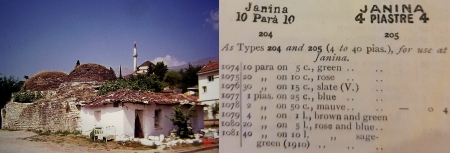
Left: Ioannina in the 1970s. Right: examples of over-printing texts
Hence, the entry in the catalogue’s table of contents. I turned to the page listed and found the section on Albania. The Italian Post Offices in the Turkish (Ottoman) Empire issued stamps, to quote the catalogue, which:
“…surcharged or over-printed for use in Italian post offices abroad.”
These stamps were the regular issues but, to quote the catalogue:
“… distinguished by the removal of some details of the design, over-printed with Type…”
Different Italian stamps were overprinted with names of places and a Type number. For example, Italian stamps were over-printed with: “ALBANIA. 10 Para 10. 201” (where ‘10 Para’ is a monetary denomination and ‘201’ is the Type number), or “Durazzo. 4 PIASTRE 4. 205”, or “Valona, or other place names. 10 Para 10. 208”. Durazzo and Valona being the Italian for the Albanian names Durres and Vlore.
Within the Albanian section of the catalogue there is also an illustration of the over-printing “JANINA. 4 Piastre 4. 205”. Janina is the name of a town now in Greece, Ioannina (Ιωάννινα). In 1912, this town was not in what was then Greece, but in the Pashalik of Janina, part of the Turkish Empire. In February 1913, following the battle of Bizani in the First Balkan War, the town was absorbed into Greece. Many Albanians still consider that by rights Ioannina should be a part of a Greater Albania. The large Albanian population in the town was forcibly reduced by population exchanges in the early 1920s and also the pre-WW2 Greek government’s policy of strongly encouraging people of Albanian ethnicity to regard themselves as Greeks. When I visited Ioannina in the 1970s, there were the remains of Turkish buildings but many of them were in a sad condition. I do not know whether they have been restored since then.
My purchase in Warwick has proved to be of interest. It records the state of postage stamps on the eve of great changes that were about to happen in the Balkan peninsular as well as illustrating aspects of European colonialism, both political and economic.
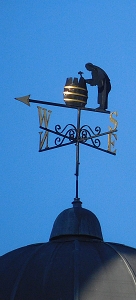
LOOK UP AND if your eyesight is reasonably up to scratch, you might well be lucky enough to see a weathervane on top of a church steeple or some other high point on a building. The ‘vane’ in weathervane is derived from an Old English word, ‘fana’, meaning flag (in German the word ‘Fahn’ means flag). Weathervanes are simple gadgets that indicate the direction of the wind. They usually consist of an arrow attached by a horizontal straight rod to a flat surface that catches the wind. The rod is mounted on a vertical support in such away that it can rotate as the wind catches the flat surface. The horizontal rod with the arrow rotates so that it offers the least resistance to the prevailing wind. Beneath the rotating arrow are often indicators that are labelled with letters denoting the four points of the compass. If, for example, the wind begins to blow from east to west, the horizontal rod will rotate so that the arrow is above the ‘E’ denoting east. Some weathervanes substitute the horizontal rod with a single flat asymmetric object that can catch the wind and rotate. Often the object seen above churches is a cock or other bird, whose beak will indicate the direction of the wind. I suppose that for birds wind direction is quite important.
The weathervane is not a recent invention. It was invented in the 2nd century BC both by the Greeks and the Chinese but separately. Some of the oldest Chinese weathervanes were shaped as birds and later, at least by the end of the 9th century AD, bird shaped vanes became used in Europe. Although avian weathervanes are still very common, a wide variety of other shapes have been used. Sundials, weathervanes, now archaic, only give an approximate indication of time and wind direction respectively. However, unlike sundials, which do not work when the sun is not shining, weathervanes work in all weather conditions and in day and night, although they are somewhat difficult to see at night-time. Despite their relative inaccuracy compared with modern instruments for measurements of wind, weathervanes are attractive adornments to buildings both old and new.
FOR SEVERAL YEARS, mainly in the 1970s and early 1980s, I used to join my former PhD supervisor, Robert, and his wife, Margaret, at their favourite camping spot on some rough ground a few yards south of the northern Greek seaside town of Platamon, a few miles south of Katerini. Robert favoured this spot because it contained colonies of a form of desert ant, whose behaviour and ecology he studied. Robert and Margaret followed a predictable daily routine.
After breakfast, which could only be eaten after all had taken a dip in the sea, Margaret usually set up a deckchair or a folding sunbed under the canopy attached to one end of the caravan and began reading one of the huge numbers of paperbacks that were stacked on shelves inside it. When not reading, she repaired Robert’s socks. Throughout the year, she collected his damaged socks, and saved them to mend. It helped fill the long hours at Platamon when there was no one apart from Robert with whom to chat. He was too busy watching and studying the ants to talk to her during the day. This was why she welcomed others, like me, to join them in Platamon.
Lunch varied little at Platamon. Almost always we ate sliced tomatoes dressed with sweetish vinaigrette. The tomatoes, which were both large and delicious, were bought from the ‘tomato man’. He was a Greek fellow who wandered along the shore with his donkey laden with tomatoes and other vegetables. Robert used to practice speaking Greek with him while he weighed out tomatoes on a hand-held weighing machine. The ‘tomato man’ did not appear every day, but the ‘goat man’ did. He wandered along the shore with his heard of goats, and always stopped to greet Margaret and Robert, who appeared not to mind when the goats stepped all over the area in which he was trying to conduct observations.
After lunch, everyone did whatever they felt like. Margaret sheltered in the shade. Robert, bringing to life the words of the refrain of Noel Coward’s song “Mad dogs and Englishmen …”, continued watching his ants out in the noonday sun. It is curious that these ants, which are so active at the hottest time of the days are referred to by some as ‘Englishmen’.
At about tea-time, we all took another bathe in the sea, which was by then pleasantly warm. Often after bathing and when we had tea and biscuits (just as if we were still in England), we would set off for Platamon in the Land Rover. Our first stop was the level-crossing at the southern edge of the village. There was a water tap close to the road that crossed the tracks that linked Greece to the rest of Europe. We used this to fill the large jerry cans that stored our drinking and cooking water. The water was then ‘sterilised’ by adding generous, but unmeasured, handfuls of small white chlorine releasing water purification tablets to it. Some of these tablets looked quite old to me. I suppose that they must have been effective because none of us ever got sick after drinking this water. During the water collection, Robert practised his Greek with the railway workers who looked after this manually operated level-crossing.
From the railway crossing, we drove into Platamon – or ‘Plat’ as my two friends called it – and parked. Margaret used to make a beeline for the railway station where, if she was lucky, she might discover a single copy of an English newspaper that was usually 2 or 3 days out of date. Few English speakers visited this seaside resort; there was little demand for the English press. Most of Platamon’s numerous visitors came either from Thessaloniki or from towns like Skopje and Bitola in what was then land-locked Yugoslav Macedonia.
Margaret left Robert to do most of the shopping in ‘Plat’. He had his favourite shops in Platamon. Typically, his choice of shop was dictated by the friendliness of its salespeople, which he considered more important than the quality of their merchandise. The three shops that he usually visited in the Greek village were a butcher, a fishmonger, and a grocery store, whose walls were lined from floor to ceiling with what seemed like every conceivable food and household product. One or two of its owners had lived in Australia and spoke English well, but with an odd accent that was neither fully Australian nor fully Greek. Each shop provided Robert with an opportunity to chat in Greek, which he did fluently but with a less than perfect accent. His attempts were much appreciated.
After my first visit to Platamon, I used to join Robert and Margaret there often during my rambles around the Balkans. I used to arrive at Platamon by train, never sure whether they had either reached it safely and/or were still camping in their usual spot.
Once, I disembarked at Platamon station at about 11 pm, and began walking towards the place where I hoped to find my friends. The grocery that Robert patronised was still open at this late hour. Its owners recognised me as I approached and beckoned me to join them at the small table where they were drinking beer out of tiny (shot) glasses suitable for spirits. They offered me a glass, which was the same size as theirs and filled it with the smallest amount of beer that I have ever drunk. After we had imbibed together, I walked through and then beyond the town to the place a couple of hundred yards south of the Platamon Beach Hotel, where I hoped to find my friends. I reached the darkened camp site where Robert and Margaret were fast asleep under the canopy outside their caravan, protected only by mosquito netting. Without disturbing them, I pitched my tent and fell asleep.
Next, morning, they were genuinely surprised to discover my tent pitched close to them. It was lucky for them that I was not someone who was visiting them with ill intention. They slept quite unprotected under their canopy and used to leave the caravan unlocked while they were away from it. Rural Greece was truly a safe place in those days.
Robert and Margaret stopped visiting Greece as they approached the end of their lives in the first decade of this century. The vacant land upon which they camped was owned by the inhabitants of a small village, Pori, on the slopes of nearby Mount Olympus. For all the years that my friends camped there, nothing was ever built on the land and it was never fenced in. Today, where we camped and sat drinking Martini whilst the sun set is now built upon. It is the site of Nea Pori. After many years, the villagers of Pori decided to make use of their seaside plots. I believe it would have broken my friends’ hearts had they arrived to discover where they loved to camp had been built on, probably destroying the habitat of the ants that Robert studied and wrote about in learned publications.
THE HARD ROCK CAFÉ at 150 Old Park Lane in central London opened its doors to customers in June 1971. It has been a popular eatery and tourist attraction ever since then. Often, a queue of hungry customers can be seen at its doors. I ate an enjoyable meal there once soon after it opened. I was then an undergraduate at University College London. Since then, I have not entered this place again. Some years ago, when the Hard Rock Café opened a branch in what had been the Tract and Bible Society bookstore in St Marks Road in Bangalore (India) in 2007, we had an indifferent meal there under the watchful eyes of a huge poster portrait of the singer Tina Turner.
Few of the customers of the Old Park Lane branch of this American-style diner in Old Park Lane are likely to have raised their heads to see what is above the eatery. It is worth doing so to see the:
“Bracketed cornice over 5th floor, shaped gable end to attic storeys finished off by giant broken segmental pediment with green brick banding and figure sculpture crowned by ornamental obelisk-finial.” (https://historicengland.org.uk/listing/the-list/list-entry/1266274).
This green (and white brick) banding gives the building an eye-catching appearance. There is a crest between the two large bow windows on the fourth (American fifth) floor. This shield with three chevrons and ten circles bears the date ‘1907’.
The building, 149-150 Old Park Lane, was built in 1904 to the designs of the architects Thomas Edward Colcutt (1840-1924) and Stanley Hamp (1877-1968), who worked together as a partnership. So far, so good, but what was the building used for when it was built and why did it deserve such an elaborate and unusual pediment? Various descriptions of its architecture describe that it consists of ‘flats and chambers’ above ‘a former showroom, now restaurant’. One source (www.foodepedia.co.uk/restaurant-reviews/2010/nov/hard_rock_cafe.htm) states that the Hard Rock is situated inside a former Rolls Royce showroom. This is confirmed by Anthony Knight, who wrote (on a restaurant development website):
“Two shaggy-haired Americans living in London were fed up with the fact they couldn’t find US-style burgers in the capital so they started a small burger joint in a Rolls-Royce dealership. In 1973 they hosted their first live gig, with the singer none other than Paul McCartney” (www.elliottsagency.com/opinion/greateststories/).
The brand name ‘Rolls Royce’ has been used since 1906. The building at 150 Old Park Lane was constructed two years earlier. I have not been able to ascertain when the luxury car company first opened their show room in the current premises of Hard Rock Café.
Looking up at the pediment, there is a sculpture of a kneeling muscular man supporting a sort of obelisk on which there are interlinked letters, which look like ‘D’, ‘J’, and lower-case ‘l’. What this stands for remains a mystery to me. However, the crest mentioned above, is identical to that on the coat-of-arms of the city of Gloucester (www.british-history.ac.uk/vch/glos/vol4/pp368-371). This is appropriate as the building is known as ‘Gloucester House’.
The building housing the Hard Rock Café is not the first edifice on this plot to have been named ‘Gloucester House’. According to the authoritative book edited by Ben Weinreb and Christopher Hibbert, “The London Encyclopaedia”, the first Gloucester House, which like the present burger joint was located on the west corner of Old Park Lane and Piccadilly, was constructed in the early years of the reign of King George III (he was on the throne from 1760 to 1820). It was in this building that Lord Elgin (1766-1841) first exhibited the marble fragments that he had removed from the Parthenon in Athens. They were displayed here, where today burgers and milkshakes are consumed, before he sold the marbles to the nation in 1816. That year, Gloucester House was purchased by William Frederick, Duke of Gloucester (1776-1834), who despite being nicknamed ‘Silly Billy’ became Chancellor of Cambridge University. The last owner of the house was George, 2nd Duke of Cambridge, who died in 1904. Soon after his death, the old house was demolished. It seems that its successor, the present Gloucester House, was built almost as soon as the old one was demolished.
In 1850, when the old Gloucester House was still in existence, Peter Cunningham wrote in his “Handbook of London” (published in 1850):
“At the Duchess of Gloucester’s, at the corner of Park-Lane, once Lord Elgin’s, and where the Elgin Marbles were placed on their first arrival in this country, is a very beautiful carpet in sixty squares, worked by sixty of the principal ladies among the aristocracy.”
At that time, William Frederick’s widow, Princess Mary, Duchess of Gloucester and Edinburgh (1776-1857), who was born in Buckingham Palace, was residing at the house. After her death, the house was sold to its last owner.
It occurred to me that quite accidentally the Hard Rock Café with its main entrance on Piccadilly is aptly named given that it is located where some ‘rocks’ that occasionally give the British Government a hard time, The Elgin Marbles, were once housed. What gives the precious ancient marbles a sort of hardness is that from time to time the Greek Government wants to have them back in Athens. So, next time you bite into a burger at Hard Rock in Gloucester House, spare a thought for the Greeks who have lost their marbles.
YESTERDAY MY WIFE visited the hair salon for some routine hair maintenance. On that visit, her hair was treated by ‘G’, a hairdresser from Greece. He told my wife that he had had a salon in Athens and had come to London in March 2020 to try his luck here and to satisfy his dream to live in London. Nine days after he arrived in London, everything closed because of the covid19 ‘lockdown’, which put an end to hairdressing for several months. He was pleased to be back at work again.
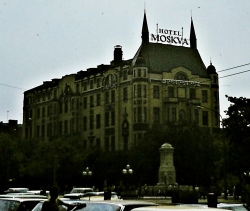
Hotel Moskva in Belgrade in the 1980s
G spent a great deal of time with my wife’s hair. She told me that he had sprayed various things on her head, far more than other hairdressers at the same salon usually used. When G was finished, he showed her the result in the mirror and took several photographs because he was pleased with his creation, as was my wife. G had used the various chemicals to give her hair more body than it had previously. He explained:
“You are now like beautiful Greek lady. You have style like Greek ladies. Much better than British, English like only too simple: no style.”
When my wife walked out of the salon, she looked as spectacular as ever, but even more so. Seeing the wonderful hairstyle that G had created reminded me of something that happened to me sometime in the 1980s.
I was staying in Belgrade, the capital of the former Yugoslavia. As was often the case, I stayed in the centre of the city with my good friend, the late ‘RR’. One day, he suggested that we should visit his barber and that I should have a haircut. The barber, who was clearly a good friend of RR, said that he was thrilled to have a British customer. I felt honoured to be the first of his British clients. He told me (RR was translating) that it was his ambition to work as a barber in London. I expressed the hope that his dream would be fulfilled.
The barber spent an hour and a half working on my hair, far longer than any other barber had ever taken to deal with my coiffure. Some years later, I attended a hairdressing school near Holborn (London) and volunteered myself as a model for a trainee. After more than two and a half hours, the trainee had barely done anything. Fortunately, the teacher came to my rescue and completed my haircut excellently and in only a few minutes. But, returning to Belgrade, my Serbian barber had not been idle during the ninety minutes I was in his capable hands.
Both the barber (‘бријач’ in Serbian) and my friend were very happy with my new hairdo. I looked quite different, but not improved as far as I was concerned. I felt that at least I had made two people happy by submitting my ‘Barnet’ (Cockney rhyming slang for ‘hair’) to the care of a ‘Dover Harbour’ (‘barber’) in Belgrade.
When we left the barber, I tried to run my fingers through my hair. It was impossible. All of the hairs seemed to be stuck together. My hair felt rigid rather than flexible. My hair had the texture of cheap dolls’ hair. A comb just bounced off the carapace that was covering my skull. The barber had used some kind of lacquer to render my hairstyle immutable. Not wanting to hurt my friend’s feelings, I made no complaints. However, as soon as I left soon as I left Yugoslavia, I washed my hair more thoroughly than usual and managed to get rid of whatever had given my hair its unpleasant rigidity.





 yamey
yamey 
