Facts, figures, and famine

blog churchill


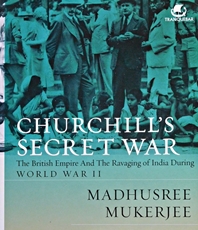
THE BRITISH PRIME MINISTER, Mr Boris Johnson, appears to be strongly dependent on his chief adviser, Mr Dominic Cummings. Mr Johnson’s hero, the late Winston Churchill, was also very reliant on his chief advisor Professor Frederick Lindemann, First Viscount Cherwell (1886-1957), a scientist. Madushree Mukherjee, the author of “Churchill’s Secret War”, wrote:

“On most matters, Lindemann’s and Churchill’s opinions converged; and when they did not, the scientist worked ceaselessly to change his friend’s mind …”

Lindemann created the ‘S Branch’, a group of specialists whose role it was to report to Churchill after distilling “ …  thousands of sources of data into succinct charts and figures, so that the status of the nation’s food supplies (for example) could be instantly evaluated…” (Wikipedia).

Mukherjee noted:

“… the mission of the S branch was to provide rationales for whichever course the prime minister, as interpreted by the Prof, wished to follow.”

It would seem from this that Churchill pulled the strings, and even the great Lindemann was somewhat of a puppet. In contrast, it is difficult to say whether the puppet-master is our present prime minister or his chief adviser.

Two Commonwealth countries, Australia and New Zealand  erected large war memorials to their citizens near Hyde Park Corner and the gardens of Buckingham Palace. A more modest memorial complex, the Commonwealth Memorial Gates (inaugurated 2002), was put up to commemorate the great contribution that people from countries in the Indian subcontinent, the West Indies, and Africa made to defending the British Empire during the Second World War. An information panel informs the viewer that during the First World War, 1,440,500 men and women from the Indian subcontinent and Nepal “Volunteered for military service in the Indian Army”, and during WW2, “…over 2,500,00… “ men and women from the subcontinent fought for the forces of the British Empire. Between about 64,500 and 74,000 of the military personnel from the Indian subcontinent died in combat during WW1, and over 87,000 Indian (that is from pre-1947 ‘British India’) soldiers died during WW2. These figures are of necessity approximate and without doubt horrific. However, during WW2, the number of Indian citizens, who died of starvation in their own country during WW2 is far more difficult to know. The most reliable approximations give the number of Indians dying of starvation in Bengal during WW2 as being at least three million, that is about half the number of civilians who died because of Hitler’s demented racial theories.

The three million or most probably more Indians, who starved to death, lived mainly in Bengal. They did not perish by accident, as Madhusree Mukerjee explained in her book, which has been highly acclaimed. Unlike other famines in India caused by failures of harvest, what happened in Bengal in 1943 and ’44, the starvation of the Bengalis was probably largely man-made. And, as the book suggests using damning evidence that has come to light since WW2, two men who were most significant in its making were Churchill and his chief adviser Lindemann. 

Churchill was quite rightly focussed on winning the Second World War and at the same time preserving the integrity of the British Empire, which was being challenged by Indian nationalists throughout the two decades leading up to the outbreak of war and after the fighting began. For reasons I cannot explain Churchill did not like the Indian people. To give just one example, he is reported to have said of them in November 1942 that they were:

“… the beastliest people in the world next to the Germans.”

His adviser, the eugenicist Lindeman (Cherwell) was also no lover of the Indians. Mukerjee wrote in her book:

“Inferior as the British working class was in Cherwell’s view, he nonetheless ranked it far above the black and brown subjects in the colonies.”

Later, she wrote:

“All the evidence points to the prime minister and his closest adviser having believed that Indians were ordained to reside at the bottom of the social pyramid …”

Long after India had become independent, Lindemann described (according to Mukerjee who provides reference for this):

“… ‘the abdication of the white man’ as the worst calamity of the twentieth century – more deplorable than the two world wars and the Holocaust”.

The gist of Mukerjee’s book is that important amongst the reasons that the 1943 famine in Bengal was not relieved was that Churchill was not in favour of releiving it. The author wrote that although at times vital supplies and shipping were at critical levels, there were opportunities for famine relief supplies to be sent to Bengal. However, the British government under the leadership of Churchill came up with many excuses to avoid supplying famine relief.

I found the evidence provided in Mukerjee’s book to be reliably persuasive. However, there are many who would prefer not to hear anything but good of the man who helped Britain and its allies win WW2, Winston Churchill. For a defence of Churchill’s behaviour during the Bengal famine, I refer you to https://winstonchurchill.org/resources/in-the-media/churchill-in-the-news/bengali-famine/, an on-line article that tries to demolish an article by Gideon Polya with the title “Media Lying Over Churchill’s Crimes”, published in 2008 (see: https://sites.google.com/site/afghanistangenocideessays/media-lying-over-churchill-s-crimes). 

You can judge Churchill’s possible role in Bengal’s 1943 famine however you wis,  but see what Professor Amartya Sen, a former colleague of my father at the London School of Economics  said. Michael Portillo said to him in a BBC interview on the 14th of January 2008:

“What’s interesting about your description is that it doesn’t appear to rest upon a shortage of rice.”

Sen, who appears to be far more generous than Mukerjee about Churchill’s attitude to the famine, replied:

“No it wasn’t. I think I have to say the British Indian government was callous. I don’t think they were criminal but they were certainly extremely callous and didn’t really worry too much about it. And secondly they were badly misinformed. What had happened is that there was a considerable expansion of demand for food because of the war boom. And with the same supply they were having rising prices. So it wasn’t connected with food deficit at all.”

(https://sites.google.com/site/drgideonpolya/bengal-famine-broadcast).

Seeing the war memorials near Hyde Park Corner and a Holocaust memorial nearby in Hyde Park, and having recently finished reading Mukerjee’s book, inspired me to write this short piece in order to provoke interest in one of the horrible tragedies that happened during WW2, the Bengal Famine of 1943.

Mukerjee’s book presented me with one very superficial resemblance between Churchill and his admiring biographer Boris Johnson. Both had their devoted advisers. Although Churchill might not have done things to everybody’s satisfaction, he did play an extremely important role in suppressing the forces of evil that were threatening Britain and its allies during WW2. Let us hope that Boris will follow in Winston’s footsteps in our fight against another evil enemy, the Corona virus, and lead us to victory.

 

Some like it hot

MANY VARIETIES OF CHILLI, differing in size, shape, and colour, can be seen growing in London’s Chelsea Physic Garden. Seeing them recently, whetted my appetite to write something about these fiery food items and their relationship to Indian cuisine.

JULY 9 chilli

Chilli is widely used in the multitude of different foods consumed in the Indian subcontinent. However, it is most likely that before the 15th century, this hot-tasting food ingredient was unknown in this part of the world.  Before its introduction to India, black pepper was used to add pungency to food. It was the European’s great yearning for valuable spices like pepper that brought them to the shores of the India, beginning with the Portuguese. It was these same seekers of spice who are believed to have introduced chillies to India from far away Latin America.

In early 1994, I made my first of many trips to India. In Bangalore, where I spent most of my time, I discovered the wonderful bookshops that the city still possesses. In one of these, I bought a book that has proved to be a useful mine of scholarly information about Indian food and its history, “Indian Food – A Historical Companion” by KT Achaya. Published in 1994, it cost 750 Rupees (about £12 in those days), which was quite expensive for a book back in 1994, but it has proved to be a valuable and useful addition to our book collection.  Much of the information that follows derives from the pages of this book.

One of the most interesting things I have learnt from Achaya’s book is that in ancient times, the inhabitants of the subcontinent, such as the Harappans and the Vedic Aryans, were keen meat eaters. Achaya wrote:

“No less than 250 animals are referred to in the Vedas, and 50 of these were deemed fit for sacrifice, and by inference eating.”

He added later:

“The abattoirs for domestic animals had specific names, like garaghatanam (beef), and shukarasnam (swine) … In the Rigveda, horses, bulls, buffaloes, rams, and goats were all described as being sacrificed for food… The Jataka tales list the flesh of the pigeon, partridge, monkey and elephant as edible. To this, the Brhat Samhita (6th century) adds buffaloes and lizards. At a shraddha ceremony, use of meat was very meritorious according to the Vishnu Purana (3rd or 4th century), and the meats listed are those of the hare, hog, goat, antelope, deer, gayal and sheep; both priest and performer partook of the meal.”

However, from the earliest of times, there were thoughtful Aryans who questioned the taking of animal’s lives for food, and gradually the trend towards vegetarianism grew.

Returning to chillies, Achaya suggests that they must have entered India quite early, but many centuries after the ‘creation’ of the Vedas. He quotes lines by the south Indian composer of Carnatic music Purandaradas, who lived between 1480 and 1564, which indicate that he was aware of the effects of chilli. The Portuguese, who introduced chillies to India, first landed on the subcontinent (near Calicut) on the 20th May 1498. So, they must have been quite a novelty when the composer wrote the lines (quoted by Achaya):

“I saw you green, then turning redder as you ripened, nice to look at and tasty in a dish, but too hot if an excess is used … fiery when bitten …”

Chilli was well received in India because, unlike pepper, it could be grown almost anywhere and had a pungency far greater than pepper. Unlike the Portuguese and later European invaders, chilli in its various forms was a welcome visitor to the Indian subcontinent.

Thus far, I have not written anything that is remarkably new to the well-informed. Now, I will describe something that fascinated me most in Achaya’s wonderful book. The author dedicates several hundred words including references to scholarly works about this topic. In brief, there is evidence that the continent of South America was visited by predecessors of today’s Indians long before Columbus ‘discovered’ America in 1492.

Amongst the wealth of evidence that Achaya describes, here is a sample. Indian deities feature in pre-Columbian sculpture: Ganesha with his rat; Vishnu’s tortoise ‘kurma’; two elephant heads with typical Indian ceremonial trappings; elephants with ‘mahouts’ wearing turbans; and a portrait of the last ruler of the Incas depicts him wearing a sacred thread the way that Brahmins do. A manuscript discovered in the Yucatan (Mexico) was written in the Kavi dialect of Java, which is derived from the Sanskrit and Pali languages. It records that a merchant, Vusulana, explored the coastline of what we now know as ‘South America’ in 923 AD, that is 569 years before Columbus made his discovery and a few years before Leif Erikson landed in Vinland (probably Newfoundland and New Brunswick). If we accept this and other evidence that there were interactions between the Indian subcontinent and pre-Columbian America, then we should not be surprised if the travellers who crossed the Pacific might have brought foodstuffs back to India.  

Some of these pre-Columbian imports might have been members of the Annona family: the sitaphal and ramphal. Convention dictates that these were imported from Latin America via the Cape of Good Hope, but some archaeological findings suggest that they might have been in India long before the arrival of the Europeans. Achaya cites the  discovery of sculptures of Bharhut (2nd century BC) and frescos painted at Ajanta (about 7th century AD) that depict a fruit looking very similar to custard apple (sitaphal), but points out that George Watt (1851-1930), the Scottish physician and botanist who worked in India, felt that it might be native Indian plants that were being depicted.

More convincing than the Annona fruits is the evidence that maize, a cereal that originated in Central America, was also being grown in India in the pre-Columbian age. Some of the evidence for this is the finding of maize pollen grains in ancient archaeological sites in the Kashmir Valley. Another intriguing discovery was made at the 12th century temple in Somnathpur near Mysore, where 92 female sculptures are all holding in their right hands “… an object looking remarkably like a corn cob.”

What I have written is based on a summary of knowledge published in 1994 in one book. It is likely that since then there has been further research on connections between India and America before Columbus, but I have not yet been able to access it.


Intriguing as the possible relationship between India and pre-Columbian America is, there is little doubt that the chilli, like the potato and the tomato,  only found its way into the Indian diet via the Portuguese and other European colonisers of the New World. So next time, you burn your tongue on a chilli lurking in a curry, you know who to blame.

A beautiful bank

FOUR THOUSAND THREE HUNDRED FLOWERS of Crocus sativus needed to be picked in order to produce an ounce (about 28 grams) of saffron in the sixteenth century. I learned this from a magnificent guidebook to East Anglia, written by Peter Sager. The fields surrounding the town of Saffron Walden in Essex used to be filled with the crocuses that were the source of the precious food additive saffron. The saffron industry flourished around the town during the 16th and 17th centuries, but by the 19th century the fields that had once been filled with crocuses became filled with barley. Even though the precious product saffron is hardly produced any more, Saffron Walden is a pleasant small town filled with interesting old buildings. One of these, which is far from being the oldest, now houses the local branch of Barclays Bank.

The centre of the square marketplace in Saffron Walden contains a tall ornate Victorian drinking fountain. This was designed by J F Bentley (1839-1902; architect of London’s Westminster Cathedral) and erected in 1862 to commemorate the marriage of Edward, Prince of Wales. The sides of the marketplace are lined with interesting eye-catching buildings. The Saffron Walden Library on the west side of the square is striking. This building was once the Corn Exchange. It was built in about 1847, possibly designed by R Tress. There is a sculpted ram’s head above the neo-classical pillar-flanked main entrance, which is below an ornate clock tower. I noticed that depictions of animals also adorn the façade of the former Corn Exchange in Bury St Edmunds.  Peter Sager wrote that the ram is placed there in memory of the former, now demolished Woolstaplers Hall that once stood where the library now stands. During the 20th century, the building’s interior was modified to accommodate the town’s library, which was founded in 1832.

SAF 2

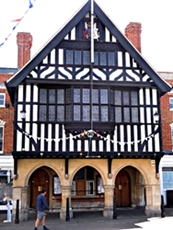
The south side of the square has a building with a ground level loggia and elegant half-timbering covering the upper storeys.  It looks mediaeval at first glance. But it is much too well-preserved to be that old.  This Victorian construction, now the Saffron Walden Tourist Information Centre, is also the Town Hall. The structure was built in 1761 and then extensively remodelled and enlarged in 1879 with money donated by George Stacey Gibson (1818-1883), a former Mayor of the town about whom I will soon reveal more.

The Saffron Walden branch of Barclays Bank is on the east side of the square and faces the library. The brick building that houses it, and which was designed by WE Nesfield (1835-1888) and built in 1874, is imposing. It has a large area of windows, each one framed by white masonry. A decorated lead frieze runs above the second floor and below the tiled roof with dormer windows and attractive brick chimney stacks. The main entrance is beneath a gothic arch, which is flanked by bas-relief depictions of birds with long necks and beaks, probably pelicans. Wooden doors near the entrance bear wood carvings that depict the letters “TG” and the date “1874”. Well-worn brass plates on the bank’s inner set of entrance doors read “Gibsons Bank”.

The first room that is reached from the entrance contains its original decorative features. These include a patterned stuccoed ceiling, a stone-framed fireplace with a colourfully tiled interior and fancy brass fire irons. There is wood panelling above the hearth and along the top of the windows in the wall separating this room from others deeper inside the building. The strip of panelling above the internal windows is richly carved with a variety of animals and birds. The rooms further inside the bank have been modernised to serve the requirements of current banking procedures.

Gibsons Bank, or to give it its full name ‘Gibson, Tuke and Gibson’, was also known as ‘Saffron Walden and North Essex Bank’, and ‘Saffron Walden and Bishop’s Stortford Bank’. It was established in 1824 by the Gibsons, a local Quaker brewing family. In 1863, Murray Tuke joined the surviving member of the Gibson family as a partner in the bank, hence the ‘TG’ we noticed on the door. That surviving Gibson was Tuke’s brother-in-law, George Stacey Gibson.

George joined the family bank in 1836 and became a partner in 1840. In addition to attending to the bank and innumerable civic duties, he became a renowned book collector and a serious botanist. In 1862, he published a flora of Essex. “This identified over 1,000 species of flowering plants and ferns, including four that were found only in Essex. “Flora of Essex” sealed Gibson’s reputation as a botanist and for the next century it was regarded as the definitive work on Essex botany” (see: http://www.hundredparishes.org.uk/). He was also the ‘discoverer’ of five flowering plant species that were new to Britain in the early 1840s.  

After his father died in 1862, George had to dedicate most of his time to the bank, his work on the Town Council, and charitable commitments, many of which related to the Society of Friends. He died at the Devonshire House Temperance Hotel in Bishopsgate Street, City of London, from inflammation of the kidneys.

In 1896, the bank, which had been associated with Fordham, Gibson and Co of Royston since 1880, became one of the twenty banks that joined together to form the Barclays Bank consortium. Another bank to join this group in 1896 was Goslings in London’s Fleet Street. Happily, Barclays have managed to preserve some of the original architectural features of both Gosling’s and Gibson’s historic premises. Even if you do not need to cash a cheque or deposit some money, visits to both of these formerly independent banks will provide a feast for the eyes.

PS: I have concentrated on the buildings in the marketplace of Saffron Walden, but must tell you, dear reader, that there is plenty more to see in the town including a fine parish church, many picturesque old buildings,  and the impressive ruins of a mediaeval castle.

Cook books I use

BOOK blog


I ENJOY COOKING. Although I like to improvise on a recipe, I enjoy looking at cookbooks. In addition to learning about food and eating traditions, they are a good place to look when embarking on food preparation. Today, one needs only access the Internet to discover an ocean of recipes, often describing numerous slightly differing ways of making the same dish. These recipes are posted by everyone from totally inexperienced cooks to highly acclaimed professional chefs. Although these on-line recipes might possibly eventually replace printed cookbooks, I will continue to value the printed volumes, cookbooks filled with recipes written by experienced and knowledgeable cooks. Here are ten such books that appeal to me.

AN INVITATION TO INDIAN COOKING by the actress Madhur Jaffrey (first publ. 1973), which I bought in 1982, guided me through my first forays into cooking dishes that originated in the Indian subcontinent. My copy falls open at the recipe for ‘lamb do pyaza’ The recipes are easy to follow and the results have an authentic flavour that impresses people for whom this kind of food is not exotic. Now, I have less need for this book because I am married to a good cook, who was born and brought up in India. She guides me through my curry creations and prepares the vegetarian dishes characteristic of her western Indian (Kutchi and Gujarati) heritage. However, if you are not as fortunate as me in this respect, I can heartily recommend this book.

MIDDLE EASTERN EASTERN COOKERY by the Armenian Arto der Haroutunian (first publ. 1982) was recommended to me by my friend, the author, art historian and first-class cook, the late Michael Jacobs. From this book, I learned a good way to cook fluffy steamed rice. A bookmark on page 252 takes me to an Iranian recipe, ‘Morgh Shekumpour’, chicken stuffed with dried fruit, which I used to prepare for guests in my bachelor days. Nowadays, my wife reaches for Arto when she cooks ‘Imam Bayildi’ and ‘Moussaka’. For some years, this book was hard to obtain, but there is now a new imprint that was produced in 2008 and is available on Amazon.

KEN HOM’S CHINESE COOKERY (first publ. 1984) was presented to me as a birthday present by Don and Eunice McMillan when I was a dentist in the Medway Towns in Kent. They knew I enjoyed cooking. Their gift could not have been better chosen because this cookbook is one of the best I have ever used. In my copy, there is a bookmark on the page that has a recipe for stir-fried minced pork, and the page with the recipe for beef in oyster sauce is stained with liquids splashed whilst preparing this dish. If you follow Ken Hom’s clear instructions closely, you cannot fail to produce Chinese dishes that almost (but not quite) rival those obtainable in many Chinese restaurants. So, if you are stuck at home as we have been during the pandemic lockdown, this book will help satisfy your cravings for Chinese food in its rich variety.

REAL GOOD FOOD by Nigel Slater (first publ. 1993) was recommended by our close friends Brian and Catherine Wilson, two enthusiastic cooks, both now no longer living. Beautifully illustrated with photographs of etchings and engravings of food ingredients, Slater provides easy to follow recipes with interesting commentaries. We reach for this book whenever we want to cook ‘Coq au Vin’. Covering many tastes, Slater includes two practical recipes for making curries.

THE FOOD OF ITALY by Claudia Roden (first publ. 1989) was presented to us by my sister when she was the chef at a successful Italian restaurant, which she and her husband owned in a village in the Emilia-Romagna province of Italy. Ms Roden is the author of many cookbooks, all of which are well-written and filled with practical easy to follow recipes. Her Italian cookbook is no exception. Our copy falls open at one page with pasta recipes from Campania, such as ‘Spaghetti alla ‘putanesca’’ and, also, at another page with a recipe for ‘finocchi gratinate’ from Emilia-Romagna.

Our copy of FRENCH PROVINCIAL COOKING by Elizabeth David (first publ. 1960) has yellowing pages and is well-thumbed. No serious cookery bookshelf should be without this evergreen classic of food writing. This is the key to the doorway of French cooking. In addition to the moderately easy to follow recipes, Ms David provides a wealth of interesting background information about the cuisine of France. Our copy has a bookmark for the recipe of ‘noisettes de ‘porc aux pruneaux’ and another for ‘champignons à la Greque’. If you wish to prepare one of my favourite French delights, onion soup, you need to look up ‘tourin bordelais’ in the index, and please observe that this ‘guru’ of French cookery states that the soup “…requires no stock.”: restauranteurs, please take note!

THE CUISINE OF HUNGARY by George Lang (first published 1971) was also recommended to me by Michael Jacobs (see above). It is a treasure amongst our huge collection of cookbooks from all over the world. I love Hungarian food and my copy of this book is now falling to pieces. The book contains not only ‘user-friendly’ recipes but also an interesting scholarly history of Hungarian food and cooking. The chapter on “Traditional Stews” is well-used in my copy. Some of its pages are becoming detached from the book. If you study this chapter you will be able to prepare superb stews and, more importantly, to distinguish a gulyás from a pörkölt, a paprikás, and a tokány. You will never again make the mistake of adding soured cream to your pörkölt or flour to your gulyás. Each recipe is well explained and easy to execute and is often followed by suitable variations.

We have only visited the much-vaunted River Café once and were disappointed enough not to want to give it a second try. However, the RIVER CAFÉ COOK BOOK by Rose Gray and Ruth Rogers (first publ. 1995) is superb. It contains delicious recipes with clear instructions and mouth-watering photographs. The recipes for ‘spaghetti al Limone’ and ‘radicchio alla griglia’ are two of many good reasons to possess a copy of this book.

THE ART OF ASIAN COOKING (RECIPES FROM THE MUSEUM OF FINE ARTS, BOSTON) compiled by Janet Sears (first publ. 1990) contains practical recipes supplied by a long list of contributors. Our favourites from this book include ‘Bang-Bang Chicken’ and ‘Roast Leg of Lamb’. The latter is a good recipe for a dish known in India as ‘raan’ of lamb.

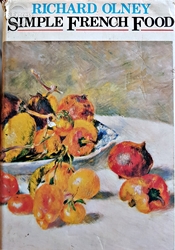
All the cookbooks described so far enable most people to cook exciting dishes without too much trouble or difficulty. My tenth book is not for the faint-hearted or even a reasonably experienced cook. Some of the recipes in the misleadingly named SIMPLE FRENCH FOOD, an erudite book by Richard Olney (first publ. 1974) are occasionally challenging. His recipe for hard-boiling eggs is half a page in length, for onion soup it is two pages, and ‘poule au pot’ four pages of fine print. But, this is nothing compared to Olney’s recipe for ‘bouillabaisse’ in his “A Provencal Table” (first publ. in 1995) that covers just over nine pages of print and has over thirty-three ingredients. But before you set out for the fishmonger, remember:

“Part of the bouillabaisse mystique resides in the persistent claim that no bouillabaisse is possible away from the Mediterranean coast …”

These ten books are but a mere drop in what is a vast sea of published cookbooks. They are vastly outnumbered by other cookbooks on our shelves: those that we have acquired over the years, but hardly ever look at. The ten books I have chosen are not necessarily to everybody’s taste, but they have satisfied us over the years.  I would love to learn of other books that readers have found to be useful in their kitchens.

Before ending this piece, I must mention the excellent recipe books by Josceline Dimbleby, published and sold by the Sainsbury food retailing company in the 1980s. Sadly, I have lost the few volumes of this series that I once owned. Lastly, here are a few other books of recipes that we consult when cooking:

“Traditional Cooking” by Caroline Conran

“Il Talismano dela felicita” by Ada Boni

“The Silver Palate Cookbook” by Rosso & Luckins

“Italian Cookery” by Elizabeth David

“The Classic Italian Cookbook” by Marcella Hazan

“A Book of Middle Eastern Food” by Claudia Roden

“Joy of Cooking” by Irma Rombauer

Camping under the stars

THE FIRST TIME I SLEPT in a tent was in 1972. With five other chaps including a friend from childhood and the now well-known Matthew Parris, we set out on a fortnight’s driving holiday around France. We did not stay in hotels. We camped in a large tent divided into two rooms. The inner one had its own fitted groundsheet. The outer one, which led to the inner, had no floor. So, it was necessary to lay out a separate groundsheet in this section. Without any prior knowledge or experience of camping (and without employing an ounce of common sense), I volunteered to position the outer groundsheet. I placed it so that the edge of one side of the sheet was just outside the wall of the tent.


adventure alps camp camping

]Photo by Sagui Andrea on Pexels.com]

At bedtime, I unrolled my recently purchased sleeping bag and wriggled inside it. I was assigned a position inside the outer room of the tent close to the wall mentioned above. I lay in my sleeping bag and felt every pebble and other irregularity of the earth beneath me through the bag’s meagrely padded material. Why, I wondered, was this uncomfortable bedding called a ‘sleeping bag’, when sleep appeared to be impossible inside it. Naively, I thought that a sleeping bag was supposed to encourage sleep. My fellow campers had all brought inflatable mattresses. I understood the reason but wished that someone had mentioned the necessity of these things before we had set off.

In the middle of the night, there was a heavy rainstorm with thunder and lightning. The inside of my sleeping bag began to feel cold. Soon, I realised that it was absorbing huge amounts of cold water. Then, I discovered why this was happening. My positioning of the outer ground sheet so that its edge was sticking out of the tent was the cause. Rain was hitting this exposed edge of a waterproof sheet, and then running into the tent.  After a sleepless night, my sodden sleeping bag was tied on to the roof of the car and it dried gradually as we sped along French D class roads (we avoided motorways) in the sunshine that followed the storm. When we reached the appropriately named town of Tonnerre, the name means ‘thunder’ in French, I purchased an inflatable mattress. Equipped with this, I fell in love with camping.

We had decided to have picnics for our midday meals, and to eat in restaurants every evening. My five travelling companions were far more energetic and adventurous than I was. It was important for them that we either had our picnic by a running stream (for cooling the wine) or at the summit of a slope (to enjoy a view). Reaching either of these ideal picnic locations usually involved climbing or descending sleep slopes. I was not good at either activity. I used to arrive at the picnic spot long after my companions had begun eating. So, after a while, I armed myself with a bag of sweets so that I could do something to assuage my hunger whilst struggling to reach a picnic spot.

The two-week camping trip in France whet my appetite for more camping experiences. The next trip I made was with my own one-man tent and rucksack. I went for a short walking trip in the Eifel Mountains in what was then West Germany. I disembarked from a train at Gerolstein and knew from my detailed map that I needed to walk past a certain hotel to find the footpath that led to my first night’s campsite. As I left the station, I asked a man the way to that hotel. He took one look at my heavily laden rucksack and recommended that I should go there by taxi. I had not the heart to tell him that not only was I going to walk to the hotel but then eight miles beyond it.

That initial encounter in a part of Germany famous for hiking was a foretaste of what was to follow. The Eifel mountains, full of former volcanic craters containing mirror smooth lakes, is criss-crossed, as is much of Germany, with well-made well-signposted footpaths. The signage on these wonderful  ‘Wanderwege’ is so thorough that you would have to be completely blind to get lost. Everyday, I left my campsite with my tent and rucksack and wandered along these paths to my next night’s stopping place. What I noticed was in accord with my brief meeting with the man at Gerolstein. The footpaths were largely unused apart from within less than a mile from a village. Near settlements, the footpaths were populated with men, often wearing lederhosen, and women out for a stroll. Almost all of them looked like professional hikers with proper boots and walking sticks often decorated with badges from places that they had visited in the past. However, none of them strayed more than a kilometre or so from their hotels and campsites. It was only I, who strode boldly through hill and dale from one village to another. My only companions were avian.  I came away from my enjoyable wanderings in the Eifel with my illusion that the Germans were a nation of keen walkers shattered. This did not put me off making another camping trip in West Germany in the late 1970s.

With my rucksack and tent in the hold of a Lufthansa domestic flight, I flew from Frankfurt-am-Main to Nuremberg, a short hop. At Nuremberg airport, I waited to reclaim my baggage, but it did not appear on the conveyor belt. After all the other passengers on my flight had left the airport, I reported my missing baggage to an official, who answered:

“That is not a problem. It will probably arrive in a few hours’ time on the next flight from Frankfurt. Just give me the address of your hotel and, surely, we will deliver it for you.”

“But, there is a problem,” I answered.

“And, what is that?”

“Well,” I replied, “My hotel is contained within my missing baggage.”

The official looked at me curiously. I explained:

 “I am planning to camp in Bamberg.”

“Ach, then you must wait for the next flight.”

I waited for about three hours in the empty airport accompanied only by the occasional security men with their Alsatian hounds at the end of stretched leads. My tent and other baggage arrived on the next flight, and I proceeded to Bamberg. I have no idea why I wanted to visit Bamberg, but I am glad I did. Many years later, I discovered that one of my mother’s ancestors, her great grandmother, Helene Springer, was born there in 1819.

From Bamberg, I travelled to Ljubljana in the former Yugoslavia. I made my way to an official campsite and pitched my tent. Then, I went into town for dinner. I ate a large and delicious fried breadcrumb-covered chicken breast stuffed with masses of molten cheese and salty ham. I returned to my tent, inflated my air-mattress, and settled down for the night. Two things troubled me throughout the night. The first was my digestive system that was struggling desperately with the extremely rich food I had enjoyed earlier. The second was incessant noise. The official campsite was located in a corner plot bounded on one side by a motorway, the main road from Western Europe to Turkey, and on another by a railway track, that which connected Western Europe with Bulgaria, Greece, and Turkey. Between the roar of the traffic on the road and the noisy rumblings of trains passing through the night, sleep was impossible. The next day, I flew between Ljubljana and Belgrade, where my friends Mira and Peter welcomed me at the airport. I had the impression that they were shocked that I had even thought of camping on my way to Belgrade.

Despite various hitches, I remained keen about camping, something my parents never admitted to having done. Some years later, I had several highly enjoyable camping holidays in northern Greece, but these I will describe on another occasion.


Love at first bite

I WAS A VERY FUSSY eater when I was a child. Because the first few weeks of my life were fraught with medical problems and then later I was a poor eater, my mother was extremely anxious about me, She allowed me to eat only what I liked and not what might have been good for me, but which I did not even want to try. In short, I was a spoilt child when it came to being fed. As I grew, I remained unadventurous gastronomically. We travelled to places like France and Italy where food is exciting and varied, but instead of exploring the wonderful foods that my parents ate in those places, I stuck to a boring diet of steak or ham (or, occasionally, Dover sole) and chips. Looking back, I regret turning down the undoubtedly delicious alternatives to these mundane foods.

FOOD Pizza Etna_800 BLOG

My parents were not keen on pizza. At least, I never saw them eat it even though we had holidays in Italy every year. They ate pasta and many other delicious Italian dishes. Naturally, given my unadventurous approach to food, I never ate it, at least not until I was about 17 years old. When I reached that age, I decided to spend a few days travelling alone in Italy whilst my parents stayed elsewhere. I used local transport to visit Volterra, Grossetto, and then reached the city of Orvieto. Believe it or not, I was extremely shy at that time and minimised speaking to anyone. Consequently, by the time I arrived in Orvieto, I was feeling miserably lonely. I felt to shy to enter restaurants and wandered around Orvieto from one eatery to the next, becoming ever hungrier.  Finally, I reached a shop that sold squares of hot pizza at a counter. The aroma coming from the pizza ovens was irresistible. I bought a square, took a bite of it, and … it was love at first bite.

Although she died forty years ago, people still fondly remember my mother’s cold rice salad, which was cooked white rice mixed with small specks of red and green peppers. Whether it was in my mother’s much praised salad or in the school rice pudding, I refused to eat rice when I was a child. This situation changed just before my 19th birthday. I was travelling around France with a friend who was studying at Cambridge University and four of his friends. One of these was Matthew Parris, who would later become a Member of Parliament and is now a frequently read columnist in the London “Times” newspaper. He was our driver. He drove us around France in an old car, which he had driven from Southern Rhodesia (now Zimbabwe) across Africa and Europe to England. One day we camped near Cerbère on the Mediterranean. As we were close to the Franco-Spanish border, we crossed it one evening to eat a meal in Port Bou (in Catalonia). Everyone wanted paella, which is a rice dish. For some inexplicable reason, I decided to try some. It was the first time that I ate rice. It was love at first bite.

During that trip around France, we used to eat our midday meals ‘al fresco’ at scenic spots. The money we saved by having picnics was spent eating more lavish meals at restaurants. Usually, everyone ordered meat (often beefsteak). One evening at a restaurant in Provence, I decided, unusually for me given my history of conservative eating tastes, to order something different. Without knowing what would arrive, I ordered an andouillette. I regretted my choice as soon as I cut what looked like a sausage. As I incised the skin covering the andouillette, little bits of what looked like rubbery material leapt out on to my plate. The thing was filled with chopped-up innards, and I was filled with disgust. Winding the clock forward a few decades, I now enjoy various kinds of innards (e.g. liver, sweetbreads, and tripe, but not kidneys) if they are prepared tastily.

My parents favoured Mediterranean cuisine. My mother was a keen follower of Elizabeth David, whose recipe books help bring the dishes of France and Italy onto British dinner tables. There were often bowls of olives available, especially on the many occasions that my parents entertained guests at our home. Having smelled these olives a few times, I decided that I was not even going to taste them. In 1975, I travelled across Europe to northern Greece with my friends Robert and Margaret. Every summer, they spent about six weeks camping by the seaside just south of the village of Platamon. Every evening while camping, as the sun began setting, we used to sit outdoors on folding camping chairs around a rickety table. Robert mixed himself gin and tonic and I joined Margaret with a glass of red (sweet) Martini. There was always a bowl of Greek olives on the table. On the first evening that I enjoyed an aperitif with my two friends, something inside me made me lean forward and pick up an olive. I popped it into my mouth … it was love at first bite. Since then, I cannot resist eating what I had avoided for a quarter of a century. My favourite olives are, just in case you are interested, the black Amfissa variety. They are plumper and juicier than Kalamatas, and at least as tasty.

In 1976, I began studying dentistry at University College London. My year had 50 students. We were a friendly bunch. One year, Jayne S, invited us all to her home in north London to celebrate her birthday. It was an afternoon event. The only food on offer was fried chicken from KFC (then, known as ‘Kentucky Fried Chicken’). There were large buckets of it, filled with legs, breast pieces, and wings: an ‘embarass de richesse’ of fried poultry.   As with so many foods, I had fought shy of trying this popular product. By then I was about 27 years old. I had eaten chicken, but never the crumb coated deep-fried variety. That afternoon at Jayne’s party, I do not know what over came me, but as soon as I saw the buckets, I seized a piece of chicken, bit into it, and …it was love at first bite. I would not go as far to say that KFC is my favourite chicken dish, but every few months I yearn for it.

Time passed, and my enthusiasm for trying new dishes and ingredients has grown exponentially. So much so, that once I was in a Chinese restaurant in London’s Chinatown when I spotted duck’s feet on the menu. I felt that I had to try them. I ordered a portion, and the Chinese waiter snapped:

“You won’t like them”

Defiantly, I responded:

“Bring me a plate of duck’s feet, please.”

“You will not like them.”

“Never mind,” I answered, “I want to try them.”

“You won’t like them”

“Look,” I said, “I want to try them. Even if I don’t like them, I promise to pay for them.”

The webbed feet arrived. They tasted quite nice, but I did not like their slimy texture.”

The waiter was right. I am glad I tried them, but was not … love at first bite.  

Eating out remembered

SEEING A PHOTO TAKEN  of La Cage Imaginaire, a restaurant in Hampstead has whet my appetite for writing about some memories of eating in this picturesque part of London long before the current restrictions on individuals’ movements and public gatherings.

COLIN BLOG

My parents used to like dining out at a ‘bistro’ in Church Row, a street lined with lovely old houses. The Cellier du Midi, as its name suggests was in a basement. Long before my mother died in 1980, they dined there often. My sister and I were never taken there. This made me curious about the place and for many years after they stopped going there, I thought it would be fun to try it out. It was only at the beginning of the 21st century that I did. My father’s teacher at the University of Cape Town, and later his colleague at the London School of Economics, Professor William Baxter (1906-2006) and his wife invited my wife and me to have dinner at the Cellier. It was Baxter, who in 1938 encouraged my father’s family to send him to England to continue his studies. I was excited about the prospect of eating in this restaurant at long last. Sadly, by the time we were invited there, the food was far from exceptional. It was far below the quality that would have been acceptable to my late mother, a discerning eater.

My parents ate Indian food occasionally. Their favourite Indian restaurant was the Shahbag in Rosslyn Hill, the continuation of Hampstead High Street. I ate enjoyably there once or twice with friends in the early 1970s but did not return for over 30 years. One evening, we drove up to Hampstead to attend a concert in a church on Rosslyn Hill. We arrived just before the performance was scheduled to start. I was driving. I dropped my wife and a friend at the venue, and then looked for somewhere to park. It took so long for me to find somewhere that I had to miss much of the concert. As the concert was near to the Shahbag and I was also hungry, I decided to miss the music and make a nostalgic trip to the Indian restaurant. I sat down and placed an order. Then, I waited and waited. While I was waiting, I looked at the food being delivered to customers on neighbouring tables. It did not look too appetising; by now, having visited India many times and eaten Indian food cooked in many Indians’ homes, I could distinguish between well and poorly prepared dishes. My appetite diminished. I looked at the time. It was nearly time to collect the rest of my party from the concert. I summoned the waiter and told him that as I was not prepared to wait any longer, he must cancel the order, which he did. I was disappointed that this experience had shattered my nostalgic illusions about this venerable establishment.

After my mother died, I began practising dentistry in a village near Gillingham in Kent. I lived down there during the week and visited my father most weekends. On Sundays, my father and I usually ate lunch out, often in Hampstead. One of our favoured places was the Cage Imaginaire, a tiny French restaurant at the end of Flask Walk furthest from Hampstead High Street. I always associate this restaurant’s name with that of a humorous film, “La Cage aux Folles”, which appeared in 1978. However, the restaurant was/still is a serious eating place. On one occasion when the waiter brought the cheese trolley to our table, I cheekily asked him to point out the cheese whose odour most resembled that of smelly socks. Without batting an eyelid or showing any disdain, he singled out a satisfyingly pungent French cheese.

Gradually, my father and I shifted our allegiance to an Italian restaurant, the Villa Bianca in Perrins Court. Although pricey, the food at this eatery never failed to satisfy. My father, whose mastery of the Italian language is good, enjoyed chatting with the Italian owner and his staff.

During my student days, all twelve years of them, I lived at my family home north of Hampstead, but visited it often. One place in which my parents would never have set foot but was popular with my friends and I was Maxwell’s on Heath Street.  This was Hampstead’s take on the American eating experience. Just up the street from the Pizza Express, Maxwell’s sold good hamburgers and milkshakes. Popular with more than one generation of northwest London’s younger set, this place opened in the 1970s and closed more than 40 years later. Incidentally, Maxwell’s pre-dated the arrival of McDonalds in London.

Almost across the road from Maxwell’s there was and still is a good Japanese restaurant, Jin Kichi, at which I ate several times more than 20 years ago. This was the first place I ever ate sukiyaki, a dish that involves cooking raw meat on a hot plate on the dining table.  Writing about this brings to mind another place, which was not strictly in Hampstead but close by in Swiss Cottage: Benihana.

I have only eaten at a Benihana restaurant once and that was long ago when the girl, who is now my wife, celebrated her birthday at the Swiss Cottage branch. We sat at counters surrounding an open space where our chef cooked, or rather performed, our meal. The chef would pick up a prawn, place it on a hot grill, and then toss it high up in the air, catch it, before placing it back on the grill. This performance of flinging food items up into the air and putting them on and off the grill was impressive in terms of juggling skills but disappointing as a gastronomic technique. By the time a much travelled, burnt, dead acrobatic prawn arrived on my plate, it had lost any appeal for me. However, a good time was had by all, except the prawns and other fragments of food we were served.

Returning to Hampstead proper, there is one restaurant that has been in existence since 1962. This is La Gaffe, which is on the same side of Heath Street as Jin Kichi, but higher up the hill. Although I have passed this place countless numbers of times, I have never entered it.

Heath Street leads down to Hampstead Underground Station and the start of Hampstead High Street. Despite vociferous objections from many of Hampstead’s ‘snobbish’ and ‘cultured’ residents, McDonalds managed to open a branch of their famous fast-food operation a few feet away from the station. It took the company twelve years to fight the objections to their opening.  Although I enjoy ‘haute cuisine’, I have the occasional yearning for a meal at Mcdonalds. The Hampstead branch was perfectly acceptable. However, after 20 years business in Hampstead, the company closed its branch there in 2013. It has been replaced by a branch of another chain, Le Pain Quotidien. I preferred its predecessor.

The Coffee Cup in Hampstead Heath Street is almost as old as I am. It first opened in 1954. Both externally and internally, this has not changed in appearance since my early childhood. When I was at school in the 1960s, this was the place to ‘hang out’. Oddly, I never did. In those days, the café had an exciting reputation. Maybe, I was not exciting enough to pay it a visit. Recently, I have ventured into this relic of the coffee bar era of Hampstead. I enjoyed a satisfactory, but not top class, espresso in its quaint interior, which looks as if it retains the original decor that it had when it first opened. I did not eat anything there, but I watched delicious looking pastries and English Breakfasts being served to other customers. Oozing with nostalgia, this place is as popular now as it was long ago.

Walk up either Perrins Court or Perrins Lane, and you will reach the southern part of Heath Street just before it continues to become Fitzjohns Avenue. On that short stretch of road, stands Louis Hungarian Patisserie. It was opened in 1963 by a Hungarian called Louis Permayer. Like the Coffee Cup, Louis has retained its original appearance. However, although it began as a place purveying Hungarian pastries and cakes, its current owners provide similar items, but not quite as tasty as what the former owner sold. That said, it is a quaint place to sit and chat over a hot beverage and a snack.

Louis has a special place in my memory. When I was an undergraduate in the early 1970s, I met one of my fellow students for a date one afternoon at Louis. My female friend liked the place and we have visited often since she became my wife some years after that afternoon. She recalls that in those long off days when we first met, Louis served coffee with a separate small bowl of whipped cream. Sadly, that tradition has disappeared and the charming Eastern European waitresses now working at the café look uncomprehendingly when you try to get a bowl of this with your coffee.

As soon as it is safe to roam around without risking one’s health excessively, we will head to Hampstead for a not brilliant but romantically nostalgic coffee at Louis, provided it has weathered the pandemic.


Photo of La Cage Imaginaire by Colin Hill


Ignorance is bliss

DURING MY UNDERGRADUATE student days in the very early 1970s, a good friend, who is now my wife, suggested that a group of us should visit one of the then very few Japanese restaurants in London. The one we chose was in St Christopher’s Place, close to Oxford Street.

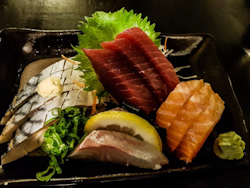
We decided to order sashimi, raw fish. I chose to have a plate of tuna sashimi. I had never eaten raw fish before, but after my first bite I decided this was a very superior way of serving fish. The sashimi was more than delicious. I would have loved much more than the five neatly cut pieces of tuna, which was the portion size. However, I could not afford that luxury.

The five bite sized pieces of tuna cost £7. And, in the early 1970s that sum could pay for a lot of food or other goods. For example, a Penguin paperback book cost 12.5 or 17.5 pence and a gallon (4.5 litres) of petrol was well under £1.

I was left hungry after our visit to the Japanese restaurant, and had to assuage my appetite at a fast food outlet.

Today, the price of Japanese food in London has dropped relative to what it was almost 50 years ago. Outlets like Itsu can provide a satisfying Japanese set meal for little more than £7. Better quality Japanese restaurants are justifiably more expensive, but not usually way out of reach, as was my plate of sashimi in St Christopher’s Place.

We used to visit a lovely Japanese restaurant in Holland Park side street. It was run by an elderly couple from Japan. It closed when they retired. For a year or two, we did not eat Japanese food in London.

One Saturday evening, we were watching a play at the National Theatre. It was not satisfactory. So, we walked out after the first act. We decided to drive to Ali Baba, an Egyptian eatery near Baker Street.

On the way, I thought that if we were to see a Japanese restaurant, we would stop and eat there. I stopped the car outside a Japanese restaurant near Bloomsbury and suggested to my wife that we ate there. She agreed and we entered the small eatery.

We looked at the menu and then looked at each other across the table. By chance, we had walked into a very (no kidding) expensive place. We were on the point of walking out when I said to my wife:
“Let’s eat here. I will enjoy it if I don’t see the bill. You check it, and I will hand over the card.”
Ignorance is bliss, and so was the food.

Pictures taken at Harima restaurant in Bangalore, India

The Gay Hussar

THE USAGE OF THE WORD ‘GAY’ to refer to same sex relationships dates back to the 1960s.

Before this time, back in 1953, Victor Sassie opened a Hungarian restaurant in Greek Street in London’s Soho district. It closed a few years ago in 2018.

Apart from serving Hungarian specialities, the Gay Hussar was a popular meeting place for politicians.

My father was often invited to meet his colleague, friend, and occasional co-author the Hungarian born (Lord) Peter Bauer at the Gay Hussar. Dad was not too keen on the fare at the restaurant because he found it too rich and a bit heavy. I only ate there once. I thought that the cooking in Hungary was better than that on offer in Greek Street.

The Gay Hussar was not the only Hungarian eatery in Soho. The other was Csarda in Dean Street. This closed long before the Gay Hussar. It is one of my few minor regrets that I was never able to eat at the Csarda.

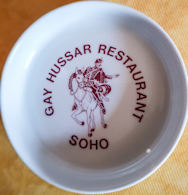
The ‘unearthing’ of an ashtray from the Gay Hussar is what prompted me to write about this no longer existing restaurant.

Foot and mouth

Wales 1 SMALL

Before she died in 2012, we used to make annual visits to a dear friend, whom I had known since my childhood, in South Wales. She used to live in London, but when she retired, she moved to a village in the Brecon Beacons, near the River Usk. We stayed in her cottage but were encouraged to leave her in peace from after breakfast until about four in the afternoon. We did not mind this because there is plenty to explore in the area and often the weather was good at the times of the year that we visited her.

In 2001, disaster hit Wales in the form of a vicious outbreak of foot and mouth disease. In order to prevent its spread, all footpaths and many open spaces were closed to visitors. This and the appalling rain that fell relentlessly during our visit, restricted what we could do while we were allowing our guest a few hours relief from her guests. We drove around the countryside not particularly having much fun.

One day, we arrived at a small town with a name I am unable to pronounce correctly:  Llanwrtyd Wells. It was lunch time. We parked outside a hotel near the town centre. The floor of the lobby was covered with a grubby, well-worn carpet. We were shown into an unattractive dining room. Our hopes for having a decent meal fell as we surveyed the room’s dingy uninviting décor. The sight of incessant rain falling outside did little to enhance the dreary mood that this unappealing room was inducing.

The hotel’s owner brought us menus. We asked what he recommended. He said “steaks” and showed us the large range of meats listed in the menu. We asked his advice about which steak to choose. Then, he did something that transformed the dingy place for us.

He gave us a ‘tutorial’ about the relative merits of different kinds of beefsteak and their tastes. The least tasty, in his opinion, was the costliest cut, fillet steak. Sirloin steak was, he advised us, tastier and cheaper than fillet. However, he considered that the tastiest cut was rib-eye. He explained that the latter was marbled with fine streaks of fat, and it was this that gives it its superior taste. We ordered it and discovered he was right. He regretted that he was unable to serve the local, and in his view far superior, Black Mountain beef. This was because of the problems connected with the foot and mouth outbreak.

Whenever I buy steak, I look for rib-eye first, and if this is not available, I go for sirloin. Whenever I think of beefsteak, I always remember that dreary eatery in Llanwrtyd Wells and its helpful landlord. For a long time, I could not remember in which town in Wales, we were given our tutorial about steaks. Recently, I discovered some photographs I had taken there almost twenty years ago. In one of them, there was a pub sign that read “Neuadd Arms Hotel”. Seeing this helped me discover where we had been.