The sunflower
Alive or press’d for its fine oil
Provides us much joy
HAVERHILL IS IN SUFFOLK, close to where this county’s border meets those of Cambridgeshire and Essex. It is not a place that is near the top of Suffolk’s list of attractions. It does not rival, for example, Lavenham, Bury St Edmunds, Long Melford, and Southwold, to name but a few. However, we chose to spend a couple of nights there. When exploring the town’s dining opportunities, one place caught my attention. It is a restaurant/bar named Baltic Amber.
On the establishment’s website (www.balticamberrestaurant.com/), there is a pair of sample menus. One is in English and the other in Lithuanian. The restaurant was established by a Lithuanian family in March 2020. Despite this, there are only a few Lithuanian dishes on the menu. When we visited, of the five Lithuanian dishes, one must be ordered a day in advance, and, sadly, another was unavailable.
On arrival at this modern place next door to a large Travelodge hotel, we were met at the entrance by two burly but extremely friendly uniformed security guards. One of them checked our names on a list which was attached to a clip board. We asked them if they were expecting trouble. They answered, half jokingly, that they were there to “… keep out the riff-raff to allow diners to enjoy their meals peacefully.” Then, we were led inside and met by a waitress, to whom the security guard said: “table 24”. We were greeted by the lady, who turned out to be Lithuanian and she showed us to our table. I practised the three words of Lithuanian, which I know, on her and later on the owner. Both seemed pleased with my efforts. The interior is modern and almost Scandinavian in design. The chairs at the tables were comfortable. Outside the restaurant, there are tables and chairs as well as a couple of fire-pits around which diners can be seated and kept warm.
We sampled Mead Vilnius, and aromatic spirit, rather like the Czech Becherovka. We also tried a Lithuanian beer. We ordered one of the Lithuanian dishes to share as a starter. Made of grated potatoes, which were fried and served with thick soured cream, they had a great resemblance to the Jewish dish, ‘latkes’. We followed that with Beef Stroganoff and Duck in an orange sauce. Both were above average both in quality and quantity.
The restaurant was full. The other diners, probably locals, were all having a good time, as did we. The place has good service and a pleasantly lively atmosphere. I am glad that I ‘discovered’ this place and would happily go again.
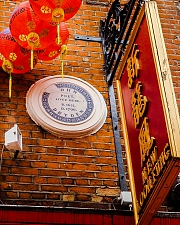
GERRARD STREET IS THE HEART of London’s Chinatown. We often visit it to eat delicious dim-sum and other dishes at our favourite restaurant, The Golden Dragon, which has both indoor and covered outdoor dining spaces. One of our favourite dishes, which was introduced to us many years ago by my sister, is steamed tripe with chilli and ginger. It might sound off-putting, but, believe me, it tastes wonderful. Our visits to Gerrard Street always include a visit to Loon Fung, a Chinese supermarket. This well-stocked establishment bears a commemorative plaque that I only noticed for the first time today (12th August 2021). Partially hidden by a string of Chinese lanterns, it informs the passerby that the poet John Dryden (1631-1700) lived on the spot where we purchase pak-choi, chilli sauce, black bean paste, and a host of other ingredients for preparing Chinese-style dishes at home. I suspect that Dryden was unlikely to have ever come across any of these exotic ingredients back in the 17th century.
According to the English Heritage website (https://www.english-heritage.org.uk/…/blue…/john-dryden/):
“Dryden lived at 44 Gerrard Street with his wife Elizabeth (c. 1638–1714) from about 1687 until his death in 1700. His years there were difficult: his conversion to Catholicism in about 1685 meant that he was unable to take the oath of allegiance after the Glorious Revolution of 1688. As a result he lost his position as Poet Laureate, one he had held for 20 years. He found himself in financial difficulties but remained highly active in London’s literary world.Dryden usually worked in the front ground-floor room of the house, and it was here that he completed his last play, Love Triumphant (1694), the poem Alexander’s Feast, or, The Power of Musique (1697) and translations such as The Works of Virgil (1697). In the preface to the latter, Dryden likened himself to Virgil in his ‘Declining Years, struggling with Wants, oppress’d with Sickness’…
… Number 44 was built in about 1681 and re-fronted in 1793, before being redeveloped in about 1901. At the same time number 43 was demolished, a deed described in the press as ‘a hideous and wonton act of vandalism’ …
… The plaque, though damaged, was immediately re-erected on the new structure. It is unique among surviving Society of Arts plaques in its colour – white, with blue lettering.”
Well, I can add nothing to that informative quote. So, ext time you wander along Gerrard Street do look for this and other reminders of the area’s history. It was a place where several other well-known writers and artists resided several centuries ago.
A FRIEND INVITED us to dine one evening at the exclusive Mosimann’s Club in West Halkin Street in London’s elegant Belgravia district. As it was dark when we arrived and I was too busy chatting with our host, I failed to notice the exterior of the establishment. Years later, I noticed that the narrow façade of this fancy eatery, named ‘The Belfry’, is that of a Victorian gothic church with a slender spire.
The church was being used by the Presbyterians in 1866, so wrote Edward Walford in the 1880s. The website of The London Metropolitan Archives catalogue reveals more:
“…a chapel was built on Lower George Street, called the Ranelagh Chapel. In 1845, on the death of the Methodist minister, the church joined the English Presbyterian Church and was renamed Ranelagh Presbyterian Church. The lease on the Lower George Street chapel expired in 1866 and the church merged with a Presbyterian Mission in West Halkin Street, Belgrave Square. The name Belgrave Presbyterian Church was adopted. The church was rebuilt in 1881. In 1923 the church moved to premises in Emperor’s Gate, Kensington.”
The former church is an unusual structure in that the end facing the entrance is considerably wider than the façade. As to when it was originally built, I am uncertain. Nikolaus Pevsner, the architectural historian, does not give it a mention in his extremely detailed guide to the buildings of the City of Westminster in which it is located. However, he does mention the chapel’s neighbour, to the left of it as you face the façade. Far more attractive than the chapel is the façade of its neighbour which is decorated in a neoclassical style. It has two porticos supported by pillars with Doric capitals. This building was built in about 1830.
Today, the Doric pillars flank entrances to a branch of Waitrose food stores. This shop also has an entrance on the street parallel to West Halkin Street, Motcombe Street. Thus, two temples of food stand side by side. If you cannot afford to dine in the former church, then you can console yourself and appease your appetite by acquiring something edible in Waitrose by stepping between the Doric pillars. In case you are wondering what we ate at Mosimann’s, I am afraid I cannot recall as it was so long ago, but I do remember enjoying it.
MANY PEOPLE ENJOY eating watercress. I quite like it, but it is not my favourite. I prefer eating its close and more piquant relatives: mustard and wasabi. As its name suggests, watercress is an aquatic plant that lives in a watery environment. It could almost be considered an edible water weed. This April (2021) we visited Ewelme, a small village in Oxfordshire, where watercress is cultivated in the river that runs through it. We had come to Ewelme to see its alms-houses and school, which were built in about 1437 and are still being used for their original purposes. I will relate more about these in the future.
On our way to the village, we met some cyclists, who told us about the watercress cultivation in Ewelme and recommended that we took a look at the set-up. I was interested to see it as I had never (knowingly) seen watercress growing. Also, I was curious because I have often walked past Willow Cottages on Willow Road in Hampstead. It was in this row of dwellings that Hampstead’s watercress pickers lived many years ago. They gathered the crop from streams flowing on nearby Hampstead Heath.
The name Ewelme is derived from the Old English ‘Ae-whylme’ meaning ‘waters whelming’ or ‘source of a stream or river’. In the early 13th century, the place was known as ‘Eawelma’. The spring after which the village is named is just north of Ewelme. Water from the spring that flows through the village is in Ewelme Brook, which is a short tributary of the nearby River Thames. It meets the Thames 1.2 miles upstream from Wallingford Bridge. Watercress grows best in alkaline water such as flows in Ewelme Brook, which rises in the chalky Chiltern Hills.
The watercress beds can be found in Ewelme near the northern end of the High Street, northwest of the attractive village pond that forms a part of the Brook. They were established in the 19th century. Watercress from Ewelme was taken to Wallingford from where it was carried further afield by train. In 1881, the idea of a rail link between Ewelme and Wallingford was mooted, but the line was never built. It was in that year that:
“…Smiths of Lewknor and South Weston, who were established at Brownings by 1881, and created cress beds along the roadside stream probably in stages. The business continued until 1988, with cress initially transported from Watlington station for sale in the Midlands, Covent Garden, and Oxford.” (www.british-history.ac.uk/vch/oxon/vol18/pp192-234)
The Ewelme watercress beds were abandoned in 1988 but restored by the Chiltern Society after 1999. This organization continues to look after them (https://chilternsociety.org.uk/event/chiltern-society-ewelme-watercress-beds-conservation-volunteers-6/2019-02-02/).
The watercress beds at Ewelme are a series of rectangular enclosures in a widened part of the stream. The cress grows, floating on the water in the enclosures. Pairs of enclosures are arranged sequentially like shallow steps in a staircase. The shallow water flows rapidly from one enclosure to the next through small gaps in the stone barriers that demarcate them. Swarms of watercress leaves on their stems almost fill each of the enclosures, deriving nutrients and water from the continuously changing water flowing through their roots. I imagine that picking the crop involves wading in the watery watercress beds.
Although Oxfordshire is no longer one of the major counties for watercress cultivation, what can be seen at Ewelme is pleasing to the eye. The counties where most of this plant is now grown include Hampshire, Dorset, Wiltshire, and Hertfordshire (https://en.wikipedia.org/wiki/Watercress). Alresford in Hampshire, near Winchester, is known as the UK’s watercress capital.
Although I am not keen on raw watercress, I prefer it served in a soup. My late aunt used to make a superb watercress soup using fresh watercress added at the last minute to a homemade vegetable stock. We have tried making it with meat stock, but this was not nearly as nice because the fresh taste of the almost uncooked watercress gets masked by the flavour of the stock. With this small bit of culinary advice, I will leave the watercress beds of Ewelme and wish you “bon appetit”.
THE AREA AROUND FITZROY Square was richly supplied with restaurants serving good Indian food during the 1970s, when I was studying physiology and then dentistry at nearby University College London. My Indian friends, all students, introduced me to the delights of the Diwan-i-am, the Diwan-i-khas, and the Agra restaurants around Fitzrovia, all of which served superb food that was far better than that which could be found in most other Indian restaurants both in and out of London. The two Diwans have long gone, but I believe the Agra has been revived. Another place to which my Indian friends took me to enjoy Indian cuisine was the self-service canteen of the Indian YMCA at the north end of Fitzroy Street.
Students from India, formerly British India, have been coming to study in London since the 19th century. Whereas now people of Indian subcontinental origin are commonly seen in the streets of London, in earlier years there were not so many of them about and their presence aroused both curiosity about them and prejudice against them. For the Indian students of yesteryear, London, its inhabitants and their habits, must have presented them with puzzling experiences. Mahatma Gandhi arrived in London in October 1888. After a few weeks, he took a room at 20 Barons Court Road. His landlady was an English widow, who had lived in India. Gandhi gave his reasons for choosing to stay in a family:
“It is generally thought desirable to live in families in order to learn the English manners and customs. This may be good for a few months, but to pass three years in a family is not only unnecessary but often tiresome…” (Quoted from “Gandhi in London” by James D Hunt).
However, lodging in an English family had its pitfalls. It was difficult to lead a regular student’s life; Indian food was not served; and most landladies knew nothing of Indians and their ways of life. Gandhi, like many other students from the Indian subcontinent moved into single rooms. In 19th century London, student hostels were a rarity, and those catering to Indian students were non-existent. At Oxford and Cambridge, Indians, like the rest of the students, were housed in college accommodation.
India House, one of the first (if not the first) hostels in London dedicated to accommodating Indian students was opened at 65 Cromwell Avenue in Highgate in 1905, as part of a protest against the unpopular Partition of Bengal and because its founder recognised the lack of places where Indian students in London could find a ‘home away from home’. It was financed by a wealthy barrister and Sanskrit scholar from Kutch (now a part of Gujarat), Shyamji Krishnavarma (1857-1930). As I have described in my book “Indian Freedom Fighters in London (1905-1910)”, India House soon became a nucleus for anti-British agitation by Indians aiming to free India from British rule. Unlike Gandhi, many of the freedom fighters who met and/or lived in India House, few of them were averse to employing violent methods to oust the British. Soon, it attracted the attention of the British security organizations. Indian students, in general, were regarded with some suspicion by these organizations because there was a fear amongst the British authorities that many of them might have been sympathetic to efforts to liberate India from British rule. There were other official fears such as Indians becoming involved in miscegenation. Things came to a ghastly head in 1909 when Madan Lal Dhingra, who was closely associated with India House, murdered a high-ranking colonial official, who had worked in India. India House was closed soon after this assassination was carried out.
Conspiracies, especially those being hatched in India House, led to the setting up of the Lee-Warner Committee in 1907 “…to Enquire into the Indian Students Problem in the United Kingdom”. One of its recommendations was to set up a hostel for Indian students, who had just arrived in London. Clearly, this was to be under the supervision and ideological control of the India Office and a ‘rival’ to India House in Highgate. It and several other government-approved organizations in London (e.g., the National Indian Association and The Northbrook Club, both established before India House) were designed to provide useful assistance to Indian students, but also to ‘keep an eye’ on them. At this point, I should point out that despite the fears of British officialdom, only a small percentage of students from India were involved in, or even remotely interested in, what was then regarded as ‘sedition’; most of them wanted to better their economic status.
On the 20th of October 1919, Kanakarayan Tiruselvam (‘KT’) Paul (1876-1931), first Indian National General Secretary of the National Council of YMCAs in India and 11 others met in London to explore the idea of establishing a hostel in London for Indian students studying in the city (“YMCA Indian Students Hostel: Triumph of Faith: 1920-2010” by John Varughese). KT Paul, born in Salem (now in Tamil Nadu), was an Indian Christian leader. In 1920, he published an article critical of the horrendous behaviour of the British in the Punjab (e.g., the Jallianwala Bagh massacre in 1919). However, despite this, he like many other Indians, believed that India’s best hope for the future was by maintaining links with western Christianity and contact with the British (https://en.wikipedia.org/wiki/K._T._Paul). The meeting decided to set up a hostel for 100 students, 75% of whom should be Indian, and for up to 500 non-resident, Indian members. Thus, the Indian YMCA in London came to be born.
The first home of London’s Indian YMCA (‘IYMCA’) was not in Fitzroy Street but in Shakespeare Hut, a now non-existent half-timbered building in Keppel Street near to the University of London Senate House. It was leased to the IYMCA by the Shakespeare Society. During WW1, the so-called hut was used for entertaining troops from New Zealand. In 1924, it was demolished to make way for the London School of Hygiene and Tropical Medicine (www.ymca.co.uk/about/feature/vintage-photographs-ymca-shakespeare-hut).
In 1923, the IYMCA moved out of the Hut and acquired the freehold of numbers 106-112 Gower Street, which was then fitted out to become a hostel with 40 rooms, a restaurant, a library, and recreation facilities. As had been the case in the short-lived India House in Highgate, the hostel in Gower Street hosted many meetings during which affairs relating to India and its future were held. Unlike those held in Highgate, the meetings were far less militantly revolutionary in Gower Street. Many students came to hear and discuss with a wide variety of prominent Indian leaders. In 1931, Mahatma Gandhi addressed members of the IYMCA in Gower Street. Other still well-known leaders of the Indian independence movement who made appearances at Gower Street included BR Ambedkar, Sarojini Naidu, MA Jinnah, Subhas Chandra Bose, J Nehru, and Pandit Malaviya, to name but a few.
On the 23rd of September 1940, three of the four houses that made up the IYMCA were destroyed by bombing. One student was killed, and five others injured. The hostel moved to temporary premises leased from the University of London at 25 and 26 Woburn Square. The booklet containing the hostel’s history records that in 1946 while inter-communal tensions were frighteningly high in pre-Partition India, the marriage of a Hindu to a Muslim woman was celebrated at the hostel. After Gandhi was assassinated in 1948, Henry SL Polak (1882-1959), donated 300 books to the hostel, the nucleus of what was to become its MK Gandhi Library. Polak had been a friend and associate of Gandhi when the Mahatma was in South Africa.
When University College London offered to exchange land, which they owned near Fitzroy Square, for the site of the bombed hostel on Gower Street, the offer was accepted and planning for a new hostel on its present site began. With finances coming from many sources in India and elsewhere, construction began, with Indian High Commissioner VK Krishna Menon laying the foundation stone in 1950. The building designed by Ralph Tubbs (1912-1996) was opened on the 24th of March 1953. Tubbs tried to harmonise his building with the fine architecture in nearby Fitzroy Square. I think he did a good job. Although of a completely different architectural style, it does not clash with the fine buildings designed by Robert Adam, which line two sides of the square.
Since the inauguration of the hostel in Fitzroy Street, it has been visited by many celebrities including Jawaharlal Nehru, Queen Elizabeth II, JRD Tata, Harold Macmillan, Indira Gandhi, the Indian National Cricket Team (1971), Harold Wilson, and Lord Mountbatten. Apart from visits by celebrities, the hostel and its extension (opened 2004) has been home to many students from India and elsewhere. Despite the Christian basis of the YMCA, the hostel caters for people of all religions. In addition to providing accommodation, both long-term and for short stays, the Indian YMCA canteen is open to all, when there are no restrictions imposed by the Government during the covid19 pandemic. It provides something closer to home-cooked food rather than fancy restaurant fare.
Had the Indian YMCA, or even the short-lived, discredited India House in Highgate, been in existence when Gandhi, a vegetarian, arrived in London in 1888, he would have had no difficulties with finding food to his liking from the start of his sojourn there. I have heard from people who have stayed in the hostel in Fitzroy Street that it is reasonably priced, conveniently located, comfortable but not luxurious. What more could one want?
THE HARD ROCK CAFÉ at 150 Old Park Lane in central London opened its doors to customers in June 1971. It has been a popular eatery and tourist attraction ever since then. Often, a queue of hungry customers can be seen at its doors. I ate an enjoyable meal there once soon after it opened. I was then an undergraduate at University College London. Since then, I have not entered this place again. Some years ago, when the Hard Rock Café opened a branch in what had been the Tract and Bible Society bookstore in St Marks Road in Bangalore (India) in 2007, we had an indifferent meal there under the watchful eyes of a huge poster portrait of the singer Tina Turner.
Few of the customers of the Old Park Lane branch of this American-style diner in Old Park Lane are likely to have raised their heads to see what is above the eatery. It is worth doing so to see the:
“Bracketed cornice over 5th floor, shaped gable end to attic storeys finished off by giant broken segmental pediment with green brick banding and figure sculpture crowned by ornamental obelisk-finial.” (https://historicengland.org.uk/listing/the-list/list-entry/1266274).
This green (and white brick) banding gives the building an eye-catching appearance. There is a crest between the two large bow windows on the fourth (American fifth) floor. This shield with three chevrons and ten circles bears the date ‘1907’.
The building, 149-150 Old Park Lane, was built in 1904 to the designs of the architects Thomas Edward Colcutt (1840-1924) and Stanley Hamp (1877-1968), who worked together as a partnership. So far, so good, but what was the building used for when it was built and why did it deserve such an elaborate and unusual pediment? Various descriptions of its architecture describe that it consists of ‘flats and chambers’ above ‘a former showroom, now restaurant’. One source (www.foodepedia.co.uk/restaurant-reviews/2010/nov/hard_rock_cafe.htm) states that the Hard Rock is situated inside a former Rolls Royce showroom. This is confirmed by Anthony Knight, who wrote (on a restaurant development website):
“Two shaggy-haired Americans living in London were fed up with the fact they couldn’t find US-style burgers in the capital so they started a small burger joint in a Rolls-Royce dealership. In 1973 they hosted their first live gig, with the singer none other than Paul McCartney” (www.elliottsagency.com/opinion/greateststories/).
The brand name ‘Rolls Royce’ has been used since 1906. The building at 150 Old Park Lane was constructed two years earlier. I have not been able to ascertain when the luxury car company first opened their show room in the current premises of Hard Rock Café.
Looking up at the pediment, there is a sculpture of a kneeling muscular man supporting a sort of obelisk on which there are interlinked letters, which look like ‘D’, ‘J’, and lower-case ‘l’. What this stands for remains a mystery to me. However, the crest mentioned above, is identical to that on the coat-of-arms of the city of Gloucester (www.british-history.ac.uk/vch/glos/vol4/pp368-371). This is appropriate as the building is known as ‘Gloucester House’.
The building housing the Hard Rock Café is not the first edifice on this plot to have been named ‘Gloucester House’. According to the authoritative book edited by Ben Weinreb and Christopher Hibbert, “The London Encyclopaedia”, the first Gloucester House, which like the present burger joint was located on the west corner of Old Park Lane and Piccadilly, was constructed in the early years of the reign of King George III (he was on the throne from 1760 to 1820). It was in this building that Lord Elgin (1766-1841) first exhibited the marble fragments that he had removed from the Parthenon in Athens. They were displayed here, where today burgers and milkshakes are consumed, before he sold the marbles to the nation in 1816. That year, Gloucester House was purchased by William Frederick, Duke of Gloucester (1776-1834), who despite being nicknamed ‘Silly Billy’ became Chancellor of Cambridge University. The last owner of the house was George, 2nd Duke of Cambridge, who died in 1904. Soon after his death, the old house was demolished. It seems that its successor, the present Gloucester House, was built almost as soon as the old one was demolished.
In 1850, when the old Gloucester House was still in existence, Peter Cunningham wrote in his “Handbook of London” (published in 1850):
“At the Duchess of Gloucester’s, at the corner of Park-Lane, once Lord Elgin’s, and where the Elgin Marbles were placed on their first arrival in this country, is a very beautiful carpet in sixty squares, worked by sixty of the principal ladies among the aristocracy.”
At that time, William Frederick’s widow, Princess Mary, Duchess of Gloucester and Edinburgh (1776-1857), who was born in Buckingham Palace, was residing at the house. After her death, the house was sold to its last owner.
It occurred to me that quite accidentally the Hard Rock Café with its main entrance on Piccadilly is aptly named given that it is located where some ‘rocks’ that occasionally give the British Government a hard time, The Elgin Marbles, were once housed. What gives the precious ancient marbles a sort of hardness is that from time to time the Greek Government wants to have them back in Athens. So, next time you bite into a burger at Hard Rock in Gloucester House, spare a thought for the Greeks who have lost their marbles.