Lunch on a leaf
Eat it using your five fingers:
An Andhra thali

Lunch on a leaf
Eat it using your five fingers:
An Andhra thali
AFTER A VERY DISAPPOINTING experience at a café we have often enjoyed when staying in Fort Kochi, we went to another eatery, which had been recommended by our friend Sharada S , when we visited Kochi at Christmas in 2019.
Our friend had introduced us to Oceanos. In this pleasant but unpretentious restaurant, we have enjoyed some of the best prepared sea food in Kochi. The dishes served at Oceanos are not only tasty but also authentic, by which I mean that they are not prepared to be ‘fine dining’ fancy; instead they give a good experience of genuine Keralan food.

Currently (February 2023), In addition to an á la carte menu, there is a seafood set lunch – a seafood thali. This included deep fried mackerel; clams (vongole) out of their shells; Aleppey fish curry; roasted prawn curry; sardine steamed in a banana leaf; Malabar paratha; rice; chhaas (buttermilk); and payasam (a local dessert). Every item was exquisitely prepared and tasted very fresh. This wonderful, faultless meal was 390 INR (£3.90) per head. We plan to explore the rest of the menu at Oceanos in the next few days.
Had it not been for the incompetent management at Kashi Art Café today, we would have eaten lunch there. However, as we had not been served our food for almost one our after ordering it, we asked for an explanation of the delay, and were told that there was a problem with the gas in the kitchen. Having been told that we would have our food “in about 10 minutes”, we walked out. If we had been served our food sooner, or been given an explanation without having to ask for one, we might have missed out on the superb lunch at Oceanos.
THE SHARAD BAUG HOMESTAY is in the extensive, luxuriant, verdant grounds of the Sharad Baug Palace. Badly damaged in the 2001 earthquake, the palace is a short walk from the excellent homestay. This accommodation is owned and run by members of the royal family of the former Kingdom of Kutch.
Close to the homestay in the middle of a field, there is another ruined edifice. This was formerly used as a guesthouse by important guests of the ruler, the Maharao. For some time, the poet Dara Shiko (1615-1659) hid from his brother (the future emperor Aurangzeb) in this building.
Near the ruined palace, there is a building, which was the last Maharao of Kutch’s sitting room and dining hall. Now, the building houses a small museum filled with exhibits relating to the royal Jadeja family. Amongst these, there are several items connected with the last ruler of independent Kutch when he spent some time in Norway.
After Kutch had joined India soon after 1947, its last Maharao, Madansinhji (1909-1991), was appointed India’s ambassador to Norway. There are photographs relating to his stay in Norway in the museum. There is also a Christmas card in Norwegian and a certificate issued by the Oslo Tennis Club. He served in Norway between 1957 and 1960.
While in Norway, Madansinhji was served by his chef from Bhuj, a member of the Yadav family. For many generations, the Yadavs have been chefs, specialising in non-veg food.

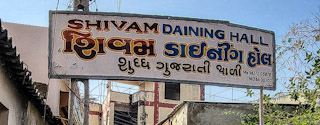
When we first visited Bhuj, in 2018, we were recommended to eat in a simple, small restaurant in the bazaar of Bhuj. Named Shivam Daining (sic), it serves very tasty pure vegetarian food. We returned to eat there several times during our recent (January 2023) stay in Bhuj. While chatting with its chef and his relatives, we learned that the man who produces the excellent food is a grandson of the Mr Yadav, who cooked for Madansinhji in Norway. Although the family have a tradition of cooking meat and fish, they do not offer it at Shivams because they rightly feel that there is little demand for non-veg food in the mainly vegetarian city of Bhuj.
Without knowing it when I booked the Sharad Baug homestay, it turned out that it and one of our favourite restaurants in Bhuj had at least one common connection, and that is Norway.
BANGALORE IS ABOUT 4800 miles from Paris (France). The French capital is noted for its gourmet delights, but on the whole the same cannot be said for Bangalore. One exception to this statement is Sunny’s restaurant currently located on Lavelle Road.
Arjun Sajnani created Sunny’s at least 25 years ago. Then, it was in a tall narrow house on a lane leading off Lavelle Road. The kitchen was on the ground floor and there were dining areas in the two floors above it. Often, Arjuna could be standing, working in the kitchen. Back in those early days, Sunny’s was one of Bangalore’s few suppliers of imported Western European cheeses, such as genuine parmesan.

Later, Sunny’s shifted to larger premises on the corner of Lavelle and Vittal Mallya Roads, next to a petrol filling station. The dining area was elegant.
For a brief period, Arjun ran a restaurant serving delicious Sindhi dishes in his original premises. Sadly, he decided to discontinue this interesting eatery.
Even later, Arjun shifted his restaurant to its present location – a two storey villa constructed about 20 years ago. The balconies on the upper floor are supported by stout carved timber pillars which remind one of pillars that you can see in much older traditional South Indian edifices. Diners can sit at tables within the building, or in the garden surrounding it, or on the first floor balconies. At lunchtime on Christmas Day 2022, every table was occupied.
At each of Sunny’s different locations, the food has been magnificent. As our daughter correctly said, eating at Sunny’s is as good as eating in a good Parisian restaurant. Also, Sunny’s Italian food (mainly pasta and pizzas) is above average in quality.
Arjun is an actor and director of theater and films, in addition to being a restaurateur. Dramatic productions require many skills. The same is the case for running a restaurant. Some of the required skills are the same for restaurants and for stage/screen. A restaurateur has to perform well both in the kitchen and the dining room to satisfy his or her clientele. Arjun achieves this successfully. If you have never been to Sunny’s, give it a try!
I SHOULD NOT BE TELLING you about a wonderful place in the heart of Panjim in Goa, but I will.

The Clube Vasco da Gama is situated on the first floor of a building beside Panjim’s lovely Municipal Garden. Founded in 1909, it occupied other buildings before it moved to its present site. With a pleasant decor, which evokes times long past, the Clube serves a wide range of drinks and superbly prepared Goan food. Today, we enjoyed baby squids stuffed with minced vegetable and chopped up squid, served in a tasty sauce. We also ate croquettes filled with a mildly spiced prawn purée. In addition, we consumed fried fish served in a very spicy sauce. Everything tasted wonderful, and as we will be in Panjim for several days, we will work our way through the menu.
We first came across the Clube in April 2018, when the weather was almost unbearable: extremely hot and humid. Quite by chance we came across the Clube and decided to enter it. We discovered that it has two small balconies, each overlooking the Gardens. Each of them has a small table with three chairs. All day long, there is a lovely, cooling breeze blowing across these two tables, making them the coolest places to sit in central Panjim (without resorting to finding places with air-conditioning).
It is because there are only two of these wonderfully positioned tables, it is with some trepidation that I am telling you about them. I do not want to turn up at the Clube to find them occupied by those who have just read this!
ONCE A CITY FILLED with lovely gardens and other verdant open spaces, Bangalore (Bengaluru) is growing alarmingly rapidly. So, public spaces that have been as yet saved from being built on are valuable amenities. One of these areas of greenery is the so-called Tivoli Garden, which is in the grounds of Airlines Hotel in the heart of the city.

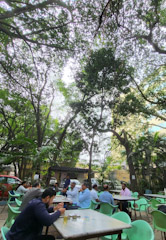
Known popularly as ‘Airlines’, the Tivoli Garden, a name by which it is hardly known, has tables and chairs set out in an open space, a clearing, surrounded by trees, several of them being elderly banyans.
Opened in 1969, the open air café and eatery is still supervised by a man who helped set it up two weeks before it opened all those years ago. Despite its rather untrendy appearance, Airlines is popular with Bangaloreans of all ages. Quite a few of them are students, but many are office workers. Very good South Indian filter coffee is served at Airlines. A wide range of South Indian vegetarian dishes is also served.
The coffee, other drinks, and food are prepared in the kitchen of the hotel. Waiters in white uniforms carry drinks and food across the car park from the kitchen, which is located at the far end of a dingy dining hall, to the garden seating area. Some customers prefer to have their orders served to them whilst sitting in their parked cars.
For my wife and me, Airlines has several attractions. One is the coffee. Another is the pleasant ambience under the trees. And yet another is nostalgia. My wife used to visit Airlines with her family in her late teens. And together with our daughter, my wife and I have been regular visitors to Airlines since when we married in 1994.
For several years, Airlines has been under threat of closure by the people who own the land. Over a decade ago, these people reclaimed half of the area occupied by the café. They built an ugly grey wall (rather like a Berlin Wall) to separate what is left of Airlines from what has now been built on. The supervisor, whom we have known for ages, assured us that as far as he knows the remaining part of the establishment will remain safe from redevelopment.
It would be tragic if Airlines were to disappear, not only because we love it but also it would be yet another example of how what was once a lovely garden city is becoming more and more of an urban jungle
KINGSLAND ROAD AND nearby in London’s Dalston area is rich in restaurants and other eateries serving Turkish food. Early in this century, “Time Out” magazine rated the Mangal Ocakbasi (now called ‘Mangal 1’) restaurant at number 10 Arcola Street as being one of London’s best Turkish restaurants. For those who do not know, ‘ocakbasi’ means ‘fireside’ and ‘mangal’ means ‘barbecue’ or ‘grill’. When we first went to Mangal, and for many years after that, there were tables alongside the long rectangular pit filled hot charcoal, upon which meat and vegetables are grilled. Recently, the restaurant has been redesigned and the grilling area is no longer alongside the tables.

The meat served is top quality. It seems far better than that served in the many other Turkish restaurants we have tried in London. Although there is a wide variety of main courses on offer, the range of ‘starter’ dishes on the menu is not as great as at some other restaurants. If it is starters and meze that you are after, the nearby Umut 2000 (on Crossway) is worth visiting. However, their main meat dishes are not nearly as tasty as those at Mangal in Arcola Street. Having said that, Mangal does serve an excellent freshly grilled aubergine hors d’oeuvre. Desserts are not available, but there are plenty of places along Kingsland Road offering a wide range of very sweet but tasty confectionery.
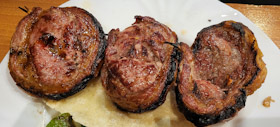
Our favourite dishes at Mangal are lokma, which is grilled rolled fillet of lamb, and yorgutlu Adana, which is pieces of semi-spicy Adana kebab in a yogurt and tomato sauce with lumps of Turkish bread. The lokma and other kebab dishes are served with generous quantities of fresh mixed salad containing many ingredients. As for drinks, you can bring your own alcohol or buy it from the restaurant. If I order a drink apart from water, I always go for Şalgam, which is a purple-coloured drink containing fermented turnip. This has a deliciously sour taste.
We first ate at Mangal in the early 2000s, when we attended a play in which one of my dental patients was acting. The theatre, The Arcola, was across the road from the restaurant, but has now shifted to larger premises on nearby Ashwin Street (close to Dalston Junction station). We loved the food at Mangal from the very first bite. We have been eating there occasionally ever since then, and the quality of the food has never once faltered. We have been there so often that the older members of its staff recognise us, welcome us warmly, and remember what we like eating. Even though this Turkish delight, frequently patronised by the artists Gilbert and George, is far from where we live in Kensington, it is well worth ‘trekking’ across London to get there.
FROM OUTSIDE IT looked like a ‘bog standard’ pub on Dartmoor. The kind of pub in which you would expect to find weary walkers and cyclists, all dressed in appropriate outdoor gear splattered with mud. The sort of place where the customers wear walking boots and thick woolly socks that reach halfway up their calves. An old-fashioned country pub with a roaring open fire. You know the kind of place, quaintly decorated with folks objects such as horse brasses, copper bed pans, Toby jugs and so on. A pub where you would find sandwiches and chips as the only solid fare. However, despite looking like the kind of hostelry just described, The Dartmoor Inn Merrivale is quite a different ‘kettle of fish’.
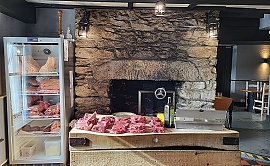
On stepping through its entrance door, the first thing you will notice is a large wooden butcher’s slap piled with raw steaks of various kinds and cuts: sirloin, rumps, chateaubriand, rib eyes, huge tomahawks, and other tasty chunks of meat. Behind this in what was formerly a fire place, there is a sophisticated charcoal grill for cooking these meaty offerings. A chef coats the meat with sprinkling of salt, oil, and herbs before grilling it.
The pub’s decor is far from traditional. It is simply decorated in a contemporary style with a few good artworks on the walls. The pub is owned by a local organic farm, which also has shops in Marlborough, Totnes, Tavistock, and London (in Selfridges Food Hall).
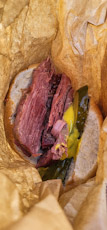
For our midday meal, we ordered a Ploughman’s Lunch contains amongst other things excellent cheddar and locally made ham, and a plate of superb barely cooked roast beef. The food could not be faulted. The staff were enthusiastic about food and were very attentive.
The Dartmoor Inn has reasonably priced rooms for overnight stays. We hope to return, spend the night, and sample the excellent looking steaks on offer.
Just as it is unfair to judge a book by its cover, one should not rate a pub by its external appearance.
RAAVI KEBAB BEGAN serving Pakistani and Punjabi food in the mid-1970s. It is located on Drummond Street, close to London’s Euston Station. This unpretentious eatery with barely any internal decoration except some mirrors with Koranic verses engraved on them in Urdu script, is next door to the Diwana Bhel Poori House. It was at the latter that we used to enjoy Indian vegetarian dishes when we were undergraduate students at nearby University College London during the first years of the 1970s. In those days, Raavi, named after the river that flows through the now Pakistani city of Lahore, did not yet exist. It was only in the early 1990s that a friend visiting from Bombay suggested that we ate with him at Raavi’s. When the grilled kebabs arrived at our table, it was love at first bite. We have been returning to Raavi’s ever since.
Yesterday (1st of September 2022), we made yet another visit to Raavi’s. As we sat down, I noticed a thick wad of photocopies held together with a bulldog clip. They were resting on top of a neatly folded shawl. Out of curiosity, I looked at the top sheet, which was a page copied from a book with annotations added in red ink. I looked more carefully and noticed that the printed text was in Italian. The page was headed “<De ingratitudine> Joanni Folci Niccolaus Maclavellus”. It is a chapter (‘The ingratitude of Joanni Folci’) from a book by Niccolò Machiavelli (aka Maclavellus), who lived from 1469 to 1527. The rest of the text on the photocopied page appeared to be a learned commentary on Macchiavelli’s chapter.
I do not know why, but I felt that Raavi’s was the last place I would expect to find scholarly papers lying about so casually. I associate the place, as do most of its many customers, with grilled meat and spicy masalas. I asked the waiter about the papers. He shrugged his shoulders and said that someone must have left them behind after eating, and that he had no idea whether anyone would return to retrieve them.
PARADISE IS A café in Great Dunmow, a small town in Essex. With several small eating areas and a cool breeze blowing through it, this comfortable eatery was a good place to eat lunch on a day when the air temperature was 32 degrees Celsius. Judging by its menu, which includes gözleme and shish kebabs, and the fact that the staff were speaking Turkish, it would be correct to say that Paradise is a Turkish run establishment.

Having noted that, it would be fair to say that this place is a well above average “greasy spoon caff”. However, the food is not at all greasy. In addition to food items usually associated with Turkey, Paradise offers the full range of English breakfast items, as well as wraps, burgers, sandwiches, and chicken curry.
One impressive feature of Great Dunmow’s Paradise, apart from the attentive and efficient staff and tasty food, was flexibility: we were able to order exactly what we wanted even if it was not on the menu.
It is always fun to discover reasonably priced, unpretentious places like Paradise. We will return there next time we are in the area.