WOMEN AS DEPICTED BOTH BY A MAN AND BY THEMSELVES AT TATE BRITAIN

I DO NOT KNOW whether it was deliberate or accidental that currently (until the 7th of April 2024) there are two contrasting (or, maybe, complementary) exhibitions on in the galleries of London’s Tate Britain.

On the first floor, there is an exhibition called “Sargent and Fashion”. It is a collection of paintings by the American-born artist John Singer Sargent (1856-1925), who was born in Florence (Italy) and died in London (UK). The aim of the show is, according to the Tate’s website, to show:

“… how this remarkable painter used fashion to create portraits of the time, which still captivate today.”

The exhibition includes some of Sargent’s portraits alongside a few of the items of clothing that his subjects wore whilst he was creating their portraits. In this well laid out show, the viewer gets to see that Sargent was an excellent painter, whose portraits manage to radiate the natures of the sitters’ personalities. I doubt that most of Sargent’s subjects would have been disappointed with the pictures he produced for them. Many of the paintings are portraits of women. Almost all of them were depicted wearing elegant clothes, and are superbly executed conventional portraits. They celebrate aspects of the ‘respectable’ (i.e., wealthy) society of his times.  

Beneath the Sargent exhibition, on the ground floor of Tate Britain, there is an exhibition showing how women in Britain broke out of their conventional male-dominated lifestyle during the 1970s and 1980s. Called “WOMEN IN REVOLT Art, Activism and the Women’s movement in the UK 1970–1990”, it is according to the Tate’s website, it is:

“… a wide-ranging exploration of feminist art by over 100 women artists working in the UK. It shines a spotlight on how networks of women used radical ideas and rebellious methods to make an invaluable contribution to British culture. Their art helped fuel the women’s liberation movement during a period of significant social, economic and political change.”

During a long part of the period covered by the show, Britain had its first female Prime Minister, Margaret Thatcher (in office from 1979-1990). Although she fought her way through hitherto male bastions to emerge as the country’s first lady Prime Minister and showed what women were capable of doing in the world of politics, she was not a feminist icon, as Natasha Walter wrote in The Guardian (online 5th of January 2012):

“Obviously Thatcher was no feminist: she had no interest in social equality, she knew nothing of female solidarity … We should never forget her destructive policies or sanitise her corrosive legacy. But nor should we deny the fact that as the outsider who pushed her way inside, as the woman in a man’s world, she was a towering rebuke to those who believe women are unsuited to the pursuit and enjoyment of power. Girls who grew up when she was running the country were able to imagine leadership as a female quality in a way that girls today struggle to do. And for that reason she is still a figure that feminists would be unwise to dismiss.”

However, as Baroness Burt of Solihull said in the House of Lords on the 5th of February 2018:

“… my next figure is 1979, which, of course, was the date when we got our first female Prime Minister. Personally, I would feel more inclined to celebrate this milestone if she had encouraged other women to come forward, to use some of the talented women that she had at her disposal. But, sadly, she got to the top and pulled the ladder up behind her, which is a great shame, because the whole point of having representation from all parts of society is to make for better government.”

As several exhibits on display at the Tate (until the show ends on the 7th of April 2024), Mrs Thatcher was intensely disliked by artists encouraging ‘female liberation’.

Before entering the exhibition, I was a little worried that all I would see was propaganda and other polemic material. Well, there was plenty of that kind of thing, and much of it was both interesting and often visually intriguing – sometimes quite witty. The exhibition, which is excellently curated, also includes many paintings, sculptures, videos, and other artistic items. These have mostly been created by female artists with whom I am not familiar. And all of them are both visually engaging and satisfying.   Several of these were of Indian heritage, and others have ‘black’ African heritage. There are also cases containing printed material that propagated feminist ideas. Included amongst these were a few copies of the magazine Spare Rib, which I remember seeing at friends’ houses many years ago. My future wife was one its readers. Published between 1973 and 1993, its aim was to challenge the traditional roles of females (of all ages) and to explore new ways in which they could engage in society. In fact, this was the aim of many – if not all – of the works in the exhibition.

We visited both exhibitions today (the 28th of February 2024), to experience the contrast between them. Both are excellent in their own ways and achieve what the curators intended. They are both well worth visiting. However, to my taste, the exhibition on the ground floor was far more exhilarating and inspiring, that the more conventional show on the floor above it.
It was the fashionable thing to do

I AM READING A most fascinating book at present (June 2023). Published in 1984, it is “Staying Power: The History of Black People in Britain” by Peter Fryer (1927-2006). In it, the author described how during the 18th century, it was fashionable for wealthy British people living in England to have at least one ‘black’ servant (or slave, in some cases) amongst their teams of domestic staff. Including a black servant in a portrait painting was believed to add to the perceived status of the subject being portrayed. Putting it crudely, just as sporting a Prada handbag or driving a Maserati is supposed to enhance the status of their owners today, exhibiting the ‘black’ servant did the same for the vanity of the wealthy in the 18th century. Sadly, many wealthy British people in the 18th century did not see the ‘black’ servants as human beings but as valued possessions or accessories.  

Today (3rd of June 2023), we paid a visit to Hogarth’s House in Chiswick. Located next to the busy A4 dual carriageway and the often-congested Hogarth Roundabout, it is now hard to believe that in 1749, the artist William Hogarth (1697-1764) bought this place to use as his country home. For, in those days this 17th century house was surrounded by countryside. The house and its garden are open to the public free of charge. The visitor gets to see a series of wood-panelled rooms, very much like those I have seen a friend’s 18th century house in the oldest street in Kensington. Unlike our friend’s house, the walls of the rooms of Hogarth’s former country place are lined with a large number the artist’s wonderful, printed works. Most of these depict scenes portrayed with many fine details. They express Hogarth’s satirical views of the life and behaviour of his contemporaries.

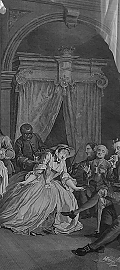
Some of the prints portray the lives of the poor and less well-off. A few depict life in ‘high society’. In several of the latter, there are a few black faces amongst the people in the pictures. All of them are obviously servants. In one of these prints, a black woman with her back facing the viewer can be seen attending to something at her white mistress’s foot. The lady is reclining, and she is looking up from a book propped in front of her. In another print, a black man is shown carrying a cup and saucer into the room filled with white people and there is also a black child playing with a small statue or toy. I examined all the prints on display and noticed that it was only those with scenes of the lives of rich people that included black people. The people in all the other prints were white only.

The depiction of black people with rich people in Hogarth’s satirical depictions of life in 18th century England helps to back up what I have read so far in Fryer’s book. That said, and I might not have noticed what I have described had I not been reading the book, Hogarth’s House is a delightful place to visit. It does not offer refreshments but the lovely café at Chiswick House is only a few minutes’ walk away.

A barber in Belgrade

YESTERDAY MY WIFE visited the hair salon for some routine hair maintenance. On that visit, her hair was treated by ‘G’, a hairdresser from Greece. He told my wife that he had had a salon in Athens and had come to London in March 2020 to try his luck here and to satisfy his dream to live in London. Nine days after he arrived in London, everything closed because of the covid19 ‘lockdown’, which put an end to hairdressing for several months. He was pleased to be back at work again.

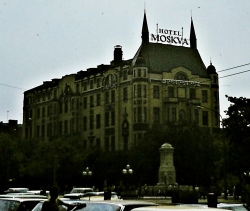
Hotel Moskva in Belgrade in the 1980s

G spent a great deal of time with my wife’s hair. She told me that he had sprayed various things on her head, far more than other hairdressers at the same salon usually used. When G was finished, he showed her the result in the mirror and took several photographs because he was pleased with his creation, as was my wife. G had used the various chemicals to give her hair more body than it had previously. He explained:

“You are now like beautiful Greek lady. You have style like Greek ladies. Much better than British, English like only too simple: no style.”

When my wife walked out of the salon, she looked as spectacular as ever, but even more so. Seeing the wonderful hairstyle that G had created reminded me of something that happened to me sometime in the 1980s.

I was staying in Belgrade, the capital of the former Yugoslavia. As was often the case, I stayed in the centre of the city with my good friend, the late ‘RR’. One day, he suggested that we should visit his barber and that I should have a haircut. The barber, who was clearly a good friend of RR, said that he was thrilled to have a British customer. I felt honoured to be the first of his British clients. He told me (RR was translating) that it was his ambition to work as a barber in London. I expressed the hope that his dream would be fulfilled.

The barber spent an hour and a half working on my hair, far longer than any other barber had ever taken to deal with my coiffure. Some years later, I attended a hairdressing school near Holborn (London) and volunteered myself as a model for a trainee. After more than two and a half hours, the trainee had barely done anything. Fortunately, the teacher came to my rescue and completed my haircut excellently and in only a few minutes. But, returning to Belgrade, my Serbian barber had not been idle during the ninety minutes I was in his capable hands.

Both the barber (‘бријач’ in Serbian) and my friend were very happy with my new hairdo. I looked quite different, but not improved as far as I was concerned. I felt that at least I had made two people happy by submitting my ‘Barnet’ (Cockney rhyming slang for ‘hair’) to the care of a ‘Dover Harbour’ (‘barber’) in Belgrade.

When we left the barber, I tried to run my fingers through my hair. It was impossible. All of the hairs seemed to be stuck together. My hair felt rigid rather than flexible. My hair had the texture of cheap dolls’ hair. A comb just bounced off the carapace that was covering my skull. The barber had used some kind of lacquer to render my hairstyle immutable. Not wanting to hurt my friend’s feelings, I made no complaints. However, as soon as I left  soon as I left Yugoslavia, I washed my hair more thoroughly than usual and managed to get rid of whatever had given my hair its unpleasant rigidity.

Taking the plunge

MOST COFFEE DRINKERS will be familiar with the cafetiere or French press (‘caffettiera a stantuffo’ in Italian and ‘Stempelkanne’ in German). The earliest versions of this were patented in the 1920s. For those not familiar with these devices, let me explain how they are used. Coffee grounds and hot water are introduced into an open topped cylindrical vessel, often made in glass but also in metal and plastic. After waiting for the coffee to brew, and people argue how long this should be, a plunger that snugly fits the opening of the vessel is placed on the surface of the hot coffee mixture. The plunger has a metal sieve that does not permit the passage of coffee grounds through it. This plunger is attached to a metal rod, by which pressure can be exerted to drive the sieve through the liquid towards the bottom of the vessel. As it moves downward, the coffee grounds become separated from the liquid (the brewed coffee) above it. Then the coffee, free of grounds, can be served.

BLOG CAF

In the early 1960s, the cafetiere became a fashionable way of preparing and serving coffee. My mother and her sister were quick to buy one for each of their homes. They were elegantly designed with clear glass vessels and shiny steel holders with black handles. And, the coffee they produce is good.

My mother kept using our cafetiere until disaster struck. It did not happen to her but to her brother-in-law. One evening after dinner, my uncle began plunging the filter through the hot coffee when something slipped causing the plunger to descend far too rapidly. As it shot down into the boiling hot coffee, the liquid shot up onto my uncle’s arm and caused him serious burns. Hearing of this unfortunate event, my over-cautious mother decided that far from being useful, the cafetiere was a potentially lethal weapon. So, our cafetiere was decommissioned, never to be used again. My uncle’s family continued to use their cafetiere(s) despite the accident.

Many years later, my wife and I were entertaining guests one evening. My wife had filled a large glass cafetiere with coffee and hot water and told me to plunge the filter whilst she sat down with our friends. Usually when you press the filter plunger into the brew, there is some resistance as the coffee grounds begin the reduce the flow of water through the fine filter mesh. On this occasion, I encountered some resistance as expected but then something unexpected happened. Each time I applied pressure and then released it, the filter disc began rising up towards the opening of the glass vessel. This happened repeatedly and it became increasingly difficult to depress the filter. It seemed as if the coffee was fighting back, pushing the filter plunger upwards.

Eventually, I managed to force the plunger down sufficiently and I served the coffee, somewhat mystified. After the guests had left, I examined our weirdly behaving cafetiere. I removed the plunger and found a deformed stainless-steel spoon amongst the compressed coffee grounds. The formerly straight stem of the spoon had become bent into a ‘U’ shape. I had applied sufficient pressure to the plunger to bend the spoon. I felt as if I had become Uri Geller, famous for his spoon bending tricks. Fortunately, and amazingly, the glass vessel of the cafetiere did not break or even crack.

Breakages are common amongst the glass vessels used in cafetieres. It is not the making of coffee that breaks them but dropping them on hard surfaces does them no good. We now use cafetieres with stainless-steel vessels. Not only do these not break but also many of them have double walls to help keep the coffee warm.

An Enquiring Mind

blahnik


People who know me well, or even not so well, would be surprised to learn that I greatly enjoyed an exhibition of designer footwear.

The designer is Manolo Blahnik (born 1942 in Santa Cruz de la Palma, Spain), whose father was Czech and mother Spanish. His rapid rise to fame in the field of footwear design began in the early 1970s. 

The exhibition called “An Enquiring Mind” is being held at the Wallace Collection in London until the 1st of September 2019 and should not be missed.

According to a leaflet about the exhibition, Blahnik has been long inspired by the  collection of diverse fine artworks (paintings, sculpture, furniture, porcelain, armour, etc.) on display in the rooms of the Wallace Collection. The shoes he designs, especially those on display at the exhibition, reflect the artistic finesse and skillfulness of the Collection’s permanent works.

The footwear in the temporary exhibition is tastefully arranged amongst the Wallace Collection’s artworks. If one dd not know that the shoes were designed and  made in the last 50 years or less, you would believe that they came from  earlier eras when most of the Collection’s artworks were created. The shoes mingle harmoniously with creations made several hundreds of years earlier. Not only that, but also they are displayed very artistically, making the temporary exhibition a joy to the viewer.

So, even if you, like me, are put off by the idea of an exhibition of shoes, please try to make it to this superb exhibition.

Thank you so much

When I was young in the early 1960s, if something was wonderful, we would have said it was “super”. Later, something super was described as “fab”. Moving closer to the present, something fab became described as “wicked”. Now, something wicked has become “awesome”, an overused word which I do not consider to be super in any way. In fact, it is used so much that I regard it as being wicked in the old sense of that word.

“THANK YOU SO MUCH” is also currently in frequent use. Call me a “fuddy duddy” if you wish, but I have problems with this expression. I have no difficulty with people expressing gratitude, but how much is “so much”? What is wrong with just “thanks” or “Thank you very much”?

Tact

nehru

I married in Bangalore in January 1995. A week or so before the marriage, I was introduced to Mr Krishnan, a tailor who worked in his home near to Cunningham Road in the heart of Bangalore. He was an elderly, dignified gentleman, and a good craftsman.

Mr Krishnan made me a suit for the wedding ceremony, a white Nehru suit with a high collar. a bandh gala. This kind of garment pre-dates India’s post-independence leader Jawaharlal Nehru; it derives from the Mughal years. The one that Mr Krishnan made me was precision fitting. I could breath in it, but it would not tolerate even the slightest increase in my girth. The same was true for a western style suit that he made for me at the same time.

A year later, we returned to Bangalore. Happiness in marriage and over-indulgence at meals had resulted in a change in my dimensions, notably an increase in my girth. We returned to Mr Krishnan with the suits he had made, which no longer fitted me. Fortunately, being a skilful tailor, Mr Krishnan had left plenty of material in the seams of the clothes in order to enlarge them.

Mr Krishnan measured me carefully, noting down my dimensions in a large book. When he had finished my wife asked him:

“Out of interest, how much has my husband increased in size?”

Mr Krishnan replied:

“Madam, I can not tell you that because I have lost your husband’s original measurements.”

Not only was Mr Krishnan a great tailor but also, he was a master of tact.