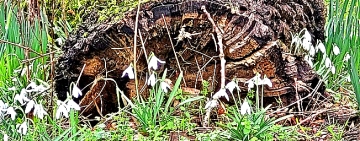
Skies may be grey
The white snowdrops are in full bloom
Spring is in the air

Skies may be grey
The white snowdrops are in full bloom
Spring is in the air
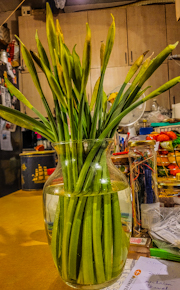
When British supermarkets begin selling bunches of daffodils at remarkably low prices, this is a good sign. It means that we are heading into springtime, and, I hope, longer days and better weather.
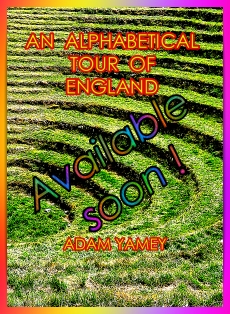
I AM AWAITING the arrival of a proof copy of my NEW BOOK about exploring lesser-known places in England to arrive from the printer.
After I have checked it for quality issues, it will soon be available for you to read.
SO, WATCH THIS SPACE!
A little introduction to the forthcoming book:
TRAVEL THROUGH ENGLAND FROM ABBEY WOOD TO ZENNOR, passing on the way places such as Abingdon Piggotts, Barcelona, Come-to-Good, Freshwater, Indian Queens, Little London, Long Melford, New York, Outgate, Queen Camel, Six Mile Bottom, and Veryan.
In this book, Adam Yamey describes a collection of mostly lesser-known places in England, many of which he visited during and after the period when covid19 pandemic restrictions made travelling abroad difficult. On the tour Adam will reveal aspects of life in England from before the Neolithic era to the reign of King Charles III. Adam’s profusely illustrated book contains historical as well as current information, along with personal observations. It will open your eyes to the delights and curiosities of England that can be discovered when you stray off the ‘beaten track’.
I am writing a book about visiting places in England. Here is a part of the introduction to the book. As it is only a draft, please feel free to comment on it, and also to let me know whether it would entice you to want to read further. What I have written is below this photograph.

This is what I have written:
There are plenty of remarkable places in England. For as the author Daniel Defoe (1660-1731) wrote in his “A Tour Through the Whole Island of Great Britain”:
“In travelling thro’ England, a luxuriance of objects presents itself to our view: Where-ever we come, and which way soever we look, we see something new, something significant, something well worth the travellers stay, and the writer’s care…”
What Defoe wrote so many years ago in the mid-1720s, is still true today. My book is about exploring a selection of places in England, especially many of them that are not on tourists’ usual itineraries. I have written about locations, which have intrigued me. Although some of them will not be familiar to most readers, I hope they will be found to be interesting. I have visited most of them since the onset of the covid19 pandemic in early 2020.
For about 10 years prior to 2020, we did not own a car. When the covid19 lockdown regulations began to ease a little in the UK, and greater freedom of movement was permitted despite the high prevalence of the infectious disease, we felt the need to roam around – to ‘escape’ from our neighbourhood. However, we had become uneasy about using public transport. So, in May 2020, when car showrooms reopened, we acquired a car, and began making day trips into the countryside. At that time, staying in hotels etc was not allowed. After a few months, it became possible to stay in hotels, guest houses, and so on.
Before the onset of the pandemic, we had, like so many others, chosen to holiday out of England, believing places abroad to be more interesting than our own country. During the pandemic, we were compelled to travel within its confines. And having travelled extensively in England during the last 5 years, we have discovered that the country is as least as interesting as many lands across the sea on the mainland of Europe. This book gives an account of some of the places we have been to in England since May 2020, and a few that we had already seen before the pandemic.
Just as many associate Spain with sunshine, plenty of folk think of rain when they consider England. Yet, ironically, there is currently a shortage of water in the country. This is partly because there has been insufficient rainfall and also because for years, governments have neglected maintaining reservoirs and other water sources and water companies have been prioritising profit over provision of water to their customers.

So when it rained today after many weeks of dry weather, we breathed a sigh of relief. But this will be short-lived, because what fell today was literally a drop in the ocean.
IT WAS UNUSUAL for my parents to take us on holidays at the seaside during my childhood. Mostly we went to cities, such as Bruges, Florence, and Delft, where there were plenty of artistic treasures to be viewed. Yet, one year when I was less than 10 years old, we spent a holiday at a hotel in a small place, Maidencombe, which is a few miles east of Torquay in Devon. All I can recall of this trip was staying in a country house hotel that had a beautiful flower-filled garden.
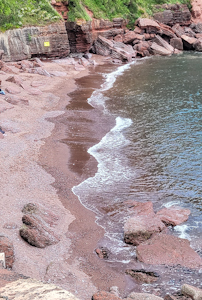
Yesterday (4 June 2025), my wife and I stopped at Maidencombe. I could not recognise anything, and I believe that the hotel where we stayed over 60 years ago has disappeared.
We followed signs to the Café Rio, which is reached down a winding staircase that clings to the slopes of a hillside overlooking a secluded cove surrounded by striated red rocks. The hillside is covered with luxuriant vegetation. The café is on a terrace above a small beach, where intrepid swimmers were enjoying the sea. We ate a light lunch on this terrace, and enjoyed the view.
I am pleased we visited Maidencombe but I can not stop wondering why my parents chose to go there instead of one of our usual culturally rich destinations. What or who influenced them to select Maidencombe? I will most probably never know.
THE FAMOUS SCULPTOR Elisabeth Frink (1930-1993) was a regular visitor to our family home in Hampstead Garden Suburb during the 1960s. During that period, I met her whenever she was invited home for dinner, but then I was too young to realise how famous an artist she had become. She was a good friend of my mother, Helen Yamey (1920-1980), who was also a sculptor. Elisabeth and my mother got to know each other when they were both creating art in the Sculpture Department of the St Martins School of Art, when it was in Charing Cross Road.
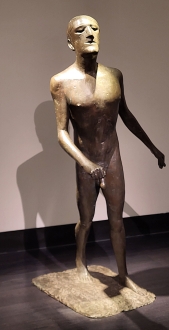
Today (15th of November 2024), I was reminded of my mother’s friendship with Frink when we entered Christie’s auction house in Mayfair. We always enter this place when we are passing near it to see some of the works of art that are on display prior to being auctioned. You never know what gems you are likely to see. Today, there was a small collection of British art created during the past 100 years. Amongst the works on display were two by Elisabeth Frink. There were also some pieces by Henry Moore (1898-1986) and by Barbara Hepworth (1903-1975). One of the works by Hepworth was a painting, the other two were sculptures. Each of these artists has become some of the greatest of 20th century British artists.
During the first half of the 1960s, my mother’s sculptures were chosen to be exhibited in prestigious exhibitions, mainly in London. In these various exhibitions, her work was selected to be exhibited alongside the creations of the three artists mentioned above, as well as other artists, who have now achieved fame (e.g., David Hockney, Paula Rego, Michael Ayrton, and Bridget Riley). Despite this, my mother’s artistic work is now largely forgotten. In my recent book about her, “Remembering Helen: My Mother the Artist”, I describe her life, her character, and consider why her art, which was judged worthy of display with the best artists of the time, has faded into obscurity.
[The book is available from Amazon: https://www.amazon.co.uk/REMEMBERING-HELEN-MY-MOTHER-ARTIST/dp/B0DKCZ7J7X/]
WHENEVER WE DRIVE to Cornwall, we make sure that we cross Dartmoor. Even if it means taking a detour along the narrow, challenging lanes of Devon, we always visit Combestone Tor. This geological formation, perched on the side of a hill commanding a panoramic view of well over 180 degrees, consists of several piles of enormous, weathered slabs of granite. Each pile has a few of these gigantic slabs piled one above the next. I have described how these impressive piles were formed in something I wrote a few years ago (https://adam-yamey-writes.com/2020/10/04/sculpted-by-nature/).

I cannot say why we find visiting Combestone Tor so satisfying. Is it the fine views over the moor and the countryside abutting it? Or is it the sculptural qualities of the rock formations? Could it be the peacefulness of the place? Even if there are other visitors at the Tor, one does not feel disturbed by them. Or is it the joy of seeing horses, sheep and cattle grazing near the stones? It is probably a combination of all of these, and other factors which affect one’s emotions, but are difficult to define. We have seen the Tor in appalling wind and rain and bright sunshine, and always feel glad that we have made the effort to reach the place.
MATTHEW KRISHANU WAS born in Bradford (UK) in 1980. His parents were Christian missionaries. His father was British, and his mother Indian. Their work took them to Bangladesh, where Matthew and his brother spent some of their childhood years. Matthew’s formal education in art took place at Exeter University, and then at London’s Central St Martin. Today, the 1st of June 2024, we viewed a superb exhibition of his paintings at the Camden Art Centre in Hampstead’s Arkwright Road. The exhibition continues until the 23rd of June 2024.

Many of the paintings on display include depictions of two young boys – the artist and his brother – often in a tropical setting that brings to mind places on the Indian Subcontinent. The paintings vary in size, but all of them are both pleasing to the eye and full of interest. His paintings of trees and other plants are impressionistic. Like many of the other pictures, they were inspired by the artist’s childhood in Bangladesh and later visits to India.
One room with several paintings contains works that must have been inspired by the artist’s memories of being brought up in a missionary family. The paintings in this gallery are depictions of the colonial legacy of Christianity in the Indian Subcontinent. Another indication of the artist’s upbringing in a Christian religious family setting is the appearance of small images of the Last Supper in several of the paintings, including those which are not specifically portrayals of religious environments.
Although, there is no doubt much that can be read into his paintings, Krishanu’s works are both approachable and engaging. I liked them immediately – as soon as I saw them. It is worth a visit to Arkwright Road to see this well laid-out exhibition.
THE TOWN OF HERTFORD is full of delightful old buildings. A house on the town’s Fore Street has a façade decorated with features that bring to mind Ancient Egypt. Known as the Egyptian House, it was built in about 1825 for the grocer JM Gilbertson, who was Mayor of Hertford in 1832. In many ways it resembles a building with an Egyptian style façade. which I have seen in Penzance (Cornwall), This was constructed in about 1835. Both of the house in Hertford and that in Penzance were built later than the now no longer existing Egyptian Hall London’s Piccadilly, which was built in 1812, and was the inspiration for the Egyptian Revival Style of the later edifices in Hertford and Penzance.
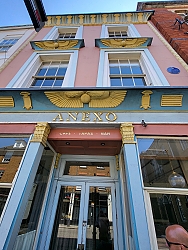
The Egyptian House in Hertford is colourfully painted, as is the building in Penzance. Sadly, the Egyptian Hall in Piccadilly was demolished in 1905 to make space for the construction of a block of flats. The Egyptian Revival Style became fashionable during the time of the Egyptian campaigns (end of the 18th century) in the Napoleonic Wars.
Currently, Hertford’s Egyptian House is home to Anexo – a “tapas restaurant and charcuterie bar”. It serves fare that would have been unknown in Ancient Egypt. I wonder what the Pharaohs would have thought about a place like this.
 yamey
yamey 