Roman recycling

TOLLESBURY IN ESSEX on the Blackwater River estuary is a village just over 5 miles southeast of Tiptree, a small town close to the Wilkinson jam factory and museum. This charming village, where a good friend of ours lives, has a venerable parish church, St Mary the Virgin.

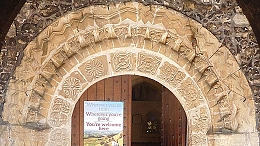
Roman bricks used to construct the arch above the south entrance of St Mary’s in Tollesbury, Essex.

In common with most of the parish churches we have visited during our extensive roamings around the English countryside, this church, whose construction had begun by the 11th century, contains a rich selection of interesting features. These are well described in a copiously illustrated booklet about the edifice published by the Friends of St Mary’s Tollesbury in early 2020. Amongst the interesting things we saw within St Mary’s, one of them particularly intrigued me: the incorporation of Roman bricks in the fabric of the church.

Archaeologists have uncovered the remains of a Romano-British cemetery near the village. They have concluded from their findings that in about 200 AD, there was a significant rural settlement located near Tollesbury at that time. Other remains are evidence that the district around the estuarine village has been the site of human activity since the Neolithic era (4000-2000 BC).

As if to prove that recycling is not simply a recent trend, the church of St Mary incorporates bricks made whilst the Romans occupied England. These can be seen clearly above the south doorway within the church. The 11th century arch above this portal is made entirely of recycled Roman bricks. Some more brickwork made with Roman bricks can be seen exposed above the gothic archway in the western wall of the nave, which is also part of the late 11th century bell tower.

Although the re-used Roman bricks have been ‘highlighted’ in St Mary’s, the structure of the parish church in the nearby village of Goldhanger also contains recycled Roman bricks. Making bricks at the time when these churches were built would have been far more laborious than making bricks using today’s industrial techniques. So, re-using bricks that had already been made would have been very sensible.

Where gold flowers grow

THE COUNTY OF ESSEX is immediately east of Greater London. Parts of it are heavily built-up and not particularly attractive. The rest of the county is both varied and delightful to explore. So near to London, many parts of it retain rural characteristics, which one might not believe existed so near to the huge city of London. Recently, we visited Goldhanger, a small village close to the River Blackwater’s estuary.

Sculpture by Horace Crawshay Frost in the parish church in Goldhanger, Essex

The village near Maldon (famous for its salt) has been known as ‘Goldanger’, ‘Goldangra’, and ‘Goldangre’. According to Maura Benham (1913-1994) in her history of Goldhanger, the place’s name has always had ‘gold’ as its first part. The gold probably referred to a yellow flower. The second part might either originate in the word ‘hanger’ meaning hill, or ‘anger’ meaning grassland. It is not known exactly when the settlement, which is at the head of a small creek, was first established but there is archaeological evidence suggesting it was already inhabited in the Iron Age around 500BC. One reason for the village’s existence might have been for making salt from seawater. The local saltworks came to an end in the early 19th century.

The heart of the small village is The Square, where Church, Fish, and Head Streets meet. We ate a hearty, tasty lunch in the Chequers Inn. This was listed as the only alehouse in the village in a document dated 1769. It might have been used by smugglers long ago. The building housing it has been used as a pub for at least 250 years. Prior to that it was built about 250 years earlier as a residence. Constructed in stages, the earliest part was probably built in 1500 (http://past.goldhanger.org.uk/Chequers.htm#:~:text=The%20Chequers%20has%20been%20an,landowner%20as%20his%20private%20ressidence.) Inside, the pub, built on several different levels, with an abundance of ageing timber beams, has an authentic ‘olde worlde’ atmosphere and appearance.

The pub is the southern neighbour of the attractive St Peter’s parish church. According to the architectural historian Nikolaus Pevsner, the church originated in the 11th century and some evidence of this can still be observed. The south aisle was built in the 14th century and the west tower in the 15th. Pevsner makes special mention of a tomb chest with a black stone cover plate which has indentations where several brasses used to be. This stands in the South Chapel, which was built by the local Higham family, whose farm was in Goldhanger, in the early 1500s.  The chest tomb contains the remains of Thomas Heigham who died in 1531,

Although the church has many other interesting features to enjoy, I will mention only one of them. Located close to the Higham tomb, I noticed a curious wooden carving, a sculpture depicting two forearms with hands clutching or gripping something I could not identify. This was sculpted by Crawshay Frost. According to a short history of the church, this artwork was dated “1960s”. Whether that means it was placed in the church then, or created then, is not stated. I had not encountered the name Crawshay Frost before visiting Goldhanger. A fascinating web page (http://past.goldhanger.org.uk/Frost.htm) described a notable inhabitant of the village, Horace Crawshay Frost (1897-1964), who lived in Fish Street between 1926 and 1964.

Horace graduated in History at the University of Oxford. During WW1, in which he suffered injuries (both physical and psychological), he took many photographs, some of which are now kept in London’s Imperial War Museum. After leaving the army in the early 1920s, he taught at a school in Brentwood (Essex). Soon after that, he moved to Goldhanger, where he gave private tuition to the children of the curate. In Goldhanger:

“… he involved himself in local history, archaeology, art, sculpture, music, ornithology, horticulture, photography and writing, and also established a reputation as a local philanthropist of extreme intelligent. Whether it was because he was sufficiently wealthy, or because he was too ill, or both, it appears that for most of the time he lived in the village he did not engaged in any kind of full time employment, but rather he spent his time enthusiastically pursuing various hobbies and pastimes, and paid others to help him with them.”

On the basis of this information provided on the webpage, I feel that it was Horace, who produced the sculpture I saw in the church. Further evidence of his interest in wood carving comes from a book, “Celebration”, the autobiography of Graham David Smith. He recalled visiting Horace in Goldhanger in 1955, during the time of the so-called Mau-Mau Uprising in Kenya. Smith wrote:

“We had come to work and earn money. Mr Frost had a perfect job for us. Laid out in front of the open kitchen door were several mahogany beams ordered through local woodyards and a large satchel of finely honed steel chisels from Harrod’s. Mr Frost, deeply disturbed by any stories about war, had come by what he thought would be a perfect solution of that awful Mau-Mau business in Kenya: art to soothe the savage breast. To get the Africans started, he had sketched out the wood scenes and motifs he thought conducive to a peaceful and pastoral life.”

On our way from the church back to the car, I noticed three pumps on Head Street, near to the Chequers pub. Two of them, standing side by side, were old-fashioned petrol pups bearing the ‘Pratts’ logo. These well cared for objects were installed in about the 1930s, but maybe originally in Church Street. Opposite these and next to the village car park, there is another pump. This was installed to supply water.

The water pump is above a water well that was dug in the hot summer of 1921. According to a notice affixed to the hand operated pumping mechanism, the well is 70 feet deep “with a further 100 feet of artesian bore, making 170 feet in all.”  In 2012, to celebrate the Diamond Jubilee of Queen Elizabeth II, Goldhanger Parish Council restored both pump and well to working condition.

Once again, a brief outing to rural Essex, albeit a small part of it, has proved to be most interesting.

A back to front church

JUST TWO AND a half miles north of Heathrow Airport and one mile north of Harmondsworth lies the former village of West Drayton, formerly known simply as ‘Drayton’, now part of the London Borough of Hillingdon.

Both the mainline railway and the Grand Union Canal run through West Drayton. During the second half of the 19th century, this settlement in middle of flat agricultural land was also home to grain mills, brickworks, ropemaking, and docks connected with activities on the canal. There is still some industry in the area, but now it is mainly residential.

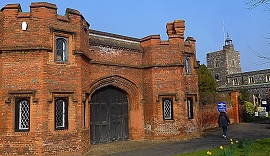
Tudor gateway and St Martins Church at West Drayton

West Drayton’s parish church of St Martin was first mentioned in writing in 1181. The present building, with a flint covered exterior and a bell tower topped with a small cupola, mainly dates from the 15th century. Whereas most of the building is 15th century, at least one part of it, a two-arched piscina in the southeast corner, is 13th century. Currently, the church is entered through a modern doorway at the east end of the south wall instead of the older south entrance near the west end of the southern wall. On entering the church, I felt immediately disoriented. This is because, as I realised quickly, the church is arranged back to front. The high altar is at the west end of the church almost at the base of the bell tower and the pews face in that direction. Some years ago, the altar was moved from the chancel, where it had been for many centuries, to the western end of the nave. The reason for this, the vicar and her husband told me, was that it was done so that nobody in the congregation would have a restricted view of the altar during services. However, the attractively carved 15th century stone font stands where it was before the position of the altar was reversed: in the southwest corner of the nave. Another curiosity in the church is the hanging pyx suspended above the high altar. This gothic revival style container (based on the appearance of a mediaeval pyx in a church in Suffolk), which holds the sacrament and can be lowered during services, was designed by Andrew Low, manufactured at Pinewood (film) Studios, and placed in St Martins in 1975.

This oddly arranged church contains several carved stone memorials on its interior walls. Many of them commemorate members of the De Burgh family. Their bodies and those of the Paget family are sealed in a vault below what was originally the chancel.

With only a brief interruption during the 17th century, the manor and estate of West Drayton was owned by the Paget family between 1546 and 1786. In 1786, Henry Paget (1744–1812), 1st Earl of Uxbridge, sold the manor to a London merchant Fysh Coppinger (died 1800), who changed his surname to De Burgh, that of his wife. His memorial is in the church. Henry Paget’s eldest son, Henry William Paget, 1st Marquess of Anglesey (1768-1854), lost his right leg during the Battle of Waterloo (1815). It was replaced by a wooden prosthesis. His amputated leg was buried in Belgium, whereas the rest of his body was interred in Lichfield Cathedral.

The church and its small cemetery are enclosed within an old wall with Tudor brickwork. This is part of a large wall, which once enclosed private grounds. Following the passing of an Act of Parliament, Sir William Paget (1506-1563), at one time secretary to Jane Seymour (c1508-1537), one of the wives of King Henry VIII, enclosed his grounds with a brick wall in the 1550s. The Act stipulated free public access to the church.  Parts of this wall can be seen around the churchyard and alongside Church Road. The Paget family built a mansion on the land that had been enclosed. This building, West Drayton Manor House, was demolished in 1750 by the then Earl of Uxbridge. Although the spacious brick mansion, where the Paget family once lived, is no longer, the red brick gatehouse to the grounds still stands. According to Bob Speel (www.speel.me.uk), this Tudor grand entrance with two octagonal turrets was built in the 16th century. Close to the old gatehouse, there is a newish housing estate, a small enclave called Beaudesert Mews, which was built on land on which at least a part of the long-since demolished manor house might have stood.  The name ‘Beaudesert’ relates to the above-mentioned Sir William Paget, who had the title ‘1st Baron Paget de Beaudesert’.  

By the 19th century, the De Burgh family were living in Drayton Hall, an early 19th century building, which now serves as Council Offices and is surrounded by Drayton Park, near the church. A new building attached to it contains offices of at least one commercial enterprise. West Drayton retains a rectangular grassy space, The Green, once the village green. Several of the buildings around it look as if they were present well before the area was engulfed by London’s western spread. Unlike nearby Harmondsworth and Longford, West Drayton is not under threat of suffering demolition if or when Heathrow Airport is expanded.

Threatened by Heathrow Airport

THE PARISH CHURCH of Harmondsworth is about 1.7 miles northwest of Heathrow Airport’s Terminal 1, yet it feels as if it were much further from it, maybe in the heart of the countryside. What was once a small village in rural Middlesex has now been engulfed by London’s westward spread. However, the old village green retains a certain rustic charm.

The name of the place derives from the name of a person, ‘Hermode’ or ‘Harmond’ and the Anglo-Saxon word ‘worth’ meaning a farm or enclosure. Set in what was once fertile farmland that provided corn and green crops for the London markets, it is now a mainly residential area. Writing in 1876 in his “Handbook to the Environs of London”, James Thorne remarked:

“The village of Harmondsworth is small and not remarkable …”

Writing 146 years later, I must disagree. The place is remarkable for retaining some of its rural atmosphere. The village green is surrounded by a row of picturesque old cottages, a slightly newer-looking village store (Gable Stores), and two pubs (The Crown and The Five Bells [formerly ‘The Sun’]), and the entrance to the churchyard of the parish church of St Mary.

The vicar of St Mary kindly unlocked the church for us. According to a history of the church by Douglas M Rust, it is probably located near the site of a pagan place of worship on one of the quintarial lines defined by Roman surveyors’ landmarks. The archaeologist Montagu Sharpe, writing in volume 33 of the “English Historical Review”, published in 1918, observed:

“Two curious discoveries came to light after the quintarial cross-lines had been drawn, making each pagus appear like a gigantic chequer-board. The first was, that 47 out of 56 mother churches of parishes in Middlesex were situated upon one or other of these lines, the apparent explanation being that Romano-British chapels (compita) adjoined the principal rural ways, which were designed to follow the quintarial lines. In the next age these little edifices were adopted by missionaries for Christian worship, following the astute and well-known direction of Pope Gregory to utilize the pagan sacra where the people had been accustomed to assemble. If so, then such sites have been associated with public worship, first pagan, then Christian, for nearly 2,000 years.”

Be that as it may, the present parish church in Harmondsworth was constructed from the 12th century onwards, much of it before the 16th century. In the 18th century, a cupola was added to the bell tower. In the following century, repairs and restoration was undertaken. The south entrance has a decorated carved stone Norman archway. The carved capitals of the pillars on the south side of the nave are 12th century. The westernmost pillars on the north side of the nave are 13th century, whereas the four pillars to the east of these are 16th century. The chancel, which is supported by the newer pillars was constructed later than the nave. Where the newer part was joined to the older, there is a discontinuity in the stonework of the arch that joins the nave to the chancel: the two halves of the arch do not match each other. The pointed arches along the north side of the nave are Perpendicular gothic in style, whereas those north of the chancel are a Tudor design.

The tower of the flint covered church used to be the tallest building in Harmondsworth until the control tower at nearby Heathrow Airport was constructed, Douglas Dark mentioned of the church:

“Little did the early builders realise that their church was later to become the parish church of the manor where many visitors to Britain first arrive.”

A few yards northwest of the church, there is another treat awaiting visitors to Harmondsworth. This is the Harmondsworth Barn, which was constructed 1425-27 on land bought in 1391 by William of Wykeham (c 1320-1404), Bishop of Winchester, to endow Winchester College. It is now maintained by English Heritage, from whose website I gleaned the following information:

“Used mainly to store cereal crops before threshing, it remained in agricultural use until the 1970s. At 58 metres (192 ft) long and 11.4 metres (37 ft 6 in) wide, the barn is one of the largest ever known to have been built in the British Isles, and the largest intact medieval timber-framed barn in England.”

The barn’s main purpose was to store locally grown cereals (e.g., wheat, barley, and oats) and was still in use during the 1970s. Its interior is a fine example of well-preserved mediaeval carpentry. The barn is located on the eastern edge of what was once Manor Farm, through which a stream of the River Colne flowed. The erstwhile farm covered the probable site of a long-since demolished Benedictine Priory.

James Thorne noted that the barn had once been ‘L’ shaped, rather than rectangular as it is today. The part of it that had made it shaped like an ‘L’ was taken away and relocated elsewhere. To quote Thorne:

“This wing was taken down about the same time as the Manor House and rebuilt at Heath Row, 1 ½ miles S.E. of Harmondsworth church. This, which is known as the Tithe Barn, exactly resembles the Manor Barn in structure, except the walls are of brick…”

Well, ‘Heath Row’ is now ‘Heathrow’ and this fragment removed from the barn at Harmondsworth no longer exists. I located it on a map surveyed in 1862. It then stood on a road or lane that ran south from the Bath Road to Perry Oaks Farm on the western edge of Heathrow village. This land is now covered by the airport terminals (1,2, and 3).

Harmondsworth village has a few other old buildings apart from those already mentioned. One of them is Harmondsworth Hall, which Wendy Tibbits described in her blog (www.wendytibbitts.info) as follows:

“This grand-sounding building was built in the early 1700s, but still has elements of a fire-damaged Tudor building which was on this site. The central chimney and a fireplace are remnants of the former hous. … In 1910 this house was the first house in Harmondsworth to have its own electricity supply.”

Both Ms Tibbits and the vicar of the parish church fear for the future of Harmondsworth should plans to extend Heathrow Airport are carried out. Most of the old village will be demolished, leaving the church and the barn. Ms Tibbits noted:

“If the London Airport Expansion plans go ahead eleven listed buildings in Longford, and twelve in Harmondsworth will be demolished, along with hundreds of other homes. Only Harmondsworth medieval Great Barn and its Norman church will survive the destruction, but who will want to visit them when they will be meters from the airport’s perimeter fence?”

Although extending the airport might benefit the country, it would be sad to lose yet more of Britain’s heritage.

A church transformed

THE VICTORIAN GOTHIC Westbourne Grove Church (with a Baptist congregation) is on the corner of the Grove and Ledbury Road. Built on the site of an earlier church, this building was constructed in 1866. On examination, it is obvious that it has been modified considerably. According to the church’s website, westbournegrovechurch.org, in 2001:

“… the church worked with the Manhattan Loft Corporation to redevelop the site. Our vision was to use the church building to serve the local community, as an expression of God’s generosity and love. The church retains space spread over the entire ground and first floors of the building, while the project was funded by development of apartments in the top four floors of the converted building.”

The church now shares its building with retail outlets and residential units, the rents from which help finance the church’s activities and maintenance.

The parts of the ground and first floors used by the congregation have been redesigned imaginatively and beautifully in a simple contemporary idiom. Airy spaces simply but attractively decorated, flow neatly between each other giving the interior of the church a cubist sculptural feel. The rooms at the base of the two towers on the south façade of the church are used for exhibitions and meetings. In short, the spaces used for ecclesiastical and pastoral purposes provide a wonderful example of successful modern interior design. The current vicar is Chris Thackery. His wife Charlotte is an architect, and was involved in overseeing, and advising on, the modernisation of the church.

A visit to see this wonderful new church is well worth making. It is not far from Portobello Road and is a treat for lovers of imaginative architectural design.

Doom painting

UNDOUBTEDLY THE CATHEDRAL in Salisbury (Wiltshire) is the city’s ‘star’ attraction and is worthy of many visits. However, the city has other things that should not be missed. One of these is the Parish Church of St Thomas (and St Edmund), about 370 yards north of the cathedral.

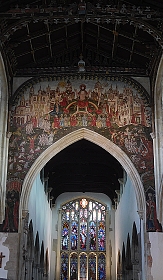
The Doom Painting

The present church was built from the 15th century onwards. Its detailed history can be found on the church’s website (https://stthomassalisbury.org.uk/wp-content/uploads/2021/06/BriefHistory.pdf). On entering the church from its western end, one cannot avoid seeing the colourful wall painting above the chancel arch. This is the Doom Painting, which depicts The Last Judgement. Images such as these used to be common in Christian Europe but are rare today. ‘Doom’ means ‘judgement’ in Anglo-Saxon. The painting in St Thomas is thought to have been created in about 1470 in the Flemish style by an English painter.

During the Reformation, the painting was covered over with whitewash in 1593. It remained hidden until 1819 when faint traces of colour began to appear when the wall was being cleaned. The painting was carefully uncovered in 1881, and then it was restored. In 1953, the image was cleaned again and retouched. Since then, it has remained untouched. Although it has been restored, it gives a good idea of how this superb fresco looked when it was first created.

While looking up at the Doom Painting, you should also examine the decorated timber ceilings above the nave and other parts of the church. These contain almost 100 wood carvings of angels. Also of interest, is a wooden panel on the wall of the south aisle. This bas-relief wood carving depicts Abraham sacrificing his son Isaac and Jacob’s Dream. It was created in about 1660 by the master Joiner Humphry Beckham (1589-1671).

There are plenty of other interesting items to see in the church, which deserves a visit. Had there not been a famous cathedral in Salisbury, this smaller church would have become one of the place’s main attractions.

A gothic church for the poor next to a canal

SPIRAL RAMPS LEAD up to the Ha’penny Bridge, which allows pedestrians to cross the Paddington Arm of the Grand Union Canal, where it runs between Delamere Terrace on one bank and Blomfield Road on the opposite one. A few yards west of the bridge and south of the waterway, there is a Victorian gothic church with a tall tower decorated with layers of red brickwork separated by layers of white masonry and topped with a white spire. It is St Mary Magdalene’s church.

The church was designed by George Edmund Street (1824-1881) and completed in 1878. It was built in what was then an area with poor quality housing, where several hard-up families lived crowded together under one roof. The parish in which it is located began life as an offshoot of All Saints in Margaret Street (near Oxford Circus). Like All Saints, St Mary Magdalene’s was established as an Anglo-Catholic church. Its website, grandjunction.org.uk, revealed that Anglo-Catholicism:

“… emphasises the Catholic heritage and identity of the Church of England. In the mid-nineteenth century Anglo-Catholicism was very controversial and provoked riots. Anglo-Catholic churches were often built in very poor areas, and their clergy believed that their services, full of light, colour, music and ritual, were likely to appeal to the poor.”

Like All Saints Margaret Street, the interior of St Mary Magdalene’s is a masterpiece of Victorian gothic extravaganza, a riot of colour. The nave has a magnificent painted ceiling which includes faces of various saints. This was painted by Daniel Bell, a Victorian artist. Sculptures of saints carved by Thomas Earp (1823-1893) look down on the nave. The floor of the vast nave is decoratively tiled. Street did not believe in fixed pews such as are found in many other Victorian churches and were rented out to parishioners to raise money. He believed in ‘free seating’, especially in a church like St Mary Magdelene’s that was built to serve the poor. The apse is unusual in that it is polygonal, reminiscent of apses that the widely travelled Street had seen in French and Flemish churches.

An unusual feature of this out of the ordinary church is that although the nave is flanked by a south and a north aisle, the latter is barely wide enough to accommodate one person, whereas the south one is almost as wide as the nave. The reason for the narrow north aisle was related to building regulations in force when the church was being constructed.

If it is open, and it was when I visited the church, it is worth entering the undercroft. This area beneath the church is flanked on its south side by a chapel that was undergoing restoration in February 2022. This is the chapel of the Holy Sepulchre created to commemorate the church’s founder and first vicar Fr Richard Temple West (1827-1893). Containing much decorative artwork and resembling a mediaeval chantry chapel, it was created by the architect Ninian Comper (1864-1960).

Outside the church, there is a WW1 memorial, added by Martin Travers in 1929. It is a gold-coloured crucifixion with a stone base on which are inscribed the Latin words “Infinitum est”, which is neither classical nor biblical; it means ‘It is not finished’, which are ominous words on a war memorial and are most portentous on a memorial to the first of (so far) two world wars.

Added on to the west end of the church, there is a modern extension, which houses a pleasant refreshment outlet called the Grand Junction Café. This is a good place to rest for a while after the excitement of seeing inside the spectacular church.

A short street in Kensington and social differences

AUBREY WALK IS a short street in Kensington. About 260 yards in length, it leads west from Campden Hill Road. Originally, it was the approach road to Aubrey House. Until 1893, when it was given its present name, the short stretch of road was named ‘Notting Hill Grove’ (https://www.british-history.ac.uk/survey-london/vol37/pp87-100#h3-0006).

St George, Aubrey Walk

Aubrey House, at first known as ‘Notting Hill House’, was completed by the end of the 17th century. It is at the western end of the street and was attached to some springs with medicinal properties: the Kensington Wells. In the mid-18th century, the house was enlarged by its then owner, Sir Edward Lloyd. The house and its extensive grounds passed through the hands of many different owners. Between 1767 and 1788, it was the home of the diarist and political observer Lady Mary Coke (1727-1811), the daughter of the second Duke of Argyll. By the mid-19th century, it acquired its present name, Aubrey House, to commemorate Aubrey de Vere, who owned the manor of Kensington at the time of the Domesday Book.

In 1863, the house became the property of a politician and Member of Parliament Peter Alfred Taylor (1819-1891). He was a radical, a supporter of the northern states in the American Civil War, and an anti-vaccinationist. A website, british-history.ac.uk, noted:

“Peter Alfred Taylor was M.P. for Leicester from 1862 until 1884 and was a noted champion of radical causes. His wife Clementia was also famous as a philanthropist and champion of women’s rights. They were closely involved in the movement for Italian liberation and Mazzini was a frequent visitor to Aubrey House. In 1873. Taylor sold the house to William Cleverley Alexander, an art collector and patron of Whistler.”

The Taylors opened the Aubrey Institute in the grounds of the house. This was to improve the education of poor youngsters.  WC Alexander (1840-1916), who bought the property, employed the artist James Abbott McNeill Whistler (1834-1903) to decorate the walls of the reception rooms of the house. Sadly, today, all that the public can see of the house, which is now a private residential complex, are glimpses over the outer wall of the roof and the upper storey windows.

Aubrey House used to be neighboured by the now demolished Wycombe Lodge and its large garden. In its place, there is a set of recently built houses arranged around a rectangular open space. This is called Wycombe Square.

Walking east from the wall of Aubrey House, we pass several places of interest including Wycombe Square. On the south side of Aubrey Walk is the club house of Campden Hill Lawn Tennis Club. This was founded in 1884, only seven years after the first championship competition at Wimbledon. Its twelve courts, six outdoor and the others indoors, are not visible from Aubrey Walk. Almost opposite the club, numbers 38-40, a 20th century art deco style building, contains the former home of the singer Dusty Springfield (1939-1999), who resided there from 1968 to 1972.

At the eastern end of Aubrey Walk there is the distinctive Victorian gothic church of St George (Campden Hill). In the middle of the 19th century, the area between Kensington Church Street and Campden Hill Road, the area containing Uxbridge Street, Hillgate Street and Place, and other small lanes, was a slum. It was where labourers in the nearby gravel pits and brickfields lived, often with several families in one tall, narrow house. Many of the folk living in this locality were destitute, which is difficult to imagine when you look at the place today. It was decided to build a church nearby to cater for the poor people living in this deprived area. This became St George’s on Aubrey Walk. The first church was an iron building, a large hut, which had been used by soldiers as a chapel on the Crimean War battlefields.  

In 1862, the Vicar of St Mary Abbots, the parish church of Kensington arranged to break up his huge parish into smaller units, one of which became the ecclesiastical district of St George. John Bennett, a local builder, financed the construction of a church to replace the iron structure. The first stone of the present church, which can accommodate 1500 people, was laid in 1864. Its architect was Enoch Keeling (1837-1886). The building he designed is a rare example of ‘continental gothic’, also known as ‘Eclectic Gothic’. This style makes use of brick and stonework of various colours, both externally and internally. Its exterior gives an Italianesque impression. This is especially the case when you look at the prominent bell tower at the southeast corner of the church.

St George’s was actively involved in providing education, and social work (including a soup kitchen on Edge Street) to its congregation who lived in the nearby slums. It also played a major role in the Temperance Society, which served Kensington, Notting Hill, and Shepherds Bush.  Before WW1, services at St George’s were well-attended, and a wide range of music was played. Writing in a booklet about the church, its authors, Tom Stacey and Ivo Morshead, noted:

“Elaborate settings for the choir were juxtaposed with favourites from ‘Hymns Ancient and Modern’ … The repertoire consisted of works by Stanford, Goss, Barnby, and Handel … St George’s was hardly classy at this time but it sang the same music as its more fashionable contemporary churches … Perhaps the music was above the heads of some of the congregation; yet St George’s remained a full church until the outbreak of the 1914 War.”

By the 1890s, the people that attended services at St George’s were becoming more similar to those living in other parts of Kensington because slowly but surely housing conditions were being improved and what had been a ‘down and out’ part of Kensington was ‘coming up in the world’. Many of the former slum dwellings just east of St George’s are still standing, but instead of being the residences of the poor, they are the much sought-after homes of the wealthy.

In nearby Kensington Place, east of the church, stands the parish hall, St George’s Hall.  In 1901, the Victorian building was, according to a plaque affixed above its main entrance:

“… acquired and altered to commemorate the glorious reign of Her Majesty Queen Victoria born at Kensington Palace May 24: 1819”

It is now used for residential purposes.

Aubrey Walk, although short in length, has several interesting sights. In the 19th century, it linked two social extremes. At the western end was the fabulous Aubrey House and at the eastern end, the poor of Kensington flocked to attend services in St George’s Church.

A Victorian gem of a church

MANY YEARS AGO, I read “The Gothic Revival” by the art historian Kenneth Clark (1903-1983). If I recall correctly, he wrote that it was likely that in Britain, the gothic style never truly died out before it came back into fashion in the 18th century. What we call ‘revival’ was merely the flaring up of the embers of the use of gothic designs, which had persisted despite the flowering of newer forms of architecture, such as neo-classicism. By the 19th century, the use of gothic motifs and structural features had fully revived, especially in the construction of churches and many other buildings, such as London’s St Pancras Station and the Prudential Building (near Chancery Lane).

Today, the 22nd of February 2022, I revisited a slightly concealed church, All Saints, in Margaret Street, which runs north of Oxford Street and parallel to it. You can see its tall, tiled spire from afar, but the church itself is set back from the street in a courtyard. Externally, with its multi-coloured patterned brickwork it is eye-catching but inside it is fantastic.

The church was established by the Ecclesiological Society, which was founded in 1839 as ‘The Cambridge Camden Society”. The group’s aim was:

“…reviving historically authentic Anglican worship through architecture.” (https://asms.uk/about/history/)

In 1841, the society:

“… announced a plan to build a ‘Model Church on a large and splendid scale’ which would embody important tenets of the Society: It must be in the Gothic style of the late 13th and early 14th centuries; It must be honestly built of solid materials; Its ornament should decorate its construction; Its artist should be ‘a single, pious and laborious artist alone, pondering deeply over his duty to do his best for the service of God’s Holy Religion’ Above all the church must be built so that the ‘Rubricks and Canons of the Church of England may be consistently observed, and the Sacraments rubrically and decently administered’.”

The architect chosen was William Butterfield (1814-1900), who specialised in the ‘gothic revival’ style. The church was built on the site of a former chapel, and within the confined space available, it was accompanied by a choir school and a clergy house. The church’s spire, 227 feet high, is taller than the towers of Westminster Abbey.

The Victorian writer and art critic John Ruskin (1819-1900) was full of praise for Butterfield’s edifice in Margaret Street. He wrote about it in his “The Stones of Venice, Volume III” (published 1853), observing that it:

“…assuredly decides one question conclusively, that of our present capability of Gothic design. It is the first piece of architecture I have seen, built in modern days, which is free from all signs of timidity or incapacity. In general proportion of parts, in refinement and piquancy of mouldings, above all, in force, vitality, and grace of floral ornament, worked in a broad and masculine manner, it challenges fearless comparison with the noblest work of any time. Having done this, we may do anything; there need be no limits to our hope or our confidence; and I believe it to be possible for us, not only to equal, but far to surpass, in some respects, any Gothic yet seen in Northern countries.”

That was praise indeed.

The interior of All Saints is a riot of colour. This results from the use of stones of differing hues – some inlaid to create bold patterns and others to form images of biblical scenes, glorious stained glass, gilt work, and elaborate ironwork. This feast for the eyes must be seen to be believed. And this gem of Victorian architecture, a peaceful have and a joy to see, is merely a stone’s throw from the hustle and bustle of Oxford Circus.

A bridge, canals, and a church in west London

THE GRAND UNION canal meets the River Thames at Brentford. From there, it runs towards the Midlands where it meets other waterways in England’s extensive network of canals, which was built for commerce, but is now used mainly for pleasure.

Six miles along the canal from Brentford, there is an important junction. Here at Bulls Bridge, the Paddington Arm branches off the main Grand Union canal. From beneath the bridge, the Arm runs 13 ½ miles to Paddington. Near its destination in central London, the arm flows through a large body of water, known as Little Venice. From there, two canals, the continuation of the Arm and the Regents Canal, link Little Venice to Paddington Basin and Limehouse Basin respectively.

The Paddington Arm was opened for use in 1801. The Bulls Bridge is a single-arch brick bridge spanning the Paddington Arm a few feet east of its junction with the Grand Union Canal. It stands amidst a dull landscape filled with industrial units and large supermarkets.

Following the towpath along the Grand Union Canal away from Bulls Bridge in a north-westerly direction for 177 yards, we reach a bridge that carries the canal over a narrow stream, the River Crane. a tributary of the River Thames. According to a website, touristlink.com, the course of the Crane is as follows:

“The River Crane is 8.5 miles (13.6 km) in length. Its source is taken to be a point south of North Hyde Road in Hayes, Hillingdon, from where its course is generally in a southerly, if near semi-circular, direction, before it joins the River Thames at Isleworth. Its name is a back-formation from Cranford, London. Formerly it was called the Cranford River. The River Crane creates the boundary between the London boroughs of Hillingdon and Hounslow.”

What could be seen from the bridge carrying the canal over the Crane was a deep weed-filled fissure in the depths of which there was a narrow stream. This lies in the shadow of an elevated road, the busy Parkway (A 312) that links both the A40 and the M4 with Heathrow Airport.

Continuing north-west along the Grand Union, the canal passes beneath a series of railway bridges that carry trains to and from Paddington Station. Nearby is Hayes and Harlington station, which stands in a part of Hayes, which was once the village of Botwell. This is now a shopping area with supplied with lavishly stocked fruit and vegetable shops and a branch of Lidl’s supermarket chain. Lidl’s faces a Roman Catholic Church, Immaculate Heart of Mary, built in 1961, which according to Pevsner, contains a painting by Pietro Annigoni (1910-1988). Near the station is a less attractive church, St Anselm, built between 1926 and 1928.

Even at the beginning of the 20th century, Hayes in Middlesex was a village north of Botwell and separated from it and other neighbouring settlements by open countryside. By 1940, Hayes had begun to be engulfed by London’s western spread. The village was, according to James Thorne, writing in 1876:

“… quiet and respectable, and chiefly dependent on the wealthy residents … consists of a few ordinary houses and shops.

Today, it is still quiet, the commercial district being in Hayes Town, the former Botwell, near the railway station.

There is one good reason to visit what was old Hayes. That is to see the parish church of St Mary the Virgin. It stands on the eastern side of Barra Hall Park, which are the grounds of the former manor house, now much modified. The church is mediaeval. Its lychgate is probably early 16th century.  Its chancel is late 13th century, the tower and the north aisle are 15th century, and the main aisle is 16th century. The church has beautiful timber ceilings and a 12th century font. On the north wall there is a large wall painting of St Christopher carrying the Christ child. Pevsner did not consider this image was painted before about 1500.

The church is full of fine funerary monuments. These include elaborate memorials for Sir Walter Grene (1456); the judge of the King’s Bench Edward Fenner (died 1612); Roger Jenyns (died 1693) and members of his family; Richard Lugg (1697); and Thomas (died 1576) and Elizabeth Higate. There are plenty more monuments to be seen as well as several fine brasses. Fenner’s monument consists of an effigy of Fenner lying recumbent supporting his head on his right hand. This is framed by marbled pillars supporting an elaborate carved stone semi-circular canopy, which is flanked by a pair of sculpted figures.

Although Hayes is not high on most tourist’s lists of what to see in London, the old church parish church of Hayes is certainly worth a detour. As for Bulls Bridge, visiting it is only for dedicated enthusiasts of  desolate landscapes and inland waterway history.