MANY YEARS AGO, I read “The Gothic Revival” by the art historian Kenneth Clark (1903-1983). If I recall correctly, he wrote that it was likely that in Britain, the gothic style never truly died out before it came back into fashion in the 18th century. What we call ‘revival’ was merely the flaring up of the embers of the use of gothic designs, which had persisted despite the flowering of newer forms of architecture, such as neo-classicism. By the 19th century, the use of gothic motifs and structural features had fully revived, especially in the construction of churches and many other buildings, such as London’s St Pancras Station and the Prudential Building (near Chancery Lane).
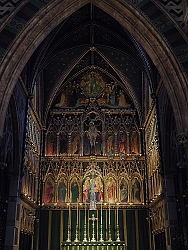
Today, the 22nd of February 2022, I revisited a slightly concealed church, All Saints, in Margaret Street, which runs north of Oxford Street and parallel to it. You can see its tall, tiled spire from afar, but the church itself is set back from the street in a courtyard. Externally, with its multi-coloured patterned brickwork it is eye-catching but inside it is fantastic.
The church was established by the Ecclesiological Society, which was founded in 1839 as ‘The Cambridge Camden Society”. The group’s aim was:
“… announced a plan to build a ‘Model Church on a large and splendid scale’ which would embody important tenets of the Society: It must be in the Gothic style of the late 13th and early 14th centuries; It must be honestly built of solid materials; Its ornament should decorate its construction; Its artist should be ‘a single, pious and laborious artist alone, pondering deeply over his duty to do his best for the service of God’s Holy Religion’ Above all the church must be built so that the ‘Rubricks and Canons of the Church of England may be consistently observed, and the Sacraments rubrically and decently administered’.”
The architect chosen was William Butterfield (1814-1900), who specialised in the ‘gothic revival’ style. The church was built on the site of a former chapel, and within the confined space available, it was accompanied by a choir school and a clergy house. The church’s spire, 227 feet high, is taller than the towers of Westminster Abbey.
The Victorian writer and art critic John Ruskin (1819-1900) was full of praise for Butterfield’s edifice in Margaret Street. He wrote about it in his “The Stones of Venice, Volume III” (published 1853), observing that it:
“…assuredly decides one question conclusively, that of our present capability of Gothic design. It is the first piece of architecture I have seen, built in modern days, which is free from all signs of timidity or incapacity. In general proportion of parts, in refinement and piquancy of mouldings, above all, in force, vitality, and grace of floral ornament, worked in a broad and masculine manner, it challenges fearless comparison with the noblest work of any time. Having done this, we may do anything; there need be no limits to our hope or our confidence; and I believe it to be possible for us, not only to equal, but far to surpass, in some respects, any Gothic yet seen in Northern countries.”
That was praise indeed.
The interior of All Saints is a riot of colour. This results from the use of stones of differing hues – some inlaid to create bold patterns and others to form images of biblical scenes, glorious stained glass, gilt work, and elaborate ironwork. This feast for the eyes must be seen to be believed. And this gem of Victorian architecture, a peaceful have and a joy to see, is merely a stone’s throw from the hustle and bustle of Oxford Circus.
THE GRAND UNION canal meets the River Thames at Brentford. From there, it runs towards the Midlands where it meets other waterways in England’s extensive network of canals, which was built for commerce, but is now used mainly for pleasure.
Six miles along the canal from Brentford, there is an important junction. Here at Bulls Bridge, the Paddington Arm branches off the main Grand Union canal. From beneath the bridge, the Arm runs 13 ½ miles to Paddington. Near its destination in central London, the arm flows through a large body of water, known as Little Venice. From there, two canals, the continuation of the Arm and the Regents Canal, link Little Venice to Paddington Basin and Limehouse Basin respectively.
The Paddington Arm was opened for use in 1801. The Bulls Bridge is a single-arch brick bridge spanning the Paddington Arm a few feet east of its junction with the Grand Union Canal. It stands amidst a dull landscape filled with industrial units and large supermarkets.
Following the towpath along the Grand Union Canal away from Bulls Bridge in a north-westerly direction for 177 yards, we reach a bridge that carries the canal over a narrow stream, the River Crane. a tributary of the River Thames. According to a website, touristlink.com, the course of the Crane is as follows:
“The River Crane is 8.5 miles (13.6 km) in length. Its source is taken to be a point south of North Hyde Road in Hayes, Hillingdon, from where its course is generally in a southerly, if near semi-circular, direction, before it joins the River Thames at Isleworth. Its name is a back-formation from Cranford, London. Formerly it was called the Cranford River. The River Crane creates the boundary between the London boroughs of Hillingdon and Hounslow.”
What could be seen from the bridge carrying the canal over the Crane was a deep weed-filled fissure in the depths of which there was a narrow stream. This lies in the shadow of an elevated road, the busy Parkway (A 312) that links both the A40 and the M4 with Heathrow Airport.
Continuing north-west along the Grand Union, the canal passes beneath a series of railway bridges that carry trains to and from Paddington Station. Nearby is Hayes and Harlington station, which stands in a part of Hayes, which was once the village of Botwell. This is now a shopping area with supplied with lavishly stocked fruit and vegetable shops and a branch of Lidl’s supermarket chain. Lidl’s faces a Roman Catholic Church, Immaculate Heart of Mary, built in 1961, which according to Pevsner, contains a painting by Pietro Annigoni (1910-1988). Near the station is a less attractive church, St Anselm, built between 1926 and 1928.
Even at the beginning of the 20th century, Hayes in Middlesex was a village north of Botwell and separated from it and other neighbouring settlements by open countryside. By 1940, Hayes had begun to be engulfed by London’s western spread. The village was, according to James Thorne, writing in 1876:
“… quiet and respectable, and chiefly dependent on the wealthy residents … consists of a few ordinary houses and shops.
Today, it is still quiet, the commercial district being in Hayes Town, the former Botwell, near the railway station.
There is one good reason to visit what was old Hayes. That is to see the parish church of St Mary the Virgin. It stands on the eastern side of Barra Hall Park, which are the grounds of the former manor house, now much modified. The church is mediaeval. Its lychgate is probably early 16th century. Its chancel is late 13th century, the tower and the north aisle are 15th century, and the main aisle is 16th century. The church has beautiful timber ceilings and a 12th century font. On the north wall there is a large wall painting of St Christopher carrying the Christ child. Pevsner did not consider this image was painted before about 1500.
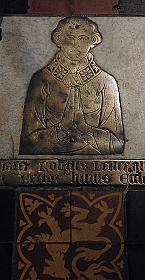
The church is full of fine funerary monuments. These include elaborate memorials for Sir Walter Grene (1456); the judge of the King’s Bench Edward Fenner (died 1612); Roger Jenyns (died 1693) and members of his family; Richard Lugg (1697); and Thomas (died 1576) and Elizabeth Higate. There are plenty more monuments to be seen as well as several fine brasses. Fenner’s monument consists of an effigy of Fenner lying recumbent supporting his head on his right hand. This is framed by marbled pillars supporting an elaborate carved stone semi-circular canopy, which is flanked by a pair of sculpted figures.
Although Hayes is not high on most tourist’s lists of what to see in London, the old church parish church of Hayes is certainly worth a detour. As for Bulls Bridge, visiting it is only for dedicated enthusiasts of desolate landscapes and inland waterway history.
WE VISITED TWO churches in Suffolk, and inside them we spotted three things that particularly interested us. The first church is in Cavendish, The Parish Church of St Mary the Virgin. Standing on a hill above the village, its construction dates from 1300 and was largely completed by 1485. Some restoration work was carried out in the 19th century. One of the two things that fascinated us in this church is affixed to the inside of the north wall. It is a bas-relief depicting the Crucifixion. It is a reredos of Flemmish make, created in the 16th century. It is framed in a Victorian surround designed by Ninian Comper (1864-1960) in 1895. The sculpted reredos was brought to the church from the private chapel of the hymn writer Athelstan Riley (1858-1945) in London, following his death.
Cavendish church
The other curiosity in this church, which has memorials to the philanthropists and local parishioners Baroness Sue Ryder and Baron Leonard Cheshire, is on a wall just behind the 19th century wooden pulpit within arm’s reach of the preacher. It is an hourglass, looking like a large egg-timer, which the priest could use to time his sermon. I had never seen such a thing in a church. Less curious but also fairly unusual are the 13 wooden crucifixes on the interior walls of the bell tower. These were made from wood salvaged from the Western Front during WW1 and each one commemorates one of the men from Cavendish who were killed in the conflict.
The other church we visited on our recent trip to Suffolk was St Mary in Stoke by Nayland, which was sometimes painted by John Constable (1776-1837), who was born nearby in East Bergholt. Built in Perpendicular Gothic style between 1300 and 1481 it is very majestic, like a small cathedral. The church is full of interesting monuments including many fine brasses. It was one of the funerary monuments that particularly intrigued us: the Lady Anne Windsor monument. Anne lived from about 1568 until 1615. A stone carving depicts her lying with her head on a pillow. At her feet, there is a carving of a kneeling man, Anne’s son. By her head, two carvings depict a pair of kneeling women, Anne’s daughters. Look closely at this pair and you will notice that their hands have been broken off. Their arms are merely amputated stumps. What is going on here?
Stoke by Nayland church
The answer is that in 1643, Parliamentary Commissioners visited the church in Stoke by Nayland and destroyed 100 religious images and 7 funerary items. Part of this over-zealous iconoclastic behaviour was the removal of the four hands of the two women on Lady Anne’s monument, as well as those of the recumbent figure of the deceased. All the hands of females on the monument were removed but those of the kneeling male figure were left untouched. Apparently, the female hands were removed because the Commissioners considered them to have been in “a superstitious attitude of prayer”, whatever that meant during the Reformation.
The three items I have described are but a few of the things worth seeing in the two churches. I have chosen to describe them because I have not seen such things in the many other parish churches I have visited in England.
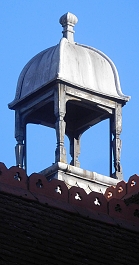
GROVE PLACE IS a short street running southwest from Hampstead’s steeply inclined Christchurch Hill. We often walk along it on our way to the lovely café at nearby Burgh House. A building containing numbers 29-31 Grove Place has often attracted my attention because its roof is topped with a couple of cupolas, each supported by four carved wooden pillars. These stand on either side of a grand central façade. The edifice bears a plaque, which is in an excellent state of preservation, that reads:
“This stone was laid by Mrs Sarah A Gotto on the 13th of July 1886 being the 50th Yr of the reign of her majesty Queen Victoria”
Elsewhere on the wall facing Grove Place there is a metal shield, painted black, which bears the following:
“1871. SPPM”
I was a bit puzzled by this because 1871 was some years before the stone was laid by Mrs Gotto.
I was pleased to discover that this building has been described in a book I possess, “The Streets of Hampstead” by Christopher Wade. He revealed that it was converted in 1970 from Bickersteth Hall, a hall built for the nearby Christ Church in 1895, and named after a former vicar, who later became the Bishop of Exeter. This gentleman was Edward Bickersteth (1825-1906), who had been vicar of Christ Church in Hampstead from 1855 to 1885 (www.praise.org.uk/hymnauthor/bickersteth-edward-henry/). Wade adds that it is confusing that the 1871 St Pancras shield and the 1886 Mrs Gotto plaque have been placed on the building. So, it seems that Mrs Gotto might have had little to do with laying the first brick of the building, but I wondered who she was.
Wade describes Sarah Gotto as Mrs Edward Gotto. Edward was most probably Edward Gotto (1822-1897), a civil engineer and architect who entered a partnership with Frederick Beesley in 1860 to create the engineering firm of Gotto and Beesley, which flourished for 30 years and carried out drainage works in towns all over the world including Rio de Janeiro, Seaford, Trowbridge, Evesham, Huyton and Roby, Redditch, Brentford and Cheshunt; and the drainage and water-supply of Campos (Brazil), Oswestry, Leominster and Cinderford (www.gracesguide.co.uk/Edward_Gotto). According to his obituary, Mr Gotto lived in Hampstead in a house called The Logs on East Heath Road. Built in 1868, The Logs, was as I have described elsewhere (see https://adam-yamey-writes.com/2021/02/01/finding-boy-george-and-bliss-in-north-london/), much later home to the comedian Marty Feldman and the singer Boy George. Edward’s wife Sarah was born Sarah Ann Porter (1829-1901; https://ancestors.familysearch.org/en/L1Q6-7NL/major-harold-ralph-gotto-1868-1957), She and Edward had eight children, one of whom was Harold Ralph Gotto. He was born in 1868 in Hampstead and later became a major in the British Army.
All of this is interesting enough, but none of it explains (to me) why Sarah is commemorated by the plaque on the house in Grove Place. If anyone knows the reason, I would be pleased to hear from them.
WESTMINSTER ABBEY IS costly for tourists to enter. Currently (November 2021) the entrance ticket ranges in price from £10 for a child to £24 for a full-price adult ticket. Without doubt, the Abbey is well worth a visit, but if you do not feel like spending so much money, its neighbour, the St Margaret’s Church is also full of interest but charges no entry fee.
Because the present Abbey was once the church attached to a monastery, St Margaret’s was built in the 11th and 12th centuries to provide a place of worship for the (non-ecclesiastical) residents of Westminster. When the residential population of the area declined, it became what it is now, the parish church for The House of Commons. The first church on the site was built in the Romanesque style, but when this deteriorated in the 14th century, it was replaced by the present structure built in the Perpendicular (gothic) style. Since then, like many old churches it has undergone various modifications over the centuries.
Amongst the many fascinating things within the church, which are described in an excellent booklet by Tony Willoughby and James Wilkinson, several things particularly attracted my attention. First of all, several of the windows in the south wall of the church contain superb modern stained glass designed by the painter John Piper (1903-1992) and created by Patrick Reyntiens (1925-2021). The were installed in 1966 to replace Victorian windows that were destroyed during WW2. Piper’s windows alone are a good reason to visit the church.
Another thing that caught my eye is a pair of doors on the north side of the church. These are covered with red leather, each one embossed in gold with a portcullis, surmounted by a crown, the symbol of Parliament. Some of the prayer kneelers are also decorated with this symbol.
Amongst the many tombs and funerary memorials within the church, there is one to the artist Wenceslaus Hollar (1607-1677). Born in Prague, he left the city when the Emperor Ferdinand the Second ordered Bohemian nobility to convert to Roman Catholicism or leave the country. A highly prolific and much-admired artist, creator of many works including detailed views of London, he died a poor man in Westminster. His monument is on the north wall.
Amongst the many memorials on the south wall there is an oval plaque commemorating the fact that in 1759, Olaudo Equiano (aka Gustavus Vassa) was baptised in the church when he was a slave owned by a sea captain, Michael Henry Pascal. Equiano (c1745-1797) was a black African slave, who gained (purchased) his freedom in 1766. After numerous adventures, which he related in his autobiographical work “The Interesting Narrative of the Life of Olaudah Equiano”, published in 1789 in London, he became active in the nascent movement to abolish the slave trade. In addition to his book, he wrote a great number of pamphlets and letters to the press.
Whereas I was able to spot the plaque for Equiano with no difficulty, I was unable to see the grave of another abolitionist, also a former slave, Ignatius Sancho (c1729-1780), who was born on a slave ship and is buried in the churchyard of St Margaret. He married a West Indian woman, Anne Osborne, in St Margaret’s, ran a grocery shop in Westminster, acted, composed music, and wrote against slavery using the pseudonym “Africanus”. He was the first black Briton to vote in a parliamentary election. He cast his vote both in 1774 and 1780.
In addition to these two black abolitionists, the church contains memorials to two men who tried to alleviate the suffering of slaves in the Americas, Richard Burn (c1744-1822) and Thomas Southerne (1660-1746). The latter was one of the first writers in English to denounce slavery.
I hope that what I have written above will help to distract you from the idea of visiting only Westminster Abbey and to encourage you to make plenty of time to explore St Margaret’s.
NAPOLEON BONAPARTE DIED in captivity on the tiny island of St Helena in the south Atlantic. While he was imprisoned on the island, Lieutenant General Sir Hudson Lowe (1769-1844) was the Governor of St Helena. He was buried at St Mark’s Church in North Audley Street in London’s Mayfair, where a commemorative plaque can be found by the main entrance. St Mark’s was built in the Greek Revival Style in 1825-28, designed by John Peter Gandy (1787-1850). In 1878, the church architect Arthur Blomfield (1829-1899) made considerable alterations to its interior including adding a timber vaulted ceiling over the nave.
During the 1950s and 1960s, the size of St Mark’s congregation diminished significantly. In 1974, the church was made redundant, and this is how it remained until 1994, when the church was used by The Commonwealth Christian Fellowship. It continued to serve this group until 2008. After that, it was used as a venue for occasional events. In about 2019 after a 5 million Pound restoration programme, the church underwent a surprising reincarnation.
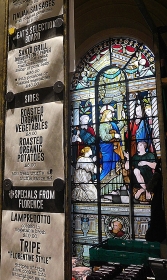
After passing beneath the grand portico supported by two columns topped with ionic capitals, one enters the church’s large vestibule. Since 2019, this has become a marketplace selling upmarket Italian delicatessen goods. Entering the body of the church is rather like taking part in a Fellini film. The floor of the nave is filled with tables and chairs and people drinking and dining. The side aisles, north and south, contain several kitchens, preparing and serving a wide variety of foods, from Turkish to Thai. On the north side of the chancel, just behind the neo-gothic stone pulpit, there is a gin bar, and facing it on the south side of the chancel, there is another bar providing alcoholic refreshments. Look upwards and you can admire the splendid timber roof supports. The wide gallery surrounding the nave at the first-floor level is home to more food stalls, each offering tempting looking fare at not unreasonable prices, especially by local Mayfair standards.
In 2019, the church became home to a branch of Mercato Metropolitano, whose first venture was converting a 150,000 square foot disused railway station in Milan during the 2015 World Expo in that Italian city. The idea of the company was:
“The development of the first Mercato Metropolitano was carefully planned to retain the site’s original appearance, which nurtured the local community’s affection for a special part of their urban history.”
And this is what has been done at the former St Mark’s in Mayfair. Many of the church’s fittings (for example, the tiled floors, the stained glass, the monuments, the pulpit, and the sacred paintings at the east end of the chancel) have been preserved. Entering the church is like entering the scene of a lively gargantuan feast. Seeing the large number of customers on a weekday lunchtime demonstrates that Mercato Metropolitano have successfully created a great place to meet, eat, and drink. It is highly original and exciting, both visually and gastronomically.
In Chapter 21 (verses 12-13) of the Gospel according to Matthew, we learn that:
“…Jesus went into the temple of God, and cast out all them that sold and bought in the temple, and overthrew the tables of the money changers, and the seats of them that sold doves, And said unto them, It is written, My house shall be called the house of prayer; but ye have made it a den of thieves.”
I just cannot help wondering, as many of you might also be doing, what The Good Lord would have made of what can now be seen inside the Church of St Mark’s in Mayfair.
THAXTED IS A PICTURESQUE small town in Essex, about six and a half miles northeast of Stansted Airport. Apart from its numerous quaint old buildings, the town has three notable landmarks: an old windmill, a 15th century guildhall, and a large parish church, which was built between 1340 and 1510 during the time when Thaxted was an important centre for the manufacturing cutlery. Also, Thaxted is home to an annual music festival, whose existence derives from the discovery of the town by a composer, Gustav Holst (1874-1934), creator of “The Planets” and many other musical compositions, who was on a walking tour in Essex during the winter of 1913.
Gustav Holst in Thaxted
Holst, who was born in Cheltenham, was living in London by 1913 and teaching music at St Pauls School for Girls in Hammersmith, James Allen’s Girls School in Dulwich, and Morley College for adults in Lambeth. At the same time, he was busy composing.
Holst had come to study at The Royal College of Music in London in 1893. Soon after arriving in London, he became acquainted with William Morris (1834-1896) and attended meetings at the latter’s house in Hammersmith, where he would have heard lectures on socialism given by George Bernard Shaw (1856-1950) and others. Holst joined the Hammersmith Socialist Society (‘HSS’), which was led by Morris. Many of the socialists he met including Shaw were vegetarians, as was the composer Wagner, whom Holst greatly admired. As a student and a regular attender of meetings of the HSS, he became a vegetarian and at the same time developed a great interest in Hinduism (www.ivu.org/people/music/holst.html). He began studying Sanskrit at The School of Oriental and African Studies (https://www.bl.uk/20th-century-music/articles/holst-and-india) and several of his compositions bear Indian-sounding titles, such as “Savitri” and another opera called “Sita”, and songs based on the Rig Veda.
According to Nalini Ghuman:
“In contrast to the vague musical orientalism in vogue during the height of the British Empire, Holst’s hymns, with their bona fide Indian texts, subjects, and musical elements, have often seemed decidedly ‘un-Indian’ to the uninformed ear: ‘Sound firm impressions of the East from a sane Western perspective’ declared The Musical Times; ‘They do not suggest a point further East than Leicester-square’ (Daily Telegraph); after all, explained the Manchester Guardian ‘many real Eastern musical ideas are frankly ugly and uninteresting’. Their Indian musical roots have long been denied by the composer’s biographers.” (https://www.bl.uk/20th-century-music/articles/holst-and-india).
However, Ghuman points out in her article that Holst did incorporate elements of Indian music, including emulating Vedic chanting and a South Indian mode, the namanarayani. You would need to be a serious musician with specialist interest in Indian music to be aware of these features whilst listening to Holst’s Indian inspired compositions.
Returning to his political leanings, major biographies of Holst tend not to focus much on his connections with socialism, but an informative article, “Gustav HoIst, William Morris and the Socialist Movement” by Andrew Heywood (Journal of the William Morris Society, vol 11, no. 4: 1996), shows that his involvement was far from inconsiderable. In addition to attending meetings of the HSS, Holst conducted its socialist choir, played the harmonium on the ‘official socialist’ cart, and was involved in the administration of the society. Heywood wrote that:
“In the light of his clear commitment to the socialist movement through 1896 it would seem likely that his involvement with the musical activity of the society did not stem from a lack of political commitment; rather it was an opportunity to serve the movement in a way which utilised his musical talents and interest.”
It was through the HSS that Gustav met his wife Isobel, who not only sang in the socialist choir but also, according to Heywood, was politically active in the society.
So, it was with a background of involvement with socialism that Holst walked into Thaxted in late 1913 and took such a great liking to the place that he rented a 17th century cottage there (actually, in Monk Street, 1 ½ miles from Thaxted) from its owner, the Jewish author Samuel Levy Bensusan (1872-1958). Thus began Holst’s several year’s association with the town. It was not long before he made the acquaintance of Thaxted’s vicar, Conrad le Despenser Roden Noel (1869-1942). After the cottage in Monk Street burnt down, Holst and his family lived in a house, The Manse (formerly known as ‘The Steps’), in the centre of Thaxted. Today, this is marked by a commemorative plaque.
Noel was not a run-of-the-mill country cleric. He was a Christian Socialist and a member of Social Democratic Federation, a founder member of the British Socialist Party, and for some time the Chairman of the Anti-Imperialist League, supporting the struggle for independence both in Ireland and India. Deeply committed to Christian socialism, social justice, and egalitarianism, Noel made sure that what went on in his parish church promoted these ideals. Noel’s biographer, Reg Groves, wrote that Conrad:
“…emphasised always that there was much more to making a new society than the acquisition of political power and the transfer of some property from the rich to the state, from one set of rulers to another. In this as in so many things, he was at one with the wisest of English socialists, William Morris, and much of what Morris said in prose and poetry and in the work of his hand, Noel tried to say in the group life he had developed at Thaxted”.
Noel and Holst shared socialist sympathies and more.
During Holst’s sojourn’s in Thaxted in between his heavy teaching and other musical commitments, he attended services led by Noel. It was after one of these held at Whitsun in 1915, that Holst, having heard the great potential of singers in the church, approached Noel and offered to give the choir the benefit of his professional skills as a trainer of vocalists. Noel, recognizing the splendid opportunity, soon had Holst become his church’s ‘master of music.’
Heywood explains that Holst’s:
“…first job was to train the choir for the church. Its members were drawn from the local population, and they achieved high standards with Holst. One member, Lily Harvey from the local sweet factory, was sent to London for professional training because of her exceptional vocal talents. In addition to his activities with the choir and playing the organ, Holst organised three major music festivals in Thaxted between 1916 and 1918.”
Lily was not the only person sent to London for musical training. The then young curate Jack Putterill, who was politically turbulent and played the organ, became one of Holst’s students at Morley College. Jack, who married Noel’s daughter, succeeded Noel as Vicar in 1942.
The festivals organised by Holst involved not only performers from Thaxted but also some of his students from Morley College and St Pauls as well as other musicians from outside the town. Each festival lasted several days, on each of which there were many hours of music making, both rehearsed concert pieces and much spontaneous music.
Holst not only helped make music in Thaxted but also composed there. The plaque on the The Manse, where he lived, is positioned on the outside of the wall of the room in which he composed. While living at Monk Street, he composed much of what was to become the well-known piece, “The Planets”. The “Jupiter” section of “The Planets” contains a tune or theme that Holst named “Thaxted” (you can listen to this familiar tune here: https://youtu.be/GdTpBSg7_8E). In 1921, “Thaxted” was used as the tune for the patriotic song “I vow to Thee, My Country”, whose words were written by the British diplomat Cecil Spring Rice (1859-1918). Holst also composed pieces specially for Thaxted and its people. These works include a special version of Byrd’s “Mass for Three Voices”, “Three Hymns for Thaxted” (later known as “Three Festival Choruses”), and a setting of the Cornish carol “Tomorrow shall be My Dancing Day” (hear it on https://youtu.be/Cz_0j__FDuc).
Although the last festival in Thaxted with which Holst was intimately involved was in 1918, he never lost touch with music making in the town, even after he moved from it to nearby Little Easton in 1925. Holst’s pupil Jack Putterill, an accomplished musician who was Thaxted’s assistant curate from 1925 to 1937 and its vicar from 1942 until 1973, helped keep the town’s musical life alive and vibrant. In the 1950s and 1960s, concerts with great orchestras such as The London Philharmonic and audiences in excess of 1000 were held in the parish church. In 1974, the hundredth anniversary of Holst’s birth, the first of what was eventually to become an annual music festival was held in Thaxted. By the 1980s, the Thaxted Festival had become a regular and respected part of the British musical calendar (www.thaxtedfestival.co.uk/).
Apart from the Festival and the house with the plaque in Thaxted, most souvenirs of Holst’s time in the town can be found within the cathedral-like parish church, which, incidentally, was once a candidate for becoming Essex’s cathedral (this honour was granted to the parish church in the centre of much larger Chelmsford). The church in Thaxted contains a photograph of Holst with singers and musicians at the Whitsuntide Festival held in 1916. Near this, there is some calligraphy with the words of “Tomorrow shall be My Dancing Day”. The church’s Lincoln organ built in 1821 by Henry Cephas Lincoln (who worked between c1810 and c1855) was played by Gustav Holst and has been recently restored. Not far from the organ is a cloth banner, sewn by Conrad Noel’s wife, which was used in the 1917 Whitsuntide Festival. It bears the words “The aim of music is the glory of God and pleasant recreation”. These words were written by the composer JS Bach (1685-1750) and were chosen for use on the banner by Holst. Near this banner, there is a bust of Holst’s friend and collaborator, Conrad Noel.
Both Holst and his student Putterill fell in love with Thaxted at first sight and were so strongly drawn to it that the town came to occupy important places in their hearts and minds. We first visited Thaxted in the early summer of 2020 soon after covid19 restrictions began to be relaxed sufficiently to permit travelling out of one’s immediate neighbourhood. Like Holst and Putterill, Thaxted made a special impression on us, so much so that we have visited it at least twice since our first encounter with it. Next year, we hope to be able to attend concert(s) at the Thaxted Festival inside a church that we have grown to love.
LANCASTER GATE IS ten minutes’ walk or a three-minute bus ride away from where I have lived for over 29 years. I have passed it innumerable times, yet I have never explored it. Yesterday, the 30th of October 2021, I decided it was high time that I took a closer look at the place. The name refers to an entrance to Kensington Gardens as well as a nearby network of streets. The network includes a long street extending from east to west between Craven Terrace (near Paddington Station) and Leinster Terrace. The section of road between Craven Terrace and Bayswater Road is also called Lancaster Gate. Midway along the long east-west section of the Gate, there is a wide street, almost a square or piazza, that leads to Bayswater Road. This rectangular piazza is south of a rectangular loop to the north of the east-west section, in the centre of which there is a 20th century building called Spire House. If this sounds confusing, then please look at a map!
What I have called the ‘piazza’ opens out onto Bayswater Road. In the middle of it, there is a monument topped with the weather worn sculpture of a seated child, probably male. The sculpture sits above a bas-relief depicting the western façade and the dome of London’s St Paul’s Cathedral. Below, on the south side of the pedestal, there is a bas-relief, depicting the face of a man with a bushy moustache and a long luxuriant beard. Weather and/or pollution has worn away details from his portrait. At first sight, I thought that it was a representation of George Bernard Shaw as an old man, but it is not. It is, according to the almost undecipherable inscription beneath it, the face of Reginald Brabazon, the 12th Earl of Meath, who lived from 1841 to 1929. The words on the plinth include that he was “a patriot and a philanthropist”.
Brabazon was Anglo-Irish and born in London (https://en.wikipedia.org/wiki/Reginald_Brabazon,_12th_Earl_of_Meath). Educated at Eton, he became a diplomat, but resigned from the Diplomatic Service in 1877. Ten years later, he joined the House of Lords as a Conservative peer. Reginald and his wife, Mary, devoted much of their lives to relieving human suffering and ameliorating social conditions. Amongst his many good works was the establishment (in 1882) of a charity called the Metropolitan Public Gardens Association, whose aim was the preservation of public open spaces and the creation of new ones, which might explain why the memorial to him faces Hyde Park. The Portland stone monument, known as The Meath Memorial, was designed by Joseph Hermon Cawthra (1886-1971) and unveiled in 1934.
A few feet north of Brabazon’s memorial, which stands on a wide traffic island, there is a slender stone column topped by an ornate octagonal structure surmounted by a shiny metal crucifix. The base of this column reveals that it is was built as a WW1 memorial. In the pavement between the two memorials, the City of Westminster has set several informative panels about the history of Lancaster Gate. The development of Lancaster Gate, originally known as ‘Upper Hyde Park Gardens’, began in the late 1860s, an initiative of the developer Henry de Bruno Austin. Many of the houses he built have rich stucco facades and porches supported by neo-classical style pillars. Quite a few of them are now hotels. These buildings are interspersed with a few newer buildings, presumably where the originals were bombed during WW2. However, most Lancaster Gate’s houses are those built in the 19th century.
The name Lancaster Gate was chosen to honour Queen Victoria, who was amongst many other things, the Duchess of Lancaster.
Before Lancaster Gate was developed, it was mostly agricultural land. Until 1775, the composer, actor, botanist, and playwright John Hill (1716-1775) had his Physic Garden here. By 1795, visitors flocked to the area to enjoy the springs and fresh air at the Bayswater Tea Gardens, which later was renamed the Flora Tea Gardens, and then the Victoria Tea Gardens. This establishment closed in 1854.
At the southern end of the loop and towering above the plaza with its two monuments, there is a tall church tower with a spire. This is all that remains of the Christ Church, Lancaster Gate, whose construction began in 1854. The last service to be held in the church was in 1977, by which time the roof was badly infected with dry rot. The church was demolished, but the tower retained. Where the body of church stood, there is now a block of flats. Opened in about 1983, it is appropriately named Spire House. Its 20th century architecture is quite attractive and contrasts dramatically with the stuccoed Victorian buildings that face its west, north, and east sides. Spire House has external concrete supporting pillars that suggest an updated version of the flying buttresses used in mediaeval church architecture.
Lancaster Gate is a relatively unspoilt example of mid-Victorian town planning and worthy of a short visit. While walking around the area, I only spotted one blue plaque, commemorating a resident worthy of note. It recorded that the “Chemical Scientist” Sir Edward Frankland (1825-1899) lived in Lancaster Gate from 1870 to 1880. He was one of the founders of organo-metallic chemistry and a discoverer of Helium. Also, he took an active interest in the problem of pollution of rivers and the quality of London’s water. I trust that he would be pleased to know that fish have returned to London’s once filthy River Thames.
After exploring Lancaster Gate and its sea of stuccoed facades, head east into Craven Street, where you can find several cafés and at least one pub.
IN CENTRAL AHMEDABAD, a large city in India’s state of Gujarat, there is a curious café called Lucky. This popular eatery is not unusual because it does not serve coffee but because its tables and chairs are placed between Moslem graves. Lucky’s is sited on an old Moslem graveyard, but this does not put off a steady flow of customers from enjoying a wide variety of vegetarian snacks in this eatery. Closer to home, near the south side of London’s Lambeth Bridge, there is another café sited on a former graveyard. Unlike Lucky in Ahmedabad, which is housed in an architecturally unremarkable building, the café in Lambeth, The Garden Museum Café, is a marvellous example of contemporary architecture.
Café at The Garden Museum in London
The café, completed in 2018, is at the east end of the Church of St Marys, Lambeth, which now serves as the home of The Garden Museum. The church stands next to the main Tudor entrance of Lambeth Palace. The tower was built in about 1378. The rest of the church contains structural elements that were built in later eras. Appropriately for a museum dedicated to gardening history, the repurposed Church of St Mary’s is the burial place of the famous gardener and plant collector, John Tradescant the Elder (c1570s-1638). It is also the final resting place of Captain William Bligh (1754-1817) of The Bounty Mutiny (1789) fame. This famous mariner owned a house in Lambeth. Customers of the café do not sit on the graves of these two well-known persons, but on gravestones that, unlike the graves at Lucky in Ahmedabad which are raised above the ground, are level with the rest of the café’s floor.
The graves at Lucky in Ahmedabad are coffin shaped and probably contain the remains of the deceased. I am not sure whether there are human remains beneath the grave slabs in the floor of the café in Lambeth. A young waiter, whom I asked, was concerned to reassure me that he believed that there are no skeletons beneath the gravestones upon which customers walk and sit. I wonder whether this is really the case.
The Garden Museum was founded in 1977 by Rosemary and John Nicholson in order to preserve the church, which was due for demolition (https://gardenmuseum.org.uk/the-museum/history/). In 2015, the museum was closed for a year and a half whilst it was being redeveloped. Part of the improvements made was the construction of an extension at the eastern end of the retired church. The new construction, designed by Christopher Bradley-Hole and Dan Pearson, includes the café and other structures that together surround a new courtyard that contains a lovely garden, The Sackler Garden designed by Dan Pearson. It contains several tombs including that of the Tradescant family and of Captain Bligh.
The café borders the western side of the courtyard. Its mainly glass walls provide good views of the garden, the buildings across the river and the leafy remains of the churchyard west of the café. Where there is no glass, the walls are covered with overlapping brown coloured metal panels. Serving great coffee and both snacks and meals, the legs of the chairs and tables rest on the gravestones that form part of the floor.
Compared with Lucky, which is in a very busy part of Ahmedabad, the Garden Museum café, although close to a busy main road, is far more peaceful. However, both are delightful places to enjoy refreshments.
THERE IS A SUPERB Vietnamese eatery on London’s Bermondsey Street, called Caphe House. After eating a tasty banh mi, a baguette filled with meat and fresh vegetable, a dish no doubt inspired by the French occupation of Vietnam, and a pho, a clear broth with meat, vegetables, and noodles, we crossed the road to examine a sculpture. This eye-catching artwork had not been present when last visited Caphe House, sometime before the pandemic and well before October 2019. It consists of a row of seven piles of stone carvings of differing heights, resembling short totem poles. Made of Portland stone, Bath stone, marble and other materials found in the River Thames, this was created in 2020 by Austin Emery and members of the local community. Over 100 members of the community made carvings in a workshop, and these have been assembled by Emery to create what we saw, an artwork named “Cornerstone”. Cornerstone also incorporates fragments from Southwark Cathedral, Westminster Abbey, London Bridge Station, and bones from the Thames.
Cornerstone, a sculpture in London’s Bermondsey
After admiring this unusual and intriguing sculpture, I spotted a notice nearby. It relates to the history of Tanner Park, where the sculpture stands, and includes the following:
“… Originally part of the grounds of Bermondsey Abbey the site of the Park was later in use as a Tannery …”
Reading this notice, I realised that this was the first time I had seen mention of an abbey at Bermondsey.
There had been an abbey in Bermondsey since the early 9th century (https://en.wikipedia.org/wiki/Bermondsey_Abbey). This was centred on the site of the present-day Bermondsey Square, about 390 yards south of the Cornerstone sculpture. The abbey to which the notice at Tanner Park refers was a Benedictine abbey, which was dedicated to St Saviour and was founded in the early 11th century. A wealthy religious establishment, it was, like so many other similar institutions, dissolved by King Henry VIII in the 16th century, in 1537. But where was it?
By 1822, only tiny fragments of the abbey were still standing. Today, nothing remains, although occasional archaeological digs have exposed parts of it, albeit temporarily. Fathome’s map of Southwark compiled in 1643-48 shows that then the abbey was still standing intact in its grounds (https://www.british-history.ac.uk/old-new-london/vol6/pp117-133). According to one writer (https://knowyourlondon.wordpress.com/2018/07/06/bermondsey-abbey/), who does not give the source(s) of his information, the site of the abbey was:
“The abbey lands extended from the present church of St Mary Magdalene, across today’s Tower Bridge Road.”
A map included by this writer marks the abbey church as lying along Abbey Street with the nave to the west of Tower Bridge Road and the chancel east of it. A wall plaque (www.londonremembers.com/memorials/bermondsey-abbey) which I have not yet seen informs that the abbey:
“… occupied ground between Bermondsey Street, Abbey Street, and Grange Walk…”
The church of St Mary Magdalen stands on Bermondsey Street just before its crossing with Abbey Street. This stands on the site of a church that existed in 1290 and which served lay workers of the abbey. This was demolished in 1680, but the late mediaeval tower was kept. It was rebuilt ten years later. During the 19th century, the exterior was covered with rendering and various other architectural modifications were made both internally and externally (https://en.wikipedia.org/wiki/St_Mary_Magdalen_Bermondsey). Apparently, the church’s mediaeval arches are visible inside the tower behind the organ and the church also contains some mediaeval stone capitals that might well have been parts of Bermondsey Abbey. St Mary Magdalen is the oldest surviving building in the area. It is open occasionally. I have entered it once, but that was long before I knew about the mediaeval remnants it contains.
Despite the fact that Bermondsey Abbey is now merely a historical memory, Bermondsey Street is an interesting place to visit. Amongst its attractions are Peter Layton’s glass studio, where you can watch glassblowers creating fantastic artworks in glass; Rachel Eames Gallery, which often has good exhibitions of contemporary artists’ works; The Fashion and Textile Museum; The White Cube (Bermondsey), which hosts spectacular shows of contemporary art; and the Cornerstone sculpture, described already. I suggest starting your visit with an early lunch at Caphe House, rounding it off with Vietnamese filter coffee, and ending it with another good coffee at the cheekily named, quirkily decorated Fuckoffee café.