THE VICTORIA LINE began carrying passengers in late 1968 when I was 16 years old. I remember when this happened and how exciting it was. Recently a new railway line opened in London: the Elizabeth Line. Originally named ‘Crossrail’, it began carrying passengers several years after it was supposed to have been completed. It is supposed to convey people from east of London to well west of the city. However, what exists now (July 2022) is not exactly what I expected. In order to travel from, say, Shenfield, at the eastern end of the line to, say, Maidenhead, west of London, you need to change trains at Paddington. Currently one section of the new line runs east from Paddington, and the other runs west from that station. Unlike Queen Elizabeth’s long continuous reign, the line named to honour her has a discontinuity at Paddington.
A visitor from abroad wanted to experience the new line today, a Sunday. He was looking forward to seeing the new station platforms on the line that heads east from Paddington. Sadly the section that fruns east from Paddington does not operate on Sundays at the moment. So, we had to head west. The Elizabeth Line trains are new, but the train follows tracks that were laid down as far back as the 19th century. Apart from being over efficiently air-conditioned, the new trains are comfortable and run remarkably smoothly.
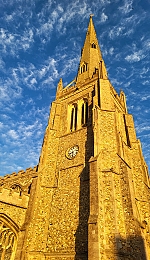
We travelled (on a train bound for Heathrow Terminal 5) to Hayes and Harlington station, and from there headed to Barra Hall Park in the old part of Hayes. There, we enjoyed a picnic before walking to the mediaeval parish church, St Mary the Virgin. We had visited it once before, but were completely unprepared for what we saw this time. The hedges lining the path leading to the south door of the church were decorated with bunches of cut flowers. A cardboard cut-out of Queen Elizabeth II greeted us at the door. The lovely church was filled with attractively arranged bouquets of flowers. Quite by chance, we had arrived whilst the church’s 57th annual Festival of Flowers was being celebrated. We were fortunate because we arrived on the 3rd of July, the last day of the festival. The festival’s theme was “A Tribute to Queen Elizabeth”. How appropriate to have travelled to it on the Elizabeth Line.
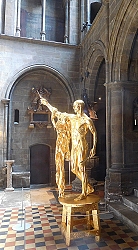
ENGLISH PARISH CHURCHES are full of surprises. The church of St Mary the Virgin in the Essex village of Hatfield Broad Oak (once known as ‘Hatfield Regis’) is no exception. Its nave is a surviving remnant of a Benedictine priory founded in 1135 by Alberic De Vere (c1085-1141) The highlight of this church is a recumbent stone effigy of Alberic’s grandson, Robert de Vere, 3rd Earl of Oxford (c1155-1221), who was born in Hatfield Broad Oak. He was one of the barons who forced King John into signing the Magna Carta at Runnymede in 1215. The effigy was placed in the church either by his son or his grandson. It lies on the floor of the chancel in front of the nave and close to the high altar. Whereas in many churches, there is an unobstructed view of the altar (or a rood screen) from the western end of a church, Robert’s effigy sticks out like a sore thumb when you are looking along the length of the nave
The effigy, which is in remarkably good condition given its age, depicts Robert lying with his legs crossed. His right hand clutches a sword and there is a shield attached to his left arm. His left foot rests on something that is not easily identifiable as it has been damaged. What is most remarkable about this funerary sculpture is that Robert is almost entirely clad in chain mail. Part of his face peers through a circular gap in the armoured head dress. The carver of this monument took great pains to show the chain mail in fine detail. For me, this is what makes the effigy quite wonderful.
Fascinating as is the effigy, Robert’s family interested me because of its connection with Kensington in London. Robert’s great grandfather Alberic (or Aubrey) De Vere (1040-1112) was a tenant-in-chief of William the Conqueror. The Domesday Book records that he was a great landowner with properties in nine counties. One of these was the manor of Kensington in the County of Middlesex. His name is remembered today in the Royal Borough of Kensington and Chelsea by the street name Aubrey Walk, which leads to Aubrey House, currently a private residence.
The day before we visited Hatfield Broad Oak, we were in Coggeshall (Essex), where I spotted a memorial to a protestant martyr, Thomas Hawkes (see: https://adam-yamey-writes.com/2022/06/26/burnt-rather-than-baptised/), who had worked for the De Vere family. Had Hatfield Broad Oak not been such a pretty village, I doubt that we would have stopped there. That would have been a pity because then we would have missed seeing the chain mail clad effigy and its interesting connection with a part of west London, with which I am quite familiar.
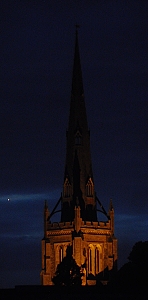
WHILE ELTON JOHN was performing in front of thousands in London’s Hyde Park in late June 2022, a small ensemble was performing works by the baroque composers Pergolesi and Purcell in the large medieval gothic church in Thaxted (Essex). The superbly performed concert in Thaxted starring the Armonico Consort ended well after 9 pm. This was not a problem for the many well-healed members of the audience in the church, who lived locally and were able to feed themselves in their own homes.
Thaxted, Essex
We could have eaten before the concert, which commenced at 7 pm, but were not hungry before that early hour. The pubs in Thaxted informed us that their kitchens stopped taking orders for food before 845 or 9 pm.
At a pub called the Star, someone hearing us asking about food after 9 pm, recommended we should head for Farouk’s. The bar attendant and several bystander’s agreed with our informant. The bar attendant kindly said that we could bring food from Farouk and she would save a table for us at which we could sit and eat after the concert.
Farouk is the owner of a caravan parked in a yard behind a petrol filling station in Thaxted. He and his colleagues, all from Turkey, prepare and sell Turkish food in the caravan. And, his eatery closes not at 845 or 9 pm, but at 11 pm.
After hearing superb renderings of Pergolesi’s “Stabat Mater” and Purcell’s “Dido and Aeneas” (semi-staged), we headed for Farouk’s caravan and the Star pub.
While waiting for our food to be prepared at about 9.40 pm, Farouk explained he had come from Gaziantep. He said that in his part of Turkey, which is quite close to Cyprus, Turkish is spoken with an accent that is very similar to that spoken by Cypriot Turks. During the ten minutes it took to prepare our food, Farouk took many food orders over the phone, which goes to show that in Thaxted there is a healthy demand for food after 9 pm.
We enjoyed our food at the table reserved for us at the Star. This welcoming pub is popular with locals. I suspect that its lively clientele was a different segment of Thaxted’s population from that which attended the concert in the church.
IN CENTRAL SARAJEVO, there used to be a pair of footprints carved on the corner of a pavement where two roads met. I do not know whether these impressions, which I saw in the 1980s, still exist. They marked the spot where a young sharpshooter, Gavrilo Princip, took aim and assassinated Archduke Franz Ferdinand of Austria-Hungary in 1914. Had his aim not been so accurate, the last Emperor of Austria might not have been buried in a church high above the city of Funchal in Madeira.
Emperor Karl of Austria-Hungary
Had Princip’s aim not been so good, his victim, Franz Ferdinand, would have been
successor to the imperial throne. With the Archduke eliminated, his nephew,
Karl (1887-1922), succeeded Emperor Franz Joseph when he died in 1916.
Following the end of WW1 in 1918, Austria’s last Emperor,
Karl, fled to Switzerland. After a couple of attempts to regain his
throne, the British exiled him and his
wife to Madeira in 1921.
In 1922, Karl died of pneumonia. He was interred in a chapel on the north side
of the nave in the Igreja Nossa Senhora in the Monte district high above
Funchal.
Plenty of tourist gawp at Karl’s simple tomb in the lovely church,
which overlooks the city and the Atlantic Ocean far below. I wonder whether Madeira would have been the
final home of the Archduke had he not been so unlucky in Sarajevo.
Curiously, Karl was beatified in 2004. Equally strange was
the British choice of a Portuguese island for Karl’s exile. After all, Napoleon
Bonaparte was eventually exiled to a British possession: St Helena.
THE SYNAGOGUE IN Bayswater’s St Petersburg Place, a gothic revival edifice, looks no more exotic or out of place than the Victorian gothic Church of St Matthew built 1881-82 on the same street. In fact, it is another building to the north of these two that is unashamedly exotic in appearance: Aghia Sofia (Saint Sophia), the Greek Orthodox cathedral on Moscow Road. This domed building constructed for a community of prosperous Greek merchants was designed by John Oldrid Scott (1841-1913 and completed in 1877.
The first Greeks began arriving in London at the end of the 17th century. By the late 19th century (according to the website http://www.stsophia.org.uk), members of the Greek community in London:
“… were distinguished for their industry and their business acumen, and … soon became for the most part financially independent. They now wished to enjoy a more comfortable life, both for themselves and their families. They kept their offices in the City, but took up their private residences in other parts of London. The favourite districts were Lancaster Gate and Bayswater. These districts, which today are almost in the centre of the unending metropolis, were then only on its fringe, and to go from the City to Hyde Park, for instance, was considered a long excursion, which was undertaken, normally, only on holidays, as a relaxation and in order to enjoy the fresh country air.
After three decades had passed from the founding of the Church of Our Saviour [in the City near London Wall], no one any longer had his private residence in the City; and whereas previously all had lived within a very short distance of the Church, now five whole miles divided the Church from the residential district of the faithful.
For the men, in particular, who had every day to make the journey to the City, a tiring one with the means of transport then available, it was hard to undergo the same fatigue on Sundays also, when they were supposed not only to perform their religious duties, but also to rest from the labours of the week. Moreover, the number of the Greeks had greatly increased, and there was scarcely room for them all in the Church then existing. These various difficulties made it imperatively necessary to build a new larger Church, situated closer to the residences of the Brothers.”
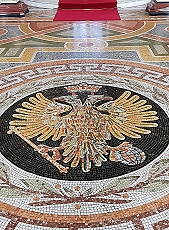
Just as the Jewish people, who had also settled in Bayswater, far from the older synagogues in the City and established a new one near their new homes, the Greeks did the same. Moscow Road’s St Sophia’s church interior is filled with icons and other religious paintings is colourful and attractive. Instead of frescos on the walls, which were believed to be at risk of damage from London’s damp climate, the church’s interior is lined with mosaics. Some of the earliest of these were designed by Arthur George Walker (1861-1939). In 1926, the Russian born mosaic artist Boris Vasilyevich Anrep (1883-1969) created some more mosaics for the cathedral. The marble floor of the edifice is also attractive.
IN 1916, A FAMOUS poet, TS Eliot (1888-1965) taught at Highgate School in north London. I was a pupil at this establishment much later, between the year when Eliot died and 1970. One of Eliot’s pupils during his short spell at Highgate was to become one of Britain’s Poet Laureates: John Betjeman (1906-1984). Betjeman wrote (quoted in https://bradbirzer.com/2015/07/06/john-betjeman-remembers-t-s-eliot-as-teacher/):
“In 1914-15 I spent two unsuccessful terms at Highgate Junior School. Mr Eliot was a tall, quiet usher there whom we called ‘The American Master.’ Some of the cleverer boys from Muswell Hill (I was from Highgate) knew he was a poet. How? I have often wondered, for I cannot imagine him telling them or anyone that he was a poet, and I did not know that he had published any poems in England as early as that.”
Betjeman’s association with Highgate where he lived as a child briefly and was educated for less than one year was much shorter than his association with the county of Cornwall.
Betjeman’s family had a house in Trebetherick, near Polzeath in Cornwall, where many holidays were spent. In later life, the poet resided there. The small church of St Enodoc is about 930 yards south of Trebetherick. In the middle of a golf course overlooking the sea, the church dates from the 13th century. Much of it was built by the 16th century. Over the centuries, St Enodoc has often been submerged by drifting sands from the nearby beaches. Between the 16th century and the mid-19th century, the church was completely submerged. In 1863-64, the church was freed from the sand and restored under the supervision of James Piers St Aubyn (1815-1895).
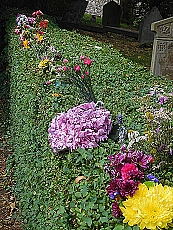
When staying or living at Trebetherick, Betjeman visited St Enodoc regularly. In 1945, he published a poem “Sunday Afternoon Service in St Enodoc Court, Cornwall”, in which he describes his impressions of the church affectionately. Author of much poetry and several books about Cornwall, Betjeman died in his home at Trebetherick. He was buried in the small graveyard that surrounds St Enodoc, a building that still appears to be partially buried in the hillside. His grave is marked by simple stone with a beautifully carved inscription. Born in Lissenden Gardens, now in the Borough of Camden, Betjeman lived briefly in Highgate’s North Road in a house opposite Highgate School. However, it is with Cornwall rather than Highgate that most people connect with the former Poet Laureate. As a former pupil at Highgate School, I was pleased to pay my respects at Betjeman’s grave in Cornwall.
SERAMPORE NEAR CALCUTTA was a Danish colony, or at least under Danish administration, between 1755 and 1845. It was then known as ‘Frederiknagore’. When we visited the place briefly in 2019, we were struck by the similarity of the type of design of its Church of St Olave (built 1806) and that of the far better-known St Martin-in-the-Fields (built 1721-26) on the east side of London’s Trafalgar Square. Although there are similarities between the two churches, there are also many differences. One of them is that the interior of St Olave’s is far plainer that that of St Martin’s. Even though many thousands of miles apart, there is a tiny aspect of Asia in the church on Trafalgar Square.
In the southwest corner of St Martin’s, I spotted a memorial, which aroused my curiosity. It is a simple green cloth-covered square notice board surrounded by a wooden frame in which various things are carved. These include the words “Requests for prayer”; carved plant motifs; Chinese pictograms; and the words “Praise God for his servant Florence Li Tim-Oi DD. 1907-1992. The first woman ordained in the Anglican Communion 25 January 1944”. There were several notices and a couple of plastic drinking cups pinned on the board.
Florence was born in Aberdeen, Hong Kong during a time that most Chinese parents favoured male children. However, her parents were unusual in that they challenged the then current prejudice against girls. As a student, she joined the Anglican church, probably after hearing a preacher (in Hong Kong) asking for women to dedicate their lives to working for the Christian ministry. At her baptism, she chose her English name, Florence, to honour the late Florence Nightingale. After studying at the Canton Theological College, she was eventually, in 1941, ordained as a deaconess. At that time, she was sent to the then Portuguese colony of Macau to help refugees fleeing there from war-torn China.
When the Japanese occupied Hong Kong, it became impossible for ordained Anglican priests to reach Macau. Although she was not yet ordained, Florence had to perform all the functions normally carried out by an ordained priest. In January 1944, she met Hong Kong’s Bishop Raymond Hall in an unoccupied part of China. There, the bishop, realising that there was no Anglican priest in Macau and that Florence had the ‘gift of priestly ministry’, ordained her as an Anglican priest. In so doing, on the 25th of January 1944, Florence made history by becoming the first woman to be ordained as an Anglican priest. This was 30 years before the ordination of women was permitted by the Anglican Church in the rest of the world. So, her ordination was frowned upon by some leaders of the Anglican Church.
After WW2 was over, Florence lived and ministered in China. In Maoist China, churches were closed (from 1958 to 1974), and during the so-called Cultural Revolution, Florence led a miserable life, as did many other Chinese people. She was sent to a farm to work with chickens and her home was raided several times. After a long time, she was allowed to retire from the farm and was given permission to leave China. In 1983, she was taken to Canada, where she assisted in the religious activities of a church in Toronto. By then, the Anglican Church in Canada had approved of the ordination of women. On the 40th anniversary of her ordination in China, she was reinstated as a priest. In later life, Florence served at the Anglican Cathedral in Toronto, where she lived the rest of her life.
I do not know when the memorial noticeboard commemorating Florence was installed in St Martin-in-the-Fields. However, on the 25th of January 2014, a service was held in the church to mark the 70th anniversary of her ordination as the first female Anglican priest. I am pleased that I spotted the somewhat unobtrusive notice board because if I had missed seeing it, I might never have known about this remarkable woman of faith.
ST MARTINS IN THE FIELDS church is a prominent landmark located on the east side of London’s Trafalgar Square. This 18th century church, which first opened in 1724 and was designed by James Gibbs (1682-1754), hosts many concerts, mostly of classical music.
There is a large crypt beneath the church. Its vaulted brickwork ceilings are supported by sturdy masonry pillars. There are many gravestones flush with the floor. The floor is covered with tables and chairs, which are used by the many customers of the café which uses the crypt as its home. It is a pleasant place to while away the time of day.
The café serves food and drink. The coffee served there is slightly below average in quality and is priced a just little bit higher than average for London. Regardless of price or quality, the crypt provides a pleasant ambience to meet friends or simply to relax peacefully.
TOLLESBURY IN ESSEX on the Blackwater River estuary is a village just over 5 miles southeast of Tiptree, a small town close to the Wilkinson jam factory and museum. This charming village, where a good friend of ours lives, has a venerable parish church, St Mary the Virgin.
Roman bricks used to construct the arch above the south entrance of St Mary’s in Tollesbury, Essex.
In common with most of the parish churches we have visited during our extensive roamings around the English countryside, this church, whose construction had begun by the 11th century, contains a rich selection of interesting features. These are well described in a copiously illustrated booklet about the edifice published by the Friends of St Mary’s Tollesbury in early 2020. Amongst the interesting things we saw within St Mary’s, one of them particularly intrigued me: the incorporation of Roman bricks in the fabric of the church.
Archaeologists have uncovered the remains of a Romano-British cemetery near the village. They have concluded from their findings that in about 200 AD, there was a significant rural settlement located near Tollesbury at that time. Other remains are evidence that the district around the estuarine village has been the site of human activity since the Neolithic era (4000-2000 BC).
As if to prove that recycling is not simply a recent trend, the church of St Mary incorporates bricks made whilst the Romans occupied England. These can be seen clearly above the south doorway within the church. The 11th century arch above this portal is made entirely of recycled Roman bricks. Some more brickwork made with Roman bricks can be seen exposed above the gothic archway in the western wall of the nave, which is also part of the late 11th century bell tower.
Although the re-used Roman bricks have been ‘highlighted’ in St Mary’s, the structure of the parish church in the nearby village of Goldhanger also contains recycled Roman bricks. Making bricks at the time when these churches were built would have been far more laborious than making bricks using today’s industrial techniques. So, re-using bricks that had already been made would have been very sensible.
THE COUNTY OF ESSEX is immediately east of Greater London. Parts of it are heavily built-up and not particularly attractive. The rest of the county is both varied and delightful to explore. So near to London, many parts of it retain rural characteristics, which one might not believe existed so near to the huge city of London. Recently, we visited Goldhanger, a small village close to the River Blackwater’s estuary.
Sculpture by Horace Crawshay Frost in the parish church in Goldhanger, Essex
The village near Maldon (famous for its salt) has been known as ‘Goldanger’, ‘Goldangra’, and ‘Goldangre’. According to Maura Benham (1913-1994) in her history of Goldhanger, the place’s name has always had ‘gold’ as its first part. The gold probably referred to a yellow flower. The second part might either originate in the word ‘hanger’ meaning hill, or ‘anger’ meaning grassland. It is not known exactly when the settlement, which is at the head of a small creek, was first established but there is archaeological evidence suggesting it was already inhabited in the Iron Age around 500BC. One reason for the village’s existence might have been for making salt from seawater. The local saltworks came to an end in the early 19th century.
The heart of the small village is The Square, where Church, Fish, and Head Streets meet. We ate a hearty, tasty lunch in the Chequers Inn. This was listed as the only alehouse in the village in a document dated 1769. It might have been used by smugglers long ago. The building housing it has been used as a pub for at least 250 years. Prior to that it was built about 250 years earlier as a residence. Constructed in stages, the earliest part was probably built in 1500 (http://past.goldhanger.org.uk/Chequers.htm#:~:text=The%20Chequers%20has%20been%20an,landowner%20as%20his%20private%20ressidence.) Inside, the pub, built on several different levels, with an abundance of ageing timber beams, has an authentic ‘olde worlde’ atmosphere and appearance.
The pub is the southern neighbour of the attractive St Peter’s parish church. According to the architectural historian Nikolaus Pevsner, the church originated in the 11th century and some evidence of this can still be observed. The south aisle was built in the 14th century and the west tower in the 15th. Pevsner makes special mention of a tomb chest with a black stone cover plate which has indentations where several brasses used to be. This stands in the South Chapel, which was built by the local Higham family, whose farm was in Goldhanger, in the early 1500s. The chest tomb contains the remains of Thomas Heigham who died in 1531,
Although the church has many other interesting features to enjoy, I will mention only one of them. Located close to the Higham tomb, I noticed a curious wooden carving, a sculpture depicting two forearms with hands clutching or gripping something I could not identify. This was sculpted by Crawshay Frost. According to a short history of the church, this artwork was dated “1960s”. Whether that means it was placed in the church then, or created then, is not stated. I had not encountered the name Crawshay Frost before visiting Goldhanger. A fascinating web page (http://past.goldhanger.org.uk/Frost.htm) described a notable inhabitant of the village, Horace Crawshay Frost (1897-1964), who lived in Fish Street between 1926 and 1964.
Horace graduated in History at the University of Oxford. During WW1, in which he suffered injuries (both physical and psychological), he took many photographs, some of which are now kept in London’s Imperial War Museum. After leaving the army in the early 1920s, he taught at a school in Brentwood (Essex). Soon after that, he moved to Goldhanger, where he gave private tuition to the children of the curate. In Goldhanger:
“… he involved himself in local history, archaeology, art, sculpture, music, ornithology, horticulture, photography and writing, and also established a reputation as a local philanthropist of extreme intelligent. Whether it was because he was sufficiently wealthy, or because he was too ill, or both, it appears that for most of the time he lived in the village he did not engaged in any kind of full time employment, but rather he spent his time enthusiastically pursuing various hobbies and pastimes, and paid others to help him with them.”
On the basis of this information provided on the webpage, I feel that it was Horace, who produced the sculpture I saw in the church. Further evidence of his interest in wood carving comes from a book, “Celebration”, the autobiography of Graham David Smith. He recalled visiting Horace in Goldhanger in 1955, during the time of the so-called Mau-Mau Uprising in Kenya. Smith wrote:
“We had come to work and earn money. Mr Frost had a perfect job for us. Laid out in front of the open kitchen door were several mahogany beams ordered through local woodyards and a large satchel of finely honed steel chisels from Harrod’s. Mr Frost, deeply disturbed by any stories about war, had come by what he thought would be a perfect solution of that awful Mau-Mau business in Kenya: art to soothe the savage breast. To get the Africans started, he had sketched out the wood scenes and motifs he thought conducive to a peaceful and pastoral life.”
On our way from the church back to the car, I noticed three pumps on Head Street, near to the Chequers pub. Two of them, standing side by side, were old-fashioned petrol pups bearing the ‘Pratts’ logo. These well cared for objects were installed in about the 1930s, but maybe originally in Church Street. Opposite these and next to the village car park, there is another pump. This was installed to supply water.
The water pump is above a water well that was dug in the hot summer of 1921. According to a notice affixed to the hand operated pumping mechanism, the well is 70 feet deep “with a further 100 feet of artesian bore, making 170 feet in all.” In 2012, to celebrate the Diamond Jubilee of Queen Elizabeth II, Goldhanger Parish Council restored both pump and well to working condition.
Once again, a brief outing to rural Essex, albeit a small part of it, has proved to be most interesting.