MY MOTHER WAS the driver in our family. Having been injured in a bad accident during the 1930s, she was an overly cautious driver.
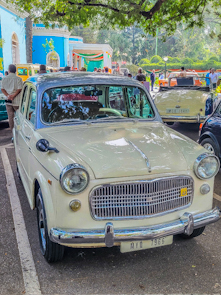
Fiat 1100
All of our family cars were Fiats. My mother believed that because there were many hills and mountains in Italy, where Fiats are made, these cars must be reliable and ‘strong’. We had a Fiat 600, then an 1100 (millecento), and then finally, a 1200.
Seeing several Fiat 1100s at a vintage car show held at the Bangalore Club (in Bangalore/Bengaluru) jogged my memories of my mother, the 1960s and 1970s, and my childhood motoring experiences.
THE HANGING GARDENS, located on the top of Bombay’s Malabar Hill, is a pleasant park in which to pass time in a relaxing way. We spent an enjoyable hour and a half sitting on a bench in the shade one Sunday morning.
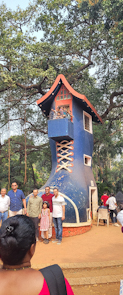
After leaving our seat, my wife wanted to see if something that she remembered from her childhood in the 1950s still existed. After leaving the Gardens and crossing a road, we entered another park, the Kamala Nehru Park, which contains a children’s play area. And it was here that we found the thing my wife recalled: a giant boot. Children can enter the boot through a door in it, and then climb up an internal staircase to reach a viewing platform at the top of the boot. The boot reminds one of the story of the old woman who lived in a shoe.
My wife used to be taken to play in the shoe by her grandmother who lived nearby in Walkeshwar Road. My wife remembered the boot as having been painted pink, but since then it has been repainted and is no longer that colour.
RECENTLY WHEN WALKING in an an orchard in Hampshire, we found that the trees were literally groaning beneath the weight of apples growing upon them. Seeing all of these ripe fruits brought back memories of visiting family friends, who lived in Kent, during my early childhood.
Whenever we went to their home, we were given a lavish lunch. The dessert was always apple pie. The apples were covered with a topping of pastry. What fascinated me was that the centre of this topping was always raised above the rest of it. Beneath this centrally located curved mound, – and this is what used to fascinate me – there would be a ceramic cup buried amongst the cooked apples. Discovering a cup buried in an apple pie tickled my imagination, and always puzzled me. I believe that it is normal practice to insert something to support the pastry topping, but when I was less than 10 years old, I did not know this. Our friend who used to cook this apple pie for us is, sadly, no more,
Incidentally, in recent years, some of the best apple pie I have tasted is that served at The Only Place in Museum Road, Bangalore (south India). Its recipe was introduced to the restaurant by the American wife of Haroon, who founded the restaurant many years ago.
DURING MY CHILDHOOD in the 1960s, there was a concrete platform on Hampstead Heath Extension. It was close to Hampstead Way. Today, where it used to be visible, there is a mound of impenetrable bushes and weeds surrounded by a fence. The concrete structure was a base for anti-aircraft guns during WW2. Although, many German aircraft were knocked out of the sky by guns such as these, many of them caused a great deal of damage all over London. Recently, while sorting through some books, I came across a slender volume called “Hampstead At War”. It was first published by Hampstead Borough Council in 1946, republished by the Camden Historical Society in 1979, and then again in 1995. The book contains many photographs of the terrible destruction caused by bombs dropped by the Luftwaffe over Hampstead.
One of the photographs in the book struck a particular chord with me. It shows the badly damaged Hare and Hounds pub after it had been bombed in 1940. The pub, which was almost next door to the famous Old Bull & Bush pub, was established in about 1751. However, the building that was destroyed was built a long time after that.
Between 1965 and 1970, I used to travel From Golders Green station to Highgate School on the bus (route 210). Every school day, the bus would pass the Old Bull & Bush and its neighbour, the Hare and Hounds. When passing the latter in those days, I always wondered why the pub looked so recently built. When leafing through the “Hampstead at War” book today, more than 50 years after leaving the school, I found the answer. The book contains a photograph showing the extensively damaged pub.
The Hare and Hounds was rebuilt during the years I studied at Highgate. Although I can only faintly recall its appearance and can find only one photograph of it after its rebuilding, its presence remains firmly fixed in my memory. Finding the book certainly jogged my memory, and seeing the photographs of war damaged Hampstead makes a great impression. One wonders why the Germans chose to waste their ammunition on an area that has always been mainly residential.
IT WAS UNUSUAL for my parents to take us on holidays at the seaside during my childhood. Mostly we went to cities, such as Bruges, Florence, and Delft, where there were plenty of artistic treasures to be viewed. Yet, one year when I was less than 10 years old, we spent a holiday at a hotel in a small place, Maidencombe, which is a few miles east of Torquay in Devon. All I can recall of this trip was staying in a country house hotel that had a beautiful flower-filled garden.
Yesterday (4 June 2025), my wife and I stopped at Maidencombe. I could not recognise anything, and I believe that the hotel where we stayed over 60 years ago has disappeared.
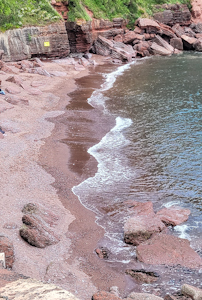
We followed signs to the Café Rio, which is reached down a winding staircase that clings to the slopes of a hillside overlooking a secluded cove surrounded by striated red rocks. The hillside is covered with luxuriant vegetation. The café is on a terrace above a small beach, where intrepid swimmers were enjoying the sea. We ate a light lunch on this terrace, and enjoyed the view.
I am pleased we visited Maidencombe but I can not stop wondering why my parents chose to go there instead of one of our usual culturally rich destinations. What or who influenced them to select Maidencombe? I will most probably never know.
When I was eleven years old, we stayed in Chicago (Illinois) for three months.
One evening, our parents took us to something wonderful. It was at the Kungsholm Restaurant in the centre of Chicago. After dining at its self-service Danish ‘smörgåsbord’ (a kind of buffet), we were ushered into a small theatre. The lights went down, and the curtains of a small stage opened. Then we watched a whole opera performed by puppets operated by people out of sight below the stage. I do not recall which opera we watched, but I do remember at the end of the performance, the puppeteers raised their heads above the stage. As my eyes had become used to the short puppets during the opera, the heads of the puppeteers looked gigantic.
WHEN MY FATHER sold our family home in Hampstead Garden Suburb in the early 1990s, he gave some of his unwanted possessions to some neighbours, who still live opposite. They stored much of it in their attic. Recently, a plumbing problem required them to empty the attic. Soon after this, we paid them a visit as we had not seen them since before the start of the covid19 pandemic and its associated lockdowns. Amongst the stuff they removed from their attic, they found a sturdy, brown leather suitcase in a well-worn canvas protective covering. The covering was stencilled with the letters ‘BSY’, these being my father’s initials.
The canvas case bears an oval label, which was provided by the “Holland-Afrikalijn”. It states that the suitcase was “For the cabin” and the name of the ship’s destination was “Southampton”. The ship carrying this case was the “Jagersfontein”, and the label bears the date “3/9/55”, There is another torn label, which was issued by South African Railways and what is left of it is “T Elizabeth”, which probably was “Port Elizabeth” before it was torn. This suggests that the case must have travelled to and/or from Port Elizabeth by rail. A third label, which is circular and was stuck on by the shipping company bears a large capital “Y”.
By September 1955, I was three years (and a few months) old. That year, my parents, who were born in South Africa, took me from London, where we lived, to be shown to family and friends in that country. I remember almost nothing of that visit apart from two things. One of them was getting my small foot caught in the groove of the tram-like track of a mobile dockside crane. The other thing was being afraid of the cacti in a greenhouse in a park in Port Elizabeth, the city where my father’s sister and his mother resided.
I know that we also visited King Williams Town, where many of my mother’s family lived. This visit was recorded in a 1955 issue of the town’s “Cape Mercury” newspaper. I discovered it while I was researching information about my mother’s grandmother, who lived in the town. The newspaper article, which is full of small inaccuracies, described me as being “… an adorable little son, aged three …”.
The Jagersfontein has an interesting history (http://ssmaritime.com/fontein-ships-1.htm). Built in Danzig (Germany) in 1939 and given another name, it was badly damaged during WW2, and it sunk. In 1947, she was recovered from the sea, towed to Holland, and refurbished by the Dutch. In September 1947, she began sailing again, as a passenger-cargo liner.
During the voyage from Southampton to South Africa, I crossed the Equator for the first time in my life. My mother told me that when the ship carrying us crossed the Line, a fancy-dress party was held for the children onboard. Some of the parents knew that this would happen and had come prepared with fancy-dress costumes for their children. However, my mother was unaware that this would happen. Being a creative person, she took some of the white bed linen from our cabin, and fashioned a Roman toga for me to wear at the party.
My mother died 44 years ago. Only a few days before we saw the suitcase at our old neighbours’ home, I was rummaging through some photographs that I had not seen since her death. It shows me in my rapidly fashioned bedsheet toga, standing between two larger children dressed up to depict Belisha beacons (that mark so-called ‘zebra’ pedestrian crossings). A small cloth with black and white stripes, representing a zebra crossing, separated the two beacons. Behind the three of us are some adults, whom I cannot recognise.
Empty, the leather case, which looks almost new, weighs 6.3 kilogrammes (13.9 lb). In 1955, passengers travelling by ships such as the Jagersfontein did not need to worry about the weight of their luggage. There were plenty of porters to carry it. We have been given the suitcase, which our daughter is keen to have because it is a family heirloom with sentimental value. Along with the photograph and the newspaper cutting, the case is a wonderful reminder of my first ever travel adventure.
BETWEEN SEPTEMBER AND DECEMBER 1963, I was living with my parents in a rented flat in southern Chicago because my father had been invited to work at the University of Chicago as a visiting academic for three months. I was eleven years old. On the 23rd of November, President John F Kenedy was assassinated – an event which moved me greatly at the time. Unknown to me then, there was another event that occurred in the UK on that fateful day. It was the broadcast of the first episode of BBC’s science fiction programme, “Dr Who”, which was aimed at entertaining children. Because of the assassination and power outages in Britain, the first episode was repeated a week later immediately before the second episode.
A few days later, I received an airletter from my friend Nicholas Gilks, who lived, as we did, in north London’s Hampstead Garden Suburb. His family had a television, but ours did not. So, I used to visit his home to watch children’s television (BBC) programmes that began at around 5 pm. Nick’s letter contained exciting news about the wonderful new programme, “Dr Who”, which had just begun to be broadcast. He wrote that he could not wait for me to get back to London so that we could watch it together. On my return, I saw my first episode of “Dr Who” and was both amazed by it and afraid of it. It was in black and white. Colour television had not yet arrived in the UK.
Just in case you are unfamiliar with “Dr Who”, here are a few basics. First, Dr Who is a time traveller. The first Dr Who was played by Richard Hartnell (1908-1975). The Doctor travels through space and time in an old-fashioned police box, called the ‘Tardis’. From the outside, the Tardis looks too small to hold more than one person, but on entering it, it seems very spacious. There was plenty of room for Dr Who and his two or three assistants to move around the space-age equipment within the Tardis. As Dr Who travels forwards and backwards in time, he and his companions encounter many sinister opponents, including the Daleks. These robotic objects which spoke English with a sinister accent appeared in many episodes. They were armed with weapons that could exterminate a variety of beings – human and otherwise.
“Dr Who” was screened at about 5pm. In winter and early spring, darkness had fallen by the time the programme ended. I would walk home after seeing the show, but it was so frightening that I felt scared to walk the short distance alone. So, very kindly, Nick’s father used to accompany me most of the way. When I look back on the early “Dr Who” shows today, I cannot believe that they affected me so much. In 1963 and the few years following it, what was being produced by the BBC without the benefit of sophisticated computers and digitally produced special effects was truly remarkable. And to my then young mind, it was oddly realistic even though I knew it was only a television show.
It was with some interest that today (the 26th of August 2024) we went to the Royal Albert Hall to attend the dress rehearsal of a BBC Promenade Concert dedicated to the music that has been played in “Dr Who” during the decades since I first watched it. Our daughter was performing in it as a member of the London Philharmonic Choir, which was accompanied by various soloists, and the BBC National Orchestra of Wales. As the musicians and singers performed excellently, large screens displayed excerpts from current and recent episodes of “Dr Who”. While the external appearance of the Tardis looked the same as it did in 1963, its interior has changed dramatically. It looks far more sophisticated than it did in 1963. And the excerpts demonstrated that full use is made of up-to-date computerised cinematographic technology. Although the scenes we watched did not frighten me, I thought that they would cause the children who watch it (and enjoy it) today to have nightmares. Also, there seemed to be far more romance in the excerpts than there was back in the early 1960s. My guess is, having seen a few elderly “Dr Who” enthusiasts in the audience at the Royal Albert Hall, that many who began watching the programme as children have never stopped watching it despite the passage of time since their childhood.
Sadly, my friendship with Nick diminished significantly when I was about 14. Since then, I have never seen an episode of “Dr Who”. And more tragically, a few years ago, I learned that Nick had died. Watching the dress rehearsal today and seeing a Dalek on the stage brought back memories of sitting with Nick and his brother in front of their television in their home in Hampstead Garden Suburb.
WHILE PREPARING A SAUCE for pasta today, my mind shot back to my mother in the kitchen during my childhood. Many people regarded her as being a competent cook. She was an enthusiastic follower of the recipes in cookbooks by Elizabeth David. She bought only the best cooking utensils, and sourced many ingredients in the Mediterranean food stores that used to exist in Soho – a few remain, but many have gone. As a child, I was allowed in the kitchen to watch when my mother was cooking. The more I saw, the greater my desire to try to cook. However, this wish was not to be fulfilled while my mother was alive.
My birth and the first few months of my life were difficult as far as health was concerned. Consequently, my mother was highly protective of me, and then later also of my sibling. My mother saw danger everywhere, and not least in the kitchen. There were sharp knives, razor like tin can lids, and the risk of getting burnt either by the oven or the hot things prepared on it. We had electric hob rings because my mother was anxious about gas explosions and open flames. I was allowed to watch her cooking, but not to touch anything she was using. Curiously, even though knives were involved, I was often asked to wash the dishes, cutlery, and cooking utensils.
Sadly, my mother died at a young age. I was 28 when she went, and still residing in the family home along with my father, who had no interest in cooking. He enjoyed good food, but would have no part in preparing it. With my mother no longer around and a well-equipped kitchen, I began to experiment with cooking, and enjoyed the activity.
Over the years, I have done much cooking, and still enjoy doing it. I am not sure what made me think of my mother today as I prepared the pasta sauce, but it might have been the pan in which I was making it. For, that pan was one that my mother used often. She must have bought it back in the 1960s, and because she purchased only the best, it is still perfectly usable much more than 50 years later.
My wife is a good cook, but I do most of the day-to-day cooking. When she told a friend of ours that I do most of the cooking, the friend asked my wife:
“Don’t you feel diminished as a woman if Adam does most of the cooking?”
My wife, who is quite happy with the arrangement, replied with another question:
“Do I look like an idiot?”
Sometime later when our daughter was a toddler, she and my wife visited some friends. After a few minutes, our little one, used to seeing me cooking, came running out of the kitchen with wide open eyes, and said to my wife:
“Do you know, Mama, but the Mummy is doing the cooking in this house.”
THE FIRST TIME I visited Turkey was in about 1960. My father was participating in a conference organised by the Eczacibaşi Foundation. It was held in the then luxurious Çinar Hotel on the European shore of the Marmara Sea at a place called Yesilköy, which is about 9 miles west of old Istanbul. This April (2024), we visited Yesilköy both for old times sake and because we had read that the place has several interesting sights to be seen. Incidentally, it was in Yesilköy that I had my first piece of chewing gum.
After disembarking from the Marmaray train, which connects settlements on the coast of the Sea of Marmara, we enjoyed the best cheese börek we have eaten since arriving in Turkey. Then, despite constant rain, we walked along Istasyon Caddesi, admiring the many houses with decorative timber cladding that line the avenue.
We made a small detour to look at a Syriac Christian Church, which looked recently built. We could not enter because a service was in progress. Thence, we walked to the rainswept seafront, where we looked around a museum dedicated to the life of Ataturk. It was housed in a mansion once owned by Greeks. The ground floor is dedicated to the first decade of the Turkish Republic, which was founded in October 1923. The first floor has a display of ethnographic exhibits from Turkey. The second floor is a collection of photographs, items, and books relating to the life of Ataturk.
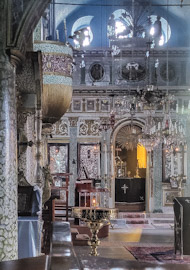
Greek Orthodox church in Yesilköy
Next, we came across a Greek Orthodox church. We could enter its covered porch in which candles were flickering. Through the windows of the porch we could see enough of the church’s interior to realise it is quite beautiful. Unfortunately, the church was locked.
Nearby, we found the huge Latin Catholic Church, which was open. Its interior was nothing special, apart from one religious painting which contained words in the Ottoman Turkish script. The size of the church suggests that there might once have been a large Roman Catholic community in Yesilköy.
Yet another church is a few yards away from the Latin church. It is an Armenian church, enclosed in a compound surrounded by high walls. The entrance was open, and after looking at the church, we joined the congregation (at least 40 people), who invited us to have tea and cakes. A couple of gentlemen began speaking with us in English. They told us that the Çinar Hotel was no longer in business, but it was still standing. They also told us that they are in the textile business. They are waiting for Indian visas because they are planning to visit Bangalore and Tiripur soon because they are looking to buy textile machinery there.
Several people told us that the Çinar Hotel is about a mile from the centre of Yesilköy. As it was cold and raining we decided against looking for it. Despite not revisiting the place I first stayed in Turkey more than 60 years ago, we saw Yesilköy and some of its fascinating sights. It is close to the railway tracks and not on most tourists’ beaten tracks.





 yamey
yamey 