Some old baggage discovered in an attic and a Roman toga

WHEN MY FATHER sold our family home in Hampstead Garden Suburb in the early 1990s, he gave some of his unwanted possessions to some neighbours, who still live opposite. They stored much of it in their attic. Recently, a plumbing problem required them to empty the attic. Soon after this, we paid them a visit as we had not seen them since before the start of the covid19 pandemic and its associated lockdowns. Amongst the stuff they removed from their attic, they found a sturdy, brown leather suitcase in a well-worn canvas protective covering. The covering was stencilled with the letters ‘BSY’, these being my father’s initials.

The canvas case bears an oval label, which was provided by the “Holland-Afrikalijn”. It states that the suitcase was “For the cabin” and the name of the ship’s destination was “Southampton”. The ship carrying this case was the “Jagersfontein”, and the label bears the date “3/9/55”, There is another torn label, which was issued by South African Railways and what is left of it is “T Elizabeth”, which probably was “Port Elizabeth” before it was torn. This suggests that the case must have travelled to and/or from Port Elizabeth by rail. A third label, which is circular and was stuck on by the shipping company bears a large capital “Y”.

By September 1955, I was three years (and a few months) old. That year, my parents, who were born in South Africa, took me from London, where we lived, to be shown to family and friends in that country. I remember almost nothing of that visit apart from two things. One of them was getting my small foot caught in the groove of the tram-like track of a mobile dockside crane. The other thing was being afraid of the cacti in a greenhouse in a park in Port Elizabeth, the city where my father’s sister and his mother resided.

I know that we also visited King Williams Town, where many of my mother’s family lived. This visit was recorded in a 1955 issue of the town’s “Cape Mercury” newspaper. I discovered it while I was researching information about my mother’s grandmother, who lived in the town. The newspaper article, which is full of small inaccuracies, described me as being “… an adorable little son, aged three …”.

The Jagersfontein has an interesting history (http://ssmaritime.com/fontein-ships-1.htm). Built in Danzig (Germany) in 1939 and given another name, it was badly damaged during WW2, and it sunk. In 1947, she was recovered from the sea, towed to Holland, and refurbished by the Dutch. In September 1947, she began sailing again, as a passenger-cargo liner.

During the voyage from Southampton to South Africa, I crossed the Equator for the first time in my life. My mother told me that when the ship carrying us crossed the Line, a fancy-dress party was held for the children onboard. Some of the parents knew that this would happen and had come prepared with fancy-dress costumes for their children. However, my mother was unaware that this would happen. Being a creative person, she took some of the white bed linen from our cabin, and fashioned a Roman toga for me to wear at the party.

My mother died 44 years ago. Only a few days before we saw the suitcase at our old neighbours’ home, I was rummaging through some photographs that I had not seen since her death. It shows me in my rapidly fashioned bedsheet toga, standing between two larger children dressed up to depict Belisha beacons (that mark so-called ‘zebra’ pedestrian crossings). A small cloth with black and white stripes, representing a zebra crossing, separated the two beacons. Behind the three of us are some adults, whom I cannot recognise.

Empty, the leather case, which looks almost new, weighs 6.3 kilogrammes (13.9 lb). In 1955, passengers travelling by ships such as the Jagersfontein did not need to worry about the weight of their luggage. There were plenty of porters to carry it. We have been given the suitcase, which our daughter is keen to have because it is a family heirloom with sentimental value. Along with the photograph and the newspaper cutting, the case is a wonderful reminder of my first ever travel adventure.

A celebration of a science fiction television show at London’s Royal Albert Hall

BETWEEN SEPTEMBER AND DECEMBER 1963, I was living with my parents in a rented flat in southern Chicago because my father had been invited to work at the University of Chicago as a visiting academic for three months. I was eleven years old. On the 23rd of November, President John F Kenedy was assassinated – an event which moved me greatly at the time. Unknown to me then, there was another event that occurred in the UK on that fateful day. It was the broadcast of the first episode of BBC’s science fiction programme, “Dr Who”, which was aimed at entertaining children. Because of the assassination and power outages in Britain, the first episode was repeated a week later immediately before the second episode.

A few days later, I received an airletter from my friend Nicholas Gilks, who lived, as we did, in north London’s Hampstead Garden Suburb. His family had a television, but ours did not. So, I used to visit his home to watch children’s television (BBC) programmes that began at around 5 pm. Nick’s letter contained exciting news about the wonderful new programme, “Dr Who”, which had just begun to be broadcast. He wrote that he could not wait for me to get back to London so that we could watch it together. On my return, I saw my first episode of “Dr Who” and was both amazed by it and afraid of it. It was in black and white. Colour television had not yet arrived in the UK.

Just in case you are unfamiliar with “Dr Who”, here are a few basics. First, Dr Who is a time traveller. The first Dr Who was played by Richard Hartnell (1908-1975). The Doctor travels through space and time in an old-fashioned police box, called the ‘Tardis’. From the outside, the Tardis looks too small to hold more than one person, but on entering it, it seems very spacious. There was plenty of room for Dr Who and his two or three assistants to move around the space-age equipment within the Tardis. As Dr Who travels forwards and backwards in time, he and his companions encounter many sinister opponents, including the Daleks. These robotic objects which spoke English with a sinister accent appeared in many episodes. They were armed with weapons that could exterminate a variety of beings – human and otherwise.

“Dr Who” was screened at about 5pm. In winter and early spring, darkness had fallen by the time the programme ended. I would walk home after seeing the show, but it was so frightening that I felt scared to walk the short distance alone. So, very kindly, Nick’s father used to accompany me most of the way. When I look back on the early “Dr Who” shows today, I cannot believe that they affected me so much. In 1963 and the few years following it, what was being produced by the BBC without the benefit of sophisticated computers and digitally produced special effects was truly remarkable. And to my then young mind, it was oddly realistic even though I knew it was only a television show.

It was with some interest that today (the 26th of August 2024) we went to the Royal Albert Hall to attend the dress rehearsal of a BBC Promenade Concert dedicated to the music that has been played in “Dr Who” during the decades since I first watched it. Our daughter was performing in it as a member of the London Philharmonic Choir, which was accompanied by various soloists, and the BBC National Orchestra of Wales.  As the musicians and singers performed excellently, large screens displayed excerpts from current and recent episodes of “Dr Who”. While the external appearance of the Tardis looked the same as it did in 1963, its interior has changed dramatically. It looks far more sophisticated than it did in 1963. And the excerpts demonstrated that full use is made of up-to-date computerised cinematographic technology. Although the scenes we watched did not frighten me, I thought that they would cause the children who watch it (and enjoy it) today to have nightmares. Also, there seemed to be far more romance in the excerpts than there was back in the early 1960s. My guess is, having seen a few elderly “Dr Who” enthusiasts in the audience at the Royal Albert Hall, that many who began watching the programme as children have never stopped watching it despite the passage of time since their childhood.

Sadly, my friendship with Nick diminished significantly when I was about 14. Since then, I have never seen an episode of “Dr Who”. And more tragically, a few years ago, I learned that Nick had died. Watching the dress rehearsal today and seeing a Dalek on the stage brought back memories of sitting with Nick and his brother in front of their television in their home in Hampstead Garden Suburb.

Blades and flames and other hazards in the kitchen

WHILE PREPARING A SAUCE for pasta today, my mind shot back to my mother in the kitchen during my childhood. Many people regarded her as being a competent cook. She was an enthusiastic follower of the recipes in cookbooks by Elizabeth David.  She bought only the best cooking utensils, and sourced many ingredients in the Mediterranean food stores that used to exist in Soho – a few remain, but many have gone. As a child, I was allowed in the kitchen to watch when my mother was cooking. The more I saw, the greater my desire to try to cook. However, this wish was not to be fulfilled while my mother was alive.

My birth and the first few months of my life were difficult as far as health was concerned. Consequently, my mother was highly protective of me, and then later also of my sibling. My mother saw danger everywhere, and not least in the kitchen. There were sharp knives, razor like tin can lids, and the risk of getting burnt either by the oven or the hot things prepared on it. We had electric hob rings because my mother was anxious about gas explosions and open flames. I was allowed to watch her cooking, but not to touch anything she was using. Curiously, even though knives were involved, I was often asked to wash the dishes, cutlery, and cooking utensils.

Sadly, my mother died at a young age. I was 28 when she went, and still residing in the family home along with my father, who had no interest in cooking. He enjoyed good food, but would have no part in preparing it. With my mother no longer around and a well-equipped kitchen, I began to experiment with cooking, and enjoyed the activity.

Over the years, I have done much cooking, and still enjoy doing it. I am not sure what made me think of my mother today as I prepared the pasta sauce, but it might have been the pan in which I was making it. For, that pan was one that my mother used often. She must have bought it back in the 1960s, and because she purchased only the best, it is still perfectly usable much more than 50 years later.

My wife is a good cook, but I do most of the day-to-day cooking. When she told a friend of ours that I do most of the cooking, the friend asked my wife:

“Don’t you feel diminished as a woman if Adam does most of the cooking?”

My wife, who is quite happy with the arrangement, replied with another question:

“Do I look like an idiot?”

Sometime later when our daughter was a toddler, she and my wife visited some friends. After a few minutes, our little one, used to seeing me cooking, came running out of the kitchen with wide open eyes, and said to my wife:

“Do you know, Mama, but the Mummy is doing the cooking in this house.”

My wife answered:

“Well, I never…”

ONCE A VILLAGE ON THE MARMARA SEA, NOW A SUBURB OF ISTANBUL

THE FIRST TIME I visited Turkey was in about 1960. My father was participating in a conference organised by the Eczacibaşi Foundation. It was held in the then luxurious Çinar Hotel on the European shore of the Marmara Sea at a place called Yesilköy, which is about 9 miles west of old Istanbul. This April (2024), we visited Yesilköy both for old times sake and because we had read that the place has several interesting sights to be seen. Incidentally, it was in Yesilköy that I had my first piece of chewing gum.

After disembarking from the Marmaray train, which connects settlements on the coast of the Sea of Marmara, we enjoyed the best cheese börek we have eaten since arriving in Turkey. Then, despite constant rain, we walked along Istasyon Caddesi, admiring the many houses with decorative timber cladding that line the avenue.

We made a small detour to look at a Syriac Christian Church, which looked recently built. We could not enter because a service was in progress. Thence, we walked to the rainswept seafront, where we looked around a museum dedicated to the life of Ataturk. It was housed in a mansion once owned by Greeks. The ground floor is dedicated to the first decade of the Turkish Republic, which was founded in October 1923. The first floor has a display of ethnographic exhibits from Turkey. The second floor is a collection of photographs, items, and books relating to the life of Ataturk.

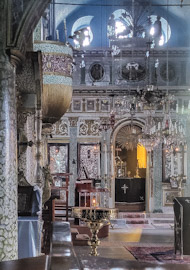
Greek Orthodox church in Yesilköy

Next, we came across a Greek Orthodox church. We could enter its covered porch in which candles were flickering. Through the windows of the porch we could see enough of the church’s interior to realise it is quite beautiful. Unfortunately, the church was locked.

Nearby, we found the huge Latin Catholic Church, which was open. Its interior was nothing special, apart from one religious painting which contained words in the Ottoman Turkish script. The size of the church suggests that there might once have been a large Roman Catholic community in Yesilköy.

Yet another church is a few yards away from the Latin church. It is an Armenian church, enclosed in a compound surrounded by high walls. The entrance was open, and after looking at the church, we joined the congregation (at least 40 people), who invited us to have tea and cakes. A couple of gentlemen began speaking with us in English. They told us that the Çinar Hotel was no longer in business, but it was still standing. They also told us that they are in the textile business. They are waiting for Indian visas because they are planning to visit Bangalore and Tiripur soon because they are looking to buy textile machinery there.

Several people told us that the Çinar Hotel is about a mile from the centre of Yesilköy. As it was cold and raining we decided against looking for it. Despite not revisiting the place I first stayed in Turkey more than 60 years ago, we saw Yesilköy and some of its fascinating sights. It is close to the railway tracks and not on most tourists’ beaten tracks.

MORE ABOUT CATS IN ISTANBUL AND SOMETHING ABOUT CATS IN MY LIFE

I HAVE ALWAYS LIKED cats. Once, when I was about 7 years old, I was in bed suffering from one of my then frequent attacks of tonsillitis. I was recovering in bed when a small black cat wandered into my bedroom.

Knowing my love of cats, my mother had bought one to cheer me up. I christened it “Crumpet”.

There was a big problem. My mother was not keen on cats. As she thought I was too young to be trusted with a tin opener and she was worried that I might cut myself on the opened tins of cat food, she became Crumpet’s feeder.

Because Crumpet knew that Mom was the source of her food, she took a liking to her, often rubbing herself against my mother’s legs. This did not please my mother, and I believe that Crumpet sensed this. After a few months, Crumpet abandoned our house, and moved into another house along our road, where she found a more appreciative host.

Cat shelters in Üsküdar

We are now visiting Istanbul, which is swarming with cats. As I have already written previously, street cats seem to be well treated in this city. People put out food for them, and various organisations, including local municipalities, provide them with cosy shelters.

Today, whilst sitting in a garden outside a mosque in Üsküdar in the Asian part of Istanbul, we saw many cats – as usual. It was a cold, rainy day, and one cat, lacking in shyness, spent time keeping warm by sitting on my wife’s lap, and then mine.

What we have seen of the cats of Istanbul reinforces my affection for these furry creatures.

Taking the plunge at the former YWCA in London’s Bloomsbury

MY MOTHER WAS ANXIOUS about water. Because I do not think that she could swim, I believe that she considered it very important that I should learn how to propel myself through water. As a result, my parents paid for me to have many private swimming lessons (usually on Saturday mornings) – most of them were a waste of their hard-earned money. I was a slow learner because I was frightened by the thought that I might sink and drown.

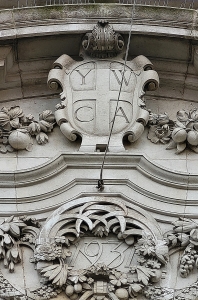
Today (the 4th of March 2024), we were walking from Tottenham Court Road Underground station to the British Museum via Great Russell Street. Along that thoroughfare, we passed a pre-WW2 brick building, which now houses the luxurious Bloomsbury Hotel. If you look above its main entrance, you can see carved stone masonry that indicates that the building, completed in 1933, was once a branch of the YWCA – it was The YWCA Central Club. The architect was Sir Edwin Lutyens of Hampstead Garden Suburb and New Delhi fame. It remained a YWCA until the 1970s, then became a hostel, and now it has been converted into its present reincarnation. While the building served as the YWCA it had a swimming pool in its basement. It was in this pool that I finally learned to swim – I was about 12 years old.

The Saturday morning classes were conducted by a Mr Brickett. Each of his pupils began by buying a set of his inflatable arm bands, which were worn on the upper halves of the student’s arms. Each lesson, Mr Brickett inflated the arm bands, and using these, we swam (or made our way) across the width of the pool – without letting our feet touch the bottom. On each successive lesson, Mr Brickett inflated the armbands less than on the previous lesson. Eventually, we were making our way across the pool with uninflated armbands. When we could do this, we had to swim one width (about 10 yards) without the armbands, and then we were given a fancy certificate with a Union Jack printed on it.

I have only just learned that Mr Brickett, who taught me how to swim, was Reg Brickett, who, along with his brother Sidney, was a founder member and then President of the Swimming Teachers Association of Great Britain. Reg was the inventor of the arm bands, which were sold as ‘Brickett’s Swim Easy arm floats’ (www.playingpasts.co.uk/articles/swimming/the-valuable-and-unremitting-services-of-swimming-coach-walter-brickett/). Reg and his brother were sons of the famous British Olympic swimming coach Walter Septimus Brickett (1865-1933). He was responsible for training over 100 British swimming champions. Well, I did not know any of this when I was awarded my (now sadly lost) certificate.

We entered the attractive lobby of the Bloomsbury to ask about the pool. The pool is no longer in use, but still exists. It has been covered by a floor, and the room that housed it has been redecorated, and is now used to host functions and meetings. Although I swim extremely rarely, I do not think that I will ever forget my lessons with Mr Brickett at what was once the YWCA.

Trains, buses, and Bar Linda in London’s Golders Green

MUCH HAS CHANGED IN Golders Green since I was a small child in the 1950s. However, a few things have remained more or less the same. My earliest memories of Golders Green Underground station and its neighbouring open-air bus terminus date back to about 1960, when I began travelling by bus to school in Swiss Cottage.

The Underground station used to have two entrances. One, which faces the bus yard, is still in use. The other, which was approached by a long, covered walkway from beneath the bridge crossing Finchley Road, was closed to the public many years ago, but the passageway still exists. It was this entrance that my family used when using the train to travel into central London. There was also a covered staircase situated between these two entrances – this, now disused, was opened during rush hours. It led to the small parking area where the H2 bus, which serves Hampstead Garden Suburb, begins its journey. During my childhood, there was no public transport in the Suburb. Every day, I used to make the 10-minute walk to Golders Green station, passing the crematorium and the Jewish cemetery on my way.

Overlooking the eastern edge of the bus yard, is what was once the Hippodrome Theatre. When I was a lad, this was a flourishing theatre showing plays and pantomimes. Later, it was taken over by the BBC. After they left it, various religious organisations have used it for their meetings. Built in 1913, six years after the Underground was extended from Hampstead to Golders Green, this building’s exterior looks much as it did when I first remember seeing it.

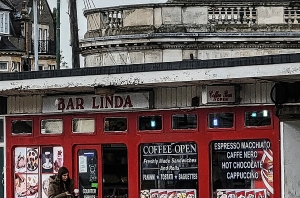
The western edge of the bus yard has always been lined with a row of single storey sheds. Most of these have been used as shops and offices for London Transport. One of them houses a small café called Bar Linda. This was not in existence when I first used to visit the station, but I believe that it opened in the 1960s. Although this friendly little place has been serving customers for many decades, the first time I ventured inside it was in about 2017 when I was about to walk around Golders Green to take photographs for a blog article I was planning to write. I have re-visited it several times since then.

Although Golders Green might not be as aesthetically pleasing as its neighbours, Hampstead and Hampstead Garden Suburb, it is an area full of interest. Much has happened there since 1907 when it began growing from a rural hamlet into a leafy suburb. You can discover much more about Golders Green – its past, my memories of it, and its vibrant present – by reading my book “GOLDERS GREEN & HAMPSTEAD GARDEN SUBURB: VISIONS OF ARCADIA”, which is available (paperback and/or Kindle, from Amazon websites, such as:

An old survivor in Hampstead

MUCH HAS CHANGED in Hampstead since I used to visit it every weekend during the early 1960s. The same is true for many places in London.

The Pimpernel on Heath Street, where my parents enjoyed espresso coffees, has long since closed. Likewise, my parents’ favourite Cellier du Midi in Church Row. Tragically, the High Hill Bookshop on the High Street disappeared many years ago, only to be replaced by yet another branch of Waterstones.

The venerable Everyman Cinema still functions, but now it is far more plush than it used to be when I was a lad. Of Hampstead’s many second-hand bookshops, only one, Keith Fawkes, remains. However, only recently I spotted Mr Fawkes sitting outside his shop, which has now been rebranded as ‘House Clearance Specialists’.

Another remnant of the Hampstead of my childhood is the Shahbhag Indian restaurant on Rosslyn Hill. Founded in 1954, my parents patronised it occasionally during the 1960s. I ate there once or twice in the late 1960s, but not since. By the 1970s, I had Indian friends, who introduced me to restaurants where the Indian food was far more authauthentic was offered at the Shahbhag. Unfortunately, many of these better eateries, many of which were on or near Warren, no longer exist.

During a recent stroll through Hampstead, I noticed that the Shahbhag was still in business. Seeing this sparked off the memories I have just described.

Photographs taken in a garden

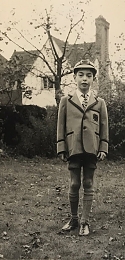
IN 1960, when I was 8 years old, I was accepted as a pupil at the Hall School in London’s Swiss Cottage area. Recently, I received some photographs of me in my newly acquired Hall School uniform. They were taken in the garden of our house in Hampstead Way in the Hampstead Garden Suburb, Maybe, it is fortunate that the photographs are in black and white because the Hall’s uniform was pink trimmed with black. The Hall’s ‘logo’ was a black Maltese cross – also a symbol used by the German army. I remember occasionally, children from other schools used to shout “Nazis” at me and my friends when we were wearing our uniforms in the street. The photographs were taken by my uncle Felix, who was born in South Africa.

When Felix came to London from South Africa in the second half of the 1950s, one of his first jobs was working in a photography shop in London’s Holborn. Like other members of my mother’s family, he was a keen photographer. His grandfather, my great grandfather, opened a photography studio in King William’s Town in the Eastern Cape in 1880.  It was while Felix was working in the shop that the photographs of me in my new uniform were taken.

I remember the occasion vividly. Felix arrived at our house in the Suburb, carrying with him a great deal of equipment borrowed from the shop. Most of it was professional lighting on collapsible stands. Felix spent some time setting up a photographic studio in our living room. There were wires all over the place, and every electric socket in the room was used to power the lighting. I was positioned in a suitable pose. When he was ready, my uncle began switching on the lights. Then, it happened. The house’s electrical fuses blew, and all the lights went out. I remember that my parents were not too pleased with what had happened.

Because of the electrical problem, the much-wanted photographs, which were to be sent to relatives in South Africa, had to be taken outside in the garden. Seeing these pictures six decades later brought that occasion to the forefront of my memory.

Felix was a delightful, kindly man. He was everyone’s friend, and never harboured a grudge against anyone. Although he never had any children, I believe that he regarded the whole world as his family.

A bigger pool

IN COMMON WITH most people, I have little or no memory of the first two or three years of my life. My earliest recollections are the birth of my sibling when I was four years old, and walking with my parents to St Albans Church Hall in Golders Green to collect the free orange juice that the government provided in the 1950s. That was issued to children under the age of two, so it must have been for my sibling within the first two years of her life. At that time, I would have been less than six years old.

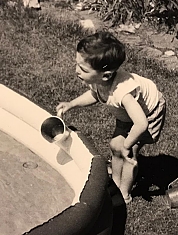
Recently, a cousin sent me scans of some family photographs. They include several of me before I was four years old. One of them taken of me in our garden in Hampstead Garden Suburb shows me standing beside a circular inflatable swimming pool filled with water. In the photograph, I am bending over the pool with a small jug in my right hand. None of this can I recall, except the crazy paving garden path behind me, which remained in existence until the 1990s, and might well still be there.

Seeing the photograph, which must have been taken before 1956, did jog my memory. I recall that after my sibling was born, my parents bought a bigger paddling pool for use in our garden. This was a rectangular affair. It consisted of a metal framework that had to be assembled and a plastic pool that was hung from its four sides before being filled with the garden hose. At each corner there was a small triangular metal seat. Well, I doubt I would have remembered this had I not seen the image of something I cannot remember at all.