
THERE WERE APPLES on sale in the Saturday street market in the Lincolnshire town of Grantham. It is extremely unlikely that they came from the tree (or one of its descendants) that dropped an apple on Sir Isaac Newton (1643-1727), and as is popularly believed, stimulated his ideas about the nature of gravitation.
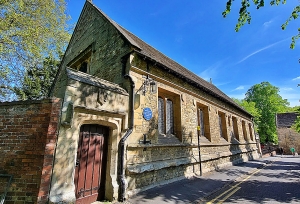
Newton was born at Wilsthorpe Manor, which is about 9 miles south of Grantham. Between the ages of 12 and 17, he attended the King’s School in Grantham. There, he was educated in Latin, Ancient Greek, and probably also in mathematics. In 1661, Newton was admitted to Trinity College in Cambridge, and the rest is history.
The King’s School in Grantham still exists, and is fully functional. It is close to the wonderful St Wulfram church, whose spire is the third tallest in England. The school’s hall, in which Newton was taught, is still used by the school. On its outer walls facing the church, there are two plaques commemorating the fact that Newton was taught within it.
Elsewhere in the centre of Grantham there is another commemorative plaque. It is attached to a building that had not existed in Newton’s time. It records that on this plot of land, there was a house owned by Mr Clak, the apothecary. It was in this gentleman’s house that young Isaac Newton lodged while attending the King’s School.
We had never visited Grantham before, and found its historic centre to be delightful. Newton is not the only person of note who was associated with the town. I hope to write about the other noteworthy people in the future.


