
With tray in hand
A smart turban upon his head
He brings us coffee
The illustration is from my new book about travels in India:

With tray in hand
A smart turban upon his head
He brings us coffee
The illustration is from my new book about travels in India:
Here is a list of the chapters in Adam Yamey’s anthology of his often entertaining travel experiences in India. The book is both for those who know India and for those who do not.
The book and/or Kindle can be bought by clicking on the picture below.
LIST OF CHAPTERS
Introduction … page 9
Prologue: A book from India … 12
Saved by a nosebleed … 14
You married him? … 16
It began with a bang … 18
Shantiniketan … 20
. Maria and Job … 23
Please use the meter … 27
Mixed couples … 29
Coracles … 31
West End Hotel … 35
Less than one degree … 39
Puncher …42
Dining with the dead … 48
A generous gratuity … 50
Miner’s sauce … 52
From Kutch to Norway … 54
Looking so lovable … 56
Beneath the banyan trees … 58
Meeting Khushwant Singh … 61
A palace by the sea … 64
Monkey business … 67
Chicken 65 … 70
Diplomatic amnesia … 72
Meeting the Mahatma … 74
Feeding the cows … 79
Montecatini Terme … 83
Hummus in Hampi … 86
Clothing can be critical … 89
Traditional but trendy … 94
Facial prejudice … 96
Paradise for bookworms … 99
Wrapped up … 105
The personal touch … 108
He worked with Le Corbusier … 111
My Ferrari … 115
From Gandhi to Hitler … 117
An unusual invitation … 121
Looking for literature … 123
Of dargahs and dyeing … 127
Before my time … 130
Improperly dressed … 132
Dining at Limra … 135
Hitler on the shelf … 139
Beefsteak not biryani … 144
Independence Day … 146
Large snakes … 148
One wife four husbands … 150
One day it might be you … 153
Waterfalls and water closets … 155
Cunning old fox … 158
Kutchi beer … 161
Albanians in India … 163
Bodies in the dark … 167
Don’t let it go viral … 169
Clubbing …171
Lopchu … 175
Threads of faith … 179
Nizam’s … 184
Teapots and politics … 187
A refreshing breeze … 190
Buried not burned … 193
Gandhi’s spectacles … 197
Tea at Lothal … 201
They came from Persia … 207
Don’t take the train … 211
Defying inflation … 215
In your face … 217
Cops and crocs … 219
A curious hotel … 222
Denmark by the sea … 225
No bill food is free … 231
Espresso in Diu … 234
Maurice and Bob … 237
An Indian welcome … 242
The pandit’s wife … 244
Royal encounter … 247
Unlocking a secret … 253
Curious coffee … 255
Do they speak Hindi in Russia? … 257
Dashiki … 260
Field of cars … 263
I love Stalin … 267
Jeremy Bentham and Calcutta …269
India’s first mosque … 273
Eggs excepted … 278
Saving their necks … 280
Reclining on a rug … 283
Bollywood in Bangalore … 285
A coffee house … 289
Bargaining in Mount Abu … 291
Not long in Nepal … 295
An unexpected sight … 299
Four bangles … 303
On the safe side … 306
PHD … 308
In touch with history … 311
James and Adeline … 316
Ladies only … 318
Lost property … 320
Plants from paper … 323
A soaking in Calcutta … 325
Mapusa market … 331
IN MAY 1984, I visited Albania, which was then still under the rule of its Stalinist dictator Enver Hoxha (1908-1985). The year before, I had spent a fortnight in Bulgaria. My impression was that Bulgaria was much less vibrant than Albania. In Albania, which had to be visited in an organised group tour, we were treated well, shown a great deal, and were fed well. I knew that by 1984, Albania was far more sealed off from the rest of the world than North Korea is today. Several things were curious about our visit. First, we were not allowed to converse with any Albanians apart from our three official guides or ‘minders’, and other Albanians were unable to converse with, or even approach, us. Secondly, we were watched carefully, even followed by plainclothes agents. Thirdly, and most strangely, whenever we ate a meal, we were kept out of sight of Albanian onlookers. Either we dined in a private room, or our tables were surrounded by curtains or screens, which separated us from other diners and staff in hotels or restaurants.
Our Albanian hosts successfully showed us some of their country’s beautiful towns, countryside, and other attractions. Their aim was to show us westerners what an ideal country Enver Hoxha and his regime had created. And to some extent, I was fooled by what I saw. Many years later, I visited the country (in 2016), and met people who told me that what I had seen was carefully stage managed – a sort of Potemkin village on a grand scale. One person told me that three days before visitors (foreign or state officials) visited the village to which he had been exiled, the town would be cleaned up, the usually empty shops would be stocked, and other things would be arranged to give the place the appearance of prosperity. And as soon as the visitors had passed through, everything would be returned to its normal depressing condition.
After returning from my second trip to Albania, I read a biography of Enver Hoxha written by Blendi Fevziu, and published in 2016. In it, I discovered something that really shocked me. He wrote that by 1984, when I was being wined and dined royally by our Albanian hosts, most Albanians were starving because of a man-made famine that had begun a couple of years earlier. It was no wonder that whenever we ate, we and our food was kept out of sight of all but the most trusted waiters and staff.
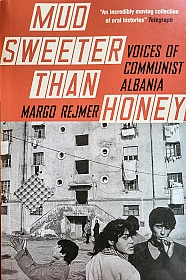
Even when I was in Albania in 1984, I was aware that Hoxha’s regime, like many others run by dictators, was home to prison camps for those who were alleged to have upset the dictator and his paranoid security services. As Margo Rejmer shows in her excellent book “Mud Sweeter Than Honey”, it did not take much to land up in one of Hoxha’s hellish prison camps, and many people suffered this fate.
Rejmer interviewed many people who had lived during Hoxha’s long reign. She successfully demonstrated that every Albanian from the humblest peasant to the highest state official lived in a constant state of fear. Up to one in three people were employed as informers for Hoxha’s secret police – the Sigurimi. It was even dangerous to express one’s thoughts to close members of one’s family. The paranoid dictator ruled, as did Stalin, by endlessly imprisoning or killing anyone that could even slightly be considered a threat to him. Rejmer’s book illustrates this very well and also describes the unbelievable cruelty that prisoners had to suffer in the camps, where they were made to do unpleasant unpaid work, especially in mines.
I am very glad that Rejmer’s book had not yet been written in 1984, because had I read it then, I am certain I would never have set foot in Albania. It is a highly readable, compelling book about the horrific era during which most Albanians had to suffer. My only criticism of it is that she tends to concentrate on people who suffered badly under the regime. However, I suppose it was difficult for her to find anyone who honestly thought that Hoxha had created the paradise, the existence of which our tour guides hoped to persuade us in 1984.
PS My memories of the 1984 visit to Albania are recorded in my book “Albania on My Mind” (https://www.amazon.co.uk/Albania-My-Mind-Adam-Yamey/dp/1291111476/)
SOME SOUVENIRS FROM MY VISITS TO INDIA DURING THE PAST 30 YEARS
— A new book with a curious title —
True love drew me to India. Since my first trip there in late 1993, I have visited the country more than fifty times.
My latest book, “THE HITLER LOCK & OTHER TALES OF INDIA”, is a literary ‘collage’ or anthology of some of my many and varied experiences in India. All the episodes in it are based closely on actual occurrences.
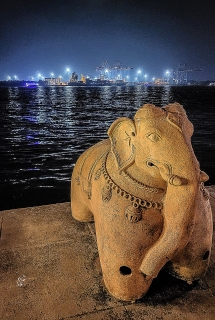
After I married Lopa in London in October 1993, we travelled to her native land, India, a few weeks later. From the moment I first landed on Indian soil, my eyes opened wide with amazement, and ever since then, India has filled me with a delightful sense of wonder.
You might be curious about the book’s title. This relates to a chance one-off sighting (in the 1990s) of a padlock made by an Indian company with the same name as that of Germany’s former Führer. From that day onward, whenever I have been in India and seen a shop or market stall selling locks, I have always looked to see whether any of this company’s locks are on sale.
To discover some of the many things that endear me to India and whether I ever managed to find one of these curiously named locks, you need to read my new book. Illustrated with my photographs, it contains over one hundred short prose vignettes, which can be enjoyed by both those who are familiar with the country and those who are not.
The book and Kindle are available from Amazon.
Paperback: https://www.amazon.co.uk/HITLER-LOCK-OTHER-TALES-INDIA/dp/B0CFM5JNX5/
Kindle: https://www.amazon.co.uk/HITLER-LOCK-OTHER-TALES-INDIA-ebook/dp/B0CG3DX1LP/
THE GREAT ACTOR David Garrick (1717-1779) was famed for his many performances of plays by Shakespeare and many others. In 1754, he bought Hampton House (now Garrick’s Villa), which overlooks the Thames at Hampton. The following year, he decided to build a garden folly to honour his hero William Shakespeare. This was completed in 1756, and is now known as ‘Garrick’s Temple to Shakespeare.’ Its architect is unknown, but Garrick did employ Robert Adam (1728-1792) to make improvements to Hampton House, and Lancelot ‘Capability’ Brown (1716-1783) to landscape his grounds. Whether either of these two were involved in designing the Temple is not known.
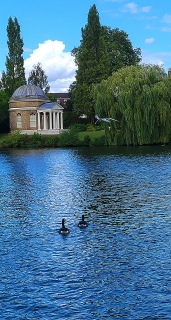
The octagonal Temple is Palladian neo-classical in style and has a portico with columns topped with Ionic capitals. Seen from across the Thames, it looks as if it had been plucked from a romantic painting of a classical Italian landscape by an artist such as Claude Lorrain. The Temple houses a statue of the Bard and a small museum about Garrick. Unfortunately, despite information on the Temple’s website which stated that it would be open, it was locked closed. We were not the only people to have arrived on a Sunday afternoon, expecting it to be open.
I am pleased that I saw the Temple, which I had read about, and plan to attempt to enter it on another occasion.
THERE IS A LOVELY walled garden, open to the public, in Sunbury-on-Thames. We were introduced to it today (20th August 2023) by our friends, Sue and Imtiaz, who live in Richmond. The large garden is well-tended and awash with flowers including a wonderful crop of late flowering roses. In the centre of the square garden, there is a carved stone lion on a plinth.

The lion commemorates the deaths of Captain Charles Frederick Lendy on the 15th of January 1894, aged 30. And his brother Edward August William Lendy on the 23rd of December 1893, aged 25. Charles died in Bulawayo (now in Zimbabwe) during the Matabele Campaign. And Edward, who was a captain in the Sherwood Foresters and Inspector General of the Sierra Leone Frontier Police, died in Warina (in Sierra Leone). According to a website (https://victorianweb.org/sculpture/warmonuments/9.html), he died as a result of ‘friendly fire’, and Charles died “from the effect of the Matabele campaign”, whatever that might mean. According to another website (www.photosunbury.com/lendymemorial4.htm), Charles
“… collapsed and died of peritonitis on 15th January 1894. Elsewhere, another interpretation places him at the Tati Hotel (in Botswana) where his illness was attributed to a heavy bout of drinking and eating.”
The brothers were the only sons of French born Major Auguste Frederic Lendy (1826-1889), a Royalist, who came from France as an exile, and settled in Sunbury-on-Thames. He ran his Practical Military College in nearby Twickenham, which prepared young men for entry into the major British military academies. He also wrote some books about warfare, and encouraged the British to be well prepared for military encounters. His sons’ military careers, though prematurely ended, were a credit to his teaching and philosophy.
Both brothers were in Africa to assist in the preservation and growth of Queen Victoria’s British Empire. One of them died because of friendly fire, and it seems that the other died of illness rather than during fighting. I doubt that their father would have been too pleased to know that neither of them had died whilst attempting something demanding bravery.
Apart from the Lendy memorial, there is a café in the walled garden, and next to that there is a small gallery. The gallery contains a fascinating embroidery on which most of the old houses in Sunbury-on-Thames are depicted beautifully and in great detail.
In addition to the walled garden and its contents, Sunbury-on-Thames has many old houses and a magnificent church (St Marys), which was designed by the Victorian architect Samuel Sanders Teulon (1812-1873), son of a French Huguenot, and built in 1857. I am very grateful that our friends introduced us to this charming place on the Thames.
Subhas Chandra Bose (1897-1945) is probably the most famous Indian to have spent time in Nazi Germany. Less well-known is Ayi Ganpat Tendulkar (1904-1975), who spent much longer in Germany than his illustrious compatriot. While studying in Paris, he married Sasha Alexandra Passini in about 1924. Soon after this, the marriage ended, and Tendulkar began studying in Berlin. He married one of his professor’s daughters – Eva Schubring. In 1933, after Hitler had come to power and Tendulkar had divorced again, he began a close relationship with the screenwriter Thea Von Harbou (1888-1954). Thea had just divorced her second husband, the great film director Fritz Lang (1890-1976) – one of my favourite film directors. The relationship between Tendulkar and Von Harbou was very close, and had Hitler’s racial laws (against marriages between ‘Aryans’ and others) not been enacted, there is a good chance that they would have married.

Tendulkar returned to India just as WW2 broke out. There, he met and fell in love with Indumati Gunaji (died 2006). From the start, her family were against the relationship, and Indumati ran away from home to live with Tendulkar. Both were followers of Mahatma Gandhi – she more than he. Soon, Tendulkar, who had published anti-British articles in Berlin and elsewhere and was under suspicion because of his long stay in Germany, was imprisoned by the British. Meanwhile, Indumathi helped the villagers where she lived. Her life was not easy, and she missed Tendulkar greatly.
Eventually, Indumathi and her family, who were concerned about her and her romantic attachment to Tendulkar, became reconciled to some extent. Her father, a Gandhian, suggested that they ask Mahatma Gandhi what he thought of the relationship. His reactions to the situation were far from simple, as is revealed in the pages of “In the Shadow of Freedom” by Laxmi Tendulkar Dhaul – the daughter of Indumathi and Tendulkar.
Ms Dhaul’s well-researched book is a fascinating read. It covers the extraordinary lives and relationships between Tendulkar, Indumathi, and Thea Von Harbou, both in Germany and in India – before and after independence. Despite some unfortunate errors missed by the proofreader, this is an un-put-downable book. It opened my eyes to the interesting subject of Indians living in Nazi Germany as well as Gandhi’s rather intriguing views on the purpose of marriage.

It has been sent
Carefully wrapped I believe
Oh, when will it arrive?
DURING A BRIEF VISIT to Nottingham made especially to view the centrally located Nottingham Contemporary art gallery (opened 2009), we spent a few minutes looking at some of the fine old buildings nearby. One of these is a shopping mall or arcade that reminded me a little of the superb Galleria Vittorio Emanuele II in Milan (Italy). Not as big as the structure in Milan, Nottingham’s Exchange Arcade is surprisingly grand.
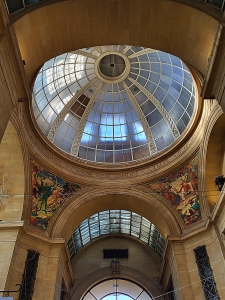
Built between 1927 and 1929, it was part of a major civic construction project, which included the nearby Council House. It was opened by the then Prince of Wales, who became King Edward VIII briefly before abdicating to marry Wallace Simpson.
Shops in the Exchange are arranged along a long central corridor and two shorter side corridors. Together, these wide walkways make a ‘T’ shape. Where the long corridor meets the two shorter ones is beneath a glazed dome. The dome is supported by four sloping walls, upon each of which there is a colourful fresco. One of these depicts a local hero, Robin Hood, firing his bow and arrow.
When it first opened, the Exchange housed Joseph Burton’s emporium, Nottingham’s version of London’s Fortnum & Mason. By the early 1980s, the arcade had become shabby, and was renovated. Now, it contains 17 retail stores. Although I am pleased that we saw the Nottingham Contemporary, I am glad we also managed to visit the magnificent Exchange arcade.
AFTER WATCHING THE film “Barbie”, which I did not enjoy and even bored me at times, we walked west from the Genesis Cinema along Mile End Road towards Whitechapel Underground station. On our way, we passed Trinity Green, which is surrounded by the picturesque Trinity Green Almshouses (‘TGA’).

Probably the second oldest surviving almshouses in London, the TGA was built in 1695 by the Corporation of Trinity House. The oldest is The Charterhouse. The purpose of the TGA was to provide housing for poor captains and ship’s masters, and/or their widows. In about 1895, the TGA was threatened with demolition, but saved by a public campaign to preserve them. The buildings were the first to be placed on a preservation register, the forerunner of the ‘listed buildings’ system that protects historic structures from alteration or demolition.
Buildings that flank the two sides of the entrance gate are adorned with sculptures of sailing vessels, complete with masts and rigging. On each of the gatehouses, there are plaques recording the fact that the TGA was built in 1695 on land donated by Henry Mudd of Rattcliff and his widowed sister-in-law. At the end of the rectangular lawn that is surrounded by the dwelling units, there is a chapel, Sadly, the compound was locked up and could only be viewed from the street. It appears that people are still living there.
Seeing the beautiful, nay elegant, TGA was a great relief after having subjected ourselves (voluntarily) to a film, chock full of unsubtle sophomoric (‘sixth or even fifth form’) messages, which many of our intelligent friends have enjoyed greatly. Maybe, we missed something that endeared the film to them. The one good thing I have to say about the film is that I am certain that its box office takings will help keep cinemas we like, including Genesis, in business after the disastrous years of the pandemic.
 yamey
yamey 