Bengali art before it was affected by influences of Europe and the Far East

THE INDUSTRIALIST KASTURBHAI Lalbhai (1894-1980) filled his Ahmedabad home (built 1905) with works of art. One of his relatives had married a member of the famous Tagore family of Calcutta. When the Tagores decided to sell their fabulous collection of Indian art in the 1940s, Lalbhai purchased it and thereby saved it from being sold to buyers who did not live in India. These works are on display in the house, which is now known as the Kasturbhai Lalbhai Museum.

The Museum houses works of Indian art dating from as early as about the 4th century AD to the 1940s. Visitors to the museum are obliged to go on a prebooked informative guided tour through the rooms of the museum. Although a bit of a speedy experience, one leaves having seen an enlightening cross-section of the history of art in India. Photography in the museum is not allowed.
In the special exhibition

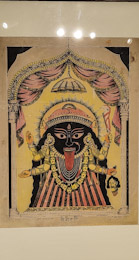
In the beautiful grounds of the museum, there is a recently constructed annex, where temporary exhibitions are held. We were treated to a show entitled “The Babu and The Bazaar”. It is a collaboration with the Delhi Art Gallery.

This fascinating exhibition contains a display of images created by Bengali artists, who painted in traditional styles that prevailed before art in Bengal became influenced by British art schools, Western European art, and the art of China and, especially, Japan. These external influences were most famously introduced by figures such as Rabindranath Tagore and his nephews Gagendranath and Abanendranath.

During my visits to India, I have seen plenty of paintings by Bengali artists who incorporated non-Indian artistic styles into their creations, but I cannot remember having seen such a large collection of Bengali paintings and other works in vernacular styles derived more from tradition than from outside influences. Most, but not all, of the artworks depicted Hindu religious subject matter. Many of the paintings were by artists I had never heard of, or were by unidentified painters. The well-labelled exhibits, which were beautifully displayed, were refreshing eye-openers.

Designed by a disciple of Le Corbusier but it stands disused

THE BUSTLING KHWAJA Market in the heart of old Ahmedabad (Gujarat, India) stretches from the Bhadra Fort to the three-arched Teen Darwaja – a magnificent medieval gateway. Between the two, on one side of the marketplace, there is a 20th century edifice that is hard to miss. Built in the Brutalist style, this massive concrete building is the Premabhai Hall.

Premabhai Hall in Ahmedabad

It was completed in 1972. Its architect was Le Corbusier’s disciple and collaborator, the late BV Doshi (1927 – 2023). His building – an auditorium -replaced an earlier meeting hall, which had been built during the British occupation of India.

Looking like a giant piece of moder sculpture Doshi’s building hardly clashes with the mediaeval buildings on either side of it. Sadly, because of concerns about fire hazards, the Hall ceased being used in the 1990s. Luckily, it is still standing, but when looked at closely, it is showing signs of deterioration.

I hope that one day, the Premabhai Hall will be restored to its former glory.

A war memorial in the heart of Bangalore: they died for the British Empire

ON ARMISTICE DAY (11th of November 2023), we stopped to look at the war memorial that stands in a busy part of Bangalore, where Brigade Road crosses Residency Road. Erected in about 1928, its design was somewhat influenced by Lutyens’s famous Cenotaph in London’s Whitehall. Actually, it has a greater resemblance to the memorial clock tower in London’s Golders Green, where I was brought up.

Bangalore

The four-sided memorial in Bangalore is to commemorate the members of the Pioneers, who died in WW1. However, it also records other earlier campaigns that claimed the lives of Pioneers The Pioneers, more correctly the regiments of the ‘Madras Pioneers’, were established by the British in the 18th century, and later became known as the Madras Sappers. More details are to be found in an article in the hindu.com :
“A glance at some historical documents shows that the 61st Pioneers originated in 1758 and were raised as the 1st Battalion Coast Sepoys which became the 61st Pioneers in 1901 and later became the 1st Battalion of the 1st Madras Pioneers in 1922. The 64th Pioneers also originated in 1758 as the 5th Battalion Coast Sepoys and became the 2nd Battalion of the 1st Madras Pioneers in 1922. The 81st Pioneers stood apart and originated in 1786 as the 28th Madras Battalion and later became the 10th (Training) Battalion of the 1st Madras Pioneers in 1922.”

Apart from WW1, the monument records other campaigns that were fought so that the British could consolidate their Empire. These include (to mention but a few named on the memorial): Mysore, Seringapatam, Nagpur, Afghanistan (1878-80), Burma (1885-87), and China (1900). For some of these conflicts the numbers of men lost are recorded. Numbers of English and Indian fatalities are listed separately.

When we visited the monument on Armistice Day, we saw two fresh wreaths at its base. One had a label attached, which said it had been placed by the French Consulate in Bangalore. The other had no words but it bore ribbon with the colours on the flag of Germany. There was neither an Indian nor a British wreath to be seen.

The shoe repairers and a great politician of India

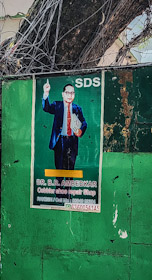
MANY SHOE REPAIRERS’ stalls in India carry at least one image depicting the politician BR Ambedkar (1891-1956). Amongst his many achievements was heading the committee that drafted the Indian Constitution. Statues often show him holding a book – the Indian Constitution.

BR Ambedkar on a cobbler’s booth

Ambedkar was born into a Marathi family in what is now the state of Madhya Pradesh. His family were outside the caste system – they were “untouchables”, also known as ”dalits” or, as Mahatma Gandhi called them, “Harijans”. One of Ambedkar’s. important ambitions was to procure political rights and social liberation for the dalits.

Traditionally, and still today, Hindu leather workers (tanners, shoemakers, leatherworkers, shoe repairers, etc) were members of dalit communities (e.g., the Chamar community). It is for this reason that images of Ambedkar, who fought for their rights, appear on shoe menders’ kiosks.

Vincent Van Gogh on a wall in India

YOU CAN SEE MURALS painted on walls throughout the Indian city of Bangalore (and in many other places in India). These paintings transform otherwise boring walls into something worth looking at.

Today, the 12th of November 2023 – Diwali, I visited Airlines Hotel in Bangalore. This place has an alfresco café and a large parking area. I saw some young people painting a mural. The design they were creating was a copy of a picture on the screen of a tablet or ipad. The building on which they were painting faces a long wall that marks the boundary of both the car park and the Airlines compound.

Since we last visited Airlines in February 2023, the boundary wall has been covered with a long painted mural. At first sight, this colourful painting brings to mind the work of the Dutch artist Vincent Van Gogh, who died long before it was made.

Though it resembles the style of the Dutch artist, on closer examination you can easily tell it is not by him. But its creator has certainly done a good job capturing the essence of Van Gogh’s style, and has livened up a hitherto unsightly, high breeze block wall. The other murals adorning the compound are visually engaging, but not as much as the Airlines “Van Gogh “

An unusual “Christmas tree” in a garden in Bangalore

WHENEVER I THINK ABOUT Christmas trees, I envisage a smallish pine tree that is roughly conical in shape. Today, I noticed a tall conifer growing in a garden in Bangalore. Attached to it there was a metal label identifying it as “Christmas tree. Araucaria cookei.” This tree bore no resemblance to any Christmas tree I have ever seen.

I used the Internet to look up ‘Aracauria cookei’, and learned that it is commonly known as ‘Captain Cook’s Pine’. It was first ‘discovered in New Caledonia by a botanist travelling with Captain Cook on his Second Voyage (between 1772 and 1775).

One botanical website revealed that when planted in a pot, this tree can be used as an alternative to regular Christmas trees. Other websites describing this plant make no mention of this. In any case, the specimen I saw labelled in Bangalore was taller than an average three-storey building. It was far too tall to be used as a Christmas tree.

Diwali and a film from Germany about the futility of warfare

GEORG WILHELM PABST (1885-1967) was a film director born in Austria. His film “Westfront 1918” was produced in 1930. This harrowing film vividly portrays the horrors of trench warfare and its effects on both the active German soldiers and their families back home in Germany. It is really an anti-war film. It was banned by the Nazis because it did not portray German soldiers as victorious heroes. Today, the 11th of November 2023 (Armistice Day), we watched a screening of this horrifying film about the last months of WW1 at Bangalore’s Max Mueller Bhavan (a branch of the Goethe Institute).

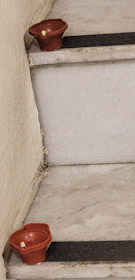
After the screening and interesting discussion about the film were over, we walked down the staircase instead of using the lift in which we had ascended. On each of the steps, there were small terracotta oil lamps (diyas), such as are typically lit during the Hindu festival of light – Diwali. Seeing this charming set of lamps placed to celebrate the imminent festival raised my spirits after having watched such a depressing film about the futility of warfare.

Eating off a banana leaf in the south of India

DURING OUR HONEYMOON in 1994, we travelled around places in southern India. At one point, we had to change trains at Coimbatore in Tamil Nadu state. With a few hours to spare, we ate dinner at a modest small restaurant near the station.

At Bheema’s restaurant in Bangalore

We sat down and banana leaves were placed on the table in front of us. These served as plates. There was no menu. A waiter hurried around the restaurant, stopping next to each diner and placing dollops of vegetarian culinary preparations on the leaves. He returned and placed a pile of steamed rice next to the mounds of vegetable items. He kept running from table to table, replenishing foods as required by the diners. This seemingly endless distribution of food set us back a total of 12 Rupees, which in 1994 was about £0.40 (yes, 40 pence). The coffee we drank at the end of the meal was the same price.

Yesterday, the 9th of November 2023, I was reminded of this experience whilst watching a waiter serving Andhra style vegetable preparations on a banana leaf in Bheema’s restaurant on Bangalore’s Church Street. Naturally, the meal cost a lot more than we paid in Coimbatore in 1994, but it was still very good value.

A café under the banyan trees in Bangalore

AIRLINES HOTEL IN BANGALORE has an outdoor seating area where you can enjoy beverages and South Indian vegetarian dishes, seated beneath venerable banyan trees.

You can read more about this popular, charming ‘al fresco’ café in my book of tales about travels in India. It is available from Amazon ( e.g., https://www.amazon.co.uk/HITLER-LOCK-OTHER-TALES-INDIA/dp/B0CFM5JNX5/ ) AND ALSO (if you live in India) from https://store.pothi.com/book/adam-yamey-hitler-lock-and-other-tales-india/