ONE OF THE characteristics of a living organism is the ability to reproduce itself. Pollination of plants is an important stage in maintaining the survival of a species.
Yesterday (the 15th of May 2024), we saw a curious tree at Kew Gardens. It looked as if it had both green and white leaves. It is a Handkerchief tree (Davidia involucrata). The white appendages are not leaves but bracts. They form for about a fortnight each year, and serve to increase the chances of the tree’s flowers being pollinated.
I ENJOY VIEWING sculpture displayed in the open-air. Seeing sculpture ‘al-fresco’ is for me much more pleasant than viewing it in a gallery. From time to time, the Royal Botanic Gardens at Kew hosts outdoor sculpture displays. In the past, I have seen exhibitions of works by Henry Moore and Dale Chihuly. This year (2024), there are several sculptures by Marc Quinn dotted around the gardens. Quinn, who was born in the UK in 1964 is an adventurous creator, whose works sometimes give rise to controversy. I do not believe that the collection of his works now on display in Kew will give rise to much, if any, controversy.
Except for several bronze sculptures depicting larger than life bonsai trees, which have been placed in the Temperate House, the rest of the sculptures are made in highly reflective stainless steel. Appropriately for their setting, these sculptures are derived from the shapes of plants, leaves, and flowers. Because they are so reflective, they reflect the plants and trees growing near them. This helps to camouflage them, or make them seem as if they are merging with the surrounding vegetation. Although they contrast dramatically with their surroundings, their reflective nature softens the contrast when viewed from certain angles.
When I see sculpture next to nature, I often feel that however well the artwork has been created, it often palls when compared to what Nature has created. Quinn’s work at Kew has this effect, but somehow, probably because it reflects the plants around it, the comparison between what he created and what has been growing naturally is not too marked, and did not disturb me.
A visit to Kew Gardens is always enjoyable, and seeing the place with Quinn’s work in situ was a good experience. The exhibition will continue until the 29th of September 2024.
I HAVE NO IDEA how many commercial art galleries there are in Central London. Today (the 14th of May 2024), we visited an art gallery, whose existence was previously unknown to us, and there we saw an exhibition of works by an artist, who was also new to us. The gallery is Carl Kostyal in Savile Row. Its discreet entrance is sandwiched between two fashionable tailors’ stores. Half Hungarian and half Swedish, Carl Kostyál opened his gallery in Savile Row in 2010. Three years later, he opened another gallery in Stockholm.
The artist, whose work is being exhibited, is Leo Park, who was born in Sweden in 1980. His exhibition in Savile Row is called “Beyond Pleasure”. It consists mostly of large paintings, but also a wall covered with a mosaic of small sketches, The beautifully executed artworks are eye-catching, and reminded me a little of the works of some of the pre-WW2 Surrealists. The paintings and sketches are of imagined forms that immediately made me think of human bodies. The images are clearly meant to evoke such thoughts, but looked at objectively, they are all shapes that do not exist in nature. The paintings and drawings are all displayed in the beautifully restored rooms of the 18th century building that houses the gallery.
The show ends on the 2nd of June 2024, and is well worth visiting.
In the last few years, I have published 3 books about Albania and the Albanians:
ALBANIA ON MY MIND
This book describes Albania as I saw it when I made a trip there in 1984. Then, the country was being ruled by the isolationist, Stalinist dictator Enver Hoxha. The country was even more isolated from the rest of the world than is the case with North Korea today.
REDISCOVERING ALBANIA
This is a description of a visit I made to Albania in 2016. The book describes Albania as we found it then, and compares it with what I saw in 1984. It also contains descriptions of Albania made by other travellers at various times in the last 300 years.
FROM ALBANIA TO SICILY
This is one of the few books in English to describe the past and present of the Albanian-speaking people who migrated to Sicily in the 15th century to escape from the Ottoman armies that were invading the Balkans. It provides an in-depth study of the lives of this interesting group of people.
These three books are available as paperbacks and as Kindles from Amazon
IT IS NOT UNCOMMON to see gravestones with inlaid engraved brass images in English churches. Known as ‘monumental brasses’, they began to be used in the 13th century instead of three-dimensional effigies and images throughout Europe to commemorate the dead. These often-elaborate brasses are set in depressions carved in the tombstones where they are placed.
During a recent visit to the Suffolk village of Long Melford, we wandered around inside its enormous 15th century Holy Trinity Church. The long side aisles of this edifice are paved with tombstones, many of which have empty depressions where once there had been monumental brasses. A person looking after the church explained to us that long ago, the brasses had been prised out of the gravestones. This had been done both during the Reformation in the reign of Henry VIII and later by the puritans. Later, when the church had run low on funds, it sold some to a local blacksmith for what was then a huge amount – about £8 and 10 shillings.
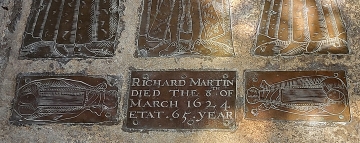
So much for the lost brasses. Fortunately, at the eastern end of the church, several monumental brasses have remained in place – some of them intact, and others damaged. To the south of the high altar, there is a set of intact 17th century brasses commemorating members of the large Martyn family. Included amongst these brasses are two of particular interest – they are Chrism brasses (see photograph above), which commemorate children who died before their mother was “churched” (that is before the mother has gone to church to give thanks to God for the birth of a child). The Chrism brasses depict babies in swaddling clothes. In addition to these brasses, there is another one depicts a brother and sister. The girl is holding a skull, which means that she died before her parents.
Churches in England, and especially that at Long Melford, offer many fascinating insights into how people lived in the distant past. The brasses – those which have gone and those which remain – are fine examples of history on display.
DURING THE REIGN of King Henry VIII, many English churches were vandalised because of the monarch’s divorcing the country from the Roman Catholic Church. Many artefacts were destroyed in churches to erase their connection with the Church in Rome. These included carvings and stained-glass windows. Holy Trinity Church in the wool town of Long Melford in Suffolk was no exception. Above the south entrance to the church, you can see empty stone frames that once contained stone effigies of saints. Much of the 15th century church’s mediaeval stained-glass was also destroyed.
Luckily for us, some of the stained-glass survived. This is because it used to be located in the windows of the clerestory high above the long nave – out of reach of the people sent to destroy it. In recent times, the surviving windows have been restored and placed in the windows lining the north wall of the church. These windows are much lower than those in the clerestory, and are easily viewed from the ground. The windows depict both dignitaries and religious subjects, which were the main targets of the vandals who were destroying religious images.
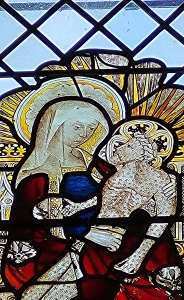
One of the windows is particularly interesting because it shows the Virgin Mary holding the dead body of Christ soon after it had been removed from the Cross. In other words, it is what is known as a Pietà. This subject matter was, and still is, extremely important in Roman Catholic imagery, and had they been able to reach it, those who attacked the church would have certainly wanted to destroy this. A knowledgeable gentleman, who was helping in the church, told us that the pre-Reformation Pietà in the church was an extremely rare survival from the time before Henry decided to break with Rome. What is more is that unlike many images of the Pietà, the dead Christ is shown with his eyes wide open.
The Pietà image in the surviving mediaeval stained-glass is just one of many interesting things that can be seen in the magnificent, large parish church at Long Melford. As the Michelin Guidebooks often say, the place is “worth a detour”.
ONE OF ISTANBUL’S many attractions is that it is intimately associated with water: the Golden Horn, the Bosphorus, the Black Sea, and the Sea of Marmara. Incorporated within the city’s excellent public transport system, there are many boat services on all these bodies of water. During our recent visit to the city in April 2024, we took a boat from Kabataş on the European shore of the Bosphorus to Büyükada – one of the Princes Islands out in the Sea of Marmara. This pleasant journey took about 1 hour and 40 minutes. As we sailed across the smooth sea, flocks of seagulls followed us, and were fed by other passengers, who threw them bread and other titbits.
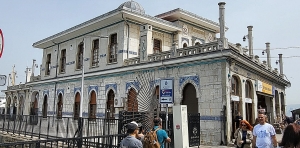
One of the piers at Büyükada has a beautiful old quay building in which passengers can wait for their boat and do a little shopping. Equipped with ticket windows, which are no longer in use because modern ticket machines have replaced them, the building is decorated with lovely tiling and stained-glass windows. As with many old buildings we saw in Istanbul, this one was supplied with a panel describing (in both Turkish and English) its history.
The pier was built in 1899. It was rebuilt with the addition of the present two-storey terminal building, which was completed in 1915 to the designs of its architect, Mihran Azaryan (1876-1952) from Izmit. He was an Ottoman Armenian. It is worthy of note that by the time that his building was built, the Ottoman rulers had been involved in the death of many Armenians.
The upper floor had a café between 1918 and 1923. And between 1950 and 1951, it had been the island’s first ever cinema. Between 2000 and 2001, the edifice was beautifully restored, and although the ticket windows no longer serve any purpose, its octagonal waiting room-cum-ticket hall is a rare survival.
Having seen this superb example of a ferry terminal, I kept my eyes open during the many other boat trips we made along, and across, the Bosphorus. Many of the landing stages have ornate terminal buildings – often with tiling and stained-glass windows, and sometimes with their names still in the old Turkish script. However, the terminal at Büyükada is the most impressive of all those we saw.
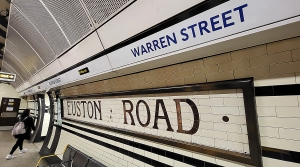
THERE ARE THREE Underground stations close to each other and very close to London’s Euston Road. Warren Street station is 285 yards west of Euston Square station, which is about 376 yards southwest of Euston Underground station.
When Warren Street station (on the Northern Line) was first opened in 1907, it was named ‘Euston Road’. An old station name sign on the platform has been retained as a souvenir (see photograph above), and it reads “.Euston Road”. Had this name remained unchanged, there would have been three stations with ‘Euston’ in their names. So, in 1908, no doubt to reduce the possibility of confusion, the present Warren Street station lost its original name and was given its current name.