Great expectations

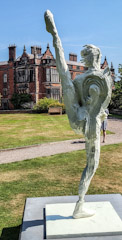
I LOVE OUTDOOR sculpture exhibitions. Also, I enjoy visiting the exhibition spaces of the White Cube Gallery, which are located in Piccadilly and Bermondsey. So, it was with high expectations that we drove up to Arley Hall in Cheshire to view an exhibition of outdoor sculpture by artists with whom the White Cube represents.

The works on display until the 29th of August 2022 are by artists including amongst others Gormley, Noguchi, Tracey Emin, Mona Hatoum,and Takis. This is a formidable line up of artists.

Arley Hall and its gardens are magnificent. Unfortunately, the same cannot be said of the temporary exhibition of works by eminent modern sculptors. Unlike other outdoor sculpture shows I have seen (e.g. Frieze at Regents Park, Houghton Hall, and the Yorkshire Sculpture Park), what was on display in Arley Hall’s garden was unexciting despite the delightful setting. I felt that White Cube, whose exhibitions are, if nothing else, always dramatic, could have displayed a more impactful selection of artworks.

Exhibition aside,visiting the grounds of Arley Hall was well worthwhile as it has given us the opportunity to spend some time in Cheshire, which we do not know well.

The writing on the wall

ALL THAT REMAINS now are the French words ‘moules’, ‘huitres’, and ‘langouste’ (mussels, oysters, crayfish). They are written in large white capital letters attached to a brick wall overlooking Leicester Place, which is a short street running between London’s Leicester Square and Lisle Street.

I am glad these words have not been removed,not only because I enjoy consuming shellfish and crustaceans but also because they provide a reminder of an establishment that thrived between the 1950s and 2006, when it closed for ever: Manzi’s restaurant.

Run by an Italian family, the eatery was famous for its seafood. Although I only ate there a few times, it was always an enjoyable experience.

Another restaurant, which has also closed, was on Lisle Street near Manzi’s. It was a Chinese restaurant called Mr Kong. Like Manzi’s, it had seafood on its menu. Their mussels in black bean sauce were superb. Kong’s also had a vegetarian menu – Chinese vegetarian dishes. I am not a lover of veg dishes, but the vegetarian offerings they rustled up at Kong’s were outstandingly tasty.

Usually, I often remember Mr Kong when I visit Chinatown around Gerrard Street, but it was only when I noticed the French words on the wall that memories of Manzi’s came flooding back.

The West End is no longer the west end

LONDON’S WEST END includes the part of the city that contains areas such as Chinatown, Theatreland, Covent Garden, Leicester Square, Oxford Street, Mayfair, Soho, Fitrovia, and Bond Street. Before the 19th century, the western boundary of London was Park Lane, which runs along the west edge of the West End.

The west edge of London in about 1809: the dashed line that runs from north to south runs along Edgware Road and Park Lane. West of this libe was Hyde Park and open fields

Until the end of the 18th century and even during the early years of the 19th, west of Park Lane and the West End was the Middlesex countryside, which was dotted with villages such as (for example) Paddington, Kensington, Chelsea, Hammersmith, Fulham, Acton, Ealing, and Southall. In between these then separated places there were farms, heathlands, parks, stately homes (such as Chiswick House and Osterley Park), and highwaymen.

During the 19th century, several things happened. London expanded in all directions and spread into what had been countryside. The small villages in Middlesex grew in size. Some of them coalesced. Canals and railways were built, and along with them, building in areas that had previously been rural, caused them to become urban. In brief, London spread relentlessly westward. What was called the West End, and is still so-called today, was no longer the west end of the city of London.

Although many previously rustic settlements (such as Paddington and other places mentioned above) became engulfed in the metropolis, most of them have retained at least a few reminders of their pre-urban past. Currently, I am putting the finishing touches on a book about London west of the West End. In it, I hope to help readers discover more about London’s western spread and what has survived it (despite being surrounded by the city’s western expansion).

An eminent tourist

MANY YEARS AGO, a now deceased Greek friend, ‘S’, related the following story.

S was born in a small port in the Peloponnese long before WW2. It was a place that tourists disembarked from their boats to visit the Ancient Greek archaeological site of Olympia. S left school at an early age (by the age of about 12 to earn money by working on the docks of the small town. When cruise ships called in at the port, he offered services as a tourist guide to earn a few extra Drachmas.

Most of the tourists swallowed the tales that S told them as they wandered around Olympia. However, one day he met his match. An English gentleman accepted his offer to act as his guide. Soon after they reached the site and S had begun giving his customer his ‘spiel’, the Englishman stopped him, saying

“Listen, young man. It is clear that you know nothing about this site and its history. Let me tell you the correct story.”

S listened to his well-informed customer with interest and amazement. It turned out that the knowledgeable gentleman was no other than the future Prime Minister of the UK, Winston Churchill.

Many years later during one of my several visits to Olympia, I was standing in the lobby of a hotel near the site on a warm afternoon. The place was filled with members of an American tourist group. One lady asked her friend if she was going to take a tour around the famous site. The friend replied:

“Aw, no. It’s too damned hot to see more of those old rocks.”

Preventing burning in Burnham

MUSEUMS OFTEN CONTAIN interesting surprises for visitors. The small museum in Burnham on Crouch (in Essex) is no exception. It amused me to see that amongst the exhibits there were several early examples of so-called pocket calculators – too large to fit most pockets. I was given one of these (made by Casio) in about 1974, and at the time this was a wonderful gift as well as being a useful tool. I was able to replace my slide-rule with my Casio. These calculators, along with other things that were regarded as being ‘the latest thing’ in the 1960’s and ‘70s, were not what surprised me most at the museum. Hanging on the wall of one side of a staircase, there was a huge piece of cloth with advertisements printed on it. It is part of the fire safety curtain that was used in the local cinema, The Rio (see: https://adam-yamey-writes.com/2021/11/13/a-small-cinematic-survivor/) , in the 1930s.

Fire curtains are usually made of metal or heavy materials containing asbestos (or some other fire retardant). They are designed to be lowered (often automatically) should a fire break out on the stage of a theatre or cinema in order to prevent the fire spreading to the auditorium. In 1613, a cannon misfired on the stage of Shakespeare’s Globe Theatre, causing the thatch on the building’s roof to catch fire; the theatre was destroyed. There were no fire curtains in those days.

The first fire curtain (it was made of iron) to be installed in the UK was in 1794 at the Theatre Royal Drury Lane in London. A large fire at the Theatre Royal in Exeter in 1887 led to the wider use fire curtains in British theatres, and later in cinemas. However, these safety devices were not infallible. A fire that began on the stage of the Iroquois Theatre in Chicago (USA) led to the deaths of about 575 people when the fire safety curtain snagged and could not be fully lowered. This led to the invention of an improved automatic fire curtain by John Clancy a year later in 1904.

Fire curtains, which must be lowered at least once during every performance in the UK can be plain or decorated. Plain fire curtains, when lowered, can serve as screens on to which advertisements are projected. The example at the museum in Burnham has advertisements printed or painted on it. Local businesses paid the cinema to have their adverts printed on the curtain that hung in the Rio during the 1930s.  The Treasurer of the museum explained that of the many Burnham firms, who placed adverts on the fire curtain, only one of them is still in business. Thus, the old fire curtain (or at least the half of it that is in the museum) not only protected Burnham’s cinemagoers from burning but also serves as a valuable record of the town as it was almost 100 years ago.

My father the professor

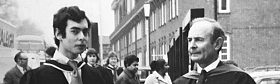
MY FATHER, BASIL Yamey (1919-2020), lived until he was over 101. Between about 1950 and 1991, he lived in our family home in Hampstead Garden Suburb. From my birth until 1982, I lived there, and afterwards I visited my then widowed father almost every weekend.

My graduation in 1973

Dad was an academic, an economist,  at the London School of Economics (‘LSE’). He became a senior professor long before he retired.

Although I have no knowledge of economics even at an elementary level (and this is not me being modest), I lived with an acknowledged leader in the field of microeconomics. Recently, the LSE published some of my memories of living with a professor: my late father. These memories are published on an LSE blog: https://blogs.lse.ac.uk/lsehistory/2022/07/06/at-home-with-basil-yamey-as-recalled-by-his-son/

I hope that you will enjoy these glimpses of the home life of a significant academic.

Wavy walls and Hercule Poirot

SADLY, THE CHARTERHOUSE was closed to the public when I walked through London’s Charterhouse Square on a Monday in July. As I walked clockwise around the grassy space in the middle of the (not so square) square, I spotted a building with a curvy brick façade with windows, many of which have both curved steel frames and glass panes.

The building, a block of flats which has Art Deco features, is called Florin Court. Although it looks recently built, it was constructed in 1936. It was designed by Guy Morgan (1903-1987) and Partners. Morgan had worked with the better-known architect Edwin Lutyens until 1927. Two years earlier, Morgan and Partners designed another block of Art Deco style flats in Highgate Village: Cholmeley Lodge. Although I was unable to enter Florin Court, I have read (on Wikipedia) that it contains 120 flats; it has a communal library, roof garden as well as a basement swimming pool. The reason that the structure looks so new is that it underwent extensive restoration work in 2013.

Florin Court has a connection with the author Agatha Christie as the following (from https://historicengland.org.uk/listing/the-list/list-entry/1390634?section=official-list-entry) related:

“Best known as ‘Whitehaven Mansions’, its exterior used as the residence of Hercule Poirot in the television adaptations of Agatha Christie’s novels.”

I have never watched this television show, but I am pleased that I stumbled upon this lovely example of Art Deco architecture in the heart of one of the older areas of the City of London.

The oyster merchant’s clock tower

BURNHAM-ON-CROUCH in Essex is a picturesque port on the River Crouch. Currently, it is a leisure resort and a centre for ship maintenance and boating. It was once famed for what grew in great numbers on the muddy bed under the water of the Crouch: oysters. For several centuries before the river became polluted in the 19th century, the oyster beds in the Crouch (and a few other places in Essex) were very profitable, providing much employment.  

“On the shores of England the principal nurseries of oysters, not only for the English markets, but also for the foreign, are those on the coast of Essex and the estuaries adjoining: those taken there are called ‘ Natives/ Mr. Sweeting claims the name as peculiarly applicable to his fishery, as within his memory no strange oysters have ever been introduced…”

Men were required both to dredge the oyster beds and process the molluscs as well as to protect the precious creatures from thieves based in other places on the Essex coast.

Today (11th of July 2022), we visited the small but excellent museum in Burnham-on-Crouch. On the ground floor, we saw a retired mechanised oyster grading machine (made in France and capable of sorting 7000 oysters per hour) amongst the exhibits. On the upper floor of the museum, which is housed in a former boat repair building, we met the museum’s treasurer, who is a mine of interesting local history. He told us several things about Burnham’s oyster heydays. I hope that what I am about to tell you is a reasonably accurate summary of what he told us. If it is not totally accurate, I hope that he and you, dear reader, will forgive me.

For 10 years, I used to live in north Kent and often visited Whitstable to enjoy eating oysters for which this Kentish seaport is famous. The treasurer in Burnham told us that many of what are described as ‘Whitstable oysters’ were born in the mud beneath the river in Burnham-on-Crouch. From what I can recall, the young oysters, which grow in the mud beneath the Crouch, are dredged and then placed on boards to which they attach themselves. Keeping them submerged in seawater, the boards to which the young oysters are attached, were transported to Whitstable where they matured in its waters. The Burnham oysters were ‘native’, meaning that they began their lives there; they were not imported, as Thomas Campbell Eyton described in “A history of the oyster and the oyster fisheries” (published in 1858):

“On the shores of England the principal nurseries of oysters, not only for the English markets, but also for the foreign, are those on the coast of Essex and the estuaries adjoining: those taken there are called ‘Natives’. Mr. Sweeting claims the name as peculiarly applicable to his fishery, as within his memory no strange oysters have ever been introduced.”

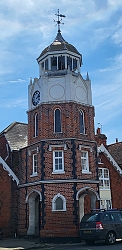
One of the exhibits in the museum is a large model of the octagonal Victorian clock tower that dominates Burnham-on-Crouch’s High Street. The tower stands next to the building that used to house the former St Mary’s School. It was erected in 1877 to honour the local philanthropist Laban Sweeting (1793-1876). So, what, you might ask, and what has he got to with what I have been writing about?

Laban Sweeting, mentioned in the quoted from Eyton’s book, was a philanthropist; a member of The Burnham River Company; and he was one of the town’s oyster merchants. The museum has amongst its exhibits a small barrow, which used to be wheeled around Burnham by a member of the Sweeting family. It would have carried baskets of oysters ready for sale to the town’s populace.

We had visited Burnham once before, and although I was impressed by the clock tower, I knew nothing of its history. Neither did I know about the town’s association with oysters, which were poor people’s food in the 19th century, when chicken was a luxury. How times have changed.