Story of a tower

“IT’S THE TOWN’S SYMBOL, you see”, we were told by a friendly young man whom we met by chance in a churchyard in the town of Bruton in the county of Somerset.

“Never been up there myself, even though I’ve been living in Bruton all my life,” he told us, pointing at a tall tower on the summit of a hill overlooking the town.

“Where have you come from?” he asked us. When we replied ‘London’, he commented:

“Never been there myself. Have a good evening.”

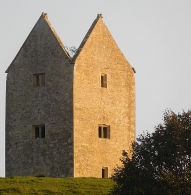
Bruton is about 120 miles southwest of central London. The tower about which we had asked the young man is square in plan, is built of neatly cut limestone blocks, has three layers of windows, and looks (from below) as if it is missing its roof. The top parts of each of the four walls are triangular, looking as if they were once the side walls of gabled roofs.

The tower that stands in Bruton’s Jubilee Park is known as ‘The Dovecote’. The hill on which it stands rises steeply from the almost level fields of the public park. Birds, mainly pigeons, could be seen perching on the edges of the four gables at the top of the tower. It stands on a square plot 65 square feet in area and is situated on land over 300 feet above sea level, to the south of the centre of Bruton. Although it is tall, I have not been able to discover its height by searching the internet. That it has lost its roof, is recorded.

The tower stands in what was a deer park of about 30 acres established in about 1545-6 by the canons of the long-since demolished nearby Bruton Abbey (whose remains can be seen in the town). The park was later enlarged and surrounded by a wall. In the 18th century, the deer were removed. However, much earlier, in the 16th or, 17th century (actual date is uncertain although some of the timber used in the construction has been dated as being felled between 1554 and 1586), the present tower was built by the Berkly family. They acquired the land after the Dissolution of the Monasteries by Henry VIII. The tower was built to be used as a ‘prospect’ or ‘look out’ tower.

In about 1780, or maybe much earlier, the tower was converted to be used as a dovecote. Inside the tower, which we could not enter, there are roosting spaces (nesting boxes) for at least 200 doves. Long ago, pigeons and doves were an important food source. They were reared for their eggs, flesh, and dung. In 1915, the National Trust (‘NT’) acquired the freehold of the tower from Sir Henry Hugh Arthur Hoare (1865-1947). Not only did Sir Henry give his tower to the NT, but also, more importantly, he also donated his family estate with its fabulous landscaped grounds at nearby Stourhead to the same organization in 1946. The Hoare family, about whom I hope to write soon, is also associated with another tower not far from Bruton, the Alfred Tower, which we have visited … but more on this anon.

Although we could not enter The Dovecote tower, we did one better than the young local with whom we spoke earlier; we walked up to its base.
A flight of pigeons

I FOUND MY COPY of “A Flight of Pigeons”, a short novel by Ruskin Bond (born 1934), amongst a collection of books about birds in the gift shop at Sanjay Gandhi National Park just north of Bombay. The book has little or nothing that would be of interest to ornithologists and other nature lovers.

The novel is about some English ladies during the First War of Indian Independence (‘Indian Mutiny’; 1857-58). They are some of the only survivors of an attack by Pathan forces on the town of Shahjahanpur.

The ladies are first given refuge by a Kayasth family, and then by various Pathan families. Having some Indian ancestry and a knowledge of Urdu, these English refugees were more or less successfully accepted into the Muslim Pathan families.

The young daughter, Ruth, becomes the object of the amorous intentions of one of the Pathans, who wants to marry her. Ruth’s mother has to try to prevent this from happening. I will not reveal what happens because I do not want to spoil the enjoyment of the reader of this simply told, compelling short book.

This is the first book I have read by Ruskin Bond. If it is typical of his writing, then I want to read more. Like the Albanian novelist Ismail Kadare, Bond skilfully manages to pack much into his book with great economy of words.

Bombay long ago

IN THE TWELFTH CENTURY AD, long before the islands on which Bombay now stands were occupied by the Mughals, then the Portuguese, and then the British, Lakshman Prabhu, a minister in the court of the Sihara Dynasty (8th to 13th centuries AD), built a tank (reservoir) on what is now the elegant residential area known as Malabar Hill. This water body, the Banganga Tank, was rebuilt in 1715 and had been cleaned up recently. Neither my wife nor I had heard of it until a correspondent, Donna Young, suggested we visit it.

The approach road that leads off one of the main roads in Malabar Hill enters an area where on one side of the thoroughfare there are expensive apartment blocks. They face a line of badly built modest homes (slightly better than slum dwellings and some with TV satellite dish aerials) all of which must have great views of the Arabian Sea.

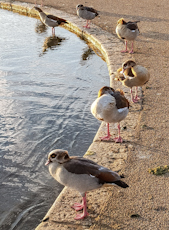
The tank is rectangular in plan and surrounded by steps with wide landings leading down to the water, which enters the pool at one corner at a fast rate of flow. Ducks and geese rest on the steps or swim in the water in the tank.

The tank is surrounded by low buildings, many of which are Hindu temples. Occasional gaps between the buildings have staircases that lead down to the steps surrounding the tank. Some of these gaps are flanked by towers containing many niches for placing diyas (oil lamps). Some of these have become perching places popular with pigeons.

The road running around the tank is the only thoroughfare for the community, mainly Hindus, who live around the tank. This community, though by no means impoverished, is far less prosperous than that which occupies most of Malabar Hill.

Banganga Tank is very picturesque and a complete contrast to its surrounding elegant mansions and apartment blocks built mainly from the 1920s onwards. It is a well preserved early mediaeval environment in the heart of busy, modern Bombay. It should be on tourists’ itineraries, and judging by a group of middle-aged Italian camera toting tourists I saw, I believe it is already.

While I was wandering around exploring, my wife sat on a wall near some parked motorcycles. There were some young men joking amongst each other nearby. One said to another: “You are fourth class fail.” He replied: ”You are second class fail.” At this point, my wife asked if one of the bikes could be moved slightly to give her legs more room. As a third boy shifted the bike, one of the others laughed and said: “Oho, that one is KG fail” (KG is short for kindergarten).

Pink flamingos

WHEN I WAS A SMALL CHILD, I used to be taken to see the small menagerie at Golders Hill Park in Northwest London. In addition to wallabies and deer, there used to be, and it is probably still in existence, an enclosure containing a few flamingos. Until a recent visit to Mandvi in Kutch (Gujarat, India), these were the only flamingos I can recall seeing.

Every year, flamingos migrate to Kutch during the winter months to escape from the cold that affects their summer habitats during winter. They might fly in from central Asia, or from parts of India that get particularly cold in winter.

We were keen to see these flamingos in Kutch. A keen bird watcher, who lives in Baroda, told us that flamingos had been sighted at Modhva beach, a few miles east of Kutch Mandvi.

We drove to Modhva beach, arriving there about twenty minutes before sunset. At first, the only birds we could see were seagulls. There were no flamingos to be seen. We asked some local fishermen about them. They pointed at the sea.

Our driver, who must have keen eyesight, pointed at some specks on the surface of sea, maybe more than one hundred yards from the water’s edge. Using the twenty times optical zoom on my digital camera, I could see quite clearly that the specks were flamingos with pink and white plumage.

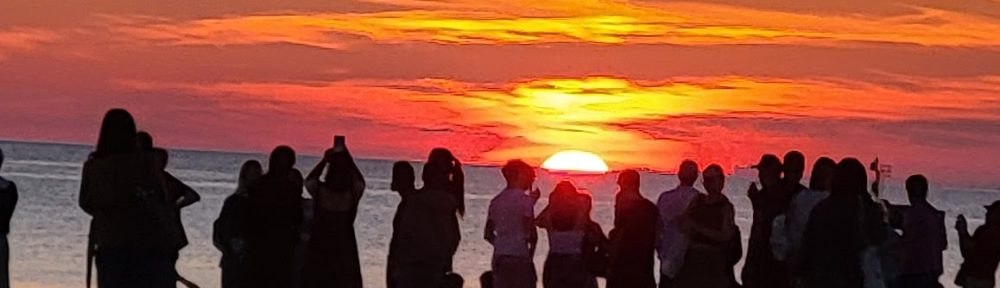
I managed to take a few photographs before the sun sunk rapidly below the horizon. I had seen flamingos in the wild for the first time in my life. It was an exciting experience.

Flying rats

pigeons


My late mother was awfully concerned about avoiding germs. For example, every can of food had to be washed before opening it just in case rats or mice had scampered across it in a warehouse.  Also, when we visited toilets in public places in the 1960s, we were told to put toilet paper on the seats so that we would not pick up germs that other users had left behind. Interestingly, in many public toilets nowadays, notably on aeroplanes, disposable toilet seat covers are provided. Mum would have approved of this development.

Recently while rummaging through some old photographs, I came across one of me, aged about 10, in Siena, Italy. I was kneeling on the floor feeding pigeons that had flown on to my hand. As a child, I loved doing this. My parents would buy me a paper cone filled with corn seeds. I would fill my palm with some of these, and then pigeons used to perch on my finger tips and pick up bits of corn with their beaks. I remember that the pigeon’s ‘feet’ felt quite soft. Feeding these creatures was a real treat.

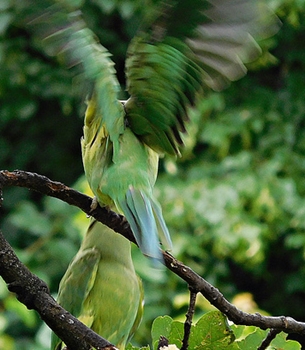
Well, I was not unusual. Many people enjoy feeding birds from their hands. Today, in London’s Kensington Gardens there are flocks of green parakeets that happily feed from visitors’ hands.

The surprising thing was that my germ conscious mother permitted my sister and me to feed pigeons as described already. In New York, pigeons are known as ‘flying rats’. Pigeons are are actually less hygienic than rats and they carry mites, which irritate human skin. I cannot believe that pigeons in Italian cities in the 1960s were any cleaner than those flying about today. Had my mother been aware of the pigeons’ unsavoury lack of hygiene, feeding these creatures would have been totally forbidden to my sister and I. I am pleased that she did not realise that the dear flying rats are so filthy!