Subversion at the Serpentine art gallery: ways with words

THE ORIGINAL SERPENTINE Gallery in London’s Kensington Gardens is housed in a former tea pavilion that was built in 1934. It began to be used as a contemporary art exhibition space in 1970. Since then, it has been showing modern and contemporary artworks in a series of temporary exhibitions. I have been visiting this gallery and its newer branch, Serpentine North, regularly since the 1990s (the North branch opened in 2013). Almost without exception, the art displayed in the Serpentine galleries has been both exciting and adventurous – sometimes quite challenging. The latest exhibition, which is on until the 17th of March 2024 in the original gallery, is of artworks by the American (USA) artist Barbara Kruger, who was born in Newark (NJ) in 1945.

Kruger’s art is not purely visual. It is designed to convey ideas that challenge the viewer to question commonly held contemporary beliefs in an eye-catching, often witty way. The exhibition, “Thinking of You. I mean Me. I mean You” consists of 12 art installations that reference or parody everyday things such as advertising, magazine illustration, video art, social media, the Internet, and other media that bombard us on a daily basis. Each of them present messages that subvert political ideas, the moral code, and the meanings of words. Kruger makes much use of video techniques. Several of the exhibits have words projected sequentially to make up sentences. Often, the words change on the screen to alter the perceived meaning of the text being projected. However, her art is not simply all about words and their meanings in different textual environments. The words are harmoniously accompanied by intriguing visual images, often continuously changing.

Although the exhibition is about words and their usage and varying meanings, words alone cannot describe this exhibition adequately. Therefore, if you can, it is worth taking a look at this interesting – nay, challenging – show. Having viewed the show, I was heartened to discover this artist from America who is perceptive enough to see where her country is heading and brave enough to criticise the political direction in which it appears to be moving. After seeing her exhibition, I would hazard a guess that she will not be voting for Mr Trump.

Blowing in Bermondsey

IT IS UNNECESSARY to travel from London to Venice to see masterpieces of glass bowing. You need only make your way to Bermondsey Street in south London where you will find London Glassblowing. It is both a gallery and workshop set up by Peter Layton, who is now over 80 years old and still creating beautiful artefacts. Layton was born in Prague and grew up in England. After studying ceramics at London’s Central School of Art and Design, he taught ceramics at the University of Iowa in the USA. It was there that he discovered glass blowing and took to it. When he returned to England in 1976, he established his London Glassblowing in London. It has been located at its present address for about 15 years. Before that, he was in Leather Yard. Apart from creating works of art in glass, he also teaches and mentors other glass blowers.

Whenever we visit Bermondsey Street, we make a point of visiting Layton’s establishment. Always the works on display are both beautiful and highly inventive. Occasionally, if we reach the place at the right time, we can watch glass blowers at work in the invariably hot workshop behind the gallery. Unlike the workshops we have visited on the island of Murano (near Venice), the works produced in Bermondsey Street – both sculptural and functional – are tastefully contemporary and often avant-garde.

Anselm Kiefer at the White Cube in Bermondsey

TODAY, I MADE MY second visit to the Anselm Kiefer exhibition, which is on at the Bermondsey White Cube gallery until the 20th of August 2023. I was pleased to visit it again because after my first visit, I left it feeling oppressed and somewhat depressed. This might be what the artist (born at the end of WW2 in Germany) intended when he created the extraordinary series of scenes of dereliction and decay on show in Bermondsey. My second visit (on the 15th of August 2023) left me with a slightly more favourable impression, but my opinion that the artist has depicted an image of a world of confusion, conflict, and decay, remains unchanged.

The works, which are distributed in several rooms and the central corridor of the gallery, are, so I read in an information sheet, Kiefer’s reactions to, and representation of, a novel by James Joyce – “Finnegan’s Wake”. The artist has written short quotations from the book on many of the items that together make up the amazing art installations. As I have not read the book, I cannot comment on the appropriateness of what he has created.

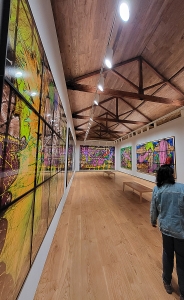
In one room of the gallery, there are mainly huge paintings, which I found attractive. On close examination, one can see that the paint has been applied to that it is far from flat. The three-dimensional surfaces create interesting illusions, which change according to from where you view the pictures.

Another room has a huge pile of sand littered with discarded, corroded supermarket trolleys – an impressive but sad sight. In yet another room, most of the floor is covered with barbed wire and huge pieces of concrete – the ruins of a large building. As a friend of ours said, it looked as if it had been imported straight from a bombsite in Ukraine.

Would I recommend visiting this exhibition? It is certainly inappropriate for people who suffer from claustrophobia or depression. However, if you are of an adventurous frame of mind, do head for this show before it ends.

Barbie and Bhabhi in Coventry

WE HAD TICKETS to watch the new “Barbie” film yesterday (the 7th of August 2023) at 5.50 pm at the Gate Cinema in Notting Hill Gate. We watched the advertisements and then the trailers for forthcoming films. Halfway through the trailers, emergency lights were switched on, the soundtrack disappeared, and the pictures being projected shrunk in size. There had been a power failure, and everyone was asked to leave after having been given complimentary tickets for a future screening of any film. We left without watching “Barbie”.

The next day, we travelled to Coventry to see the cathedral and the Herbert Art Gallery & Museum. At the Herbert, we saw several excellently curated exhibitions. They were far better than many we have seen in London in recent months. They were imaginatively and intelligently conceived, as well as being superbly displayed.

One of these shows was called “Divided Selves”. In simple terms, it consist of mostly recent works of art by various artists, which deal with conflicts between different groups of people all over the world.

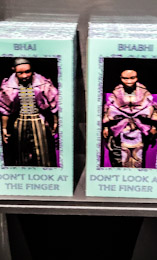
One of the exhibits is by an artist and filmmaker Hetain Patel. Part of the artwork are three sets of plastic dolls. Each doll is contained in a cardboard box with a transparent plastic window, just like the containers in which dolls are often sold. One pair of dolls was labelled ‘Bhai anmonthshi’, Bhabhi means sister-in- law in Hindustani and Bhai means brother.

We missed Barbie yesterday, but seeing Bhabhi today almost made up for not seeing the film.

Artists as artworks in London’s East End

BRICK LANE IN east London has been home to immigrants from various parts of the world. Currently, many of the people who live and work in the area are of Bangladeshi heritage. In the last few years, the area has attracted the ‘trendy’ set, whose interests are mainly in the attractions north of the former Truman Brewery. Some years ago, my friend David, visiting from Atlanta (Georgia), and I paid a visit to Brick Lane and were surprised to find a bit of ‘Ye Olde England’ almost hidden amongst the predominantly Asian businesses. It was the The Pride of Spitalfields London – a real old-fashioned ‘boozer’. Stepping into it, it was difficult to imagine you were not in a country pub, but in the heart of east London. It is on Heneage Street next door to what had once been part of a brewery.

In 2015, the Trustees of the Gilbert & George Centre, a charity, acquired the building next door to the pub. On the 1st of April this year (2023), the converted buildings were opened to the public. They have been beautifully transformed by the SIRS Architects practice and they house artworks by the duo Gilbert and George (‘G&G’), who both trained at London’s St Martins School of Art. According to the G&G website (gilbertandgeorgecentre.org):

“The property was purchased with the idea to create a permanent home for works of the artist and to enrich London’s cultural offering thus further.”

G&G produce often very colourful works, all of which include the pair of creators within their images. As artists, they are also the subjects of their creations – they are almost always depicted in all their works. Their works deal imaginatively with a wide variety of things that we all face in our daily lives – some of them often considered too distasteful to be discussed or displayed. But G&G boldly bring them to our notice in a dramatic way.  As Michael Bracewell, a Trustee, wrote on the website:

“Gilbert & George maintain an ideological opposition to formalistic art theory and the reference of art to the history or theory of art. Asserting instead the power of emotion and actuality, their art addresses subjects that are culturally excluded, neglected or disowned. Their art questions social taboos and morality. By looking at difficult subjects the art and vision of Gilbert & George is intended to ‘de-shock’ rather than seeking to shock. Its aim is not the simple task of ‘shocking’ a viewer, but the difficult task of interrogating a subject and themselves … Unchanging, they have the appearance and countenance of modern sober-minded, anonymous citizens, who have embarked on the astral journey of their own Divine Comedy: purgatory, Heaven and Hell as they find it and perceive it in our world, in nature and in themselves.”

Whether or not you like the creations of G&G, the new Centre is well worth visiting, even if only to see the fine design of the buildings containing it. If the art is all too much for you, you can pop into the pub next door and seek liquid relief. And if you loved the place, which we did, you can visit the boozer to celebrate the arrival of this superb new addition to the London art scene.

Women in art

SURVEYING THE REPRESENTATION of women by artists in a single exhibition might seem a daunting task, if not impossible. Yet, this is what the exhibition “Visible/Invisible” achieves successfully. Curated by Kamini Sawhney, Arnika Ahldag, Vaishnavi Kambadur, Riya Kumar and Arshad Hakim, this magnificent display of artworks can be viewed at the recently opened (in late February 2023) Museum of Art and Photography (‘MAP’) on Kasturba Road in Bangalore (Bengaluru). The exhibition, which is displayed in most of the rooms on one floor of MAP confines itself to works created by artists, both male and female, from the Indian subcontinent and its diaspora. However, this did not hinder the curators’ aim of demonstrating the female in art over the centuries.

The 130 artworks on show range in date of creation from the 10th century AD to the present. MAP’s website reveals that the various artworks:
“… are interwoven into four key sections based on narratives and counter-narratives: Goddess and Mortal, Sexuality and Desire, Power and Violence, and Struggle and Resistance. Each section presents how women’s lives have been portrayed, the spaces that they occupy and challenges that women have faced in the Indian subcontinent. The themes and ideas explored in Visible/Invisible hopes to encourage audience awareness of the history and role of women and gender in art.”
And the exhibition successfully raised my awareness of the multiple ways in which the lives of women have been portrayed by artists of both genders over the centuries,

The artworks include sculptures, paintings, photographs, film posters, textiles (some created by female artists and others woven in traditional patterns by craftswomen), and prints. Almost every exhibit was a joy to behold, What was particularly interesting were examples of artworks created within the last few decades that demonstrate how Indian women artist have taken control of the way they portray women and their lives, What the viewer sees is how women see themselves, which is a contrast to what has happened in earlier times when women have often been shown in the way that men have viewed their lives.

All in all, this exciting exhibition is compelling both visually and conceptually. The curators have expressed their ideas beautifully and powerfully, but not without considerable subtlety.

Art and documentaries at the Kochi Muziris Art Biennale 2022

ASPINWALL HOUSE IN Fort Kochi is the epicentre and largest exhibition space of the Kochi Muziris Art Biennale. We have attended this event four times to date – 2014, 2016, 2018, and 2022. Outside the main entrance to Aspinwall House, there is a list of those companies, organisations, and individuals, who have donated money to the Biennale. The current (2022/23) list has the following heading “Principle supporters”. Is this wording an undetected typographical error, or is it intentional, or is it a Freudian slip? I ask this question because the sentiments expressed in many of the exhibits question the consequences of the activities of some of the donors.

Far too many of the exhibits in Aspinwall House are more like well-made documentaries than what has until recently been regarded as art. The documentary exhibits are mostly well put together with superb still photography and cinematography, and quite a few of them are highly informative – akin to, for example, National Geographic productions.

The majority of the documentary-like exhibits have elements of political protest, often leftward leaning. Now, I have no objection to political protest in art, but I wonder whether some of these exhibits have strayed too far from what used to be considered art, and have become more documentary than artistic. In the past, to mention but a few, artists such as Picasso, George Grosz, Otto Dix, Joan Miró, Subhi Tagore, Diego Riviera, and currently William Kentridge, have made artworks with political content. These artists and some of their contemporaries produced artworks which are not purely political or polemic, but can also be enjoyed as purely visual experiences; knowing the message is not important to the impact the works make on the viewer, but can add to that. Much of what is on display at Aspinwall House during the current Biennale simply thrusts political messages at the viewer. There is little else to appreciate but often depressing messages and images.

As for the abundance of photography it is mostly superb. Since the invention of photography, it has been used highly creatively by some photographers. Examples of these include Julia Margaret Cameron, Charles Dodgson, László Moholy-Nagy, Ansel Adams, and Alfred Stieglitz. Artists like these were competent photographers who exploited the camera to create original images that would have been difficult if not impossible to produce with other artistic materials. In contrast, many of the beautiful photographic works in the current Biennale seem to be aiming at documentary or archival accuracy rather than creative images – works of ‘pure’ art.


Having blasted at what I did not like about the Biennale, I must point out that there are many artworks that satisfied me purely visually. Some of them are in Aspinwall House, but many of them are elsewhere, notably in the Durbar Hall in Ernakulam. The works that impacted me positively because of their purely aesthetic 7characteristics might also be conveying political sentiments, but the nature of these did not impede my immediate, visceral rather than cerebral enjoyment of them.

Returning to the predominantly documentary exhibits, those that made most impact on me were housed in the TKM warehouse complex in Mattancherry. Some of the works there are not only political or polemical, but also highly creative and artistic (in the old sense of the word).

As for the odd use of “principle” on the list of donors mentioned above, I found this not only careless but ironic. Many of the artworks in the current Biennale question the principles of some of the donors, who funded the show.

Having read this, you can call me ‘old-fashioned’ or ‘politically incorrect ‘ if that makes you feel better. I might well be both, but I was brought up by my artistic parents to appreciate the works of both old masters and contemporary artists equally, be they works by Piero della Francesca or JMW Turner or Brancusi or Barbara Hepworth or Rachel Whitehead or Anish Kapoor.

Visit the Kochi Muziris Art Biennale if you can before it ends in early March 2023, and judge it for yourself. Almost all of the exhibits are housed in heritage buildings, which are alone worth seeing. I look forward to the next show in 2024/25.

William Kentridge at the Royal Academy of Art in London

THE ARTIST WILLIAM Kentridge (born 1955), son of a prominent lawyer, is a South African. His creations are usually highly imaginative and often politically challenging and critical of the subjugation of non-European African people. This is fascinating given his privileged background – having been brought up in a South Africa where the ‘white’ people were a highly advantaged section of the population until the ending of the apartheid regime (and maybe even now to some extent).

His artworks are frequently dramatic, often employing cinematographic and sometimes theatrical techniques. The messages they convey to the viewers can be both disturbing and humorous, sometimes both simultaneously. Whenever I have seen them, I have been both fascinated visually as well as moved emotionally.

The Royal Academy of Art in London’s Piccadilly has a large retrospective exhibition of Kentridge’s work until the 11th of December 2022. Apart from numerous drawings, tapestries, and other static artworks, there are plenty of his cinematographic installations on display. In fact, there are too many of these installations. Each one is amazing to see, but having so many together in one place spoiled their intended impact. Just as the first chocolate from a box is wonderful, eating all of them at once gives one indigestion, and this was the case with the Royal Academy’s crowded assemblage of Kentridge’s works. Too much was crammed together in insufficient space. To be fully enjoyed, each of his installations should be seen on their own in a sufficiently spacious environment – they need ample room to breathe and express themselves.This overcrowding was a pity because the exhibition does not allow his works to shine in their full glory.