An artist from Pakistan at an Indian art gallery in London

THE CHEMOULD ART Gallery was founded in Bombay (Mumbai) in 1963, and ever since then it has been an important player in India’s modern art world. Until 8 June 2025, it is holding a temporary exhibition at London’s Frieze at number 9 Cork Street. The exhibition is of works by Rashid Rana (born 1968).

Rana was born in Lahore (Pakistan), where he is currently the Dean of the School of Visual Arts and Design at BNU (Lahore). Apart from being an artist, he is also a curator and an educator. He is considered to be one of Pakistan’s most innovative artists.

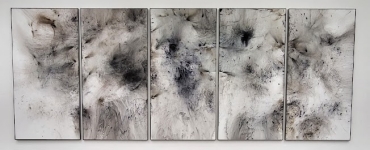
The exhibition in Cork Street includes 4 intriguing images. Each one consists of a mosaic of thousands of tiny photographic images, each one not much larger than a passport photograph. The photographs are not arranged randomly and subjects in neighbouring photographs seem to be unrelated to each other. They are put together in ways that when seen from a distance, form either large objects or abstract patterns. The resulting images are both fascinating and unusual.

Rana has exhibited in many parts of the world. These places are listed on the gallery’s handout and on the artist’s website. However, as far as I can determine, India is not one of these places. I wondered whether this related to the fact that an Indian gallery is displaying his works not in India but in London.

An ingenious use of simple matchsticks in a work of art

FROM AFAR IT LOOKS like a small red and black oriental rug, but as you approach, it is not what it seemed at first sight. This artwork by Hadi Rahnaward, who was born in Afghanistan in 1986 and now resides in Belgium, is made with matches, glue, and other materials. The matches used are of two sorts. Some are tipped with black material, and the others with red.

The matches have been glued to a base so that each one of them is vertical and standing with its tip pointing upwards. They have been placed close to each other in such a way that their tips form a mosaic resembling a patterned oriental carpet or rug. The artist made this incredibly intricate creation in 2023. It is one of a collection of often intriguing artworks by young artists from south Asia and Afghanistan being exhibited at the SOAS Gallery (formerly known as the ‘Brunei Gallery’) in London’s Bloomsbury until 21 June 2025.

One of the other exhibits that intrigued me is an embroidery by Varunika Saraf (born 1981), who lives and works in Hyderabad (India). Called “The Longest Revolution” and made in 2024, this embroidery depicts many features of Indian women’s struggle for basic rights and parity with men. This busy looking artwork depicts many aspects of women’s political struggles, and in places reminds the viewer of some parts of the Indian Constitution that appear to have been considered less relevant than previously by some in India during the last few years. Even if the political content of this piece is ignored, it is an eye-catching work of art.

Painted in blue and displayed at Kew

THE SHIRLEY SHERWOOD Gallery of Botanical Art is a relatively new addition to the buildings dotted around London’s Kew Gardens. It is an attractive clean lined contemporary edifice containing several interconnected exhibition spaces of varying sizes. Until 23 March 2025, it is housing an exhibition of mostly enormous ceramic objects, which were created by Felicity Aylieef, Professor of ceramics and glass and research at the Royal College of Art, London.

The enormous ceramic objects, which look like grossly magnified jars and vases, were handmade by craftsmen in China, whose names were not prominently displayed (if at all) in the exhibition. Ms Aylieff has painted attractive designs on the vessels using blue paint containing cobalt oxide. The painted ceramic objects are then placed back into enormous kilns, and fired once again to fix the painted designs and to glaze them. Undoubtedly, what she creates is impressive, but maybe pointless. However, the art historian John-Paul clarifies things a bit:

“These are objects to be encountered physically, peered at anear, admired from afar. They may derive from utilitarian vessels, but as objects they are architectural, sculptural even, in their forms. Painterly, we might also say, for the manner in which their surfaces are articulated with glazes”. (Quoted from a label at the show).

I enjoyed seeing these gigantic ceramic objects, but kept wondering whether the great effort (especially physical) to make them was worthwhile.

An artist from South Africa and a civil war

DURING THE ANGOLAN civil war (1975-2002), many Angolan families were forced to flee to South Africa.  The parents of Helena Uambembe, who was born in South Africa in 1994, were amongst those who were forced to leave Angola. Her father was coerced to join the South African Defence Force (‘SADF’), which was engaged in fighting in southern Angola during the period when the Apartheid regime was still in power.  He was enrolled in the 32 Battalion of the SADF.

Until 20 March 2025, there is an exhibition of art works by Ms Uambembe at the Goodman Gallery in Mayfair’s Cork Street. Her intriguing and somewhat terrifying works are on paper, canvas, and cloth. The drawings on display show her interest in the kind of posters used to attract young people into joining the military. I felt that these pictures illustrated the fearsome nature of serving in the military, rather than its attractions.  A large cloth work with images printed on it depicts the loss of self-identity or individuality that members of the military must undergo.

The small exhibition is visually exciting, of interest historically, full of angst about the war in Angola and now elsewhere, and well worth visiting.

Traditional inlaid metalwork used to make contemporary art

BIDRI WORK IS a method for creating decorative metal items. Its name derives from Bidar in Karnataka,  where this technique was developed and is still used. Objects are made by casting a black coloured alloy containing copper and zinc in the proportion 1: 16. Then, craftsmen use fine chisels to engrave often very intricate patterns on the surface of the cast alloy. These grooves are then filled by hammering fine silver wire into them. So, the resulting item is a dark metal object inlaid with silver.


Today, 8 February 2025, we visited the Kaash gallery, which is housed in a well-preserved traditional Bangalore bungalow. One of the three small exhibitions currently being displayed is a collection of Bidri art works. The artefacts were designed by Stephen Cox, a British artist, and were made by Abdul Bari, a Bidri craftsman. The resulting artworks are both unusual and beautiful.


The two other exhibitions at Kaash were: colourful contemporary seating made by weavers from Tamil Nadu and designed by David Joe Thomas,  and some sculptures and lighting by Italian artist Andrea Anastasio.


Our visit to Kaash was very satisfying. Although small, it is a place in Bangalore that art-lovers should not miss.

The azulejo tiling of Portugal is moving onwards

ONE OF THE CHARMING aspects of Portuguese culture is the use of the mainly blue and white decorative tiling known as ‘azulejo’. It can be found in Portugal and wherever else the Portuguese had colonies. One of the former colonies was Brazil. It was there that the artist Adriana Varejão was born in 1964 (in Rio de Janeiro). Today (the 11th of October 2024), at the Frieze Masters art show in London’s Regents Park, we saw a fine exhibition of her works in the booth set up by the Victoria Miro Gallery.

It was fascinating to see how Adriana subverts the azulejo, which was introduced to what is now Brazil by its Portuguese conquerors. Clearly inspired by the traditional tiling, her works both refer to it and distort the technique to create attractive, imaginative artworks that allude to the distortive effects of colonialism on indigenous culture.

I love seeing traditional azulejo. Seeing Adriana’s work was particularly enjoyable given that, to use a well-worn expression, ‘I know where she is coming from’. And I like the way that she has been moving the age-old art of azulejo into pastures new.

Magnetism, Mecca, and an artist from Arabia

IT IS THE AMBITION of many Muslims to make a pilgrimage to Mecca. Part of this involves visiting a sacred black stone, the Ka’abah, which is cuboidal in shape. One part of the annual pilgrimage, the Haj, involves pilgrims circling the Ka’abah seven times clockwise – a ceremony known as the ‘Tawaf’.

The artist and physician Ahmed Mater, who was born in Saudi Arabia in 1979, has created artworks based on the pattern created by the pilgrims circling the Ka’abah, as seen from above. Some of these are aerial photographs, but others are based on magnetism. Those who have studied physics even at an elementary level will be familiar with the demonstration of the shapes of magnetic fields that can be achieved by scattering iron filings near a magnet on a sheet of paper. The magnet arranges the filings in a pattern that corresponds to the shape of its magnetic force field.

What Ahmed Mater did was to create a cubic magnet in the shape of the Ka’abah. Then he scattered iron filings around it on a sheet of paper. The filings then arranged themselves according to the magnetic field of the cuboid magnet. Next, the artist gave the magnetic miniature Ka’abah a twist. This caused the filings to rearrange themselves into swirls, which when viewed from above, resemble the pilgrims encircling the sacred stone in Mecca.

This simple artwork demonstrates not only the fascination of magnetism, but also the spiritual magnetism of the Ka’abah, which draws Muslims to Mecca. In discussing this work of art, Tim Mackintosh-Smith makes an interesting point:

“But Ahmed Mater’s magnets and that larger, Meccan lodestone of pilgrimage can also draw us to things beyond the scale of human existence, and in two directions at once – out to the macrocosmic, and in to the subatomic. In the swirl of Ahmed’s magnetized particles and the orbitings of the Mecca pilgrims are intimations of the whirl of planets, the gyre of galaxies.” (www.ahmedmater.com/essays/magnetism-tim-mackintosh-smith).

The artworks based on magnetism and the Tawaf, are just a small selection of the intriguing, beautiful works by Ahmed Mater, which are currently being exhibited at Christies in King Street (London) until the 22nd of August 2024.

A Nigerian artist near London’s Edgware Road

OTOBONG NKANGA WAS born in Kano (Nigeria) in 1974. Her artistic training was carried out in Ile Ife (Nigeria), then in Paris (France). Now, she lives and works in Antwerp (Belgium). I doubt that I would have come across her work had we not visited the Lisson Gallery near London’s Edgware Road, where some of her artworks are on display until the 3rd of August 2024.

The exhibition contains sculptures, two attractive tapestries, and several framed works on paper. The sculptures, which are pleasant enough, are made with materials including clay, glass, and fibres. A leaflet with a text written by the artist describes how she is portraying her connections with nature. Without this text, I would have been hard pressed to realise what she described.

What impressed me most in the exhibition were Nkanga’s delicately executed framed works on paper. These, more than the other exhibits, convinced me that she is a highly talented artist. As I compared them to the sculptural works, I was remined of my thoughts about the artist Damien Hirst. At first, I thought that his works were interesting although often gimmicky, and did not display his deepest artistic feelings. I changed my mind about his inherent talents when, some years ago, I saw an exhibition of his paintings at the White Cube Gallery in Bermondsey. Great artists like Picasso and David Hockney, who are known for their experimental exploration of artistic expression, were, in their younger days, highly skilled exponents of what might be considered ‘traditional’ composition style. This was what I felt about the framed works on paper by Nkanga – although she clearly enjoys experimenting with a variety of media (including with recorded sounds – a soundscape, which is included in the exhibition), she is clearly able to express herself beautifully in the traditional art of sketching and painting.

Had we enough wall space and sufficient spare cash, I would have happily bought several of Nkanga’s lovely works on paper.

A COMMANDER OF THE BRITISH EMPIRE AND THE ARTISTIC INTERPRETATION OF COLONISATION

THE ARTIST YINKA SHONIBARE was awarded the prestigious CBE in 2019. In case you do not know what these three letters stand for, it is ‘Commander of the British Empire’ – not that Britain has much of, if any, empire left to boast of. For much of its long existence, places in the British Empire witnessed many injustices and inhumanities. This was especially true before the abolition of the slave trade in the early 19th century. Yinka Shonibare, who was born in London in 1962 and brought up between that city and Lagos in Nigeria, uses his artistic skills to explore Britain’s lengthy history of imperialism imaginatively and creatively. Even without knowing that he does this, his art works are in themselves visually exciting and fascinating to the viewer. The pieces on display until the 1st of September 2024 at the Serpentine South gallery in Kensington Gardens are well worth seeing both for their inherent beauty and for the way that Shonibare expresses his interpretation of Britain’s colonial past and its legacy.

For more information about the exhibition, please visit: www.serpentinegalleries.org/whats-on/yinka-shonibare-cbe-suspended-states/

A colourful tunnel with paintings beneath Waterloo Station

LEAKE STREET RUNS beneath the platforms and tracks of London’s Waterloo Station. It is 300 yards long and its walls and ceiling are covered with colourful graffiti created with cans of paint spray. The artwork creation in this street that runs in a tunnel was inaugurated in May 2008 during the Cans Festival, which was organised by the artist known as Banksy.

Unlike many public places in London, painting the walls in Leake Street is legal. Walking along this highly decorated street is a magnificent experience, which you can repeat often because the images on the wall are frequently changed. If you are lucky, you can watch the artists in action.