Works of art flating on a canal near London’s Paddington

EVERY FEW WEEKS, we walk along the towpath of the Grand Union Canal (Paddington Arm) between the Meanwhile Garden in North Kensington and Little Venice near Paddington station. About 1/3 of the way along this route, we stop at the pleasant Grand Junction Café. Many canal narrow boats are moored alongside the towpath. Most of them are floating residences. Today, 31 August 2025, we spotted a narrow boat that we had not seen before. Moored between the Meanwhile Garden and the café, it is a floating, mobile art gallery.

Below the words “Canal Boat Contemporary” attached to the starboard side of the boat, there was a large glass-covered frame facing the towpath. This contained about 15 paintings. Next to the frame, there were notices giving information about the gallery’s concept and the works of the artist being displayed. There was also a whiteboard on which viewers could add their reactions to the art, using the marker pen attached to it. Between 27 August and 2 September, works by the artist Henrietta Roeder are on display.

Also attached to the boat and visible to passersby was the ‘manifesto’ of Canal Boat Contemporary, which can be read on a website (www.canalboatcontemporary.com). It refers to the ‘box’, by which they mean the display containing the art. Here are some excerpts from the manifesto to illustrate what the organisation is trying to achieve:

“Opera sings to chandeliers. If art wants to matter, it has to leave the palace … We moor up. We don’t ask for permission.We resist fixed power structures and take art to different places and contexts … We’re all speaking, nodding, showing – but always to each other. The Box is a window turned outward – away from the art world – for new eyes. It’s for someone walking their dog … The Box is modest, but powerful. A single painting on the towpath can shake you to the core … We don’t want your submissions. We want doppelgängers. Copy us. This idea wants to spread like moss. All you need is a frame no one’s using. A window everyone passes.”

Seeing the boat with its artworks, appearing as if from ‘out of the blue’ was a lovely experience. I think it is a wonderful idea to bring contemporary art outside of great institutions and commercial art galleries to make it available for anyone to stumble across unexpectedly.

Displaying and selling works of art in London for forty years

VICTORIA MIRO WAS born in London in 1945, Her parents, who were keen on cultural pursuits, saved their money and took Victoria for holidays in Italy to see art there. My parents did the same thing for me and my sibling. Victoria studied painting at the Slade School of Fine Art (at UCL), and then became an art teacher at a secondary school. In the 1970s, she married a businessman, Walter Miro. After bringing up her children for a few years, she opened an art gallery in 1985. It was in Cork Street. In 2000, she moved to larger premises near Hoxton and Old Street. The gallery is housed in a converted former furniture factory. Since then, Mrs Miro has opened another smaller gallery in Venice.

To celebrate the fortieth anniversary of her gallery, the Victoria Miro has put on a special exhibition in her London establishment.  It will continue until 1 August 2025. The show includes works by many of the artists that have exhibited at Victoria Miro since 1985. They are displayed beautifully in the large galleries within the converted factory. The list of artists can be found at https://www.victoria-miro.com/exhibitions/656/ . Some of the works, for example by Paula Rego, are now old, but many of the other artworks were created especially for the exhibition.

To see the entire exhibition, you must be prepared to climb many stairs, including an impressive 72 step staircase, because some of the works are on the upper floors of the building, which have never before been used as exhibition spaces. It is worth seeing the whole show because moving through the gallery spaces allows one to appreciate the converted factory’s elegant architecture.  The interior was designed by architect Michael Drain in collaboration with Claudio Silvestrin. At the rear of the building, there is a terrace beside a pond shaded by trees.  

Although the works in the anniversary exhibition are wonderful, it is the gallery’s interior design that steals the show. It does not overpower the artworks, yet it does compete with them for one’s attention. I must admit that the design of the spaces and the way they interconnect fascinated me more than what was on display. Whether your interest is modern art or modern architecture, a visit to the gallery will be well worthwhile. Its precise address is 16 Wharf Road, London N1 7RW.

Inspired by the Bauhaus in Cambridge

PORTUGAL PLACE IS a narrow winding lane that runs east from Bridge Street in Cambridge. It contains many picturesque old cottages and in the midst of them is one that looks as if its design was inspired by the Bauhaus school of design. Occupying numbers 5 to 7 Portugal Place it is a wonderful example of Modernist architecture.

Until 1933, numbers 5, 6, and 7 Portugal Place were Victorian cottages. In 1933. The three cottages were sold by auction to Samuel Bostock. In 1935, the publisher Gordon Fraser (1911-1981) bought the properties, and demolished them. In their place, he had the present Modernist edifice constructed, which was completed by 1939. The new building served as a bookshop and a gallery for prints.

Today, this well-lit, spacious place is home to an art gallery called ArtSpace 5-7. It hs been in this Modernist building for at least 10 years. Although I have been visiting Cambridge regularly since the 1960s, I had never walked along Portugal Place until May 2025. Finding this elegant Modernist building in that tiny thoroughfare was a wonderful surprise.

Exploring some unknowns in London’s fashionable Mayfair

I HAVE NO IDEA how many commercial art galleries there are in Central London. Today (the 14th of May 2024), we visited an art gallery, whose existence was previously unknown to us, and there we saw an exhibition of works by an artist, who was also new to us. The gallery is Carl Kostyal in Savile Row. Its discreet entrance is sandwiched between two fashionable tailors’ stores. Half Hungarian and half Swedish, Carl Kostyál opened his gallery in Savile Row in 2010. Three years later, he opened another gallery in Stockholm.

The artist, whose work is being exhibited, is Leo Park, who was born in Sweden in 1980. His exhibition in Savile Row is called “Beyond Pleasure”. It consists mostly of large paintings, but also a wall covered with a mosaic of small sketches, The beautifully executed artworks are eye-catching, and reminded me a little of the works of some of the pre-WW2 Surrealists. The paintings and sketches are of imagined forms that immediately made me think of human bodies. The images are clearly meant to evoke such thoughts, but looked at objectively, they are all shapes that do not exist in nature. The paintings and drawings are all displayed in the beautifully restored rooms of the 18th century building that houses the gallery.

The show ends on the 2nd of June 2024, and is well worth visiting.

TWO ARCHITECTS IN ISTANBUL SEPARATED BY A SHORT DISTANCE AND SEVERAL CENTURIES

A MOSQUE DESIGNED by Mimar Sinan (c1489-1588), probably the best of Ottoman architects, stands a few yards away from Istanbul Modern (modern Art museum) designed by one of Europe’s best contemporary architects – Renzo Piano (born 1937).

The mosque is the Kiliç Ali Paşa, designed by Sinan and completed 1580. Like other mosques designed by this architect, the spaces contained within feel most satisfying. Sinan was masterful in his creation of contained spaces. The mosque with buttresses also has some attractive tiled panels both inside and outside.

One minute’s walk away from the 16th century mosque stand Piano’s Istanbul Modern, which was completed in 2004. Quite different from the mosque, it shares one thing in common – brilliant spatial design. Located next to the waterfront of the Bosphorus, brilliant views of Istanbul can be obtained from the waterfront, from the rooftop terrace, and through the gallery windows.

Piano’s building is so utterly engaging visually that it competes with the exhibits for one’s attention. Although many of the mostly Turkish artworks are both beautiful and engaging – we spent three hours looking at them, it is Piano’s building that steals the show.

I found it fascinating that two magnificent buildings, their constructions separated by 424 years, should be standing so close one another. Had I been in Renzo Piano’s shoes, I would have felt honoured to have one of my buildings so close to that of an architect who has easily passed the test of time.

An exhibition in London at a gallery called Parafin

ONE OF THE MANY advantages of living close to central London is that it does not take long for us to reach the numerous commercial art galleries in Mayfair and Marylebone. Many of these hold exhibitions of modern and contemporary art, which is often fascinating to see. My mother was a sculptor, many of whose works were abstract rather than figurative. Being brought up in close proximity to someone so interested in the contemporary art world (of the 1960s and 1970s) might well have been a source of my lifelong interest in seeing works of contemporary artists (as well as modern artists who no longer live). My enthusiasm for viewing art has been enhanced by two people close to me. My wife has always had an interest in art in general and ‘modern art’ in particular. Our daughter, who works in the world of art and its propagation, has added to our enjoyment of experiencing artistic creations by recommending galleries with exhibitions that often prove to be most fascinating.

Recently, our daughter suggested that we see an exhibition, “As Above So Below”, by an artist with whom she is working. Creations of British born Tania Kovats (born 1966) are being displayed at an exhibition in a small Gallery, Parafin, in Woodstock Street (close to Bond Street Underground station) until the 24th of February 2024. Although she is known for her work in a wide range of artistic activities, she best known for her drawings and sculptures. The present exhibition includes many drawings and a few sculptural creations. The gallery’s ‘flyer’ (or handout) explained that:

“… Kovats’ enduring themes are the experience and understanding of landscape, geological processes, patterns of growth and the intersection of landscape, nature and culture and how art can speak to our critical climate crisis.”

This summarises what the artist is trying to convey with her artworks. Everything on display at the exhibition was pleasing visually and meticulously executed, but just by looking at the works I was unable to grasp anything about them but their beauty. Fortunately, the gallery’s flyer helps to explain the artist’s intentions.

Many of the works on display relate to the sea and evoke it beautifully. One exhibit, also connected with the sea, was a series of images of numbered, but un-named, graves of 20 migrants who lost their lives crossing the sea from Africa to the Italian island of Lampedusa. Near this artwork, there was another work – a line of used school shoes. This is Tania’s memorial to her son’s childhood, and (to quote the flyer):

“… explores how growth houses loss, and is built into the child’s progress towards individualisation.”

The passage of time is depicted in another work in the exhibition, “Luna”, in which a series of pictures depicting the phases of the moon as they change during a lunar month.

I am very pleased that our daughter recommended this exhibition by an artist, who we had not encountered before. Although I greatly enjoyed the exhibition, now that I write about it and reflect on what I saw and read, I feel that I would like to see the show once again because at a second viewing I will gain much more from it than during my first visit.

MY FAVOURITE VISITOR ATTRACTION IN BANGALORE

IF YOU HAVE ONLY a short time to look at Bangalore, there is one place that you must try not to miss. I am not referring to Tipu’s summer palace or the Bull Temple or Lalbagh Garden or Cubbon Park or many of the other oft-mentioned places in the city. My first choice of ‘must-see’ places is the Bangalore NGMA (National Gallery of Modern Art), which is located on Palace Road.

Manikvelu Mansion

The NGMA opened its doors to the public in February 2009. It is housed in the elegant former Manikvelu Mansion and the beautiful modern extensions that have been added to it in such a way that the beauty of the old building has not been impaired.

The NGMA stands Inn spacious grounds with a landscaped garden. Within the garden, there are modern sculptures – part of the NGMA’s permanent collection.

The modern extensions contain galleries for displaying artworks, a shop, an auditorium, a library and a very pleasant café under a deep veranda. Even if you have little interest in seeing artworks, the harmonious ensemble of architectural styles is well worth seeing.

The galleries, located both in the old mansion and on the new extensions, are well lit and vary in size. Usually, some of the permanent collection is displayed as well as an often fascinating temporary exhibition. Currently (January 2024), there is a wonderful temporary exhibition of paintings by the Bengali artist Nandalal Bose – I will write about that soon.

Situated not far from bustling Shivajinagar and busy Cunningham Road, the NGMA is a peaceful haven – a place to enjoy some of the best of modern Indian art. In a city where so many modern developments are of dubious aesthetic value, the NGMA on Palace Road is a feast for the eyes.

An artistic British Nigerian in Mayfair

WHEN WE ARE IN LONDON, we make regular visits to the commercial art galleries, many of which are to be found in and around Mayfair. Not only can one get to see some of the most recent works of contemporary artists, but also those that will eventually end up in private collections that are usually inaccessible to the general public. Today, the 12th of October 2023, we were walking along Cork Street, heading towards the Waddington Custot Gallery when we passed a gallery, the Stephen Friedman, which we had never entered before. Through its window, we saw works by an artist, whose oeuvre we enjoy, and entered.

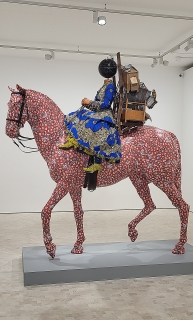
Much of the exhibition at Stephen Friedman is dedicated to creations of the British Nigerian artist Yinka Shonibare. He was born in London in 1962. His Nigerian parents took him to Lagos in Nigeria when he was 3 years old, and he lived there until he was 17. A year later, he developed transverse myelitis, which left him paralysed on one side of his body. Despite this, he went on to study fine art at the Byam Shaw art school, and then later at Goldsmith College (part of the University of London). Because of his disability, Yinka directs a team of assistants to create his artworks (sculptures, photographs, fabrics, and much more). He has become a widely exhibited and highly acclaimed artist.

Yinka’s works are visually engaging and highly imaginative. They are also full of meaning. He uses his creations to:

“… question the validity of contemporary cultural and national identities within the context of globalisation. Through examining race, class and the construction of cultural identity, his works comment on the tangled interrelationship between Africa and Europe, and their respective economic and political histories.” (see https://yinkashonibare.com/biography/)

Although one can easily enjoy the aesthetics of his creations without understanding the artist’s messages contained within them, a good knowledge of colonial and post-colonial history will enhance the viewer’s experiences of them.

The exhibition is on until the 11th of November 2023. In addition to Yinka’s works, he has curated a small, but fascinating, collection of artworks by several artists from the African diaspora.

Pioneers of making selfies?

THE LONDON-BASED ARTISTS Gilbert Prousch (born 1943) and George Passmore (born 1942) first met whilst they were studying sculpture at the St Martins School of Art, where, incidentally, my mother created sculptures in the 1950s and early 1960s. From the late 1960s onwards, most of their creations have portrayed themselves, usually together, in an incredible variety of poses and situations. One might say that they were pioneers of selfie-making.

On the 1st of April, Gilbert and George (‘G+G’) opened their new establishment, The Gilbert & George Centre, in London’s Heneage Street near Spitalfields and Brick Lane (see https://gilbertandgeorgecentre.org/). I have yet to visit this new gallery, and look forward to doings so soon. To coincide with this new venture, the White Cube Gallery in Mayfair’s Masons Yard is holding an exhibition of works by G+G until the 20th of May 2023.

Called “The Corpsing Pictures”, this exhibition at White Cube consists of G+G posing as corpses in a range of different settings. In each picture, the two artists are portrayed lying as if dead but fully dressed in their characteristic smart suits. In many pictures, images of bones have been included in the compositions. At first sight, these pictures, which look like stained glass windows, appear somewhat macabre, but soon the viewer becomes aware of the playful and often punning nature of the images. Each composition is compelling visually and together the collection is a stunningly beautiful sight.

I suspect that the crowds at the Heneage Street Centre will be great for the first few weeks after its opening. So, if you want to see some good examples of the works of G+G without being bothered by too many other viewers, I recommend that you head for the White Cube in Masons Yard.

A great art gallery near the sea

UNTIL WE WENT to Southend (in Essex) in February 2022, it was not the first place to spring to mind when thinking about art galleries. To my mind, Southend was mainly associated with its spectacular pier, which is over one mile in length. Now, to the pier I will add the Beecroft Art Gallery to the good reasons for visiting Southend.

The gallery has been housed in a distinctive 20th century building on Victoria Avenue since 2014. Its current home was formerly Southend’s Central Library. The edifice was designed by Borough Architect R Horwell and opened in 1974. Prior to moving there, the gallery was housed in a large Edwardian house on Station Road in nearby Westcliffe-on-Sea.

The permanent collection of art in the gallery was donated to the town in 1952 by a local collector, a solicitor called Walter Beecroft, who worked in Leigh-on-Sea. His paintings ranged from the 17th century to the late 19th, and a few from the 20th. A selection of these was on display in the first-floor gallery of the Beecroft when we visited. Newer additions, mainly on long-term loan, to the gallery’s collection were hung alongside examples donated by Beecroft.

We went to the Beecroft to see a temporary exhibition of 20th century artists from London’s East End. It was excellently curated. I will write about this in the future. There were also temporary exhibitions of Pakistani wedding outfits and feminism during the covid19 lockdown. The basement of the Beecroft is currently dedicated to the history of jazz.

All in all, the Beecroft Gallery is well worth visiting. The quality of the exhibitions we saw there puts to shame a few of the better-known art galleries in London.