
This artist shines lights on life in modern India

BORN IN MYSORE (Mysuru) in 1969, the Indian artist NS Harsha lives and works in that city. He studied art first at Mysore’s Chamarajendra Academy of Visual Arts, and then at Maharaja Sayajirao University in Baroda (Vadodara). Until 31 July 2026, there is a wonderful exhibition of his large paintings at the Victoria Miro Gallery in London.
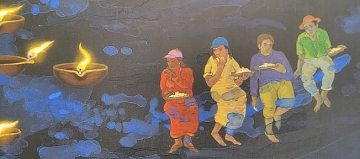
Almost all of Harsha’s beautifully executed paintings in the show contain depictions of lighted oil lamps (diyas), often many in a single work. In some paintings, the oil lamps are arranged to form regular patterns. In others, they are interspersed with images of people, animals, food, and items used in daily life. The numerous people who appear in these works are frequently workers in their overalls and hard hats (helmets), animals, and people planting crops. From a visual point of view, the paintings are very pleasing even if one has no idea what, if any, message the artist is attempting to convey. Although they depict contemporary subjects and far from being miniature, they hark back to the historical traditions of Indian Miniature paintings.

In a web page produced by the Chemould (Prescott Road) Gallery in Bombay, I read that:

Like a chronicler, often drawing from popular stories and local perceptions of international news events, Harsha depicts in his canvasses small town/city Indian life in our increasingly globalized times. His intricately detailed canvasses juxtapose seemingly disassociated images of scenes of small town and village India with those of more recognizably international ones. Harsha’s multi-layered narratives strongly suggest that the global is always already located within the local imagination.”

Regarding the lamps in the paintings, the Victoria Miro website explained:

The works, which elaborate on the artist’s celebrated, ongoing ‘lamp grid’ series, feature diyas – lamps traditionally made from clay that are lit during rituals, prayers, ceremonies, celebrations and during power cuts – with flames and trails of smoke together creating patterns that guide the eye around each canvas …  In Harsha’s work they represent energy, forces perhaps unseen.”

This interesting interpretation is useful enough, but the paintings alone speak for themselves, and throw an intriguing light on contemporary life in India.

I enjoyed viewing this exhibition, and becoming aware of a fascinating artist, whom I had not come across before.

Displaying and selling works of art in London for forty years

VICTORIA MIRO WAS born in London in 1945, Her parents, who were keen on cultural pursuits, saved their money and took Victoria for holidays in Italy to see art there. My parents did the same thing for me and my sibling. Victoria studied painting at the Slade School of Fine Art (at UCL), and then became an art teacher at a secondary school. In the 1970s, she married a businessman, Walter Miro. After bringing up her children for a few years, she opened an art gallery in 1985. It was in Cork Street. In 2000, she moved to larger premises near Hoxton and Old Street. The gallery is housed in a converted former furniture factory. Since then, Mrs Miro has opened another smaller gallery in Venice.

To celebrate the fortieth anniversary of her gallery, the Victoria Miro has put on a special exhibition in her London establishment.  It will continue until 1 August 2025. The show includes works by many of the artists that have exhibited at Victoria Miro since 1985. They are displayed beautifully in the large galleries within the converted factory. The list of artists can be found at https://www.victoria-miro.com/exhibitions/656/ . Some of the works, for example by Paula Rego, are now old, but many of the other artworks were created especially for the exhibition.

To see the entire exhibition, you must be prepared to climb many stairs, including an impressive 72 step staircase, because some of the works are on the upper floors of the building, which have never before been used as exhibition spaces. It is worth seeing the whole show because moving through the gallery spaces allows one to appreciate the converted factory’s elegant architecture.  The interior was designed by architect Michael Drain in collaboration with Claudio Silvestrin. At the rear of the building, there is a terrace beside a pond shaded by trees.  

Although the works in the anniversary exhibition are wonderful, it is the gallery’s interior design that steals the show. It does not overpower the artworks, yet it does compete with them for one’s attention. I must admit that the design of the spaces and the way they interconnect fascinated me more than what was on display. Whether your interest is modern art or modern architecture, a visit to the gallery will be well worthwhile. Its precise address is 16 Wharf Road, London N1 7RW.