
Caught by the camera,
Frozen in time:
An eternal memory
Postcard of a scene in Bangalore during the British occupation

Caught by the camera,
Frozen in time:
An eternal memory
Postcard of a scene in Bangalore during the British occupation

In the early 1960s, I attended a preparatory (‘prep’) school between Swiss Cottage and Belsize Park in north-west London. A prep school in the UK is a place that young children aged between 5 and 11 to 13 years study in order to pass examinations that will admit them to Public Schools, which, despite the name, are actually private schools.
At my prep school, The Hall School, we were made to sit in alphabetical order (by surname) in the classrooms. We were addressed by our surnames. I suppose arranging us alphabetically might have helped the teachers remember who was who.
My surname is Yamey, so I always sat in one corner of the classroom. There were often no other boys at my end of the alphabet, although occasionally I was in the same class as someone with the surname Yeoman or Zangwill.
Often, we had to learn poetry off by heart (by rote). We would then have to recite the poem in class. Invariably, the teachers began be asking the boy at the beginning of the alphabet to commence the recitations. Then, the other boys in the class took their turns, as the teacher worked his way down the surnames towards the end of the alphabet. Often the bell marking the end of our 45 minute lessons rang before the teacher reached my end of the alphabet and I was spared the embarrassment of having to try to recite a poem that I was never able to remember. I was hopeless at learning poetry, or anything else, by heart. I can only remember things if I can put them into some conceptual framework in my mind. Poetry did not seem to fit anywhere in my head!
What continues to surprise me is the lack of imagination of our teachers. Why did they always start asking us to recite by beginning with the pupil whose surname was at the beginning of the alphabet? Why did they not begin at Y or Z and work in the other direction?
Many years later, our 6 or 7 year old daughter attended a school in which students were asked to do things in alphabetical order of their surnames. Unlike me, she was always keen to take part in class activitues. So, one day she informed the school that she her surname had been changed to one begining with D. That way, she was always asked to participate in class activities that were being done in accordance with the alphabetical order of the children’s surnames.
All went well until we received the termly bill for the school fees. It was addressed not to Dr and Mrs Yamey, but to Dr and Mrs D…. I told our daughter that as the bill was not addressed to us, I would not be able to honour it. Our daughter quickly agreed to change her surname back to Yamey.

Books on shelves
Scholars on laptops:
A day in the British Library

In India, many people ‘sky’ their drinks. This means that they take a drink from a container without letting it contact their lips or mouth. To ‘sky’ a drink means literally pouring a drink into your mouth from a distance. This method of drinking allows many people to drink from the same container without risking contamination of the drinks by any of the drinkers’ germs.
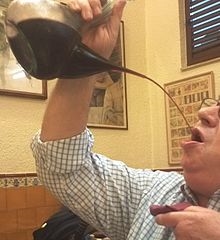
Drinking wine from a porro (source: wikipedia)
Spain, which is many miles away from India, uses special vessels known as porron (porro, singular) to ‘sky’ wine. These traditional vessels, popular in Catalonia, allow many people to imbibe from the same vessel without making any contact between it and the mouth. The design of the porro is such that the drink container can be held at a much greater distance from the mouth than in the Indian mode of sky-ing a drink.
George Orwell was not keen on using porron. He wrote in his Hommage to Catalonia (published 1938):
“A porron is a sort of glass bottle with a pointed spout from which a thin jet of wine spurts out whenever you tip it up; you can thus drink from a distance, without touching it with your lips, and it can be passed from hand to hand. I went on strike and demanded a drinking-cup as soon as I saw a porron in use. To my eye the things were altogether too like bed-bottles, especially when they were filled with white wine.“
I have no idea when or where the habit of drinking without contacting the vessel originated. If anyone has any ideas, please let me know.
The top photo was taken in Mattancherry, Kerala, India

A wild wind blows,
Weeping willows sway:
Maybe spring is in the offing

“Come up and see my etchings…” is often interpreted as being an invitation to sexual adventures. But when I used to say those words, there were, actually, genuine etchings to be viewed.
My late mother had a cousin Dolf Rieser (1898-1983; https://dolfrieser.com/biography/), who used to hold classes to teach etching and engraving. He lived in West Hampstead. I used to attend his classes onc evening a week while I was a dental student (1976-82). Dolf was an excellent teacher and an inventive artist. His comments on composition were constructive and and always apt.
Dolf, who had a doctorate in some aspect of biology, became interested in art long before WW2. In the compulsory tea breaks that we had during the classes, he would tell us about his life as a young artist in Paris. He would frequent the same cafés as Picasso and other famous artists. The great artists in Paris during the thirties sat at one table presided over by Picasso. Budding artists like Dolf sat at neighbouring tables. He was very proud of a small picture by Joan Miró, which hang next to the door to his studio in London. Miró, who was five years older than Dolf, had presented his picture to his young friend ( i.e. Dolf).
Having studied in Switzerland, Dolf had learnt how to ski in the 1920s. He used to ski every year in Switzerland while he was becoming an artist in Paris. He told us that in the thirties when he used to arrive at the railway station in Paris in order to visit the mountains with his skis, people would stop him to ask him what he was carrying because in those days hardly anyone in Paris went skiing. Few people in Paris had ever seen skis.
I loved the classes. It was wonderful becoming so immersed in what I was doing that I lost all sense of time and, more importantly, everything that was worring me at the time evaporated from my head during the three hours each week while I was engrossed in creating an artwork.
I graduated as a dentist in early 1982 and went into practice. Soon after that, Dolf died. Also, my urge to create artworks (prints, drawings, and paintings) seemed to disappear. I suppose that was because I was working all day with my hands in the surgery, my need to do fiddly manual tasks in my spare time, such as drawing and etching, diminished.
By now, you are probably wondering whether I ever invited anyone to come up and see my etchings. Well, of course I did, but I will not tell you whom I invited. Suffice it to say that the woman I eventually married has a good collection of my works!
The picture is a detail of an etching by Adam Yamey
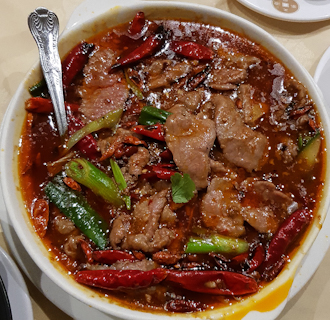
I love eating Chinese food. So, do many people in India, where this cuisine is served everywhere from simple, unsophisticated street stalls to dedicated, smart Chinese restaurants.
Indian Chinese food is prepared to suit Indian peoples’ tastes. To people used to eating Chinese food in London or elsewhere in the UK, the Chinese food in India may seem somewhat different, especially its taste. Although I much prefer eating Chinese food in London, where the restaurants serve food to many people of Chinese origin, I also enjoy eating Indian Chinese food, which is prepared mostly for Indian diners. On the whole, the Chinese food in India is less ‘authentic’ than that served in London, where there is a large population of Chinese from Hong Kong and mainland China.
Once when we were visiting Mangalore on the coast of the Indian State of Karnataka, we entered a Chinese restaurant. Its main entrance was almost hidden in a dingy yard that would have made an excellent setting for a performance of West Side Story. This establishment was staffed mainly by a Chinese family, rather than people with slanting eyes who had originated in the north eastern states of India. I was delighted to find steamed pork dumplings on the menu amongst the starters. I ordered these, and was told that I would have to wait atleast 45 minutes. I said that was alright, and we ate other dishes whilst we awaited the dumplings.
When the dumplings arrived, we found them to be as delicious as the best we had eaten in London. They were made without making compromises to satisfy Indian tastebuds. The reason that they had taken so long to arrive was, I believe, that they had been made fresh, from scratch. Of all the Chinese food I have eaten in over 25 years of visiting India, these dumplings are the best Chinese food I have been served in the country. I have eaten other enjoyable Chinese meals in India, but none matched those dumplings in Mangalore.
There is one feature of Indian Chinese food that particularly displeases me: the over use of fresh coriander. I like this herb in some Gujarati vegetarian dishes and some Mexican food, but I do not think it enhances Chinese food. Almost every Chinese dish served in India is tainted with fresh coriander.
I am fond of Hot and Sour Soup, both in London and in India. However, in India my enjoyment of it is marred by the obligatory addition of fresh coriander. Recently, a friend of mine in Bangalore made the very sensible suggestion that I should ask for this soup to be made without coriander added. So, the next time I ordered the soup I followed his advice. The waiter noted my request and the soup arrived without coriander. I tasted it. To my great surprise, the soup was tinged with a taste I associate with Polish food. The chef had replaced coriander with freshly chopped dill leaves!
Tea in a bag, not a teabag …
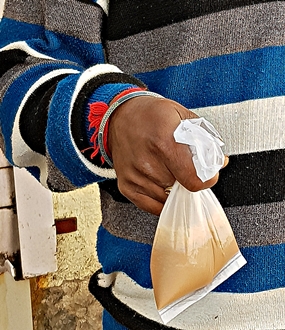
In Porbandar, the city where Mahatma Gandhi was born, we found a small tea-stall.
As we drank our tiny cups of milky, spiced tea, we watched the chaiwallah filling narrow, cylindrical plastic tubes with hot tea. When these thin-walled short cylinders are almost filled, they are tied closed and handed to customers to drink elsewhere. Later, we learned that these popular thin plastic containers of ‘take-away’ tea pose a potential health hazard because the hot drink leaches toxic chemicals from the plastic.
The picture above, which was taken in Ahmedabad, shows a portion of take-away tea in a bag rather than a tube.
Just as in the UK, take-away and home delivery foods and drinks are becoming popular in India. There are many mobile ‘phone ‘apps’ that allow the customer to order the food or drinks in advance. Often, motorcyclists deliver what is ordered. In India, the Swiggy company does…
View original post 28 more words

One of the great features of possessing a Tate Card (an annual season ticket) is that one can enter (with or without a companion) the regular special exhibitions without paying extra for tickets, which tend to be quite costly. What I particularly like is that if an exhibition does not meet one’s expectations, one can spend a short time viewing without worrying about having wasted, maybe, as much as £18 per person.
Recently, I visited the much-hyped special exhibition of works by the French painter Pierre Bonnard (1867-1947) at the Tate Modern in London. Without the Tate Card, the two of us would have had to shell out £36 (about 30% of the cost of a Tate Card) to see what I thought was a tedious exhibition.
I like Impressionist and Post-Impressionist art in general, but the Bonnard works left me cold (or at least lukewarm!). I cannot comment on the competence of their execution, but I found them short of visual excitement, almost boring compared with works of other artists painting during Bonnard’s lifetime. Consequently, we did not linger long in the exhibition. I may sound like a Philistine with my comments about the famous Bonnard, but it is only fair to write honestly about how the exhibition affected me. Incidentally, I noticed that many of the visitors at this show were more interested in chatting to each other than looking at Bonnard’s works. I saw one man sitting on a bench reading his newspaper rather than trying to enjoy Bonnard.
As we were still in the mood for looking at art, we decided to enter another special exhibition in the Tate Modern. Using our Tate Card, we saved up to £26 when we entered the exhibition of artworks by the American-born Dorothea Tanning (1910-2012). However, this is an exhibition that is well worth its entrance fee. Bonnard and Tanning’s working lives overlapped for a few years, but the American’s output made a far greater impression on me than the Frenchman’s.
The exhibition at the Tate Modern commences with paintings from Tanning’s surrealist phase. Her execution and composition sets her amongst the best of the surrealist artists. Each painting has subtlety, excitement, a sense of adventure, and creative freshness. As Tanning grew older, her works tended towards abstraction in an original way. In brief, Tanning was an artist whose visual language(s) really attract me. Her work has a freshness and impact that I found lacking in Bonnard.
In addition to paintings and designs for stage sets, the exhibition at the Tate includes some of rather weird soft fabric sculptures, which did not appeal to me quite as much as the framed works. However, they display another aspect of Tanning’s undoubted inventive talent.
I am glad we decided to visit the Bonnard, even though it disappointed me, because it got me to visit the Tate Modern after a long break (in India) and to discover the delights of Dorothea Tanning’s artistic output.
The photo is a detail of a work, “Endgame” , painted by Dorothea Tanning in 1944
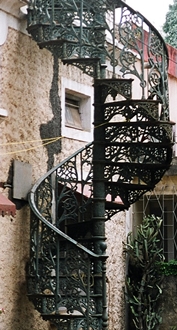
Curling around,
Ascending gradually:
A staircase spiralling

 yamey
yamey 