With strings attached


During my wanderings through India, I have often noticed trees with thin threads tied around their trunks. These are peepal trees with heart-shaped leaves. They are held to be sacred by devout Hindus. Women wrap threads around the trunks in the hope that their prayers will be answered satisfactorily.

On at least one occasion, and this was in an Islamic mausoleum (dargah) in Baroda (Gujarat), I have seen threads tied around pillars within the dargah. Some of these threads had bangles attached to them. We were told by the guardian of the dargah, that Muslim women tie these threads, hoping that their wishes will be fulfilled.

Statues of Christ, the Madonna, and saints in churches in India are often draped with flower garlands. This is done more likely to honour the persons depicted in the statues than to have wishes granted. I have not yet seen any examples of threads tied in churches like I have seen in Hindu and Muslim shrines in India.

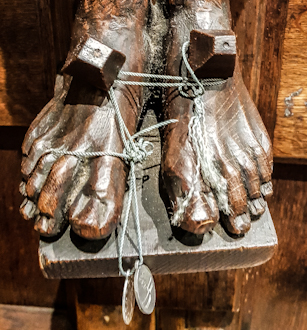
Yesterday, I visited St John the Baptist Church (Church of England) in Holland Road, Shepherds Bush, London. At the entrance to this magnificent Victorian Gothic building, there is a wooden crucifix. I was surprised to see that it had something that made me think of India. Two threads, each bearing a small metal medallion with some prayerful words on them, were wrapped around the heads of the nails penetrating Christ’s feet. I have never seen anything like this in a church in the UK. Is this a chance finding or the beginning of a new trend?

How sad is that?

I was visiting Christie’s auction house in London to view some modern art being displayed prior to an auction.

Seated by a large painting by David Hockney, there was a well dressed man looking at his mobile phone.

A decorous young lady sauntered up to him and said in a French accent:

“Do you follow me on Instagram?”.

The man looked up and said:

“No. Who are you?”

How sad is that?

Love at first bite

pizza


Until I was  16 years old, I always went on holidays with my parents. Every year, we visited Florence and Venice in Italy. When I was 16, I decided that I would try touring on my own.  After spending some time with my folks in Florence, I set off alone on a tour of my own planning: Volterra, Grossetto, Orvieto,  and Cortona, hoping to visit some Etruscan remains on the way.

All went well except for one thing. In those days, I was extremely shy and unable to strike up a conversation with strangers. As the days passed, I travelled through Italy becoming increasingly lonely. I spoke to no one, and, unusually for Italy, nobody spoke to me. I would get very hungry, but often felt unable to step into any eatery. I would wander around feeling a bit hypoglycaemic yet unwilling to risk entering a restaurant or bar.

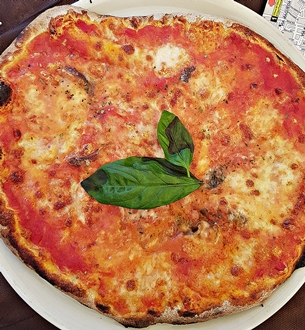
When I reached Orvieto, I stayed in a hotel that was close to a church whose bells struck throughout the night. One lunch time when I was wandering pathetically from one eating place to the next, I passed a place selling pieces of pizza. I was overcome by the delicious smell of freshly baked pizza. I bought a piece and loved it. This was the first time that I had ever eaten pizza. Being unadventurous in my food choices, such as I was as a teenager, but no more, I had always avoided pizza. However, when I tasted it in Orvieto, it was love at first bite.

I still enjoy eating pizza occasionally, but now I am not shy about entering the first place selling food as soon as I feel hungry.

A myth


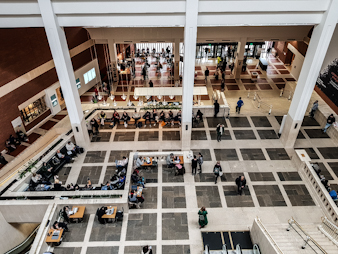
Recently, I renewed my Reader’s Card at the British Library, currently housed in superb premises on Euston Road, next door to the Victorian Gothic St Pancras railway station. This building was opened by Queen Elizabeth II in about 1998. Prior to this, the library’s Reading Room was a huge circular structure in the heart of the British Museum.

When our daughter was at primary school, she was taught about the Ancient Egyptians  including a female Pharaoh called Hatshepsut. One Saturday, I took our daughter to the British Museum in the hope of finding an image of the pharaoh in the Egyptian Galleries. After a desultory search, we gave up and walked acoss the the lovely covered Great Court, created relatively recently. The central circular structure within it contains the unused but well-preserved round Reading Room, which was designed by Sidney Smirke and opened in 1857, the year of the First Indian War of Independence. 

We entered the old Reading Room and I asked the attendant sitting there:

“Where exactly did Karl Marx used to sit when he used the library?”

“It’s a myth, sir,” replied the attendant, “He did not have a particular place because it has always been the library’s policy that places can not be reserved from day to day.”

I was a bit disappointed with his reply, but had to accept it.

When we got home, my wife asked our child how we had got on. She replied:

“You know Mummy. Daddy asked about his friend at the big old library?”

My wife asked which friend. Our daughter replied:

“I don’t know, but the man said he was a myth really.”


Picture shows foyer of current British Library in Euston Road


Salt

Salt is more than just a condiment on your dining room table. It is one of life’s essentials…

yamey's avatarGUJARAT, DAMAN, and DIU

salt pan

Salt is an essential part of the human diet. In Africa, salt  produced by the Moors was transported across the Sahara Desert to salt-free Central Africa, where it was exchanged for gold. This shows how much salt is valued as a commodity.

On a recent bus trip between the two Gujarati cities of Baroda and Bhavnagar, we passed through a flat low-lying district not far from the sea (the Gulf of Khambat).  Along the way, we passed numerous white piles of salt recently extracted from the sea. These piles stand amongst pools of salty water that is evaporating in the hot sun. Although flat, the landscape is varied and fascinating.

Gujarat is the largest salt producer in India and the third largest in the world. Sadly, the salt workers, whose life is tough and dangerous, are poorly treated by their employers. According to the Indian Express dated April 26, 2016…

View original post 21 more words

Curious ‘cookies’

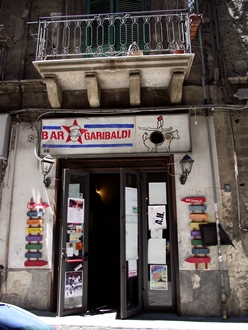
GARIBALDI

In 1860, Giuseppe Garibaldi commenced his famous invasion of Sicily. This led to the downfall of the House of Bourbon’s rule in Sicily and Naples and, ultimately, to the Unification of Italy.

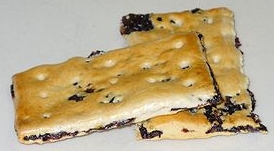
Many people who live in the UK will be familiar with Garibaldi biscuits (‘cookies’ in US English). They consist of a paste made with currants sandwiched between two layers of thinnish baked biscuit dough. Because of their appearance, they are sometimes called ‘squashed flies’.  Garibaldi biscuits were first made in 1861 by the Peek Frean Company in London and have been popular ever since. Garibaldi, who visited England in 1854, became very popular amongst the British at that time.

garib bisc

Garibaldi biscuits (from Wikipedia)

In 1910, the Peek Frean Company designed a biscuit that consists of a chocalate flavoured paste placed between two rectangular chocolate flavoured biscuits. This now very popular biscuit was named the ‘Bourbon Biscuit’.

I wonder how many of the millions of Garibaldis and Bourbons are eaten by people, who know the historical significance of their names.

Saved by a coffin

Old people

Before I began studying at Highgate School (in North London) in 1965, joining the Combined Cadet Force (‘CCF’) was compulsory. The CCF was military training for teenagers, who were dressed in full military uniforms. The school was well-equipped for CCF training, having an assault course, a shooting range, a fully-equipped armory, and several members of staff who had been, or still were, high ranking military officials. 

Fortunately for me, joining the CCF became voluntary just after I joined the school. The CCF trained on Tuesday afternoons. Those, incuding me, who had opted out of the CCF, had to do something worthy instead of military training.

For a while I was enrolled in ‘Digweed’, a squad of pupils who helped with gardening in the school’s numerous properties. I was assigned to the garden of one of the boarding houses. I could not tell a wanted plant from a weed, and was therefore quite useless. We used to be given cups of tea halfway through the afternoon. It was tea with milk, which I detested in those days. So, my only useful contribution to Digweed was watering plants with the contents of my tea cup.

After a spell of Digweed, I was asked to visit a home for elderly people every Tuesday afternoon. My task was to chat with them. People who know me now will not believe how shy I was when I became a visitor to the home, but I was. The elderly folk living at the home used to sit in high backed chairs arranged around the walls of a large room. I was supposed to talk with them. I tried, but almost all of them were too far gone to respond. These Tuesday afternoon visits were dreary and depressing, as well as being pointless.

There was one old lady, who was very chatty and friendly. However, she was not present every time that I visited. She told me that whenever she could, she would run away from the home, but would always be found and brought back.

One Tuesday, I rang the doorbell of the home. One of the staff opened the front door, but prevented me from entering. Behind her, I saw a coffin resting on a trolley in the hallway. “Best you don’t come in today,” the staff member whispered to me. I know it sounds wrong, but I was really pleased that the coffin had spared me yet another afternoon of misery with those poor distressed gentlefolk.

Camels on the beach

Beasts of burden fit for the climate of Gujarat…

yamey's avatarGUJARAT, DAMAN, and DIU

CAMELS

Somnath beach

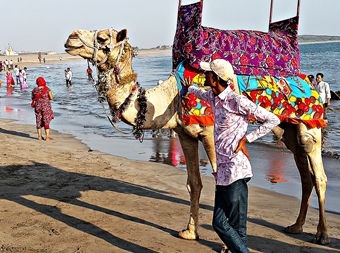
When we visited the beaches at Daman, Kutch Mandvi, and the temple town of Somnath, we saw camels on the beach. Their owners offer rides to holidaymakers, who have come to enjoy the sun, sea, and sand.

However, camels are not only kept for pleasure. All over Gujarat, we spotted camels drawing carts and wagons in towns, villages, and in the open countryside. Apart from being picturesque to my western eyes, they are much valued beasts of burden.

Gujarat and Kutch are areas with a semi-desert terrain and almost desert weather conditions. The camel is ideaaly suited to this environment. Most of the camels used in Gujarat State are bred in Kutch and are highly priced.

Read much more about this fascinating part of  western India in “TRAVELS THROUGH GUJARAT, DAMAN, AND DIU” by Adam Yamey. The paperback is available from lulu.com, bookdepository.com, and Amazon, which…

View original post 5 more words