Travelling on a budget

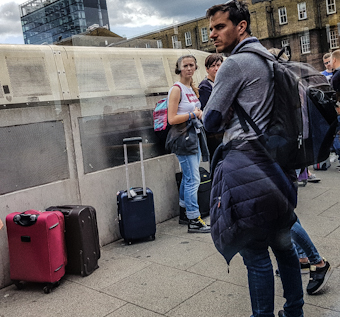
Suitcases that become trollies.

Trollies that run over the feet of others.

Wheelies that fit overhead lockers.

Hand baggage that is too big for a hand.

Waiting in long queues.

Cases filled to the brim to avoid paying for baggage in the hold.

Seats that cannot be reclined

Baggage for flights that often run late

To airports far from where you actually want to go.

Suitcases to avoid waiting at the baggage claim.

The joys of ‘budget’ airlines.

No outside food


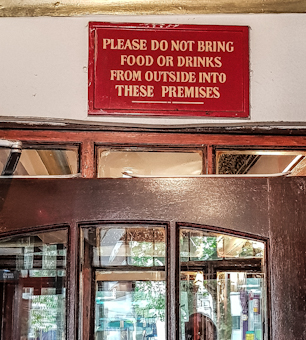
The Coffee Cup café in London’s Hampstead has been in business since 1953, and has been very popular since I first remembered it in the early 1960s. I have visited it several times, but never before noticed the sign at its entrance, which reads: “Please do not bring food or drinks from outside into these premises.” This instruction is not seen frequently in restaurants and cafés in the UK. Seeing this sign reminded me of what is very common in eateries in India, namely, signs reading: “Outside food not allowed.” Customers are forbidden to bring into the estblishment food or drink they have obtained elsewhere. That is fair enough, I suppose.

Cinemas in India, like in many other countries, try to sell food and drink to their customers, often at outrageously high prices. Apparently, watching a film is for many people more enjoyable if you are stuffing popcorn into your mouth at the same time as spilling it on the floor in the dark.

Back in 2001, my family, my in-laws, and my wife’s brothers family went to watch the recently released Bollywood blockbuster Kabhi Khushi Kabhie Gham at a large cinema in Bangalore (India). After purchasing the tickets, we had to wait in a queue before all of our baggage, shopping baskets, handbags etc., were searched by uniformed security personnel. I wondered what these officials were looking for. Was it guns or explosives, I asked my sister-in-law after we had reached the auditorium. No, it was not that, she replied. They were looking for food and drinks brought from outside the cinema. She told me that outside food was not allowed into the cinema, and then showed me inside her shopping basket, All I could see was a shawl (some cinemas are too cool because of air-conditioning). She moved the shawl aside to reveal that her bag was filled with sufficient drinks and snacks to easily satisfy all eight of us during the three and a half hour film. So much for the security check! Had we been carrying anything more dangerous than ‘outside food’, this would have also been missed by the not so vigilant security people.

It is odd how a chance sighting of something like the sign in the Coffee Cup can bring back distant memories.

It was not all bad in East Germany


For those of you who are too young to remember, Germany was divided into two separate countries, West Germany and East Germany (‘DDR’), between the end of World War 2 (‘WW2’) and 1990 (when the two countries were united into one). The DDR was a socialist republic overshadowed by the USSR.

Many years after the re-unification of Germany, our German-built Bosch dish-washing machine broke down. The engineer who came to mend it, fixed it in a couple of minutes, but remained talking to us for half an hour. He had been brought up in the DDR. He wanted to explain to us that contrary to all that we might have heard about the evils of the DDR and the difficulties its citizens faced, it was not all bad. He told us that, for example, education was good, there was little or no unemployment, and there had been a great sense of camaraderie. It was very important for our engineer that we should not think ill of the former DDR.

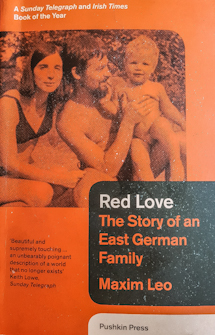
Recently, I finished reading an excellent book about the DDR, Red Love written by Maxim Leo and published in English in 2013. Leo was born in 1970, and like our Bosch engineer, does not damn the DDR, but takes care to point out that living in that former country was not at all easy or straightforward. For anyone curious about life in the DDR, this book is very illuminating. However, there is much more to this short book than describing the DDR.

What is most fascinating in Leo’s book is his stories about his two grandfathers, both of whom lived in the DDR. One of them remembered life being reasonable during the Nazi regime. Despite his grandson’s questioning, it is not clear what he did during those terrible times. The other grandfather led an exciting and dangerous life as a member of the French resistance during WW2. His story is gripping. 

Leo’s parents are also interestingly described. They were both in favour of, or atleast not completely against, the regime in the DDR. Each of them expressed their didfferent critical views of the political system, but neither of them did so strongly that they fell out of favour with it.

The book is a very readable translation of the original German translation. It provides a fascinating insight into life in the DDR and the period that preceded it. It was a book that I found difficult to put down, a real ‘page-turner’. Some of what I read in it chimes well with what our dish washing machine engineer told us.

A puff of smoke

Three students


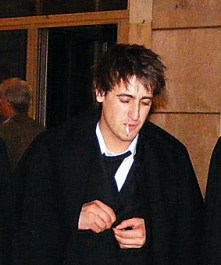
My father gave up smoking when I was about eight years old. As far as I know, my mother never smoked. I had an aunt who smoked, and entertained us by creating smoke rings with exhaled cigarette smoke. Visitors to our home smoked, so I was not completely isolated from cigarettes and so on during my earliest years. 

I was about 13 or 14 when I went on a field trip with other boys from my class. On that outing, I was shocked to see many of my fellow pupils lighting up cigarettes when we were out of sight of our teachers. I did not realise until that moment thay young children smoked.

In those early years, and possibly still today, I was a contrarian. Being that sort of person and seeing my peers smoking made me decide never to even try smoking, and  this situation remains unchanged tosay, so many decades later. It was not for health reasons nor because of economic problems that I have never taken up smoking. I simply did not want to be one of the crowd.

I often wonder if the situation had been reversed whether I would have become a smoker. If no one else had been smoking, would I have lit up just to be different? I doubt it because as a child I was far from adventurous.

The Wall

DDR


The Berlin Wall ceased to be a barrier between capitalist West Germany and socialist East Germany in late 1989. It marked the ending of the ‘Cold War’ and the recent collapse of the former USSR. 

At that time, my father made an interesting observation, which I want to sahre with you. He is a retired academic at the world famous London School of Economics (‘LSE’). The LSE had a large number of academics with an expert interest in politics. He told me that the end of the Cold War had come as a complete surprise to his colleagues, who professed to be experts on the subject. Not one of them had predicted either the downfall of the USSR or the ending of the Cold War. I was staggered by this information, and my faith in ‘experts’ reduced a bit.

So, now when I listen to ‘expert’ after ‘expert’ giving opinions on the outcome of ‘Brexit’ and the future of politics in the UK (or elsewhere), I take what they say with the proverbial ‘pinch of salt’.


Picture: The emblem of the DDR, sourced from Wikipedia

Smoking prohibited

No smoking_640


A few years ago, it became illegal to smoke in any public place in the UK, be it a place of work or a place of leisure. Other countries have the same prohibitions on smoking.

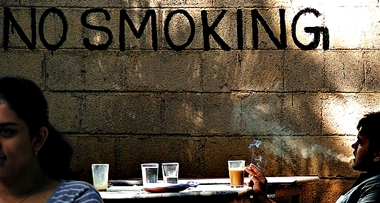
We spent a holiday in Istanbul in 2010 and noticed that all bars, cafés, and restaurants were places where smoking was forbidden. Yet in one tea house on the Asian side of the Bosphorous, we saw everyone was puffing away on cigarettes, even those who were sitting close to the ‘no smoking’ signs. The picture attached to this blog article was taken in Bangalore, India. It shows how much notice is taken of a ‘no smoking’ sign.

A couple of years ago, we were staying in Goa’s capital Panjim. Our host told us that smoking is forbidden in all public places including on the streets. How seriously this is policed, I do not know.

One of the objects of anti-smoking policies is to reduce the chances of secondary smoking, which is inhalation of exhaled cigarette smoke by people near to a smoker but not smoking themselves. This is a worthy and sensible reason for banning smoking in public places. 

The prohibition of smoking makes pubs far more pleasant, but I have a reservation about restaurants. Having been brought up eating in restaurants where some diners are smoking, I feel that the current absencse of smoking in these places detracts from their ambience ever so slightly.

Whether it will rain or not


Whether the weather be fine
Or whether the weather be not,
Whether the weather be cold
Or whether the weather be hot,
We’ll weather the weather
Whatever the weather,
Whether we like it or not. 

[anonymous]


One of the best ways to engage a stranger in conversation in the UK is to begin talking about the weather. Because of its unpredictability in the British Isles, there is always much to discuss.

There is at least one explanation of why it is so difficult to forecast British weather reliably. I read about it in a book about chaos theory some years ago, so please forgive me if my explanation is not totally clear. As I understand it, weather forecasting is done using mathematical models involving a complex set of  interlinked equations. The forecaster feeds multiple parameters into the equations, and a result is obtained that allows the weather to be predicted reasonably accurately. This model is quite reliable in many parts of the world, but not here in the UK. The problem is that when the parameters for the region containing the British Isles, whose weather system is affected by far more complex and many more influences than in other places (I do not know why), are fed into this set of equations, instead of one solution, several appear because the parameters introduce a large degree of instability into the forecasting model. Hence, the uncertainty in British forecasting that occurs. 

Nowadays, I use a popular weather forecasting app on my mobile ‘phone. It provides several predictions of what the weather will be like during different times of the day and several days following it. Potentially useful are the rainfall predictions which are expressed as a percentage, 0% being ‘rain completely unlikely’ and 100% being ‘rain inevitable’. So far, so good.

If the app predicts rainfall of less than about 5%, I do not bother to take an umbrella or rain coat, otherwise I do. Things can go wrong. Suddenly, out of the blue, rain falls heavily. I look at my app. Suddenly, what had been a prediction of, say, 3% becomes a prediction of, say, 78%. The app appears to be responding to the weather (or recording it), rather than predicting it.

Moral of the story: take an umbrella.


Poem from: https://www.poemhunter.com/poems/weather/page-1/22212436/#content

Chopsticks


My earliest recollection of eating Chinese food was in a restaurant called ‘Tung Hsing’ in Golders Green almost opposite the old Hippodrome Theatre. It opened in the 1960s and was one of the first restaurants in London to serve Pekinese food, rather than the then usual Cantonese cuisine. The restaurant was owned by a retired ambassador from Chiang Kai-shek’s nationalist China and his wife, whom I believe was responsible for the very excellent food served. 

Although I am sure they were available, I am not sure whether I used chopsticks when eating at the Tung Hsing. Maybe, I learned to use them there, but I really cannot remember. Whatever the case, I have been eating Chinese food with chopsticks for many decades. I would not say that I am 100 percent proficient with them, but I feel that using them to eat Chinese food satisfies me.

Chinese-style food is very popular in India. Most Indians eat in Chinese restaurants using western utensils such as plate, fork and spoon. If you ask for chopsticks, they are usually available, but they are not supplied as default table settings.

Some years ago, early this century, a new Chinese restaurant opened in Museum Road in Bangalore. We visited soon after its inauguration. It was a lovely restaurant and the food was good by Indian Chinese restaurant standards. As usual, we asked for bowls and chopsticks. The waiter disappeared for a while, and then returned empty-handed.

“There are no chopsticks,” he told us.

“Why not?” we asked.

“I will ask the manager.”

The Manager came over, and explained:

“We have been so busy since we opened, and many of the guests have taken them home as souvenirs. So, we have run out of them”