Two shepherds

IT IS LESS THAN THREE and a half miles as the crow flies between Shepherds Bush Market in the west and Shepherds Market (in Mayfair) due east of it, but there is a world of difference between the two places.
Let us get one thing straight immediately, and that is the markets’ names and their relation to sheep. Shepherds Bush Market is named in connection with actual sheep. The place, Shepherds Bush, might either refer to a family name or to shepherding. A ‘shepherd’s bush’ is a bush from which a shepherd can shelter from the elements to watch his (or in the case of Little Bo Peep, her) flock. The place name might also refer to a place where shepherds rest their sheep on their way to Smithfield Market. However, today you are unlikely to spot a sheep anywhere in the area except in a butcher’s shop. In contrast Shepherds Market in Mayfair is named after an important London architect Mr Edward Shepherd (died 1747), who owned or developed some of the land on which fashionable Mayfair was built in the early 18th century.

According to one website (https://alondoninheritance.com/londonpubs/shepherd-market-a-village-in-piccadilly/), in its early days:

“The core of the market consisting of butchers’ shops and the upper floors containing a theatre.”

There is a large building in the heart of Shepherds Market that bears the market’s name. It looks to me as if this was  the building referred to in this quote.

Shepherds Market is a quaint village-like enclave surrounded by fashionable Mayfair, an extremely prosperous part of London. Although it bears the name ‘Market’, it is no longer a bustling market with stalls such as you would find in, say, Borough Market, Petticoat Lane, Ridley Road (Dalston), Portobello Road, and relevant to this essay, Shepherds Bush. The Mayfair enclave is a series of quiet streets with small boutiques, cafés, picturesque old pubs, hairdressers, a village-style newsagent-cum-postoffice, and upmarket eateries. This is not a place you should visit if you are planning to buy good value groceries or cheap clothing. It is now a part of London for meeting people and relaxing.

One restaurant, which closed in 1998, was a landmark in Shepherds Market. This was ‘Tiddy Dol’s’, which was named after a famous Georgian street-seller of gingerbread snacks (see: http://scrumpdillyicious.blogspot.co.uk/2013/10/mayfair-memories-tiddy-dols-welsh.html?m=0). I remember entering this rather gloomy eatery with my Italian brother-in-law, who wanted to try ‘real’ English food. We ordered him Welsh Rarebit, for which the restaurant was justifiably renowned. He looked at the dish in front of him, prodded its cheesy topping, and then made an involuntary expression that conveyed ‘disgust’ to me.

In the past (and maybe still today), Shepherds Market was a place where prostitution was not uncommon. Tiddy Dols was in the ‘epicentre’ of the prostitution ‘business’. So much so that:

“…in the late Seventies, commissionaires in the grand hotels of Park Lane would tell families of tourists not to go to Tiddy Dolls, such was the gauntlet of girls they would have to run.” (see: “The Independent” newspaper, 14th March 1996)

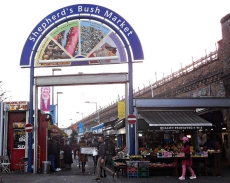
Shepherds Bush Market (‘Bush’ for short) is many things that Shepherds Market is not. The Bush market runs along a lane next to the railway arches above which trains run between Shepherds Bush Market and Goldhawk Road stations. Although it is an enjoyable place to visit. the Bush market is not at all ‘chic’ or ‘luxurious’; it is the opposite. However, it is a real street market with a few full-size shops that are housed in the arches under the railway tracks. The clientele of the market looks far less prosperous than the people you can see in Shepherd Market, and they come from a wealth of diverse ethnic backgrounds. On a recent visit, many of the vendors were Sikh men.

The Bush market offers a wide variety of fruit, vegetables, meat, fish, spices, pulses, plenty of other food products from all over the world, and many non-food items. If you are looking for, clothes, hats, shawls, shoes, suitcases, cooking utensils, ‘phone accessories, artificial flowers, tailoring, household goods, and you name it, you should head for the Bush market. Normally, this street market is crowded and busy. However, when we went there in early December 2020, there were few other shoppers to be seen. One stall holder explained that the decline in footfall was due the covid19 pandemic. This did not surprise us as much as what he said next. And that was the market had suffered because of lack of tourists due to the pandemic’s effects on tourism. According to him, the Bush market depends heavily on foreign visitors. That astonished me because I had always assumed that it was a market that catered mainly to locals.

Like Shepherds Market, the Market in Shepherds Bush contains a variety of eating places and nearby Shepherds Bush Green is surrounded by reasonably priced eateries.

Although I have not done it yet, a walk from Shepherds Market to Shepherds Bush Market would be most fascinating. It would be a stroll through the history of London’s westward spread that occurred between the early 18th century and the beginning of the 20th.

Both of the markets I have described are well-worth exploring. If I had to choose one over the other, that would be most difficult for me. I love the bustle and variety of markets such as that at shepherds Bush. However, that is not the only place you can enjoy such an atmosphere in London. Shepherds Market in Mayfair has a uniqueness that I have not found in other parts of London. It is a serene yet vibrant oasis in one of the busier parts of the city. So, let me drink a cortado or macchiato at Shepherds Market, and let me buy my halal lamb at Shepherds Bush Market. I will enjoy both experiences equally.
Your vehicle is no longer taxed

A CROWD OF CROOKS is out to steal your money, but they vary considerably in skill. Today, I received the following email bearing the triangular logo of the DVLA (Driver and Vehicle Licensing Agency). It was addressed to my email address not to me, the licence holder, by name. It reads as follows:

_________

𝗬our 𝘃ehicle is no 𝗹onger 𝘁axed.

Dear myemailaddress@hotmail.com,

𝐃VLA have been notified electronically about you latest 𝐩ayment for your 𝐯ehicle tax failed because there is not enough 𝐦oney on you debit card.

We sent you a 𝐃VLA bill, and we still haven’t received 𝐩ayment.

Acknowledge that it’s illegal to drive your 𝐯ehicle until you’ve taxed it.

𝗧ax 𝘆our 𝘃ehicle – 𝗦TART 𝗡OW >

Notice: Un-taxed vehicles risk a fine of up to £240. 𝗬our 𝘃ehicle is no 𝗹onger 𝘁axed.

 Yours sincerely

@GOV.UK

Vehicles Service Manager        

_________

Many of the letters in the email were in bold type. The words ‘START NOW’ is a hyperlink, which I did not click. Initially, I was concerned, but only for a few seconds. This obvious scam contains something in common with many other scam emails that try to worry the reader into believing that something momentous might happen if the instructions in the email are ignored. That common factor, which is well-illustrated above is bad use of the English language. For example, in this case:

“𝐃VLA have been notified electronically about you latest 𝐩ayment …”,

and

“Acknowledge that it’s illegal to drive your 𝐯ehicle until you’ve taxed it.”

Neither of these mistakes would have been made by the DVLA, nor would that organisation have signed itself as “@GOV.UK, Vehicles Service Manager”

Also, the DVLA would know my name and would address me by that, rather than by my email address. Just in case you missed the erroneous wording of the email, you might become suspicious of the sender’s email address: pashegm@hotmail.com, which does not look like the kind of email address that the official DVLA would use.

So, there is a great need to brush up on your use of the English language if you wish to succeed, you contemptible bunch of damnable scammers.

In brief, this scam email was hardly convincing, and the dishonest sender deserves to reap a poor reward, if any, for his or her pathetic attempt to rob me of cash or, worse, sensitive banking or similar details. So, please read all emails carefully before making an error that you might easily regret.

PS: my vehicle is taxed until June 2021. You can check the validity of your vehicle’s tax on https://www.gov.uk/check-vehicle-tax

Two books on Albania by an Albanian and his American wife

I have received news of two books about Albania. One, an intriguing novel, is written by American born Kim Malaj. The other, a collection of Albanian folk tales is written by her husband, Arti Malaj, who was born and brought up in Albania. I look forward to reading them in the future. Why not give them a try, and let me know how you enjoyed them?

THE NOVEL:”CASTLE OF TESKOM” by Kim Malaj

‘Shiny ember rocks are fuel for time; the dull rocks are a fool’s dime.’An old nursery rhyme, or so they think. Itra and Danae stumble across an ancient secret kept hidden behind a reflection in time near their Albanian home. A faded memory and cryptic messages have propelled them to risk an encounter with foes from Greek mythology, altering their perception of Albanian folklore and reality. Itra and Danae grapple with events set in motion centuries ago and must choose toprotect and serve or risk having the secret exposed. Will love, loyalty, and lineage be enough to hold them together, or will they lose their way in auniverse they are only beginning to understand?

Amazon: https://amzn.to/3n5Aetj

eBook: https://books2read.com/u/bpryMl

THE FOLK TALESNORTHERN ALBANIAN FOLKTALES, MYTHS AND LEGENDS

by Arti Malaj

Generations of Northern Albanian are known as great storytellers. They shared many folk tales, myths, and legends with their descendants. The collected short stories include mysterious legends of lost treasures, mystical tales of mountain fairies, superhuman powers, century-old witches, blood feuds, and more written by a twelfth-generation Albanian. The lands described in the stories are still visible today, and locals share a sense of wonder and respect the mysteries that hide beneath. Northern Albania is a true treasure of raw natural beauty and a hidden gem in Southeastern Europe.

Amazon https://amzn.to/2GcDDq2

eBook: https://books2read.com/u/b5ZNOl

History at the end of a narrow alley

A WIDE FOOTPATH runs south from Piccadilly along the eastern edge of Green Park. We have walked along this many times, but it was not until a few days ago that we noticed a small alleyway leading east from the footpath about 190 yards south of Piccadilly. This unmarked footway, which is barely wide enough for two people to pass each other, passes under a building and emerges opposite the Stafford Hotel on St James Place, a short cul-de-sac with a dogleg, which leads off St James Street. St James Place, whose construction began in 1694, is an attractive short street lined with many fine buildings, some of which I propose to describe. What made this lovely quiet road interesting for me was that several fascinating people have been associated with it. I will begin with a relatively recent inhabitant.

Number 9 was home to Sir Francis Chichester (1901-1972), who circumnavigated the world single-handedly in 1966/67. He lived here from 1944 to 1972. He sailed in his boat named Gypsy Moth IV. In 1929, Sir Francis attempted another exploit, to fly from New Zealand to Australia in his ‘plane, a de Havilland Gypsy Moth. He made the first ever flight from New Zealand to Australia. He was also the first person to land a ‘plane on both Norfolk and Lord Howe islands. If you want to see his historic boat, then you need to get down to Greenwich, where it is on display close to the much larger Cutty Sark.

There is another building in St James Place, which associated with water transport. The elegant number 20, an 18th century building, has been the London Club House of the Royal Ocean Racing Club since 1942. The Club was founded in 1925. Between 1822 and 1857, the building housed the servants who worked in number 21, which was demolished during WW2 (www.british-history.ac.uk/survey-london/vols29-30/pt1/pp511-541#h3-0019).

Not far from Chichester’s house is number 4. This is the house from which the short-lived Polish born pianist and composer, Frederick Chopin (1810-1849), departed to give his last public performance at the Guildhall on the 16th of November 1848 (www.chopin-society.org.uk/articles/chopin-britain.htm). It was held:

“… in aid of a Polish charity, came at the end of a difficult six-month British sojourn, which had included concerts in Manchester (one of the largest audiences he ever faced), Glasgow and Edinburgh… Finally back in London, the composer-pianist spent three weeks preparing for what turned out to be his final recital by sitting wrapped in his coat in front of the fire at St James’s Place, attended by London’s leading homeopath and the Royal Physician, a specialist in tuberculosis. A week after the concert, he was on his way home to Parisian exile and death the following year.” (www.londonremembers.com/memorials/frederic-chopin-st-james-s-place).

Before discussing the most curious inhabitant of St James Place, I will discuss one of its famous residents, the writer and politician Joseph Addison (1672-1719), who founded “The Spectator” magazine in 1711. According to Peter Cunningham in his “Handbook of London” (published in 1850), Addison was living in St James Place by 1710. I am sure that we did not see any memorial celebrating this on any of the buildings in the street. Cunningham wrote, quoting from another source:

“Addison’s chief companions before he married Lady Warwick (in 1716) were Steele, Budgell, Philips, Carey, Davenant, and Colonel Brett. He used to breakfast with one or other of them at his lodgings in St James Place …”

His companions listed above were probably sympathetic to Addison’s Whig politics.  However, Cunningham gives no indication of Addison’s address. He frequented the St James Coffee House in nearby St James Street, as he recorded in issue number 104 of his “Spectator”:

“That I might begin as near the fountain head as possible I first of all called in at St. James’s, where I found the whole outwardroom in a Buzz of Politics. The Speculations were but very indifferent towards the Door, but grew finer as you advanced to the upper end of the room, and were so very much improved by a knot of Theorists who sate in the inner Room, within the steam of the Coffee Pot, that I there heard the whole Spanish Monarchy disposed of; and all the line of Bourbons provided for in less than a Quarter of an Hour.” (https://www.british-history.ac.uk/survey-london/vols29-30/pt1/pp459-471#h3-0014)

The coffee house was at number 87 St James Street. It was demolished to make way for a new building, erected 1904/05.

Wikipedia (https://en.wikipedia.org/wiki/St_James%27s_Place)  lists many other notable residents of St James Place, including Oscar Wilde and Lord Randolph Henry Spencer-Churchill, but omits one very interesting person, William Huskisson (1770-1830), whose residence at number 28 is commemorated by a plaque. This records him as having been a ‘statesman’. He was that as well as a financier and several times a Member of Parliament. He lived in Paris between 1783 and 1792 and witnessed the French Revolution. Although he had an active political life, what makes him remarkable was the manner of his death.

Against the better judgement of his physician, Huskisson attended the opening of the Liverpool and Manchester Railway on the 15th of September 1830. Thomas Creevey (1768-1838) related the story in a letter written to a Miss Ord on the 19th of September 1830:

“Jack Calcraft has been at the opening of the Liverpool railroad, and was an eye-witness of Huskisson’s horrible death. About nine or ten of the passengers in the Duke’s car had got out to look about them whilst the car stopt. Calcraft was one, Huskisson another, Esterhazy, Billy Holmes, Birch and others. When the other locomotive was seen coming up to pass them, there was a general shout from those within the Duke’s car to those without it, to get in. Both Holmes and Birch were unable to get up in time, but they stuck fast to its sides, and the other engine did not touch them. Esterhazy, being light, was pulled in by force. Huskisson was feeble in his legs, and appears to have lost his head, as he did his life. Calcraft tells me that Huskisson’s long confinement in St. George’s Chapel at the King’s funeral brought on a complaint that Taylor is so afraid of, and that made some severe surgical operation necessary, the effect of which had been, according to what he told Calcraft, to paralyse, as it were, one leg and thigh. This, no doubt, must have increased, if it did not create, his danger and [caused him to] lose his life.”

(quoted from “The Creevey papers; a selection from the correspondence & diaries of the late Thomas Creevey, M.P., born 1768 – died 1838. Edited by Sir Herbert Maxwell”)

Thus, Huskisson achieved the dubious distinction of becoming one of the first widely reported casualties in a railway accident. The ‘Duke’ mentioned above was the Duke of Wellington and the engine that caused Huskisson’s death was the “Rocket”, a pioneering locomotive designed by Robert Stephenson in 1829. I wonder why his demise was not noted on the commemorative plaque.

Huskisson’s former home has a superb front door flanked by iron lampstands each with its own conical torch flame snuffer. St James Place has plenty of fine 18th century buildings as well as some newer ones. These include the Stafford and Dukes Hotels, which are late 19th and early 20th century in appearance. Number 26 St James Place, a mid-twentieth century building, bears a Civic Trust Award. It is a block of flats built 1959/60 to the designs of the architect Denys Lasdun (1914-2001), who also designed the National Theatre on the South Bank. It replaced an 18th century house that was destroyed by bombing in WW2. Although not unpleasing, it stands in stark contrast to the far more elegant older buildings near it.  

Even greater contrast to its surroundings is the building on the northern corner of St James Place and St James Street. This avant-garde metal-clad structure, the Target Building, designed by Rodney Gordon (1933-2008) and completed in 1984, is opposite William Evans gun shop and houses the Stern Pisarro art gallery on its ground floor. One of the galleries owners, Lélia Pissarro, is a great-granddaughter of the Impressionist artist Camille Pissarro (1830-1903). The gallery specialises in Impressionist art amongst other things. While on the subject of art galleries, it would be easy to walk past number 6 St James Place without noticing a small plate on its front door that says ‘Agnews Est 1817’. Between 1877 and 2013, this gallery, which deals in the highest quality works of fine art (e,g. Caravaggio, Rubens, Rembrandt, and Velasquez) was on Old Bond Street. Then, it relocated to number 6.

St James Place is only 180 yards in length, but as can be seen from the small selection of buildings I have chosen to describe, it is choc-full of historical associations. I am pleased that we discovered the tiny alley that led from Green Park to this fascinating cul-de-sac. And, finally, if you find that you are getting tired of staying at the Ritz Hotel, you would do well to book into one of the two hotels discreetly located in St James Place.

[PS I have not dealt with Spencer House because I hope to write about it in the future]

Mistaken identity

One of the daughters of my former PhD supervisor was about to get married. As a friend of his family, I was asked to be one of the four ushers at the service, which was to be held at St Giles and St Andrews, better known as ‘Stoke Poges Church’, whose graveyard has been immortalised by the poet Gray in his “Elegy Written in a Country Churchyard”. The church stands on land that was once owned by William Penn (1644-1718) after whom the American state of Pennsylvania is named.

Stoke Poges Church

As an usher, I was required to wear formal ‘black tie’. So, not possessing such clothes, I had to hire the necessary formal attire. I went to a branch of Moss Brothers, who hire clothing, and was fitted out with all the trimmings, morning suit, trousers, waistcoat, shirt, bow tie, and a top hat, but no cummerbund. Getting a top hat that fitted properly presented great difficulty to the assistant at the clothes hire shop.  He looked at my head knowledgeably with an air that suggested to me that he was an experienced clothing fitter. After a moment’s contemplation, he decided that I needed a certain size. The hat he chose by eye was far too small. It wobbled uneasily on the crown of my head. He selected another size. At this stage, I was still impressed that he appeared to be able to judge head size by eye. The next hat was far too large. It slipped right over my ears. I became less impressed with the fellow. Eventually, he found one that almost fitted my head; its rim rested on the tops of my ear lobes. That was the best he could do. I hired this and all the rest of the required ‘gear’.

Just before the wedding, I got dressed in my formal wear at the bride’s parents’ home. I had endless difficulties trying to get dressed in the two-piece waistcoat, which seemed to separate into two separate items whatever I did. One of my fellow ushers managed to get this on to me correctly as well as to fasten my bow tie (another skill I have yet to master). Sadly, I do not possess any pictures of me in this ‘get up’. Then, we set off for the church.

Of the four ushers, two were Christian and two were Jewish. The two Christians were on duty outside the church. The two ushers inside the church were Jewish by birth. I was one of them and the other was Victor, a friend of the bride. Victor, whom I had not seen for several decades, was one of my classmates at primary school in Golders Green back in the 1950s.  My duty as usher was to help people find a seat in the church and to hand out leaflets, which I referred to as ‘programmes’ until one lady with a plummy voice told me sternly:

“They’re not programmes, dear; they’re Orders of Service, don’t you know.”

Well, you learn something every day.

About 25 years later, I communicated with Victor, whom I had not seen since the wedding, via the LinkedIn website. We agreed to meet for lunch at an Italian restaurant near London’s Charing Cross Station as Victor was coming up to London from his home on the south coast. I arrived at the restaurant a few minutes before Victor. When he came through the door, I recognised him. He had aged but was still recognisably Victor, even though his hair which had been red when we were children was no longer that colour. Red hair, or ‘orange’ as I used to call it as a child, fascinated me in my young days. I greeted him, and he shook my hand, saying:

“Hmmm … you are not the person I was expecting to meet.”

I was not sure whether to feel pleased or upset that he had mixed me up with someone else from his past.

Bob Marley and the waxworks

A BUILDING ON THE CORNER of Lancaster Road and Basing Street, a few yards east of Portobello Road, looks as if it was once a church. Attached to its brickwork is a plaque commemorating the fact that the building was once used by the reggae artist Bob Marley (Robert Nester Marley:1945-1981). While we were looking at the building, a friendly passer-by stopped and chatted to us, confirming that the building had once been used as a church, but also as a waxworks studio and, maybe, a synagogue for a time.

Whereas many Jewish people used to live near the building before WW2 (www.rbkc.gov.uk/pdf/Colville%20March%20Newsletter3.pdf), notably in nearby Powis Square, I can find no evidence that there was ever a synagogue where the church-like building stands. A detailed map, surveyed in the 1890s, reveals that this building was a ‘Congregational Chapel’. It was ‘The Lancaster Road Congregational Church Notting Hill’ and is described in “A Book of Metropolitan Churches and Church Enterprise” by William Pepperell, which was published in 1872. The Reverend Pepperell describes the origin of the chapel as follows:

“The foundation-stone of this chapel was laid by Samuel Morley, Esq., M.P., in July, 1865, when, although so recent, the whole of that part of North Kensington in which it is situated was open field, with here and there a dotting of new buildings commenced, and new streets laid out.  At the present time the occupied suburbs extend quite a mile beyond it either North or West.  The congregation worshipping here first assembled in smaller numbers in Westbourne-hall, where they kept together for between two and three years, always with a view to a separate building as opportunity offered … The form of service is what is understood as Congregational, and the Congregational Hymn-book is used.  An organ well suited to the dimensions of the building is efficiently employed by Mr. Charles Wetton, Jun., in aid of the devotional singing, which seems to lose nothing of its congregational life and character by the presence of the instrument.”

The authoritative British-history.ac.uk website confirms the date when the chapel was established and makes no mention of it ever having been used as a synagogue. It does state that the building was designed by James Rankin of St Marylebone and is now used for commercial purposes, its interior having been completely remodelled.

I could not find the chapel marked on a detailed map surveyed in 1914. This is not surprising because in the early part of the 20th century, the chapel became home to the workshop of Gems Waxworks (“Colville Conservation Area Appraisal”, published by RBKC in 2014). It was at this workshop that the model of the serial killer John Christie (1899-1953), who had a flat at 10 Rillington Place in Notting Hill (located at where is now Bartle Close and Andrews Square), was prepared (www.golbornelife.co.uk/colvillenewsletter1.pdf) in the 1950s for Madame Tussaud’s exhibition in Baker Street.

By 1970, the former chapel had reincarnated as the ‘Basing Street Studios”, established by Christopher Blackwell, founder of Island Records (began in 1959). In 1970, Led Zeppelin recorded his album “Led Zeppelin IV” at the studios. The same year, Jethro Tull recorded his “Aqualung” album at the same place. At one point in 1973, Bob Marley and the Wailers were using the studios at the same time as the Rolling Stones. Bob Marley lived for a year at the studios in 1977 (www.timeout.com/london/blog/15-places-in-london-with-a-bob-marley-connection-051116). Early in that year he recorded his album “Exodus” there. Before that, in 1973, he recorded his album “Catch a Fire”, also at Basing Street. In addition to the works already mentioned, many other well-known songs and albums, including Queen’s “We are the Champions” and Band Aid’s “Do they know It’s Christmas”, were recorded at these studios.

In 1983, Trevor Horn (born 1949) and Jill Sinclair (1952-2014), of SARM studios, acquired the recording establishment in the former chapel. The plaque on the outside of the building was placed there by the Nubian Jak Community Trust, which is:

“… an African and Caribbean community organisation that provides products and services to the generic population of the UK and internationally” (http://nubianjak.org/).

Their plaque not only celebrates Bob Marley’s use of the former chapel and his fellow musicians Bunny Wailer and Peter Tosh, but also the memory of Jill Sinclair. When the plaque was unveiled by her widowed husband, he said:

“… So much great music was made in the building while it was open for over 50 years as a recording studio. This plaque commemorates my late wife Jill Sinclair who was a long time supporter of the local Jamaican company. She would be happy to see the community being recognised for the music culture brought to the local area.” (https://tiemotalkofthetown.wordpress.com/2019/10/08/bob-marley-and-the-wailers-honoured-with-blue-plaque-at-legendary-sarm-studios/).

Currently, SARM is based on nearby Ladbroke Grove.

Having seen this building and looked into its history, I feel sure that the Congregationalists who used to sing in the chapel long ago would be pleased to know that the building remained a place of song, even if what was sung there is somewhat different to what they used to sing.

Churchill owned this village

YOU CAN NEVER PREDICT how much traffic you will encounter on the roads in and near London. So, we always allow extra time when making a trip, and often we arrive earlier than we had planned. Such was the case yesterday when we had arranged to meet some friends for a walk in Heartwood Forest, which is close to the village of Sandridge in Hertfordshire. We reached our destination about an hour too early and stopped in Sandridge to get a warm drink and to take a look around. What little remains of old Sandridge is attractive and is worth a visit despite its description in “Hertfordshire, a Shell Guide” by RM Healey:

“Subtopian clutter in a village that has ribboned out to join St Albans.”

We bought coffee in the well-stocked small village shop and heard its owner saying:

“I am still in business despite being surrounded by three Tesco Express supermarkets.”

Now, here is a strange coincidence. After dinner, when I had finally warmed up after our excessively chilled walk in Heartwood Forest, I settled down to continue reading the wonderful biography of John Churchill (1650-1722), the First Duke of Marlborough, by Richard Holmes, and read on page 110:

“On 14 May that year John Churchill was created Baron Churchill of Sandridge in Hertfordshire …”

The year was 1685. Well, I was staggered to read the name of the village, of whose existence I had not previously been aware and which we had just visited by chance earlier that day. I reached for my Shell Guide to Hertfordshire but found no mention of Churchill in the section about Sandridge. Somewhat surprised by this omission, I looked up ‘Sandridge’ in James Thorne’s “Handbook to The Environs of London”, published in 1876. Thorne revealed something about Churchill’s connection with Sandridge.

The manor of Sandridge was given to Sir Ralph Rowlett (before 1513-1571; see: http://www.historyofparliamentonline.org/volume/1509-1558/member/rowlett-sir-ralph-1513-71) of Holywell House (St Albans, Hertfordshire), Member of Parliament for Hertfordshire and Master of the Mint of England (in1543), by Henry VII in 1540.  When Sir Ralph, who had no heirs, died, it was passed on to his sister Elizabeth, the wife of Ralph Jennings (aka ‘Jenyns’; 1529-1572; http://www.wikitree.com/wiki/Jenyns-10). Sir Ralph died in Churchill, Somerset. The Jennings family kept the manor for several generations. When Richard Jennings (c1619-1668) died, he left the manor to his three daughters, Barbara, Frances, and Sarah (1660-1744; the youngest). Sarah was probably born in Water End House, which was built by her grandfather John Jennings (Jenyns) and which I have described elsewhere (https://adam-yamey-writes.com/2020/07/23/why-go-abroad/).

In 1677 or ’78, John Churchill, then a colonel, married Richard’s daughter Sarah Jennings. Then, he purchased the other sisters’ shares in the manor of Sandridge so that he owned the whole property. This permitted him to gain his first aristocratic title, that of ‘Baron Churchill of Sandridge’. As a baron, he was able to sit in the House of Lords. However, his attempt to become an MP for his borough, St Albans, met with failure:

“Churchill acquired one moiety of the Jennings estate by marriage … He thus enjoyed the principal interest at St. Albans, and in 1685 the mayor announced his candidature for the borough. In the event, however, his brother George was elected, perhaps because James II had made known his intention to give him an English peerage.” (https://www.historyofparliamentonline.org/volume/1660-1690/member/churchill-john-ii-1650-1722).

On reflection, it seems a bit strange that we did not notice any obvious indication in Sandridge of the connection of the celebrated John Churchill, ancestor of Sir Winston Churchill, with the village in the manor he acquired.  Some months earlier we had visited the village of East Knoyle (in Wiltshire), where the architect Christopher Wren was born in 1632. Despite the fact that Christopher left the village with his family when he was only three years old, visitors to East Knoyle are left in no doubt about its famous connection.

What remains of old Sandridge is attractive, even in the appalling weather conditions that we endured whilst walking around it. The village’s name is derived from ‘Saundruage’ meaning a place of sandy soil worked by bond tenants (i.e., feudal tenants completely subject to a lord or manor to whom they paid dues and services in return for land). The earliest written record of the place is in a document dated 796 AD.

The most fascinating building in the village is the Church of St Leonards. Although its exterior looks in great condition, it contains some structural elements that were put in place in the 10th century. These include Roman bricks found at sites near and in St Albans (Roman ‘Verulamium’). The church was consecrated as ‘St Leonards’ by 1119. Later, the church experienced modifications and enlargements.  Sadly, but predictably during this time of pandemic, the church was locked. So, we will have to make another visit to see this interesting building when things ease up. Likewise, the picturesque Queen’s Head pub next to the church was also closed, except for take-away meals.

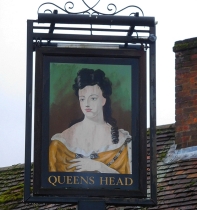
The Queens Head was built in the 17th century and, maybe, earlier, but has had much later work done to it (https://historicengland.org.uk/listing/the-list/list-entry/1102874).  The pub sign has the portrait of a woman’s head. The lady depicted has long black hair and is wearing a garment that exposes her neck and upper chest but not her cleavage. One long ringlet of her hair, which ends in a helical coil, is draped over the front of her left shoulder, and her face is looking slightly towards her right. The portrayal on the pub sign resembles that of Queen Anne (reigned 1702-1714) found in many better painted pictures.  This might not be accidental on a pub that existed long before Anne was on the throne. For, Lady Sarah Churchill, John’s wife, was a court favourite of Queen Anne. Incidentally, it is one of three pubs in this tiny village.

Once again, a short stop in a small English village has been most rewarding both from the aesthetic viewpoint and also because it has caused me to learn yet more detail about the fascinating history of the country where I live. I am grateful to our friends in Hatfield for giving us an excuse to discover Sandridge, a place so close to London but until yesterday, not on our ‘radar’.

A bust among the books

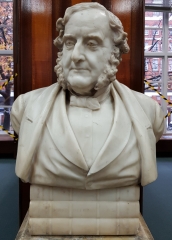
A WHITE STONE BUST depicting a man wearing a jacket and a waistcoat is perched on a pile of books carved in the same material and stands on a marble pedestal in the centre of the open access bookshelves in the public lending library on Hornton Street in London’s Kensington. His face has copious mutton-chop sideburns but neither moustache nor beard. The person depicted is James Heywood (1810-1897), who founded the first public library in Kensington in about 1870. His sculptural portrait in the library was created by Middlesex born James Adams-Acton (1830-1910), some of whose other busts include representations of Emperor Caesar Augustus, John Wesley, and ‘Pharaoh’s daughter’ (www.artuk.org/discover/artists/adams-acton-john-18301910).

Heywood, who was born in Manchester, was a man of many achievements (www.gracesguide.co.uk/James_Heywood). Son of the banker Nathaniel Heywood, James studied at the universities of both Edinburgh and Geneva before joining the family bank at Manchester. On inheriting a large sum from his uncle, he left the bank and matriculated at Trinity College Cambridge in 1829, where he continued to study but did not graduate. In 1838, he was admitted to the Inner Temple in London, where he was called to the Bar but did not practise as a barrister. In that same year, James became a founder member of the Manchester Geological Society. The next year, he was one of the founders of the Manchester Athenaeum, which provided reading rooms and lectures.

Heywood’s interests also included statistics as can be seen from the citation that was presented in 1839, when he was a successful candidate for Fellowship of the prestigious Royal Society  (https://catalogues.royalsociety.org/CalmView/Record.aspx?src=CalmView.Catalog&id=EC%2f1839%2f08&pos=6).:

“James Heywood, Esq of Trinity College, Cambridge, residing at 17 Cork Street, London, Barrister of the Inner Temple, author of a Report on the Geology of the Coal District of South Lancashire, published in the Transactions of the British Association, & also of a Report on the state of the population in Miles Platting, Manchester, published in the Journal of the Statistical Society of London; a gentleman much attached to science, being desirous of becoming a Fellow of the Royal Society, we the undersigned, do, from our personal knowledge, recommend him as deserving of that honor, & as likely to be a useful & valuable member.”

So, by 1839, Heywood was residing in London. In addition to his scientific work, he was involved in politics. Between 1847 and 1857 he represented the constituency of Lancaster Northern. He was a member of the Whig/Liberal Party. In 1859, he moved to Kensington (Kensington Palace Gardens), where in about 1870 he established Kensington’s first free public library at Notting Hill Gate. Heywood was a Unitarian. His home in Kensington was close to the current location of a Unitarian church, which was only established on this site in 1887. However, before that, in 1867, the Unitarians began meeting in Kensington at Sir Isaac Newton’s old home, now demolished, in Church Lane. The history of the Kensington Unitarians, found at  www.kensington-unitarians.org.uk/images/EssexChurchInKensington_forInternet.pdf reveals that:

“The congregation was growing under the Chairmanship of James Heywood, MA, FRS, MP, ‘one of Kensington’s most distinguished citizens’…”

The church moved to its present site near the Mall Tavern in the 1880s.

The free library, which Heywood created in Kensington and was opened on the 15th of August 1874, was located at ‘106, High Street, Notting Hill”, according to “The Catalogue of Mr James Heywood’s Free Public Library”, published in 1879 (and viewable on Google Books). The ‘High Street’ is now named ‘Notting Hill Gate’. If the numbering was the same then as it is today, then 106 would have been on the north side of the street just west of Pembridge Road, roughly between where Tescos and Mark and Spencers Simply Food stores stand currently. Today, the Notting Hill Gate branch of Kensington’s public libraries stands on the corner of Pembridge Road and Pembridge Square.

Heywood’s library was open seven days a week and before receiving a book, an applicant had to fill in a form with the following wording:

“I REQUEST TO READ

Name of books ….

Date …. Signature of applicant .…”

Reading books in the library was free of charge but borrowing them required a monthly payment of sixpence (2.5 p) and one penny (about 0.5 p) per book borrowed. The catalogue included a very respectable variety of books and periodicals. I was pleased to note that there was a book about Albania, “Travels in Albania and Other Provinces of Turkey” by Lord Broughton, Baron John Cam Hobhouse Broughton (1786-1869), who accompanied Lord Byron on his trip through the Balkans at the beginning of the 19th century.

Given his important contribution to the development of public libraries in Kensington, it is entirely appropriate that James Heywood is commemorated in the main branch of the library system of the Royal Borough of Kensington and Chelsea. It is also worth noting that like his pioneering establishment in Notting Hill High Street, the library is not entirely free for borrowers. Although books may be borrowed free of charge, other items including DVDs can only be borrowed after making a payment.

Judging a book’s value by its cover

NOT LONG AGO, you could buy used books donated to charity shops for a few pence. They were sold to raise money for the charity running the shop. Not only did the charities gain much needed funds, but also many unwanted books were saved from being burnt or entering our already overloaded waste disposal systems. The joy of the charity shops’ bookshelves is that you never know what you will find, and often you can discover books no longer stocked by regular high-street bookstores.

Times change, rents rise, costs increase. So, naturally, the charity bookshops do not sell most books for a few pence anymore. A charity, which shall remain unnamed, used to have two of its shops near my home. One of them had a wonderful selection of books, but was managed by an over-zealous man, who priced many of the books at ridiculously high amounts. No doubt, he hoped to raise as much money as possible for the charity he represented. If a book looked old to him, he ‘whacked’ up its price, regardless of whether or not it was scarce enough to deserve his high valuation of it. A year or two (or more) ago, his branch shop changed. The unsold books were moved ‘en masse’ to another branch of the same charity shop chain, also near my home. Even before the start of the covid19 pandemic in the UK, the overpriced books remained unsold, taking up valuable space on the shop’s bookshelves, which could have been occupied by reasonably priced volumes that sold fast. The current manager of this shop, no doubt seeing that the overpriced books hardly ever shift, has gradually reduced the amount of space for displaying books. To add insult to injury, the books are poorly sorted into categories. Why, only today I spotted the “Diary of Anne Frank” on the Fiction shelf. Was this careless, or the action of a holocaust denier or, simply, ignorance?

Some charity bookshops sell used books at reasonable prices, but often their selection is limited to books by popular authors and only those examples that look almost new. I know there are some book buyers, who only wish to fill their bookshelves and coffee tables with books that seem to be in pristine condition. Maybe, certain charity shops feel the need to cater to these folks. Avid book collectors (hoarders?) like me are less fussed by a book’s outward appearance than its contents. Charities like Oxfam have stores specialising in ‘pre-loved’ books to cater for the likes of me and others for whom the pages are more important than the covers.

Not far from my home, there is an Oxfam bookshop in Portobello Road. This has a superb range of books, and the stock on its well-organised shelves changes rapidly. Every visit to this shop is a delight because often I discover interesting books, which I cannot resist buying and then adding to my continuously increasing pile of books that I hope to read one day. In addition, the staff who work there are friendly and take a great of interest in their regular customers.

I believe that part of the reason that the Oxfam bookshop in Portobello Road and other similar Oxfam outlets are successful and a pleasure to use is that book pricing is realistic and affordable. The shops do have small sections where truly high-value books, rare first editions and genuine antiquarian volumes, are protected and sold at a not unreasonably higher price than the rest of the stock. Because most of the books are affordable, they sell quickly and can then be replaced by books that have arrived in new donations. It is the fast turnover and reasonable pricing that I believe helps keep these Oxfam bookshops in business. Other charities that wish to earn money by recycling books should look to Oxfam for inspiration.

Cholera in Hampstead and spread of disease

THIS IS NOT ABOUT our current plague, the covid19 pandemic, but an earlier one that occurred occasionally in the 19th century. In many countries today, millions of people live with plague and disease and might even accept it as a part of daily life. Fortunately, until recently this was not the case in the UK. However, in the 19th century when diseases and their transmission were less well understood than currently, living conditions in the UK were considerably less healthy than today, disease was rife, and life expectancy was not great. While walking amongst the picturesque steeply sloping back streets of Hampstead village in North London in late November 2020, we spotted a carved stone plaque high on a wall of a house, currently Heathside Preparatory School, on New End (at the point where the street makes a right angle and becomes north-south instead of east-west).

The plaque reads:

“This building was erected by voluntary contributions for a dispensary and soup kitchen. It was intended as a thank-offering to Almighty God for his special mercy in sparing this parish during the visitation of cholera in the year 1849. The site was purchased in 1850 and the building completed in 1853.

He shall deliver thee from the noisome pestilence. Thomas Ainger M.A. incumbent”

As you will discover soon, not everyone in Hampstead was spared from cholera in 1849. One of those, who was afflicted, not in 1849 but five years later, unwittingly made a great contribution to science.

Thomas Ainger (1799-1863), who was born in Whittlesea, Cambridgeshire and studied at Cambridge University, was awarded ‘perpetual curacy’ of St Mary’s Hampstead in 1841, a position he held until his death (http://hampsteadparishchurch.org.uk/data/magazines_2013.php?id=897). He was:

“An energetic parish priest and poor-law guardian; helped to found schools and a dispensary; enlarged his church and promoted the building of new churches in the district around Hampstead.” (https://venn.lib.cam.ac.uk/).

Today, we can have injections that radically reduce the chances of suffering from cholera, but that was not the case back in 1849, when the mechanism by which the disease spreads was not yet understood. One case of the disease that significantly helped to further knowledge of its spread occurred in Hampstead in 1854.

Dr John Snow (1813-1858), who led the way in hygiene and anaesthesia, suspected that cholera was spread via drinking water. He demonstrated that cases of the disease were clustered around particular water sources. During an outbreak of cholera in 1854 in London’s Soho district, which was centred around a pump in Broad Street, now Broadwick Street, he found that by removing the handle from the pump so that the locals could no longer draw their drinking water from there, the local outbreak of cholera was brought to an end. The pump in Broad Street was only three feet away from a leaking cess pit and its water was contaminated by waste matter (www.ph.ucla.edu/epi/snow/broadstreetpump.html). Snow theorised that the cause of cholera was not as previously thought a ‘miasma’ in the air, but something in drinking water. Now, let Stephanie Snow continue the story (International Journal of Epidemiology, 2002; vol.31: pp 908–911):

“In 1849, the London Medical Gazette had suggested that in regard to Snow’s theory, the experimentum crucis [i.e. critical experiment] would be that the water conveyed to a distant locality where cholera had been hitherto unknown produced the disease in all who used it. One of the cholera victims Snow had traced through his Broad Street investigation was a widow who lived in Hampstead. She had a regular delivery of water from the Broad Street pump as she preferred its taste. Her last delivery was made on 31 August and by 2 September, having drunk the water, she had died from cholera. Snow regarded this as ‘the most conclusive’ of circumstances in proving the connection between the water pump and the cholera outbreak.”

The widow had lived at ‘West End’, which until the 19th century was that name of what is now West Hampstead.

The plaque in New End suggests that Hampstead Parish was ‘spared’ from the cholera in 1849. That was almost true. In that year, Hampstead had 8 deaths from cholera per 10,000, whereas many areas of London reported between 100 and 200 deaths from cholera per 10,000 (www.ph.ucla.edu/epi/snow/publichealth118_387_394_2004.pdf). The rate of cholera fatalities in its area was determined by the location of its drinking water supply.  The uppermost rates of deaths from cholera in 1849 were exceedingly high compared with even the highest rates of covid19 infection anywhere in the UK during the second half of 2020.  

John Snow had been alerted to the existence of the widow in Hampstead by Reverend Henry Whitehead (1825-1896), a vicar in London’s Soho district, who was at first sceptical of Snow’s theory of the water-borne transmission of cholera (http://www.ph.ucla.edu/epi/snow/whitehead.html) and favoured the idea that cholera existed as an airborne ‘miasma’. Although Snow and Whitehead differed on their ideas on the transmission of cholera, they decided to work together. Peter Daniell and David Markoff provide more detail (www.choleraandthethames.co.uk/cholera-in-london/cholera-in-soho/) about the widow in Hampstead:

“Whitehead was able to tell Snow about a widow living in Hampstead, who had died of cholera on the …  2nd September [i.e. 1854], and her niece, who lived in Islington, who had succumbed with the same symptoms the following day. Since neither of these women had been near Soho for a long time, it was impossible that they could have contracted the disease through breathing in the polluted air of the area. Intrigued, Dr Snow rode up to Hampstead to interview the widow’s son. He discovered from him that the widow had once lived in Broad Street, and that she had liked the taste of the well-water there so much that she had sent her servant down to Soho every day to bring back a large bottle of it for her by cart. The last bottle of water—which her niece had also drunk from—had been fetched on 31st August, at the very start of the Soho epidemic. This was just the sort of evidence he needed to prove the argument of the miasmatists wrong.”

If we had not noticed the plaque in Hampstead, I doubt that I would have become aware of the West End widow’s role in the unravelling of the method of transmission of cholera. Below the plaque and on the same wall, there is a pink granite object, which looks like a broken drinking fountain. This bears the date ‘1859’, five years after the large outbreak in Soho, and I hope that people did not contract cholera by drinking from it. It was in that year, that Joseph Bazalgette (1819-1891) began his programme of improving London’s sewerage system. This helped to reduce the out breaks of cholera, but there was at least one more in the East End of London in 1866.