He paid with spears and swords

MALDON IN ESSEX is best known for the sea salt, prized by cooks and gourmets, which is produced nearby. The town perches on a hill overlooking a marshy inlet of the River Blackwater and the River Chelmer, after which Chelmsford is named, flows through a lower section of the place. We have visited Maldon several times over the last 18 months and always walked along part of its promenade that provides attractive views over the marshes and streams watered by the Chelmer and the Blackwater. However, it was only during our most recent visit (August 2021) that we walked the entire length of the promenade to its end point, which is out of sight of the town. The promenade ends abruptly, a bit like the end of a pier. There at the furthest extremity of the walkway, there is a tall statue. It depicts a man in a helmet, brandishing a sword in his right hand, holding a circular shield in his left, and looking out to sea.

The statue overlooking the sea is a sculpture of Byrhtnoth, Ealdorman of Essex, an Anglo-Saxon aristocrat or high official, who lived during the reign of Ethelred the Unready (c996-1016). Byrthnoth died during the Battle of Maldon on the 11th of August 991. The battle was fought by the Anglo-Saxons against an army of Viking invaders. It is said that before the battle, the Vikings offered to sail away if they were paid with gold and silver. Byrhthnoth was recorded as replying that he would only pay the attackers with the tips of his men’s spears and the blades of their swords.

After the battle, the then reigning Archbishop of Canterbury, Sigeric the Serious, advised Ethelred to pay off the Vikings instead of continuing the fight against them. According to an article on Wikipedia, this payment of 3,300 kilogrammes of silver was the first example of the so-called Danegeld in England. This was a ‘tax’ paid to the Vikings in exchange for them desisting from ravishing the territory which paid it.

So, the statue depicts a participant in a defeat of the English (Anglo-Saxons), and much loss of life amongst the Viking invaders. It was created by John Doubleday (born 1947) and unveiled in 2006. Byrhtnoth stands on a tall cylindrical base decorated with bas-relief depictions of scenes of life in the 10th century and moments during the Battle of Maldon. A plaque embedded into the promenade’s pavement near the statue gives more background to the historical event. It reads:

“Byrthnoth, represented by the figure standing on this monument, was the principal voice in rejecting the policy of appeasement which dominated the court of King Ethelred in the closing years of the 10th century. The leading military figure of his time; he was probably aged 68 when he confronted the Vikings at the battle of Maldon. He surrendered his life in defence of the people, religion and way of life represented in the lower relief panel of the column. Above it you will see aspects of the battle in which he died. Around the base is a quotation from his final prayer as recorded in the surviving fragment of the poem ‘The Battle of Maldon.’”

The poem, mentioned above, was written in Old English. However, much of it has now been lost.

Apart from the statue, Maldon has much to offer the visitor. Along the quayside, there are several old Thames Barges with their maroon/brown sails and a lovely pub, The Queen’s Head Inn. Church Street climbs from the riverside to the High Street which is lined by several old houses; a disused church, now a museum; an attractive parish church; and plenty of decent places to eat and drink. Within easy reach of London, this is a delightful place for a day out or as a base for exploring rural Essex.

Harnessing the tide to grind grain

GRAIN CAN BE GROUND between two parallel circular stones, one of which was rotating. The grain was fed between the stones which broke it up to form flour. The rotation was usually powered by harnessing either the energy of wind (as in windmills) or of flowing water (as in watermills).

Many watermills are powered by water flowing in streams or rivers. At Woodbridge in Suffolk, a different system is employed. At high tide, the sea water enters a pond next to the water mill via a channel fitted with a one-way valve that allows water to enter the pond but not to leave it. The water that has accumulated in the pond can be released from it by a valve that allows the water to escape via a mill wheel fitted with paddles, rather like the paddle wheels on old-fashioned paddle steamers. The water flowing out of the pond causes the wheel to rotate. This rotation is transmitted to the grain grinding stones via a series of cogwheels. The mill at Woodbridge is an example of what is known as a ‘tide mill’.

There has been a mill on the site of the Woodbridge tide mill since the 12th century. There was some kind of tide mill on the spot since at least 1340. The present tide mill buildings have been standing since at least the beginning of the 19th century. It might well be the mill that was rebuilt in the 17th century.

Today, the tide mill is open to the public. It is still in working condition and used to produce flour. Visitors, including us, are shown the mill in action, subject to there being sufficient water stored in the pond. We were fortunate to see this remarkable piece of engineering in action.

A watery staircase for boats

UNLIKE IN HOLLAND, the landscape of England is often not flat. In the 18th century, a network of canals was constructed to carry freight between different places in England and its neighbouring countries. The routes of these canals almost always involved crossing hilly terrain. When a canal encounters a hill, it can sometimes be routed around it, or it can pass through a tunnel, or it can cross the incline by means of a lock or a series of locks. A series of locks can be separated by short stretches of the canal on level terrain, in which case it is called a ‘flight of locks’. A good example of this are the six locks on the Grand Union Canal at Hanwell in Middlesex. Alternatively, one lock can lead into the next in the series without an intermediate pool or stretch of water. When one lock leads into the next, and that leads into yet another one, this is called a ‘staircase’ of locks. A good example of this is on the Leicester Line (branch) of the Grand Union Canal at Foxton in Leicestershire.

Foxton lock staircase

The staircase at Foxton, which we visited recently, consists of two sets of five interconnecting locks separated by a pool where boats can queue whilst the staircase is occupied with other boats. Each of the ten locks are just broad enough to accommodate one traditional narrow boat. Locks work by raising or lowering boats by being filled or emptied of water respectively. When each of the locks at Foxton is emptied to lower a boat, the water released flows via a series of valves into a side pond. The water from a side pond is reused to fill the next lock down when a boat needs to be raised. This ingenious system means that little water is required to operate the staircases.

The staircase of locks at Foxton was constructed between 1810 and 1814. On average, if there are not queues of other boats, it takes about 45 minutes to ascend or descend the whole staircase of ten locks. In 1900, an alternative to the Foxton staircase was constructed. This was known as the Foxton Inclined Plane. The way this worked was as follows. A boat sailed into a water filled container, which was made watertight. This was then hauled up rails on an inclined ramp or lowered down it if it was descending. The motive power for this boat lift was provided by a mechanism powered by a steam engine, whose housing is now an interesting canal museum. This lift reduced to traverse time from 45 minutes to about ten minutes. There were two parallel lifts, so that when one boat was being hauled upward, another could be lowered simultaneously, rather like the counterweight in a lift in a building. This ingenious mechanism was abandoned in about 1911 and dismantled in 1926. Visitors to Foxton can see what remains of the inclined plane tracks.

A visit to Foxton Locks is highly worthwhile. It is not only fascinating from the viewpoint of the history of engineering. It is also an impressive visual treat. The volunteers who work at the locks helping both users of the canal and sightseers, like us, are both friendly and well-informed.

Amazing Grace was written here in this small hut

MANY PEOPLE KNOW, but I did not, that the words of the hymn “”Faith’s Review and Expectation”, now better known as “Amazing Grace”, were written by John Newton (1725-1807), an Anglican clergyman. What fewer people know is that John Newton had once been the captain of ships that transported slaves across the Atlantic, but also a slave himself. In 1745, having fallen out with the crew on the ship he was sailing, he left his ship in what is now Sierra Leone. He was captured and enslaved and became the property of a princess of the Sherbro People, who lived in that part of Africa. He remained enslaved until 1748, when he was rescued by a sea captain, whom his father had sent to rescue him. On the voyage back to England, he received his spiritual calling.

Cutting a long story short, Newton was ordained as a priest in 1764. Soon after, he became the curate of a church in the small town of Olney in the north of Buckinghamshire. He remained in Olney until about 1779. While living in Olney, Newton struck up a friendship with the poet William Cowper (1731-1800; pronounced ‘koo-per’), who moved to the town in 1767. They collaborated on several literary projects.

From 1779 until his death, Newton was Rector of St Mary Woolnoth in the City of London. In 1788, Newton published his “Thoughts upon the Slave Trade”, a pamphlet that described to horrors on board the slave ships crossing the Atlantic. It was also a confession of his error of having been involved in such an inhumane business. He became an ally of William Wilberforce in the campaign to abolish the slave trade.

Olney is a charming little town, which we visited recently. Close to the market square, there is a large building in which William Cowper lived between 1768 and 1786. It now houses a museum dedicated to commemorating both Cowper and Newton. Behind the house, there is an attractive garden, which leads to another equally lovely garden. In the further garden, there is a small hut with white plastered walls and a tiled roof. It is just large enough for one person to sit inside it. It was here that Cowper’s friend John Newton used to sit and write. It is said that one of the hymns he wrote here in this tiny edifice was the hymn, now known by the words of its first line, “Amazing Grace”. This hymn was probably written in 1773.

A conspiracy at the crossroads

DUNCHURCH IN WARWICKSHIRE is located where the old road between Oxford and Leicester crosses that between London and Holyhead. This charming village was a place where, in its heyday, up to forty carriages a day stopped to change their horses for a fresh team. This was done at the various coaching inns in the village. One of these hostelries, which is still in business today, is The Dun Cow, where we ate a good English breakfast. Some of this inn’s previous guests included the engineer George Stephenson (1781-1848) and his son, another engineer, Robert (1803-1859), who dined at the hotel on the 23rd of December 1837. Their dinner was to celebrate the completion of the Kilsby Tunnel on the Birmingham to London Railway, a project supervised by Robert.

While we were wandering around the graveyard of Dunchurch’s St Peters Church, which dates back to the 12th century, we asked a gardener working there about where one of Dunchurch’s former famous characters had once stayed. He told us that he had no idea. Half-jokingly but with some earnestness, he added: “…we could do with another one like him.”

Guy Fawkes House in Dunchurch

The man about whom we were asking had associates, who were staying at the village’s former inn, The Lion Inn, in the early 17th century, the year 1605 to be exact. It was in early November of that year that those waiting at The Lion in Dunchurch were wondering about their colleague who was 79 miles away in London.

The fellows at The Lion were waiting to hear whether their co-conspirator Guy (Guido) Fawkes (1570-1606) had been successful in blowing up the House of Lords in London. He was not, and the conspirators waiting in Dunchurch were arrested. Had the plot to blow up Parliament and along with it the Protestant King James I succeeded, the men at The Lion were to have travelled to nearby Combe Abbey to seize Princess Elizabeth (1596-1662), who became Queen of Bohemia. As an informative website (www.ourwarwickshire.org.uk/content/article/rugby-school-science-teaching-around-1900-2) explains:

“In 1605 the monarch was James I; the Princess Elizabeth was his eldest daughter and sister to the future Charles I. In 1605 she was nine and being educated by Lord Harington at Coombe Abbey. She wasn’t a Catholic, but the conspirators planned to convert her and use her as their figurehead … Her main importance with regard to British history is that one of her grandsons (the son of her youngest daughter Sophia of Hanover) became King George I.”

The man about whom we were chatting with the gardener was neither of the Stephensons, who dined at The Dun Cow, nor the Duke of Wellington, who also stayed in the village, nor Lord John Douglas-Montagu-Scott (1809 – 1860), whose statue stands facing The Dun Cow. He was referring to Guy Fawkes, but this time a Guy Fawkes who completes the job before being arrested!

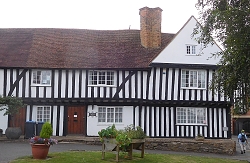
The former inn, a lovely half-timbered edifice is now a private house, named ‘Guy Fawkes House’, even though the famous man never lived there. The rest of the village contains several old thatched cottages, a thatched bus shelter, and the old village stocks. Close to the town of Rugby, this village is well worth a visit.

A pillar box

In Britain, posting boxes for letters and small packages are sometimes referred to as ‘pillar boxes’

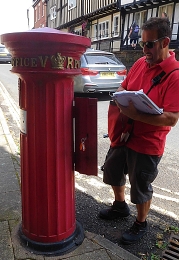
While visiting the town of Warwick, famous for its castle, we spotted a letter box that is truly a pillar box.

This post-box (pillar box) is shaped like a classical pillar. It was made in cast-ron in 1856 and is one of two of this design in the town of Warwick. They are still in use.