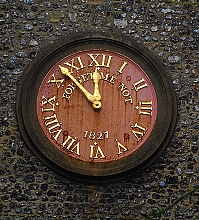
Hands move slowly
Time pass-es unceasingly
The clock remains unmoved

Hands move slowly
Time pass-es unceasingly
The clock remains unmoved
WE ATTENDED A WEDDING in a most attractive location today, the 25th September 2021. The ceremony was held in the great hall of a palace favoured by Queen Elizabeth I. Built in 1497, most of the palace was demolished but this superb hall, a masterpiece of Tudor architecture, remains. The great hall has a newer neighbour, a triumph of Jacobean architecture: Hatfield House built in about 1608 and incorporating material from the former palace of which only the great hall remains. The Jacobean edifice was built for Robert Cecil (1563-1612), First Earl of Salisbury. Some of his descendants still reside in the house.

With about 250 people attending and dining at long tables, it was not hard to imagine such joyous festivities occurring during the Tudor heyday of the great hall.
DURING THE PENULTIMATE year of our daughter’s time at secondary school (i.e., high school), we, her parents, were invited to several early evening meetings to hear about options for her higher education. At one of these, representatives from three US universities gave talks about the delights and advantages of studying at universities in the USA. One of the Americans explained that when applying, you should only include things that you were the first to do; things that you were best at; and things that only you have done. She emphasised this by saying:
“You have to be the first, the best, and/or the only.”
Well, our daughter chose not not to move to the USA to study, but, chose to study at Cambridge University. Recently, we visited a country house managed by the National Trust, which can easily claim to be the first and the best, and maybe the the only. The property is in Norfolk and is called the Blickling Estate. Its last owner was Philip Henry Kerr, 11th Marquess of Lothian (1882-1940), who was instrumental in getting the National Trust Act passed by Parliament in 1937. At his death, he bequeathed the Blickling Estate to the National Trust. It was the FIRST large Jacobean house to become a property run by the National Trust.

Built in the 1620s for a wealthy London lawyer, Sir Henry Hobart (died 1626), who did not live long enough to see it completed, Blickling Hall is the BEST Jacobean building in the care of the National Trust. As for fulfilling the ONLY criterion, as advised by the above-mentioned lady from an American university, this is more difficult because like all other National Trust properties, Blickling Hall is unique; it is the only Blickling Hall.
However, apart from many things that makes Blickling Hall so special, there is one other aspect of it that gives it some extra kudos. Currently, it has the largest second-hand bookshop of all such outlets run by the Trust. But this is a place well worth visiting for its interiors, exteriors, and fine gardens, both formal and otherwise. I feel that it is one of the first places you should see in Norfolk, as well as being one of the best, but only you can judge whether I am right.
YORKSHIRE IS RICH in the ruins of abbeys and other religious institutions, which were all dissolved (closed down) by Henry VIII in the 16th century and left to decay. The better known of Yorkshire’s ruined abbeys include those at Fountains, Rievaulx, and Whitby. In the North Yorkshire district of Ryedale, there are the extensive ruins of a former Cistercian abbey, founded in 1137 and called Byland Abbey. Having visited ancient but still intact and well-preserved Cistercian monasteries in various places in France, I have a reasonable idea of what these places look like. What I particularly liked about the ruins at Byland was that although much of the old stonework has been taken away and incorporated in other buildings, sufficient remains not only of the abbey church but also of the many buildings (e.g., the refectory, the cloisters, the chapter house, and the abbot’s house) that made up the monastic settlement. Having seen the monasteries in France I was able in my mind’s eye to create an image of how Byland might have looked in its heyday.
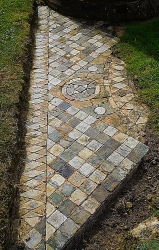
Apart from its great beauty as a ruined church, the abbey’s vast former church has something that I cannot recall ever having seen at other ruined abbeys I have visited. Exposed to the open air and risking being trod upon by visitors are many quite large expanses of mediaeval floor tiling. Many of the fired clay tiles still bear their coloured glazes. There are patches of tiling where they are laid out in circular geometric patterns. It was surprising to see such a great number of these tiles because even in many of the still intact British churches and cathedrals, such ancient flooring is quite rarely preserved to such an extent as in the ruined Byland Abbey.
I was told that when the abbeys were dissolved by Henry VIII, their roofs were removed, and this ensured that the buildings became unusable and fell into decay. The west end of Byland’s huge church contains the remains of a masonry circle that was once the frame for an enormous rose window, believed to be a prototype for the rose window that still can be seen at York Minster. While the Minster is a sight not to be missed, so is Byland Abbey. The latter might not have such a spectacular location as the ruins at Whitby and Rievaulx, it is, in my opinion, a far more interesting place to explore.
AFTER A SUNNY DAY spent at Whitby in North Yorkshire, we stopped for a drink at sundown in a small pub for a pre-prandial alcoholic beverage. Behind and slightly above the pub, we could see a well-maintained 12th century parish church with later modifications and a square tower. Below the pub, a narrow stream, lined with bushes and trees, ran alongside the main road. Apart from the infrequent passing car, the place was silent except for some pleasant birdsong. From where we sat on the terrace of the hostelry, we could see a small, sloping village square with a simple war memorial, some parked cars, and a small post box. At first, I did not realise where we had stopped. Then, I noticed that the village is called Kilburn.

There is another Kilburn about 215 miles south of the lovely village where we stopped for an evening drink. The latter is in North Yorkshire and the place with the same name many miles south of it is in north London. Apart from sharing the same name, London’s Kilburn is anything but rustic and peaceful, as many Londoners will know. London’s Kilburn is not really picturesque in conventional people’s eyes; it might appeal to lovers of urban sprawl. It is a crowded metropolitan area with much commercial activity and a racial profile infinitely more diverse than that of the village in North Yorkshire.
I am not sure which of the two Kilburns is the oldest. North Yorkshire’s village was mentioned in the Domesday Book of 1086 and named ‘Chileburne’. London’s Kilburn was a settlement on an ancient Celtic route, a track between the places now known as St Albans and Canterbury. A priory was constructed on a stream that flowed through where London’s Kilburn now stands. The stream was known variously as ‘Cuneburna’, ‘Kelebourne’, and ‘Cyebourne’.
Whatever the origins of these two Kilburns, I know which of them is the place where I would prefer to linger in front of a glass of bitter.

Rings of growth
Within a now dead tree trunk
Record a fine life long lost
I VISITED BARCELONA in the late 1960s. One of the sights I saw was a museum dedicated to Pablo Picasso. Before entering that place, the artist’s works somewhat puzzled me. In the museum, there were some of Picasso’s earliest paintings. They were straightforward rather than abstract, and extremely well executed. The artist’s talents were immediately obvious. As I moved from room to room, the works on display became increasingly abstract. By seeing his progression from figurative to abstract, I began to appreciate his greatness as an artist, and I began to understand why he is regarded as a brilliant creator by many people. By the time I had finished looking around the museum, I had been converted from being sceptical about Picasso to becoming yet one more of his fans. More recently, I saw an exhibition showing the artistic development of Roy Lichtenstein from his earliest to his latest creations. No longer was he just a creator of entertaining pictures based on American comic strips, but I could see that he was an artist of great competence. Like the foregoing examples, a visit to the Cartwright Hall Museum in Bradford and seeing some of David Hockney’s earliest works also enhanced my appreciation of this highly prolific visual artist.
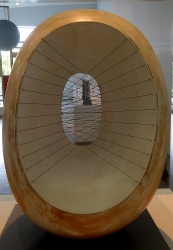
Bradford in Yorkshire is not far from the city of Wakefield, where Barbara Hepworth (1903-1975) was born. She was baptised in the city’s fine cathedral. Until today, I had mixed feelings about Hepworth’s works. There are some that I like very much, including a Mondrian-like crucifix at Salisbury Cathedral and a Naum Gabo inspired work attached to the eastern side of the John Lewis shop on London’s Oxford Street. Also, I have enjoyed visits to Hepworth’s studio and garden in Cornwall’s St Ives. However, as beautifully executed as her works are, I did not become terribly keen on her artistic output until today, the 18th of September 2021.
What converted me and increased my appreciation of Hepworth as an artist was today’s visit to the Hepworth Wakefield Museum. We arrived to discover that for the time being the whole museum is filled with works by Hepworth, beginning with her earliest and ending with her latest. The temporary exhibition, “Barbara Hepworth: Art & Life”, continues until the 27th of February 2022, and should not be missed.
As with other abstract artists, such as Picasso, Hepworth began learning the basics of figurative representation. Her earliest carvings and drawings were created superbly competently but give no hint of which directions her creative output was soon to follow. Had she not developed any further, she would have been regarded as a skilled, if not too exciting, sculptor. However, Hepworth soon became involved artistically, and in one case maritally, with leading artists of the twentieth century. Contact with them and their ideas can be detected in some of the works she created as she moved from purely representational to highly abstract. It was particularly interesting to see a small carving with a hole in it, the first of her many works to have holes in them. The idea of the holes is to allow light to flow through her sculptures. It was not only other artists who inspired Hepworth’s creation but also the forces of nature, which unconsciously sculpt rocks, trees, and other natural features in the landscape.
It was interesting to see the life-size prototypes of some of Hepworth’s works I have admired in the past. It was wonderful, for example, to be able to get close to the full-size model sculpture which is now high up on the wall of John Lewis in Oxford Street.
Once again, seeing a collection of works illustrating the progression of an artist’s output from student days until the achievement of fame and beyond has helped me to increase my appreciation of an artist about whom I had some reservations. Today’s visit to the Hepworth Wakefield has moved Barbara Hepworth a long way up my ladder of great artists and removed any doubts I had about her works.
Finally, here is something that intrigues me. Hepworth, like Picasso and also my late mother, had what might be described as traditional basic artistic training, just like the European and western artists who created during the many centuries before the 20th, yet all three of them (and many others) moved from expressing themselves with figurative works to abstract creations. However, unlike the artists who flourished before the latter parts of the 19th century and never strayed into the world of artistic abstraction, those who created during after the late 19th century (including the Impressionists) strayed away from the purely figurative/representational. Why this happened is no doubt the subject matter of much art historical literature, which I have yet to read. As I wrote the previous sentence, it occurred to me that the move towards abstraction (and other forms of art that do not appear to give the viewer a straightforward recreation of nature) coincided with the advent of photography. The photograph can give the illusion of being a true image of the world, leaving the artist to explore other more imaginative representations of what he or she has seen.
THERE IS A FASCINATING pair of railway viaducts at Chapel Milton, near Chapel-en-Frith in the Peak District. Constructed in about 1860 and then 1890, the viaducts support a place where two railway lines diverge. The viaducts, which join each other at a bifurcation were built at different times as the dates suggest. One of the arcades consists of 13 arches and the other of 13.

Allow Wikipedia to explain:”The Midland Railway opened a new line via Chapel-en-le-Frith Central and Great Rocks Dale, linking the Manchester, Buxton, Matlock and Midland Junction Railway with the Manchester, Sheffield and Lincolnshire Railway, in 1867, giving it an express through route for the first time between Manchester and London … The eastern section, essentially a second, mirror-image viaduct in an identical style, was added in 1890 to allow trains to travel between Sheffield and the south via Buxton and the Midland’s own line.” (https://en.wikipedia.org/wiki/Chapel_Milton_Viaduct)
EVERY NOW AND THEN, a canal needs repairing. For example, it might have sprung a leak either in its retaining walls or in its clay bottom. In such circumstances and no doubt others, the repair work can only be carried out if the canal is emptied of water, a tall order in a canal that might be many miles in length. Recently, we were walking along the towpath of the Macclesfield Canal, which links Marples Lock on the Peak Forest Canal with Hardings Wood Junction on the Trent and Mersey Canal, when we spotted something that we had never noticed before whilst walking along a canal towpath.
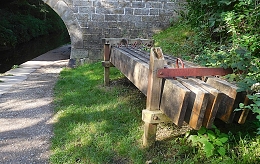
What we saw was a pile of sturdy wooden planks, each with two metal handles attached to their narrowest edges. They looked quite modern. We asked a man, who was walking his dog, about the planks. He explained that they were used to block both ends of a section of canal between two consecutive bridges. When these barricades are lined with plastic sheeting, the water between the two barricades can be drained from the part of the canal between the two waterproofed wooden barriers, Then, work can be carried out on the drained stretch of the canal. The planks are known as ‘stop planks’
Our informant pointed out notches carved in the stonework near to a bridge. The notch is opposite another identical one across the canal. It is into these pairs of notches that the planks we had noticed ate inserted to create a dam, I regard myself as being quite observant, but I have never seen or noticed either this kind of notch or the wooden planks for inserting in them during many long walks along canals in other parts of England. Maybe, they are common, but until we walked beside the Macclesfield Canal, I had never seen them before, Maybe, this is because other methods of damming (see: https://www.rchs.org.uk/wp-content/uploads/2017/01/OP-128.pdf) are also employed in addition to that which we spotted on the Macclesfield Canal at Bollington in Cheshire.
ONE OF THE SEVEN WONDERS of the Derbyshire town of Buxton has to be Scrivener’s bookshop. Located on the town’s High Street, this shop displays books on five floors including the basement. Many, but by no means all, of the books are second-hand (pre-loved). At first sight, the books seem to be crowded together in no particular order, but the reverse is true: they are arranged systematically rather than chaotically.
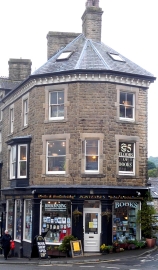
The books are far from being at bargain prices, but they are priced fairly, not outrageously. Those of you, who know my addiction for acquiring books, will be relieved to know that I purchased only two volumes. There were plenty more that I might have been tempted to buy had I not already embarked on on a project of carefully reducing the number of books in my possession.
 yamey
yamey 