I WAS FOURTEEN IN 1966. That year, Selfridges in London’s Oxford Street opened the Brass Rail restaurant on the ground floor, with windows facing Orchard Street. Its speciality was then, and still is, salt beef. I recall visiting the place once or twice with my mother back in the 1960s. In those days, I did not particularly care for the taste of salt beef. For some reason, maybe the cost of the place, we did not frequent the Brass Rail.
Winding the clock forwards several decades, I now enjoy eating salt beef occasionally. Today, the 22nd of March 2023, we needed to go to Selfridges for something, and as we were there, I suggested that we ate at the Brass Rail. Unsurprisingly, the eatery has changed its appearance considerably since the 1960s, but it is still located in the same part of Selfridges as it was originally. Its tables are enclosed in an area lined banquettes upholstered with red fitted cushions. The service was brisk and attentive. We ordered Reuben sandwiches in rye bread. These are generously filled with warm salt beef, sauerkraut, Swiss cheese, gherkin, and Russian dressing.
The Reuben was enjoyable, filling, and quite tasty. However, I felt that the taste of the salt beef was overpowered by that of the dressing and the other ingredients. Good though it is at the Brass Rail, I prefer eating the bagels crammed full of salt beef, which are served at the 24 hour Beigel Bake in Brick Lane. At half the price of the Brass Rail, but without the great service, they are more than twice as enjoyable.
MY MOTHER SETTLED in London in about 1951, a year before I was born. The UK was still recovering from WW2, and life was not too easy. There were shortages of food. I remember my mother telling me that during the early 1950s, relatives in South Africa used to send parcels of food, including, as I can still recall, tinned guavas. The postman used to lug these heavy packages to our home in Hampstead Garden Suburb. My mother used to feel guilty that she was lucky enough to be receiving food that few others could not obtain, and used to open the parcels and give the postman a couple of tins from them. Soon after I was born, my mother, already a painter, began making sculptures. Somehow or other, she managed to get permission to work in the sculpture studios at the St Martin School of Art, which was then located on Tottenham Court Road. She was not enrolled as a student, but worked alongside, and received help from, several sculptors who have now become famous. Amongst these were Antony Caro, Phillip King, William Turnbull, and Elisabeth Frink, who became a family friend.
Most of my mother’s sculpting was done during the 1950s and 1960s. This was a period when many people, including British sculptors, were simultaneously recovering from the horrors of war; fearful of the Cold War and the possibility that it might develop into a war with atomic weapons; and looking towards the future. Sculptors reacted to this situation in various ways as can be seen at an exhibition being held in the Marlborough Gallery in London’s Mayfair until the 22nd of April 2023. Called “Towards a New World: Sculpture in Post-War Britain”, this show to quote the gallery’s press release:
“… emphasises the international impact of a group of young sculptors and artists who merged past trauma, present anxieties, and future hopes into a new visual language.”
Lyn Chadwick
The artists whose works are on display include, amongst others, Elisabeth Frink, William Turnbull, Reg Butler, Bernard Meadows, Kenneth Armitage, Lyn Chadwick, Graham Sutherland, and Francis Bacon.
Apart from some of the works by Reg Butler and Bernard Meadows, the artworks on display exhibit what the art historian Herbert Read described as: “…the iconography of despair, or of defiance; and the more innocent the artist, the more effectively he transmits the collective guilt. Here are images of flight, or ragged claws ‘scuttling across the floors of silent seas’, of excoriated flesh, frustrated sex, the geometry of fear.”
The Geometry of Fear was the name of a group of British artists who exhibited at the 1952 Venice Biennale.
Bernard Meadows (1915-2005) was a name that was new to me. He was Henry Moore’s first assistant. Later, he taught Elisabeth Frink at the Royal College of Art. He was a member of the The Geometry of Fear group but as the press release explained he differed from most of its members: “While the distorted human figure became a prominent motif for many of the artists associated with the ‘geometry of fear’ group, for others, like Bernard Meadows, it was animal imagery that resonated most with the collective societal trauma of the war. Visceral depictions of birds and crabs acted as vehicles to express human emotion.”
I enjoyed seeing this exhibition. The works are well-displayed in the spacious, well-lit rooms of the Marlborough. After viewing the exhibition, I wondered about my mother’s sculptures, most of which now only exist in photographs. Her first sculpture, a terracotta mother and child, was figurative but veering towards the abstract. As time passed, her work became increasingly abstract, and tended to be closer to being brutalist rather than naturalist. Although I never heard her mention The Geometry of Fear, I wonder whether her artistic sympathies lay with them rather than with any other ‘school’ of artistic activity.
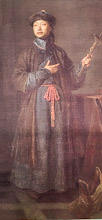
I BET YOU DID NOT KNOW that Michael Alphonsus Shen Fuzong (c1658-1691) was the first documented person from China to visit England. I did not know that he met King James II in 1687. Furthermore, did you know that the Chinese sculptor Tan-Che-Qua (c1728-1796) from Canton, who visited London between 1769 and 1772, not only exhibited at London’s Royal Academy but also met King George III before returning to his native land. Maybe, I might have stumbled across these two notable men from China by accident had I not visited the British Library today (the 20th of March 2023), but this is highly unlikely. Until the 23rd of April 2023, there is a fascinating, well-displayed exhibition called “Chinese and British” at London’s British Library.
Beginning with the earliest Chinese visitors to Britain, this splendid exhibition charts the growth and considerable achievements of Chinese people who chose to live in Britain. John Hochee (1789-1869) was one of the first people from China to have settled permanently in England. He arrived from Canton in 1819, worked as a property manager with John Fuller Elphinstone (1778-1854; son of William Elphinstone a Director of the EIC: see https://www.rh7.org/factshts/hochee.pdf), whom he probably met whilst working for the East India Company in China. Hochee married an English lady, Charlotte Mole, and James (1832-1897), one of their seven children, became a surgeon. John was naturalized in Brighton in November 1854.
Since Hochee (Ho Chee) settled in Britain, many more people from China have followed in his footsteps. The exhibition at the British Library illustrates this well. Early settlers included many who had worked on ships and had landed in Liverpool or London. Chinese communities became established in the 1880s, notably in London’s East End. The Chinese in Britain established businesses to serve their community and their British neighbours. Chinese restaurants and laundries figured largely amongst the early enterprises. With the advent of laundrettes in the 1950s and 1960s, the Chinese laundry business faded away, but still today the Chinese are very important in Britain’s catering industry. It was after WW2 that restaurants and take-aways really took off in Britain. These outlets supplied both British and Chinese food. Many of their workers and owners were from Canton and Hong Kong.
During WW1, nearly 100,000 Chinese men provided support for The British Army in Europe – digging trenches, burying the dead, and other tasks. Some of these men had signed 3-year contracts, which obliged them to return to China after the war, which most of them did. The exhibition devotes some space to the activities of these men.
Apart from what I have already described, the exhibition has displays illustrating the many other achievements of the Chinese British. One exhibit that particularly amused me was a selection of books in English by Chinese British authors. They were displayed on a ‘lazy Susan’, a revolving serving platform often found in the centre of round tables in Chinese restaurants.
All in all, I am very pleased that a post on Instagram alerted me to this interesting exhibition, and I encourage everyone to visit it.
ANYONE FAMILIAR WITH London will know that except for some parkland, the city is a built-up urban environment all the way west from Marble Arch to Acton and further beyond. This is also the case from Hyde Park Corner to Heathrow Airport. However, this has not always been the situation.
When John Rocque (1709-1762) drew his detailed, accurate maps of London in the 1740s, Paddington was a small village separated by open countryside from what was then London. In those days, Kensington was a village reached from London by a country road flanked on its northern edge by Hyde Park. And from Kensington to Hammersmith would have been a ride along a road running between a series of agricultural fields and orchards. And to the north of Hammesrsmith, Shepherds Bush was an open space around which there were only a few well-separated houses. And as for Notting Hill Gate, Rocque did not even bother to name this road junction in the middle of the countryside.
By 1826/27, when C & J Greenwood published their detailed map of London, Earls Court was still a country hamlet; Kensington a small town; and there was barely any development around what is now Notting Hill Gate. However, by 1826 Paddington was beginning to grow and was no longer separated from Marylebone by open countryside. Additionally, the northern edge of the eastern end of Bayswater Road was losing its rural nature and being built upon.
In brief, as the 19th century progressed, London spread west. As it did so, urban development covered what had been open countryside and places that had been separated from London began to become part of it. Places like Kensington, Earls Court, Shepherds Bush, Hammersmith, and places further west were no longer separated by open countryside. Instead, they became engulfed by the expanding metropolis.
My book “BEYOND MARYLEBONE AND MAYFAIR: EXPLORING WEST LONDON” describes in detail how the villages and towns to the west of Park Lane and what is known as ‘The West End’ became engulfed by London’s westward growth. It reveals the history of these places; what they are like today; and what remains of their existence before they became joined to London, as it spread from Mayfair and Marylebone to Heathrow and beyond.
BEYOND MARYLEBONE AND MAYFAIR: EXPLORING WEST LONDON
By Adam Yamey
is available as an illustrated paperback and Kindle from Amazon:
THE RIO CINEMA in London’s Kingsland Road district (in Dalston) is a fine example of a film theatre constructed in the Art Deco style. It was designed by Frank E Bromige, who specialised in designing cinemas in that style, and constructed in 1937 on the site of an earlier Edwardian-style film theatre, which first opened in 1909. The Rio has been showing films ever since then. Since 1976, the Rio has been run successfully, and independently of any cinema chain, as a not-for-profit charity. The cinema’s Art Deco exterior has been faithfully maintained and the interior’s original design has been reconstructed. There are two screens. The largest one, the main auditorium, looks much as it might have done when it was built in the late 1930s. There is a smaller auditorium in the basement. This has a large screen and comfortable raked seating.
Today, the 18th of March 2023, we watched a film in the smaller auditorium. Called “Lunana: A Yak in the Classroom”, this film was shot mainly in the tiny Himalayan Kingdom of Bhutan. It is a beautiful film, beautifully made. Without giving the story away, it is about the experience of a young Bhutanese teacher sent from the capital to teach in a remote village called Lunana. The tiny elementary school in that high altitude settlement surrounded by breathtakingly attractive mountain scenery is the remotest school in the world. The film shows how Lunana impacted on the young teacher and vice-versa.
Apart from having a good story, some humour, and much emotion, the film provides a fascinating view of Bhutan. “Lunana” allows the viewer to realise the spectacular nature of the country’s landscape and rural traditions. What particularly interested me was the depiction of a lifestyle so remote and different from what we are used to here in the west and in many parts of India, even also in the urban areas of Bhutan’s neighbour Sikkim. The subject of global warming is introduced, but in a quite subtle way. The villagers in Lunana are portrayed as being simultaneously innocent, playful, spiritual, and philosophical. Although “Lunana” is a highly enjoyable film and Bhutan is portrayed in an affectionate and appealing way, I felt that the country, which is undoubtedly spectacularly attractive, is not one that I am in a hurry to visit. It is an unusual and unique film, and it was appropriate to have watched it in one of London’s unique individual cinemas.
ONE OF THE MANY JOYS of living in London is the ability to view exhibitions in the city’s commercial galleries, many of which can be found in Mayfair and the West End. These galleries display artworks, which are mainly for sale, or occasionally borrowed from places away from London. The exhibitions are of a temporary nature. Visiting them allows members of the public to view works, which might never be on public view again in London because they will be sold to private collectors, big corporations, or to galleries and museums abroad. When we are in London, my wife and I try to visit several of the commercial galleries at least once a week. At the recommendation of our daughter, whose employment is in the world of art, we paid a visit to Pace Gallery in Hanover Square to see an exhibition that will continue until the 15th of April 2023.
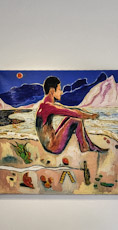
The artist, whose works are being displayed in the spacious modern rooms at Pace, is Gideon Appah. He was born in 1987 in Accra, Ghana. His training as an artist was at the Kwame Nkrumah University of Science and Technology in Ghana. His first major exhibition was in 2022 at the Institute of Contemporary Art at Virginia Commonwealth University in Richmond, Virginia (USA). His paintings have also been exhibited in many other places.
All of Appah’s works on show at Pace are oil and acrylic on canvas. They are all highly colourful and include, with one exception, figures in a variety of landscapes. The figures are positioned in landscapes that have an intensity that makes them look slightly unreal, yet completely compelling. One of the pictures we particularly liked is “Night Vision” which depicts a brightly lit town on a hill at night reflected on a sea of still water. The leaflet issued by the gallery describes Appah’s work as “dreamlike”, and this was also my opinion. On the whole, the dreamy nature of the works is quite distinct from that seen in the works of the great Surrealists of yesteryear. Appah portrays his scenes with the clarity and strangeness that I associate with the dreams I experience. His works are intriguingly eery, but not scary. If you can get to Pace, do so to enjoy the well-executed and fascinating works by this artist from Accra.
PARTICIPANTS IN HUMAN endeavours frequently like to work together or in small communities. By being in close contact they can inspire and encourage each other; criticise each other’s work; influence each other; provide mutual assistance both theoretical and practical; and so on. Working communally is often favoured by groups of artists. Such was the case at Black Mountain College (‘BMC’) in North Carolina. The establishment was founded by John Andrew Rice, Theodore Dreier, Frederick Georgia, and Ralph Lounsbury in 1933 as a private liberal arts college. These people had been dismissed as faculty members from Rollins College (in Florida) after an incident that threatened their academic freedom. BMC thrived until it was closed in 1957.
By Josef Albers
In the year that BMC was opened, the Nazis in Germany closed down a ground-breaking art and design establishment in Dessau – the Bauhaus. Many faculty members fled from Germany to the USA, and some of them, notably Josef Albers (1888-1976) and his wife Anni (1899-1994), joined BMC. Josef headed up BMC’s art programme and Anni taught weaving and design. The college was unusual in many ways and differed from other liberal arts colleges in the States.
BMC favoured an inter-disciplinary approach to teaching. It attracted artists and other cultural figures, who were at the forefront of the avante-garde in the USA. These people included Buckminster Fuller, Merce Cunningham, John Cage, Charles Olson, and Robert Creeley, Willem & Elaine De Kooning, to name but a few. It would not be an exaggeration to say that the remotely located BMC was one of the most important powerhouses for the development of modern art in 20th century USA.
Until the 15th of April 2023, there are two exhibitions being held at the David Zwirner Gallery in London’s Grafton Street (in Mayfair). One of them is dedicated to a series of paintings by Josef Albers. The other, and more interesting show is a collection of artworks created by several artists, who attended BMC either as students or members of the faculty. The works in this exhibition include a few works by Anni and Josef Albers, as well as by other artists, including the De Koonings, Buckminster Fuller, Sue Fuller, Leo Amino, Ray Johnson, and Ruth Asawa. It is a small but excellent show, and well worth a visit. Until today, when I visited David Zwirner, I must admit that I had never heard of BMC, which was founded at the same time as the Germans were closing down the Bauhaus, which had already become one of the most influential pioneers of innovative design during the 20th century.
OBSERVANT VISITORS TO KETTLES Yard art centre in Cambridge will notice a couple of incised stone signs embedded into the centre’s wall facing Castle Street. One of them reads: “Godmanchester Turnpike Road Ends Here”. Below this, there is another stone sign that reads: “To the Horse-shoe Corner, Godmanchester, 14 Miles 4 Furlongs” Just in case you did not know, or have forgotten (as I had), there are 8 furlongs in 1 mile (1.6 Km), and a turnpike is a toll-road. Godmanchester is northwest of Cambridge.
The turnpike was in existence by 1744. According to a website (www.geograph.org.uk/photo/568133), the tolls were: “… collected by the Godmanchester to Cambridge Turnpike Trust. Horseshoe Corner in Godmanchester is almost probably the location of the then Horseshoe Inn at the southern end of Post Street. It was also where markets were held as early as 1533.” The turnpike might well have run along a part of the course of a road built by the Romans – Via Devana. Robert Fox, writing in his 1831 history of Godmanchester, noted: “The celebrated William Stukely had no doubts upon this point; for, in describing the course of the Via Devana through Cambridge, in his Itinerariium Curiosum, republished 1757,4to, at page 203 we find ‘Out of the ruins of this city—Granta now Cambridge—William the Norman Duke built a castle; a very straight Roman road comes to it from Durosiponte, Godmanchester. It passes as straight through the present Cambridge by Christ College and Emanuel College… so to Camulodunum, Colchester.’ “ Stukely was almost certainly describing Castle Hill and its southern continuation Magdalene Street, which leads almost straight towards Christ and Emannuel Colleges.
The stones were originally set higher than they are at present. They were then at the level of the eyes of coachmen seated high up on the front of their vehicles. The stones were discovered when Kettles Yard was undergoing restoration in 2016, and have been set at a level lower than would have been the case in the past.
Though not of as great visual impact as some of the exhibits in Kettles Yard, the two reminders of an old toll road are of considerable historic interest.
HAILEYBURY SCHOOL WAS founded by the East India Company (‘EIC’) in Hertfordshire in 1806. It was an institution where young British men heading out to India to become British colonial administrators were given training. It was not the first of such establishments. In 1800, Fort William College (in Fort William, Kolkata) was founded by the Governor General Richard Colley Wellesley (1760-1842) to teach Indian languages, laws, and so on, to young recruits to the EIC. This school continued until it was closed in the 1830s. For various reasons, the EIC decided to open a training school in England – The East India College.
The East India College was first housed in Hertford Castle, where it remained whilst bigger premises, designed by the architect of University College London, William Wilkins (1778-1839), were being built nearby in Haileybury. When it was completed, the college moved from the castle to the new building, where a school has been located ever since then. Teachers at the East India College included well-known people such as Thomas Malthus and the Sanskrit scholar Monier Monier Williams.
It is ironic that one of the former students of the EIC college at Haileybury was Allan Octavian Hume (1829-1912). After studying at London’s University College Hospital, he was nominated to the Indian Civil Service. He went out to India in 1849 having passed through the course at the EIC college at Haileybury. After returning to England in 1894, having worked in the Indian Civil Service, he recognised that there was a sense of hopelessness and unrest amongst the Indian population and that the people were held in contempt by their British rulers. To try to remedy the plight of the Indians and to provide a ’safety valve’ for relieving unrest that he perceived in Inda, he founded what soon became the Indian National Congress. Little was he to know that eventually this organisation would play an important role in getting Britain to leave India.
Taking a rather circuitous route from Cambridge to London, we stopped for lunch in Hertford. I wanted to see the castle because I had just read about it and its brief connection with the EIC in an interesting book, “The Colonial Subjugation of India”, by Amar Farooqi. After enjoying a portion of splendid fish and chips, we entered the small park in which the castle is located.
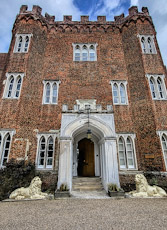
What can be seen today is a well preserved brick building with crenellations and windows in gothic style frames. When viewed face on, the edifice can be seen to consist of a tall central portion flanked by two lower wings. The tall central part, which was constructed in the 15th century was the gatehouse to the castle, which was fell into disuse and was demolished long ago (in the 17th century). The two wings were added during the reign of George III. Today, the so-called castle, erstwhile gatehouse, houses Hertfordshire council offices. We entered the lobby and noticed the gothic revival interior décor within the castle. We will revisit the castle on one of its open days and see some more of the building.
Hertford Castle played a short role in the history of British India and the EIC. The school at Haileybury continued its imperialistic function until 1857/8, when the EIC was wound up after the Indian Mutiny (First Indian War of Independence) of 1857-58. The present school, Haileybury College, a private school with boarding facilities, opened its doors to pupils in 1862 and occupies the old college’s premises.







 yamey
yamey 