The naked ceiling at Osterley Park

WHEN THE BANKER Sir Francis Child (1642-1713) acquired Osterley Park in the 18th century, its Elizabethan manor house was in a poor state of repair. His grandsons, Francis and Robert, employed the famous architect, Robert Adam (1728-1792) to give the house a major ‘makeover’ including adding a grandiose neo-classical front portico. And that is what he did on a grand scale. Adam was no ordinary architect. Not only did he plan buildings (and modifications to them), but he also designed their interiors: everything from ceilings and wall decorations to furniture and doorhandles. Osterley Park offers a magnificent display of his wide-ranging skills.

Long gallery at Osterley Park

The visitor to Osterley Park, now managed by the National Trust, usually gets to see a series of wonderful rooms on the ground floor of the house. All the rooms except one have beautifully decorated ceilings, all designed by Adam. Some of them have paintings created by Adam’s favourite painter, the Venetian Antonio Zucchi (1726-1795). Amongst my favourite ceilings are those in the Etruscan Dressing Room and the Drawing Room. The latter has a fantastic ceiling that was inspired by drawings in “The Ruins of Palmyra otherwise Tedmor in the Desert” by James Dawkin and Robert Wood (published in 1753).The ruins were those that were recently badly vandalised by the IS group. In each of the rooms, except the long gallery, the visitor’s attention is dominated by the eye-catching ceilings.

The ceiling of the long gallery is devoid of decoration. It was in this room that the Child family’s collection of fine paintings used to be displayed. The gallery’s ceiling was left plain, without decoration, deliberately, so that the viewer’s attention would be concentrated on the paintings.  Sadly, the paintings are no more. After WW2, the house’s owner, George Francis Child-Villiers, 9th Earl of Jersey (1910 -1998) gave the house and its grounds to the National Trust. He moved to Jersey, taking with him most of the paintings that had hung at Osterley. Unfortunately, many of these works were destroyed in a warehouse fire soon after he donated the house. The artworks in the gallery have since been replaced with other paintings and because the ceiling is naked, you can give them your full attention.

Constable, Turner, and a soap maker

MY GREAT GRANDFATHER Franz Ginsberg (1862-1936) was an industrialist and a politician in South Africa. One of his main industries was soapmaking. Many of his workers would have been black Africans, mostly living in poor conditions around his factory in King Williams Town (‘KWT’). While serving on the town council of KWT, he played an active role in establishing what he hoped would be a township with improved living conditions for some of the town’s black people (including his workers). Named after him, Ginsberg township, founded at the beginning of the 20th century, still exists.

A few years before my great grandfather established the township named after him, another soap maker, William Hesketh Lever (1851-1925) who was based in England, created what he hoped would be better living conditions for his workers. Far more grandiose and much more attractive than Ginsberg Township, Lever began building Port Sunlight (south of Birkenhead) in about 1887 (a year or two after Ginsberg began making soap). Lever’s model town provided his employees with salubrious dwellings in a well landscaped environment. However, they were subject to strict rules; Lever, who believed that discouraging immorality (e.g., gambling) led to a good workforce, was a benevolent paternalist.

Turner on the left, and Constable on the right

Lever and his wife were avid collectors of artworks. These are housed in the purpose-built Lady Lever Art Gallery in the centre of Port Sunlight. This gallery, contained within an impressive French neo-classical style edifice, was designed by the Warrington based architects William Owen (1846-1910) and his son Seager Owen, and opened in 1922. It contains a fine range of artworks dating from early times (pre-Christian) to the early 20th century. It contains one of the largest and most important collections of Pre-Raphaelite artists’ works. With its spacious, airy galleries and well displayed exhibits, it is amongst my top ten British galleries and museums.

In one small gallery, which contains a sculpture of a reclining nude, two paintings hang close to each other but are separated by a neo-classical fireplace (an exhibit). One of them is by JMW Turner (1775-1851) and the other by his contemporary rival J Constable (1776-1837). It is interesting to see them almost side-by-side because it allows the viewer to compare their styles and what they try to convey  in their paintings. The Turner painting depicts “The Falls of the Clyde”, and the Constable depicts “Cottage at Bergholt”. Neither of the paintings, both created in the age before photography, achieves the accuracy of, say, a photograph; both seem impressionistic, but the effects that the artists were attempting to have on the viewer are entirely different.

Turner’s paintings are often far more impressionistic than Constable’s. Although his subject matter is always at least almost discernible, I feel that Turner’s works are created to evoke both the artist’s and the viewer’s psychological and/or emotional reaction(s) to what was being depicted. In contrast, Constable’s painting techniques seem to have been designed to emphasise aspects of the scene he was painting to give the viewer the impression that he or she is looking at the very same view as that which attracted the artist. Constable regarded painting as being a branch of science. In a lecture he gave in 1836, he said:

“Painting is a science and should be pursued as an inquiry into the laws of nature. Why, may not landscape painting be considered a branch of natural philosophy, of which pictures are but the experiments?”

Turner, in his almost abstract paintings such as the one at the Lady Lever, appeared to be wanting to stimulate the viewer’s emotions. In contrast, Constable tried to convey what he saw or felt was important in his subject matter. Without resorting to the almost photographic accuracy of, for example, both Canaletto and Vermeer, the two artist whose paintings hang almost next to each other in the Lady Lever successfully achieve their aims. For me, the avoidance of detailed accuracy of representation in both Turner’s and Constable’s paintings, enhances the impression of reality in my mind, something that photography cannot do to the same extent.

Even if you do not wish to compare Turner and Constable, I can strongly recommend a visit to the soap maker’s gallery in Port Sunlight. Finally, it is a pity that my great grandfather did not invest in great works of art!

Painting by hand on a brick wall

IN THE LATE 1930s, my mother studied commercial art at the Michaelis School of Art in Cape Town (South Africa). One of her earliest jobs after leaving college was hand-painting posters advertising cinema films. Many years later, long after her death, I began visiting India and have been making regular visits there since January 1994. During the first few years of making trips to India, I used to notice the huge hand-painted cinema posters both in and out of towns. I recall seeing men perched on precarious looking bamboo scaffolding painting these enormous images. To someone, like myself, used to seeing printed cinema posters, seeing these men in action was an eye-opener.

A few years ago, I was walking near Shepherds Bush in west London when I saw a group of men colouring in details of a poster beneath a railway bridge. Like the painters in India, their scaffolding also looked slightly precarious, given the current preoccupation with health and safety in this country.

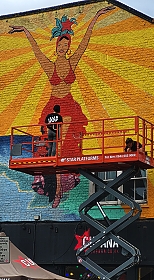
These memories of hand-painted posters came to mind a couple of days ago (late July 2002) while we were walking towards Lower Marsh (near Waterloo Station) from the Young Vic Theatre, where we had just watched a poorly acted, and badly written play called “Chasing Hares”. We spotted two ladies perched on a very adequate scaffolding device painting a colourful mural on a large expanse of brick wall above the Cubana Restaurant. It was good to see that in an age where machine produced images are common (and have largely replaced hand-painted adverts in India), traditional methods are still being used to create large images for attracting the public.

Tragedy in Sweden

PARR HALL IN the heart of Warrington (Cheshire) is a concert hall designed by local architect William Owen (1846-1910). It was built for the townspeople by Joseph Charlton Parr, descendant of the founder of a local bank. The benefactor was a prominent member of his family’s bank, Parr’s, and Warrington’s Mayor between 1901 and 1903. A plaque on the wall of the hall facing Palmyra Square commemorates his generosity. A much larger and newer plaque, actually a frieze, also outside the front of the hall, serves a sadder purpose.

In May 2013, a new rock band was formed in Warrington. Called Viola Beach, it had four members: Kris Leonard, River Reeves, Tomas Lowe, and Jack Dakin. Frankie Coulson and Jonny Gibson were initially members, but they left the group to concentrate on their university studies. Reading of this, I was reminded of one of my father’s students at the London School of Economics: Mick Jagger. Unlike Coulson and Gibson, he could not afford to remain a student as his band was becoming so successful. Incidentally, The Rolling Stones performed at Parr Hall in November 1963.

In June 2016, the band’s debut album, “Viola Beach”, was released. Consisting of 9 tracks, it reached the number 1 position on The UK Albums Chart in August of that year. However, the band were never to learn of their success. In February 2016, the members of the group and their manager were on tour in Sweden. In the early hours of the 13th of February, the car in which they were travelling failed to stop at the closed barriers of a bridge across the Södertälje Canal. The roadway of the bridge was lifting to allow the passage of a vessel in the canal. The car carrying the band plunged into the water 98 feet below. The driver, the band members, and its manager, were all killed.  The memorial outside Parr Hall, which portrays the band members and their manager in bas-relief, was sculpted by Tom Murphy. It was unveiled in September 2021.

Had they not met their end so prematurely, I wonder whether Viola Beach formed in a town on the Mersey might have gained some of the success enjoyed by another now much more famous Merseyside band: The Beatles.

Piero della Francesca in my life

A FEW WEEKS AGO, we were going to meet friends at a Chinese restaurant in London’s Chinatown. As we had arrived in the area far too early for our rendezvous, we decided to pass some time looking at pictures in the nearby National Gallery. We headed for the rooms containing paintings from the Renaissance era, which we had not visited for a long time because usually, for reasons that I cannot fully explain, we look at works created in later periods. We entered one of the rooms and I stopped in front of a couple of paintings that brought childhood memories flooding into the forefront of my mind. Both artworks are lovely creations of the early Renaissance painter Piero della Francesca (‘Piero’; c1415-1492).

In the National Gallery, London

In my childhood and early adulthood, I lived at 36 Hampstead Way in Hampstead Garden Suburb. The front door was under a covered porch and reached up a few stairs that led up from the street. The front door opened into a hallway with red polished stone flooring and a few pictures hanging on its walls. At the end of the hallway, facing the front door, there was a large high-quality photographic reproduction of the “Montefeltro Altarpiece”, painted by Piero. This coloured picture had been bought in Florence (Italy) from Alinari, the famous photography company that specialised in taking good photographs of artworks. The feature of the picture that always fascinated me was the egg suspended from a scallop shell above the head of the Madonna.  I have learned recently that the egg depicted is an ostrich egg, symbol of the new Venus: i.e., the Virgin Mary. It has also been suggested that it is not an egg but a pearl, which is a reference to the Immaculate Conception (pearls are created in oyster shells without sexual intervention!).

Also in the hall, there was a smaller coloured reproduction of another of Piero’s paintings: “The Flagellation of Christ”. Mounted on board and glazed with a shiny varnish, this reproduction was smaller than the original. So, every time I entered or left our home, I used to see these two images originally created by Piero. They were a part of my life.

My parents loved Italy. We visited Florence and Venice every year except 1967, the year after Florence had suffered from a devastating flood. My mother was a sculptor, and my father was a serious amateur art historian with a special interest in the Italian Renaissance. Hence, their love of Florence and the art treasures it contains. Piero was amongst their favourite artists.

Piero was born in Borgo Santo Sepolcro (‘Sansepolcro’) in Tuscany, which is about 47 miles southeast of Florence. Once when we were staying in Florence, we made an excursion to Arezzo, where there are some frescos by Piero, and then to Sansepolcro. There, we visited the Museo Civico that contains one of Piero’s great works: “The Resurrection”. None of us, my parents, myself and my sister, had seen it ‘in the flesh’ before.

For my father, Piero was not the only reason for our visit to Sansepolcro. In addition to his deep interest in the history of art, Dad was one of the world experts in the history of … wait for it … double-entry bookkeeping. This system of accounting has been a cornerstone of business since it was invented by the mathematician Luca Pacioli (c1447-1517), whose life overlapped that of Piero. Not only that, but Luca was also born in Sansepolcro. Apart from his advances in accounting methods, Luca also wrote various mathematical treatises including “Summa de arithmetica, geometria. Proportioni et proportionalita”. The second volume of this was Luca’s rewriting of a work by Piero. And the third volume was an Italian translation of “De quinque corporibus regularibus”, which had originally been written by Piero. Apparently, in both cases Luca made no mention of Piero as their author.

Although Piero and Luca figured often during the years I lived with my parents, I have not thought about either of them for a long time. It was only when we entered the National Gallery to pass time whilst we waited for our friends that seeing the paintings by Piero evoked childhood memories.

Once it crossed the River Mersey, but now it has gone

WIDNES IN CHESHIRE is across the River Mersey from the town of Runcorn. In the past, both places were important industrial centres. Currently, they are linked by two impressive road bridges (the Mersey Gateway, opened in 2017; and the Silver Jubilee Bridge, opened in 1961 and given its present name in 1977) and a Victorian railway viaduct. The Silver Jubilee Bridge (‘SJB’) begins cross in the Mersey from Widnes near to St Mary’s church and the Victoria Gardens.

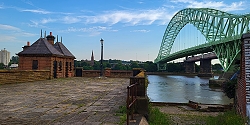
A few feet downstream from the SJB, there is what looks like a short jetty projecting a little way over the Mersey. On one side of this, there a small building with two separate slate roofs. The wide jetty-like structure looks disused. And so, it is. The structure is all that remains on the Widnes riverbank of the Widnes–Runcorn Transporter Bridge. Until 1905, when it was constructed, the only bridge across the Mersey at Widnes was the railway bridge (variously named as The Runcorn Railway Bridge, Ethelfleda Bridge, and Britannia Bridge), which was opened in 1868.

Between 1901 and 1905, when it was opened, the transporter bridge was under construction. It was the first of its kind in Britain. At each end of the bridge there was a 180 feet high steel tower. Suspended from them and spanning the length between them was a 1000-foot-long girder along which ran a continuous loop of cable. A transporter car was attached to the cable. The loop of cable was wound around a wheel attached to a winch on an engine housed in a building: the one which can be seen on the jetty-like structure at Widnes. As the wheel rotated, the cable moved, and the car attached to it moved across the river and high above it. The crossing took about 2 ½ minutes in favourable weather.

When it was built, the transporter bridge was cheaper to construct than a conventional bridge such as the one that replaced it in 1961 (i.e., the SJB). The transporter bridge, which was deemed inadequate for modern traffic volumes, was closed on the day that the SJB was opened, and it was demolished soon after. All that remains in Widnes is what can be seen at the end of Mersey Road next to the start of the SJB and Victoria Gardens. Although we did not visit Runcorn, I have read that the approach to the transporter bridge can be seen on that side of the river.

When we came across the remains of the transporter bridge, we had no idea what we were looking at. We asked several young people nearby, and they were unsure of its purpose. Older people whom we met in the nearby friendly pub (The Mersey), whose garden provides not only a pleasant place to drink but also a fine view of the SJB and the railway viaduct, were able to inform us about the bridge which is no more.

A Boer War warrior in Warrington

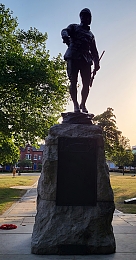
PALMYRA SQUARE IS a delightful rectangular piazza in the heart of Warrington in Cheshire. I use the word ‘piazza’ because the English word ‘square’ includes many squares which are anything but square. The centre of this open space is filled with the pleasant Queen’s Gardens, the Queen in the name being Victoria. It was near the end of her reign that the 2nd Anglo-Boer War (‘Boer War’; 1899-1902), a bloody conflict between the British Empire and the Dutch speaking colonists in what is now South Africa, occurred. In the middle of the eastern half of Palmyra Square there is the statue of a man in a helmet carrying a rifle in his left hand. His right arm points forward, as does his right index finger. The other fingers of his right hand clutch a pair of binoculars. He is wearing knee high boots, standing on a sculpture of a rock, and dressed in an old-fashioned military uniform. As soon as I saw this statue, I guessed (from the style of the uniform) it was connected the Boer War, and when I looked at the plinth upon which the military figure is perched, I discovered that I was right.

The monument was unveiled by General Sir Redvers Henry Buller (1839-1908), in the year before his death. Buller commanded British forces in South Africa during the Boer War. The man depicted on the plinth is Lieutenant Colonel MacCarthy O’Leary (1849-1900). He was killed on the 27th of February 1900 whilst leading men of his regiment (The South Lancashire) during the Battle of Pieters Hill. Richard Danes in his “Cassell’s History of the Boer War” (published 1901) pointed out that the 27th of February was Majuba Day, which was when the British were soundly beaten by the Boers at the Battle of Majuba Hill in 1881. The battle at Pieters Hill, which led to a British victory, facilitated the opening of the road to Ladysmith, which was being besieged by the Boer forces. An informative website (www.alamy.com/stock-photo-statue-of-lt-col-william-mccarthy-oleary-in-queens-gardens-warrington-54385554.html) revealed:

“The Regiment drew many of its recruits from the then-South Lancashire town of Warrington, where Colonel O’Leary was very well known. When the town erected a memorial to the men of the Regiment who died during the war, it chose to feature a sculpture of Colonel O’Leary on campaign in South Africa.”

The statue was sculpted by Edward Alfred Briscoe Drury (1856-1944). Amongst his many other creations is the South Africa Gate on The Mall in London.

The plinth upon which O’Leary stands forever motionless bears a large plaque on which the many members of the 1st and 2nd Battalions of the South Lancashire Regiment, who died during the Boer War, are recorded. These include a few officers and too many men of lower rank. Another plaque records the campaigns in which the regiment was involved. Apart from Pieters Hill, these were: Spion Kop, Vaal  Krantz, Colenso Kopjes, Tugela Heights,  Relief of Ladysmith, Botha’s Pass, Laings Nek; and the occupations of Wakkerstroom, Utrecht, and Vryheid. In other words, they took part in most of the important struggles during the Boer War.

The monument stands in a peaceful square in a small town, once in Lancashire but now in Cheshire, just about 400 yards from the River Mersey. As I stood looking at it during an unusual heatwave when the air temperature was between 35 and 37 degrees Celsius, I wondered how the brave men recorded on the plinth, who would have been encumbered with military equipment and inappropriate uniforms, managed to keep on going during the hot weather that they would have encountered whilst struggling against the Boers in the south of Africa.

The road to Wigan Pier and …

WIGAN PIER WAS made famous by the author George Orwell, who published his “The Road to Wigan Pier” in 1936. Recently, we were staying in Widnes (Cheshire), which is not far from Wigan, a town that was in Lancashire when Orwell wrote his book. So, we decided to see Wigan Pier for ourselves.

A quick glance at a map reveals that Wigan is not on the sea, which is where most piers are to be found. The town is inland, and the so-called Wigan Pier is neither a pier nor on the seaside. It is on a part of the Leeds and Liverpool Canal in central Wigan. It was originally a landing stage where locally mined coal was loaded onto barges.

The name ‘Wigan Pier’ might have originated when a train carrying excursioners to the seaside was delayed at Wigan and they saw a structure that looked like a pier, as the following (from http://www.wiganarchsoc.co.uk/content/Projects/WiganPier.htm#Folklore )  described:

“…not long after leaving Wallgate Station, an excursion train from Wigan to Southport, was delayed on the outskirts of Wigan and passengers saw a long wooden structure that reminded them of Southport Pier. This structure would have been the 1,050 yard long wooden gantry … It was built in the late 1880s and carried a double line of rails from Lamb and Moore’s Newtown Colliery high across the River Douglas, the canal and the Wigan to Southport Railway line, to Meadows Colliery by Frog Lane … It certainly would have been easy to see this wooden gantry from a train heading towards Southport.”

I cannot say whether or not this is the true origin of the name, but it is a good story.

We took a road to Wigan Pier and after going around the town’s one-way system and several roundabouts, passing a huge Asda store a couple of times, we arrived at a series of old warehouses labelled Wigan Pier, and parked next to the canal. The Orwell visitor centre, which we were led to believe existed, is no more. A passer-by, with whom we chatted, told us that any memorials to Orwell and his book had disappeared a few years ago. Likewise, the collieries: these have been closed down long ago. Where they were there are housing estates, factories, and shops.

The warehouses close to where the coal used to be loaded many years ago, were inaccessible. They are being redeveloped to create a leisure ‘hub’. This will include (according to hoardings surrounding the old buildings): a beer tap house; conferences; live music; canal tours; festivals; a food hall; and an ‘artisan deli’. I am not sure what is meant by an artisan deli, but whatever it is, I am sure that should George Orwell ever make his way back along the road to Wigan Pier, he would be truly astonished by it.