Walter and the woodlice at Whiteleys

Painted by Walter Sickert

AT THE TATE Britain, I visited the exhibition of paintings and drawings by the artist Walter Sickert (1860-1942). Amongst these, I was interested to see one which depicts a stretch of the platform at what is now Bayswater Underground station. In Sickert’s time, this station was called ‘Queens Road (Bayswater)’. Painted in 1914-15, this station was the closest one to his then home in Kildare Gardens (off Westbourne Grove). In the painting there is a man seated on a bench beneath an advertisement for Whiteleys. This was a department store, whose history I have described in my book “Beyond Marylebone and Mayfair: Exploring West London”*. Here is a shortened extract:

“Queensway was the home of a large department store called Whiteleys. Created in nearby Westbourne Grove by William Whiteley (1831-1907) in 1863, it moved into its large home on Queensway in 1911. After going through various transformations over the years, eventually becoming a shopping mall with restaurants and a cinema, it closed in 2018 … Since 2018, developers have removed the building’s innards whilst preserving its outer walls. The aim is to create a new shopping area along with a hotel and residential units. The final product might be interesting as its architects are from the team led by Norman Foster.”

Between 1968 and 1970, I was at north London’s Highgate School studying in preparation for my A-Levels (examinations to gain admission to university). One of my subjects was biology. I decided to enter the school’s Bodkin Prize biology essay competition. For some long-forgotten reason, I chose as my essay topic the life of woodlice.  Seeing the above-mentioned painting by Sickert, reminded me of this essay. Being a keen researcher, even in my late teens, I discovered that there was a detailed book on my chosen subject, and this was available for perusal in a science library (the National Reference Library for Science and Invention), which was part of what has now become known as The British Library. In the late 1960s, when I required the book, the library’s collection was housed in a part of what had been the former Whiteleys department store on Queensway. It was a peculiar place: the bookshelves and readers’ desks were arranged on several layers of curved galleries surrounding a circular open space on the ground floor. Above the circular space, there was a spectacular, circular, large diameter, glazed skylight. The book I consulted was in French, and I spent a whole day laboriously translating it and making notes for use later. ‘cloporte’ is the French for ‘woodlouse’, just in case you are wondering. I believe that one visit was sufficient for me to collect what information I needed.

In December 1967, there was a debate about the state of the British Museum Library (now British Library) in the House of Lords. During a long speech, Viscount Eccles (1904-1999) mentioned the library where I had read about woodlice:

“Learned societies and famous men in the arts and the sciences have been shocked by the substance and the manner of the Government’s decision concerning the Library … An example of how the Act works can be seen in what has happened to the National Reference Library for Science and Invention. For years the former Trustees were frustrated by the delays and niggardliness of previous Governments in finding accommodation for this growing section of scientific material, not to mention the disgraceful shilly-shallying over the Patent Office Library. The position grew so desperate that the Trustees decided to gather together part of the material in temporary premises in Bayswater—admittedly very unsatisfactory…” (https://api.parliament.uk/historic-hansard/lords/1967/dec/13/british-museum-library)

I visited the library a year or so after that speech. As for my essay, I won 2nd prize: 15 shillings (75pence) to spend on books, which was reasonably generous at that time. 2nd prize might impress you for a moment until I reveal that I was one of only two entrants. The 1st prize was won by my classmate Timothy Clarke. His older brother, Charles Clarke, not only became Head of School but later served as British Home Secretary between 2004 and 2006.

Returning to Whiteleys, I began visiting it regularly after 1993, when I began living nearby. Then, as described already, it had become a shopping mall. The galleries, which had once served as a library, were lined with shops and eateries, as well as a cinema. But that is all in the past, and what was once Whiteleys is now a building site.  I doubt that Sickert would have been pleased if he were able to see it today.

* My book is available from Amazon:

Throwing light into the darkness and shadows

FOR UNKNOWN REASONS, we were initially reluctant to bother with viewing the exhibition (at London’s Tate Britain until the 18th of September 2022) of paintings and drawings by Walter Sickert (1862-1942). However, I am glad that we did because we got to know and appreciate an artist, of whom I had heard but knew little about. That little which I did know was that for a brief while Sickert had one of the Mall Studios in Hampstead, where years later the sculptor Barbara Hepworth worked and resided with one husband, and then another. Later, Sickert moved from Hampstead to Camden Town.

Sickert was born in Munich (Germany). He and his family moved to Britain when he was 8 years old. His father, Oswald Sickert (1828-1885), an artist, introduced him to the works of important British and French artists, but Walter’s inclinations led him to study acting. However, in 1882 he entered London’s Slade School of Art (at UCL) and he became a student and assistant of the artist James Abbott McNeil Whistler (1834-1903). Soon, he began spending a lot of time in France, where he met Edgar Degas (1834-1917), whose work was to have a great influence on his style.

The exhibition at Tate Britain successfully demonstrates that Sickert was a highly competent artist. His topographical paintings (notably of Dieppe and Venice) are superb, as are the many of his portraits, some of which verge on being impressionistic, on display. His depictions of scenes within theatre show his great ability to portray light and shade. A series of paintings of nude women, some of whom are shown being in the company of often disinterested-looking men in far from elegant clothing, throw light on the shady world of the poor in places such as Camden Town and its environs.

Although some of Sickert’s paintings show features that later would become associated with artists such as the impressionists, Lucien Freud, and Francis Bacon, he is not one of the first artists that springs to mind when thinking about the great artists of the late 19th and early 20th century. Why is this the case? Despite hinting at what was to become common in the works of the Abstractionists, he never broke through the barrier into Modernism as did painters such as Braque, Picasso, Miro, Kandinsky, Matisse, and Mondrian. In no way does this detract from the brilliance seen in Sickert’s work. In a way, he was born too late to be considered as distinguished as those I have mentioned. Considered alongside 19th century artists, he shines. But, although he received many commissions, he was painting during an era when the more adventurous and innovative artists were in their heyday. That said, I can strongly recommend the exhibition at the Tate, which demonstrated to me that Sickert, a master of light and shade, was an artist who deserves much more attention than he gets today.

No park like this in New York City

MOUNT STREET GARDENS in London’s Mayfair was formerly the burial ground of St George’s Church in Hanover Square. Its name derives from Mount Field, where there had been some fortifications during the English Civil War. The burial ground was closed in 1854 for reasons of protecting public health. St George’s Church moved its burials to a location on Bayswater Road, St Georges Fields, which is described in my book “Beyond Marylebone and Mayfair: Exploring West London”. In 1889-90, part of the land in which the former burial garden was located became developed as the slender park known as Mount Street Gardens (‘MSG’- not to be confused with a certain food additive). Small as it is and almost entirely enclosed by nearby buildings, it is a lovely, peaceful open space with plenty of trees and other plants.

The garden is literally filled with wooden benches. Unlike in other London parks where there is often plenty of space between neighbouring benches, there are no gaps more than a few inches between the neighbouring benches in MSG. The ends of neighbouring benches almost touch each other. The result is that MSG contains an enormous number of benches given its small area. And they are much appreciated by the people who come into the park and rest upon them.

Each bench bears a memorial plaque. Many of these memorials commemorate people from the USA, who have enjoyed experiencing the MSG. And most of these having touching messages written on them. Here are just a few examples: “For my children Philippa and Richard, young Americans who may one day come to know this place. Richard L Feigen. 8th August 1987”; “Seymour Augenbraun – a New Yorker and artist for whom this spot in London is his oasis of beauty. From his wife Arlene and family on July 15th 1986”; “To honour a dear brother and sister Ira and Nancy Koger of Jacksonville Florida”; “This seat was given by Leonora Hornblow, an American, who loves this quiet garden”; “In memory of Frances Reiley Bochroch, a Philadelphia lady who found these gardens a pleasant pace”; and “In loving memory of Joe Bleich (1910-1990). An American who could not find a park like this in New York City,”

There are plenty of other similar memorials to Americans on the benches. All of them interested me, but one of them particularly stood out: “To commemorate Alfred Clark, pioneer of the development of the gramophone. A friend of Britain, who lived in Mount Street”. Clark (1873-1950) was a pioneer in both cinematography and sound recording. Eventually, he became Chairman of EMI. A keen collector of antique ceramics, he donated some of his pieces to London’s British Museum.

Not all of the benches are memorials to Americans. There are others to Brits and people from other countries, but the Americans outnumber the rest. Had it not been for the extraordinarily large number of benches in this tiny gem of a park, I doubt that my eye would have been drawn to the commemorative plaques, but having seen the one in memory of Joe Bleich, who was unable to find a park like it in NYC, I was drawn to examine many of the others.

Americans in Mayfair

MY UNCLE SVEN Rindl (1921-2007) was a structural engineer. He was involved in the construction of the building on the west side of Mayfair’s Grosvenor Square, which used to house the Embassy of the USA until recently. About yards south of the former embassy building, there is another place associated with the USA on South Audley Street. Far older than the embassy, this is the Grosvenor Chapel, whose foundation stone was laid in 1730 by Sir Richard Grosvenor (1689-1732), the local landowner. The relatively simple brick and stone church with some neo-classical features was ready for use in 1731. When the church’s 99-year lease ran out in 1829, it became adopted as a chapel-of-ease (i.e., a chapel or church within a parish, other than the parish church) to St George’s Hanover Square.

Until very recently, I had often passed the Grosvenor Chapel when going to and from The Nehru Centre, also on South Audley Street, but had never entered it. Yesterday (26th of August 2022), the doors were open and, being early for a dance performance at the Nehru Centre, I looked inside the chapel. Its interior is simply decorated. The wide nave lies below a barrel-vaulted, plastered ceiling. Galleries supported by columns with Ionic capitals flank the north and south sides of the nave. The chancel is separated from the nave by a screen with openings, each of which is flanked by pairs of Ionic columns. The screen was added by the architect John Ninian Comper (1864-1960) when he remodelled the church’s interior in 1912.Ionic columns with their bases on the gallery support the ceiling of the nave. Windows (with plain glass panes) on two levels, both below and above the galleries, give the chapel good natural illumination. In summary, the simple, white-painted chapel, though not large, feels spacious. Its simplicity is a complete contrast to its neighbour, the flamboyant Gothic Revival style Catholic Church of the Immaculate Conception.

An inscribed stone plaque on the west front of the chapel records its American connection. The words on it are:

“In this chapel the Armed Forces of the United States of America held Divine Service during the Great War of 1939 to 1945 and gave thanks to God for the Victory of the Allies”

The American General Dwight David Eisenhower (1890-1969) was amongst those who worshipped there during WW2. Many years before that, another person connected with the USA, John Wilkes (1725-1797) was buried in the chapel. Wilkes, a radical journalist and politician, was a supporter of the American rebels during the American War of Independence.

America (i.e., the USA) has been associated with Mayfair since it gained independence from the British. Its first embassy was in a house in Mayfair belonging to John Adams (1735-1786), who was the first US Minister to the Court of St James (between 1785 and 1788). The embassy’s Chancery moved several times before 1938, when it was housed in 1 Grosvenor Square, now the home of the Canadian High Commission. Thus, during WW2, it was close to the Grosvenor Chapel. The embassy building, in whose construction my uncle was involved, was designed by the architect Eero Saarinen (1910-1961), and completed in 1960. By January 2018, the embassy had shifted from Grosvenor Square to a newly constructed edifice across the Thames at Nine Elms.

Returning to the small chapel, a small note about its name. The place’s website (www.grosvenorchapel.org.uk) explained:

“It retains its title of Chapel because it is not, and never has been a parish church, and its continuing existence is entirely dependent upon the generosity of those who worship here regularly or visit from time to time.”

Seeing things differently

I DOUBT THAT Auguste Rodin (1840-1917) would have ever imagined that a copy of his sculpture “The Kiss” (created 1901-1904) could have ended up being displayed bound up in one mile of string. Situated in the lower ground floor foyer of London’s Tate Britain gallery, that is what can be seen currently (August 2022). The British artist Cornelia Parker (born 1956) decided to wrap-up/tie-up a replica of “The Kiss” as described. You might wonder why. I cannot tell you, but make the observation that we all perceive things differently. And one of the skills that has united artists over the centuries is that they can express to other people the way they perceive and understand the world they observe. Rodin’s bound sculpture stands close to the entrance of an exhibition dedicated to works by Ms Parker, which runs until the 16th of October 2022.

Part of “Perpetual Canon” by Cornelia Parker

The exhibition consists of artworks of varying sizes including visually dramatic installations, each large enough to fill a spacious room in the gallery. All the works are labelled. These labels explain how they were created and the concepts, some of them with political aspects, that the artist intended to express. When I look at works of art, I am primarily stimulated by their appearance and the visceral emotions they evoke in me. I am less interested in the concepts being portrayed and the artist’s explanations. Therefore, amongst the exhibits in the Parker exhibition, it was the installations that both interested me and excited me most.

The installation “Thirty Pieces of Silver” consists of domestic silver plate items that were squashed beneath a steam roller. Each piece is suspended above the ground by fine threads attached to the ceiling. They are arranged in thirty separate groups and lit from above. The shadows of the silver objects are projected on the floor below them. This delicate-looking installation’s name is taken from the 30 pieces of silver, which Judas received for betraying Jesus.

A spectacular installation, “Cold Dark Matter: An Exploded View”, is housed in another room. Parker arranged with the Army School of Ammunition to use Semtex (as used by terrorists) to blow-up her garden shed (filled with tools and other stored objects). Then, all the fragments were recovered, and one by one they were suspended from the ceiling of the gallery in such a way that the ensemble resembles a still from a film made whilst the shed was exploding. In the middle of all the suspended debris, there is a single light bulb shining. This throws the distorted shadows of the blackened fragments onto the gallery’s walls.

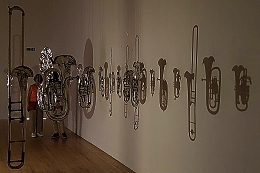
In another room, there was an installation, which also made effective use of reflections projected on to its walls. “Perpetual Canon” consists of a collection of silvered brass instruments, which have been flattened. Each of them is suspended from the ceiling by a fine thread, and they are arranged in a circle which surrounds a centrally located light. The light throws shadows of the instruments onto the four walls surrounding them. Like the two previously described works, this provides a very effective and intriguing visual experience.

Another installation, “The War Room”, impressed me least amongst this category of Parker’s works on display. One of the last rooms in the exhibition houses an installation called “Island”. This consists of a common design of garden greenhouse. Its floor consists of worn floor tiles that used to line the corridors of The House of Commons. The glass panes are covered with white dots made from cliff chalk. They are related to Parker’s reaction to Brexit. Contained within the glasshouse, there is a light whose brightness pulses like that of a lighthouse: increasing gradually, and the slowly diminishing. This causes the shadows of the dots and the frame of the greenhouse to be projected on to the walls of the room containing it. Like the light producing them, the intensity of the shadows pulsates gradually.

As already mentioned, the exhibits’ labels explain what Parker is trying to express. Interesting as that is, it was the visual impact of these installations that impressed me most. Parker, like all great artists, has interesting ideas expresses them most imaginatively and effectively.

The black man’s burden

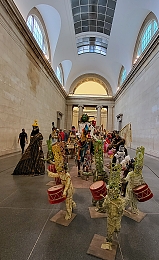
IN 1899, RUDYARD Kipling (1865-1936), who was born in Bombay (when India was under British rule), wrote a poem called “The White Man’s Burden”. The content of this piece was in harmony with the then current idea that the ‘white race’ was morally obliged to ‘civilise’ the non-white races of the earth, and through colonisation to encourage their economic development and ‘progress’. Well, this was an illusion happily believed by most of the colonisers. The reality was that colonisation was not designed to benefit the colonised but to increase the prosperity of the colonisers. The white man’s burden was in truth much more the burden which had to be borne by the non-white races, which were colonised. This is beautifully characterised in an art installation, “The Procession”, on display in London’s Tate Britain until the 22nd of January 2023. Conceived and created by the Guyanese-British artist Hew Locke (born 1959 in Edinburgh), I have seen it twice so far, and loved it each time.

“The Procession” consists of a large number of models of people dressed in colourful and fantastical costumes. They are arranged as if they are taking part in a carnival or parade. Many of the models appear slightly grotesque or even menacing. If these models were real people, they would inspire awe and maybe fear. Some of them carry banners, others carry skulls, and there are some supporting poles from which objects are either suspended, or on which objects are supported.

There are banners in the procession. Some of these depict colonial dwellings and institutions. Others show enlarged photographs of company share certificates and financial bonds. Some of the characters in the parade wear clothes on which these old-fashioned records of financial investment are printed. Thus, the artist has portrayed the fact that success of the investments of the European and American colonists and their backers rested on the shoulders of the hard-working black colonial subjects, who derived few if any benefits from their labour.

“The Procession” is not only a highly original way of conveying the unfortunate history of colonization, but also a feast for the eyes. It is both a reminder of Britain’s not always too glorious colonial past, as well as a celebration of the cultural diversity, which this country enjoys. The installation is housed in the magnificent neo-classical Duveen Galleries (opened in 1937), whose design is derived from architecture characteristic of the ancient imperialist regimes, which dominated the Mediterranean many centuries ago. Was it accidental or deliberate to place an essentially anti-imperialist exhibit in rooms that evoke an imperial past and by their immensity dwarf the exhibits? Whatever the answer, this is an exhibition for which it is well-worth making a detour.

Living beside the flowing stream

THE RIVER BRENT is a major tributary of London’s River Thames. It has two main sources: one, which feeds into Dollis Brook, is west of Barnet; the other, which feeds into Mutton Brook, is near East Finchley. As a child, Mutton Brook figured amongst the places where I used to play with my friends. It flows through Hampstead Garden Suburb (‘HGS’) where I lived during the first three decades of my life. In those far-off days, I had no idea that the then rather malodorous, winding Mutton Brook flowed into the Thames. Mutton and Dollis Brooks merge to become the Brent near Golders Green. The Brent flows through northwest and then west London to reach its junction with the Thames at Brenford, an interesting place, rich in history, described in my book “Beyond Marylebone and Mayfair: Exploring West London”.

The cafe in Pitshanger Park

On its way to the Thames, the Brent skirts another garden suburb, Brentham Garden Suburb (‘BGS’), which, like HGS, was an attempt to create a leafy residential Utopia. They were built at roughly the same time. The northern edge of BGS borders Pitshanger Park, through which the Brent winds its way towards the Thames. The name of the park derives from the Putelshanger or Pitshanger family, who occupied the area in the 13th century. The manor occupied the area between Hanger Hill and the Brent. Until 1908, when it was demolished, the manor house (and its antecedents), known as ‘Pitshanger farmhouse’, occupied a plot on the present Meadvale Road, which runs along the northern edge of BGS. This building was completely different to Pizhanger Manor near Ealing Broadway, which was built by John Soane (and is described in my book).

Pitshanger Park is laid out on what used to be part of the grounds of Pitshanger farmhouse. BGS was built on another part of that same estate. The park is adjacent to Ealing Golf Course. Both were already in existence by 1912. The Brent also runs through the golf course. While we were visiting the park, we watched two men leaning over the bank of the river, rather ineffectually attempting to recover a ball from the weeds growing beside the water.

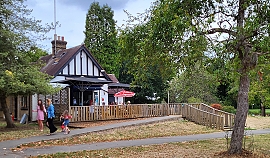
The park consists mainly of spacious grassy meadows that are bordered to the north by dense bushes and trees lining the bank of the Brent. Amenities offered in the park include, tennis courts, outdoor exercising equipment, and an attractive children’s play area. Housed in a small building with fake half-timbering, there is a small café with a terrace on which there are tables and chairs. The ‘caf’ offers hot and cold drinks and a few snacks. Its staff are pleasant, and the washrooms were clean.

While Pitshanger Park cannot be classed as one of London’s more exceptional open spaces, it is a wonderful amenity for residents in the area, just as was (and still is), the public gardens in HGS through which Mutton Brook flows.

Built during a time of war

FROM THE OUTSIDE, the church of St Barnabas in Pitshanger Lane (Ealing) is not particularly attractive. Even though we visited it on a Sunday, it was locked up. However, we were fortunate to meet a lady, who had been in the church hall and happened to have the key to the church with her. Kindly, she unlocked the edifice, and we were able to enter. The church’s interior, unlike its exterior, is wonderful.

The church stands close to Brentham Garden Suburb, which was built largely between 1901 and 1915. I will write about the Suburb at a later date, but now I will concentrate on the church. Although the Suburb was built with a magnificent club house, there had been no plans to include a church. In 1907, a temporary church made from corrugated iron sheets, and dedicated to St Barnabas was constructed at the junction of Pitshanger Lane and Castlebar Park. Eventually, it was too small to accommodate its congregation in an area where plenty of housing was being constructed. For legal reasons, it was not possible to build a larger church on the site. So, in 1911 a larger plot was acquired at the corner of Pitshanger Lane and Denison Road (one of the streets within the Garden Suburb).

Ernest Shearman (1859-1939) was the architect chosen to build the larger St Barnabas Church, which can be seen today. After working in Buenos Aires and later at Sandringham, he moved to Winchester in 1907. From that year onwards, his work was mainly concerned with designing churches. According to a book by Hugh Mather about the centenary of the church of St Barnabas, all of Shearman’s churches:

“…are tall imposing buildings without spires, and their austere, simple architecture was designed so that elaborate furnishings and other adornments could be added subsequently …”

His churches represent “… almost the final flowering of the last phase of the Gothic Revival.”

All except one of his churches demonstrate Shearman’s fascination with rose windows and elaborate tracery. St Barnabas is a fine example of this.

The construction of the church began just before the start of WW1, in June 1914. It was completed in the middle of the war by June 1916, when it was consecrated.

The church has a spacious nave, which has a lovely timber ceiling. Although it was designed to reflect the heritage of the gothic era, the inside of the church feels almost contemporary. There is an enormous organ at the west end of the church. Made in 1851, it was made by the company of William Hill and  originally housed in St Jude’s Church in Southsea. It was moved to St Barnabas in 2011. Some of the pipes on the south side of the central tall organ pipes do not make sounds. They were added to the organ for purely aesthetic reasons. The current organ replaced an older, less reliable instrument, which was removed in 2010.

The apse is adorned by a large painting by James Clark (1857-1943), who was living in Bedford Park not far from the church when he created it. He was one of many artists residing in Bedford Park, which was an ancestor of the Garden Suburb movement. His painting in the apse depicts the three hierarchies of angels praising and adoring the Holy Trinity. It is a magnificent addition to the church.

As we did not want to delay the lady who opened the church for us, we did not have sufficient time to examine its interior in great detail, but it did demonstrate how wrong it was to, to rephrase a well-known saying, to judge a church by its cover.