Unknown's avatar

About yamey

Active author and retired dentist. You can discover my books by visiting my website www.adamyamey.co.uk .

Fishermen at Mandvi and entering Pakistan

Fishermen from Gujarat in India risk straying into the waters off Pakistan

yamey's avatarGUJARAT, DAMAN, and DIU

Mandvi

The picture shows dogs resting in the shade provided by a beached fishing vessel in the estuary of the River Rukmavati at the town of Mandvi in the former Kingdom of Kutch, now part of Gujarat.

Nearby, there were many similar fishing boats, all manned by Muslim seamen. These boats sail into the Gulf of Kutch, a piece of water that separates most of Kutch from another part of Gujarat, Saurashtra (or Kathiawad). 

The vessels are allowed to sail as far west as Okha, but no further as they would then stray into Pakistani water. We were told that there is quite a good deal of smuggling between the Indian and Pakistani fishermen. The Indians have to be careful because they might be arrested in Pakistani waters, as a recent newspaper report  reveals:

“A group of 100 Indian fishermen Monday crossed over to the Indian side through 

Attari-Wagah border after…

View original post 117 more words

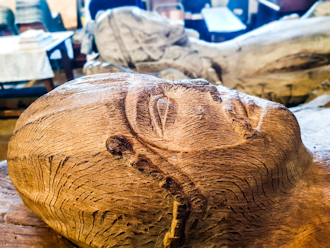
A carved Crusader

A life no longer,

Remember’d in timber:

Farewell, Crusader knight


14th century wooden effigy in church at Paulerspury in Northamptonshire, England


For more information about this rare mediaeval carving, see: History of Paulerspury

website from which this information was extracted:

Under the arcade between the chancel and the north chapel, on a freestone tomb panelled with cusped ogee blind tracery enclosing shields, are wooden effigies of a lady (c. 1340) and an armoured man (c. 1346-9), now placed side by side but not necessarily originally associated with each other. The male figure may represent Sir Robert de Paveley.  The monument was restored by Frederick H. Crossley of Chester in 1920, following a report on its condition by the S.P.A.B. in 1915

Green crime

plant


I am no gardener, but I enjoy garden, plants, and flowers. When I lived in Kent, I had an enormous garden, which I filled with shrubs because someone advised me that they needed little care and attention. This was good advice.

There was a strip of earth next to where I parked my car at night. I filled this with various shrubs that needed almost no care. One of these plants was a very slow growing conifer, which looked like a miniature Christmas tree. It grew close to where I entered the driver’s door of my car.

One day, I noticed that this tiny tree was no longer in its place. It had disappeared. I thought that maybe it had died and rotted away. After that, I thought little if anything about the missing plant. Where it grew was soon covered with foliage from the neighbouring fast-growing shrubs.

Many weeks later, a uniformed policeman visited my house and asked me if anything, such as garden tools or plants, had gone missing from my land. At first, I thought that this was an odd request. Then, I remembered the mysterious vanishing of my small conifer. I told the policeman about this. Then, he told me that there had been a garden thief operating in the area and the police were collecting evidence.

I told the policeman that I could not believe that my tiny plant could have been of any value for a thief. He explained to me that plants are valuable, and that the maturer they were, the greater their value. I was amazed that there was such a species of criminal as a plant thief.  But, since then, I have heard it is quite common, especially amongst respectable looking visitors to horticultural gardens such as Kew Gardens.

Well, as the saying goes: ‘you learn something new everyday’

Keeping fit

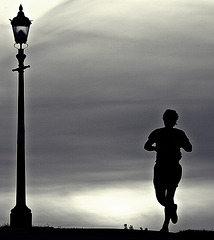
Evening jogger_240


While I was engaged to my wife, she suggested that I join her at her health club and try some of its facilities.

The first time I went, I decided to go swimming. After swimming two lengths very slowly, I managed to climb out of the pool, exhausted and breathless.

For the next visit, my wife-to-be suggested that I try a session in the sauna. She thought it would do me good and would  not be particularly exhausting. I removed most of my clothes and sat alone in the poorly-lit sauna room. After a few minutes I began feeling cold, and started shivering. Fed up with this miserable experience, I left the sauna, and got dressed. The sauna had not been switched on!

Undismayed by this, I decided to give the sauna another try a week later.  This time it was switched on, and steaming hot. Because my first visit had been so boring, I decided to take a magazine into the sauna to read to pass the time. I took my place on a bench alongside some very muscular men and opened my copy of a glossy BBC clasical music magazine. Within minutes, the glue holding my magazine together melted. Numerous pages covered with fascinating information about classical music floated gently downward on to the floor of the sauna, Sheepishly, I recovered some of them, and then hurried out of the sauna.

“Why not try the exercise cycles next time? ” my wife asked. “Good idea,” I replied reluctantly. So, a week later, I sat in the saddle of an exercise bike. My wife was seated on a neighbouring cycle pedalling away while reading a book resting on the handle bars. The third cycle in the room was being pedalled furiously by a man lstening to his Sony Walkman through a pair of headphones. Meanwhile, I was just trying to move my cycle’s pedal … completely unsucessfully. After a few minutes, I abandoned the cycle, and after that I have never bothered with health clubs again. 

“That’s a pity,” you might think.

But, maybe not, as I will explain.

When I was practising as a dentist, quite a few patients, often young men, used to limp when they walked into my surgery. Almost everyone of them had injured knees or tendons whilst playing football or running, or trying to keep ‘fit’. When I saw them, I thought how lucky I was that I did not become addicted to ‘keeping fit’.

Two heads, two cities


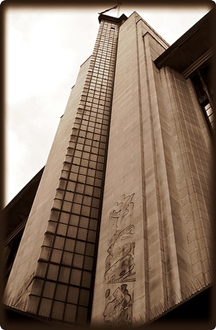
Ever since my interest in Albania began in the 1960s, I have had a fascination with the use of the double-headed eagle as a symbol. It appears in many places including the Albanian flag. Far less commonly used than single-headed eagle, the symbol has been found on ancient Babylonian archaeological remains dating from roughly 3000 to 2000 BC.

A few days ago, while I was visiting an exhibion (of works by Ruskin) in London, I spotted a man carrying a bag with the badge and letters in the photo above. I suspected that the letters above the double-headed eagle were Greek, but I did not know what they stood for. I asked the man, who turned out to be a Greek from Thessaloniki (Salonika). He told me that the badge and letters were the logo of a football team based in Thessaloniki.

PAOK stands for ‘Panthessaloníkios Athlitikós Ómilos Konstantinopolitón ‘, which means ‘Pan-Thessalonian  Athletic Club of Constantinopolitans’.   The club was founded  in 1926 by Greeks who had fled from Istanbul (Constaninople) following the tragic population exchange that began in 1923 after the Greco-Turkish War (1919-22). During this exchange, Turks living in Greece were deported to Turkey, and Greeks living in Turkey were deported to Greece. Over 160,000 ethnic Greeks from Turkey were resettled in Thessaloniki.

Some of the Greeks who had been evacuated from Istanbul established the PAOK in 1926. The team has two nicknames, translated as ‘The Black-Whites’ and ‘The double-headed eagle of the North’. Why did PAOK choose the double-headed eagle? The answer might lie in the fact that since the early Middle Ages this symbol was used occasionally by the Byzantine Empire, which had its headquarters in Constantinople, from where the founders of the team originated.

Fryers delight

FISH


Sometime during the summer in the early to mid-1980s, when I was living in Kent, two young people came to stay with me from land-locked Hungary. Because travelling opportunities were limited and money was short in the Communist country, people did not travel abroad as much as people in Western Europe. My two guests had never seen the sea, except in photos and on the TV or cinema screen.

One evening, I drove my guests to the Kent coast to see the sea. We parked by a beach. As soon as we had stopped, the two lads leapt out of my car and ran into the sea fully clothed. That is how excited they were to see real waves and the sea.

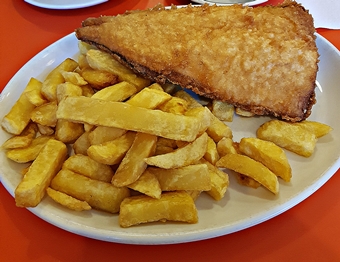
After experiencing the sea, they asked me about ‘fish and chips’, which their English teacher in Budapest had mentioned. We walked to a nearby fish and chips shop and placed an order. When the fillets of fish arrived wrapped in crisp golden batter, my friends looked at them, wondering whether or not they had been served pieces of fish. They had never seen fish prepared like this before.

Fish prepared, fried and covered with batter, as it is served in British fish and chip shops is actually not a dish of British origin. According to that mine of knowledge Wikipedia, it was the Sephardic Jews, who settled in the UK from the 16th century onwards, who introduced fish prepared this way. Alexis Soyer (1810-58), the famous 19th century chef wrote in his A shilling cookery for the people, published in 1854:

There is another excellent way of frying fish, which is constantly in use by the children of  Israel … In some families … they dip the fish, first in flour, then in egg, and fry in oil“, which is more or less what happens in a fish and chips shop. 

This leads me to the real subject of the article: a reccommendation. There are many highly-rated fish and chips shops (‘chippies’) in the British Isles. The ‘Fryers Delight’ is one of them. This unpretensious shop, whose decor seems unaltered since the day it opened back in in 1958, serves excellent fish with superb chips cut in the shop’s kitchen, all fried in beef dripping. I have eaten there twice, and look forward to my next visit. The staff are friendly, and the prices are very reasonable and the food is good value for money. 

The FRYERS DELIGHT, which is open from noon to 10pm every day except Sunday is located at:

 19 Theobalds Rd, Holborn, London WC1X 8SL

Adding up

CALCULATOR

When I was at high school in the second half of the 1960s, I studied, amongst other things, maths, physics, and chemistry. All of these subjects require calculation, sometimes quite complicated. There were no pocket calculators and few computers accessible to schoolkids in those days. 

For complicated calculations, we had to rely on working out the arithmetic with pen and paper, or with tables of logarithms, or using slide rules. Today, you would find it difficult to buy either a table of logarithms or a slide rule. By the way, calculating with the latter required one to make an estimate of the answer to ascertain which power of ten the anser should be. For example, should it be in the hindres, thousands or hundreds of thousands? Also, when making divisions using slide rules, there were almost always two possible answers, only one of which was correct. A rough estimation done on paper or in one’s head, would determine which of these two was the right one. 

If you are getting lost already, stop worrying because this will not get more complicated.

In the late ’60s or early ’70s, pocket electronic calculators entered the market place. At first, they required enormous pockets and pockets filled with money because they were quite expensive. Well, they were certainly beyond my means.

In late 1973, I began working in a laboratory with a view to collecting experimental data to be submited eventually in a PhD thesis. One of the other PhD students in our laboratory came from Kuwait. He would travel there occasionally to visit his family. When he returned from one of his trips home, he brought me a wonderful gift. It was a Casio pocket calculator. Reading this today, you will probably think that was a lousy thing to give, as you can go into shops all over the place and buy a pocket calculator for a very modest price, maybe no more than the cost of a packet of cigarettes. However, when I received my Casio, it was a very precious gift both financially and in terms of labour saving.

And, now one does not even need to buy a calculator because there will be one installed in your mobile telephone. I suppose this is progress. However, progress is a word I do not like to use because in medicine a ‘progressive’ disease is one that continues to get worse, often leading to death.


Picture taken at Russell Market in Bangalore, India