Unknown's avatar

About yamey

Active author and retired dentist. You can discover my books by visiting my website www.adamyamey.co.uk .

Hair today, gone tomorrow

HAIR


The fastest haircut that I have ever had was in San Francisco (USA) in early 1995. The barber shop was staffed entirely by Chinese men, who were playing cards, maybe gambling, when I entered. Six minutes later, with my hair beautifully cut, I had already paid my bill. The barber could not wait to get back to his card game.

The slowest haircut that I have experienced (or, rather, endured), was in London. My wife suggested that I tried a salon near Holborn, which was also a training centre for budding hairderssers. For a modest fee, a student would cut one’s hair under the watchful eye of the professional hairdressing teacher. I was not against the idea as I had once had an excellent student cut at the London School of Fashion.

I don’t know whether the man allotted to practice on my hair was a complete novice or extremely nervous or just totally incompetent, but the experience was tedious to say the least. The appointment begun at 2 pm and was supposed to finish by 5 pm.  Throughout the afternoon, my student seemed to do little more than gather up swathes of my hair in his comb and then contemplate them. Very occasionally, he would snip a few strands of hair without much conviction. The afternoon wore on. 

By 4.45 pm, when all the other haidressing students had completed their tasks, my hair was much the same as it was at 2 pm. The teacher wandered over to me, pushed the student out of his way, and completed my haircut very competently by 5 pm.

Since then, I have had one more supervised student, which was performed by a very competent student, but she took much longer than an experienced hairdresser. Even if I have to pay more, I prefer my ‘short, back, and sides’ to be performed as rapidly as possible. 

Wasting time by the pool

Pool side_240


My parents, like many other parents, wanted me to learn to swim. I was a reluctant learner. The reason was I could not believe that if I took my foot off the floor at the bottom of the pool or the sand beneath the sea, I would not sink like a stone. I could watch others swimming, but could not understand how they could do it and how much they enjoyed it.

Almost every Saturday morning, I used to be taken to one pool or another to get private swimming lessons. Year after year, these produced no results. I could not learn to swim. My parents must have spent a small fortune on these fruitless swimming lessons.

At school, we were taken to a public swimming bath at least once a week  during the Summer Term. The teachers supervising us were uninterested in those, like me, who were unable to swim. We were told to remain at the shallow end of the pool and not to move from there. This happened both at my primary school and also at secondary school.

Eventually my parents learnt of a Mr Brickett, who gave swimming lessons on Saturday ornings at the YWCA, which used to exist in Great Russell Street near Tottenham Court Road Underground Station. The red brick building still stands, but now it serves another purpose. 

Mr Brickett had a system that involved the pupil wearing an inflatable buoyancy arm-band arround each upper arm. Each armband had two separate inflatable chambers. With these fully inflated, I became convinced that I could make it across the pool without my feet touching the bottom. Each week, Mr Brickett would inflate the armbands a little less than the previous week, and then the pupil would be encouraged to swim to and fro across the pool. After a few weeks, I swam across the pool wearing my armbands. When I had done this, Mr Brickett revealed to me that he had not inflated the armband at all and that I was swimming without their assistance.  As I trusted Mr Brickett, I removed the bands and under his watchful eye I swam across the pool unaided. For this, I was awarded a certificate with my name and a Union Jack flag on it. It certified that I had swum 10 yards unaided, under my own steam.


I hardly ever swim any more, but I used to enjoy it a little bit, especially in the sea. I am glad that my parents persisted with the lessons, but regret that my slow progress led them to waste so much of their spare time by the pool.


Taking the plunge


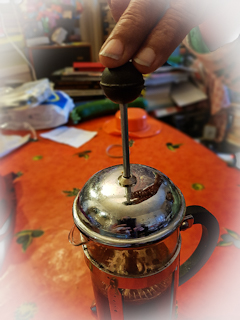
The cafetière (or ‘French press’ or ‘coffee plunger’) has been around for 90 years. It was first invented in 1929. It achieved popularity in England much later. I remember my mother bought one in the 1960s. It was then a ‘trendy’ way of making coffee. My mother used this device to make coffee for some time until one evening something awful happened.

Her brother-in-law, my uncle, was preparing coffee in a cafetière one evening, when suddenly the plunger, which usually needs some pressure to force down the coffee beneath the filter, suddenly shot downwards very quickly. As it did so, boiling hot coffee shot up and burnt my uncle’s hand and arm extremely badly. After this unfortunate accident, my mother, who was a very cautious and safety-conscious person, abandoned using her prized plunger, and reverted to making coffee through conical filter papers.

Although my mother would never use a cafetière again, I continued to do so. Many years after her premature death, I had a strange experience whilst plunging the coffee after feeding dinner to some guests. My wife had filled the cafetière vessel and had left the coffee to ‘infuse’. It was my job to take the plunge so to speak. I pressed down the plunger cautiously. It was harder than usual to press it. The plunger descended a little, but when I removed my hand it began rising. I pushed it again, getting it down a little further, but again the plunger rose up towards its staring position. I kept repeating the procedure, and each time the plunger rose a little. Eventually, I managed to get the plunger to remain near the base of the coffee container, and I poured out the coffee into cups.

I was mystified by our plunger’s abnormal behaviour.

After the guests had left, I opened up the cafetière to clean it. Beneath the plunger amongst the compressed coffee grounds, I disovered the reason for the odd phenomenon. Hidden amongst the dregs of the coffee there was a stainless steel tea spoon. Its previously straight stem had been gradually bent into a U-shape whilst I was trying to press down the plunger. What amazed me when I thought about it afterwards was that it was lucky that the glass vessel was tough enough to withstand the pressure exerted by the spoon on the glass while I was inadvertantly bending it.


Looking for something?

Archive


I write a great deal in my spare time. Apart from blogs like this one, I write books about subjects that require a considerable amount of research. I have a British Library (‘BL’) reader’s card, which gives me access to an unbelievable collection of material. However, even though I live not far from the BL, it is quite time-consuming getting to and from the material inside the library. Apart from security checks at the BL, one must leave many items, which are forbidden in the reading rooms (e.g. food, drink, all kinds of writing implements apart from pencils), in a locker in te basement. Once in the reading rooms, the BL becomes a joy to work in.


Over the years, I have been using another kind of library. It is on-line, and is reached by typing https://archive.org/ . Using its superb search engine, you can explore its collection in many ways, such as by author, by title, by keywords, etc. What comes up, if you are lucky, is a set of scanned volumes of relevant books or pamphlets. By clicking on an item, you are given the option of downloading it (.pdf, Kindle, and other formats), reading the scanned book using a very practical online reader, or reading a typed transcript of the entire text online. If the item is one you need, it is a lot easier reading it via this website than having to ‘schlep’ to the BL. This is especially the case if you do not live in London.


If you have not come across this website and you are looking for texts published long ago and not so distantly, head for archive.org, and give it a try!


My picture is part of a screen-shot of a page of results from archive.org


A palace in Kutch

A painting in London brings back memories of a wonderful trip to Gujarat…

yamey's avatarGUJARAT, DAMAN, and DIU

VARSHA blog size

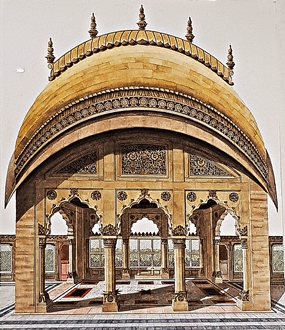
Varsha Bhatia, whose family originated in Kutch, trained as an architect in Bombay. Now, she has become a painter, specialising in water colours. Her delicately executed, finely detailed works display her appreciation of the asethetics of architectural masterpieces.

Following a recent visit to Kutch Mandvi, she has painted a pavilion that is perched on the roof of the Vijay Vilas Palace built by the Maharao of Kutch in a traditional Rajput style during the 1920s . 

My wife and I visited this lovely palace during 2018. This extract from my book Travels through Gujarat, Daman, and Diu describes what we found:

A notice on a wall near the main entrance reads: “Tides come and go but the legend here of sheer enchantment continues unabated”.  On entering the palace, we saw a large banner which exclaimed: “Welcome to palace and experience history which is housed within.” The walls of the…

View original post 265 more words

Time zones and … O Juice

clock


I am writing this on the 30th of March,  the day after that on which the UK was scheduled to leave the EU, but did not. This day, Saturday,  is in the last weekend of March. Early on Sunday morning, we shift from Greenwich Mean Time to British Summer Time, by advancing our clocks by one hour.

In late 1994, while we were on holiday in California, we decided to drive over to the State of Arizona to see Lake Havasu City. After London Bridge was dismantled in 1968, its stones were carefully labelled and sent to Lake Havasu City, where it was reconstructed. By 1971, the bridge had been re-built in a picturesque lakeside position where it has become one of Arizona’s major tourist attractions.

After settling into a motel, we wandered over to a restaurant. For the duration of our evening meal we were the only diners. I ordered ‘New York Steak’, which turned out to be strips of beefsteak. Soon after taking our order, the waitress returned and asked: “D’ya want it with or without O Juice?”

I had never heard of eating steak with orange juice, so I said:

“Excuse me, what did you say?”

She replied, slightly impatiently: 

“O juice, you know kinda gravy.”

What sounded like ‘O Juice’ was the waitresses attempt to pronounce the French culinary term ‘au jus‘.

After eating our meal, it was only eight o’clock. We asked the waitress where were all of the other diners and why was she clearing all the tables and stacking the chairs, getting ready to close the eatery.

“It’s  getting late you know”

“But it’s only eight,” we retorted.

“Nope, it’s nine,” she informed us.

We had not realised that by crossing from California to Arizona, we had moved into a time zone one hour ahead of California.

With a baby in Belgium

baby seat


Young parents sometimes ask my wife and I when it is safe to take their baby abroad for the first time. Why they ask us is a mystery. We are not experts on child care. Our experiences in this field are confined to our only child, our daughter.

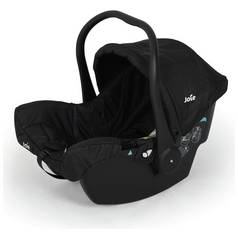
We first took our daughter abroad when she was six weeks old. We went on a driving trip from London to Belgium and Holland. After about an hour driving through northern France, our daughter began crying plaintively and continuously. We stopped, removed her from the baby seat, fed her some milk, and that brought the complaints to an abrupt end. At that stop, both my wife and I had separately thought that  we were not too far from home to turn back and abandon our trip. Neither of us expressed this thought verbally when we stopped, but later we discovered that we had had the same idea.

Several hours later, we arrived at our destination, Damme, which is close to Brugge (Bruges). After settling in the hotel, we  found a restaurant nearby. It was Saturday night. The restaurant occupied a long room. There were tables on both sides of a corridor that ran the length of the room. Most of them were occupied by frumpy-looking, late middle-aged, middle class Belgian couples, none of whom seemed to be having fun.

Soon after we settled at our table, our daughter began crying. She was hungry and my wife wanted to breast-feed her. She asked the head waiter whether there ws somewhere secluded that she could breast-feed. The waiter pointed to a back room. When my wife stood up, the hitherto silent and rather glum Belgian diners became animated. They told us that they did not want the baby to leave them. From that moment onwards, all of the diners cheered up and became lively, firing us with questions and advice about our tiny daughter. It seemed that our arrival was the best thing that had happened to them for many a year.

A few months later, we took our child to India, and that was also a successful trip. So, if you are crazy enough to ask my advice (based on a sample of only one) about travelling with a baby, my answer would be “go for it.”


Picture from argos.co.uk