Unknown's avatar

About yamey

Active author and retired dentist. You can discover my books by visiting my website www.adamyamey.co.uk .

FIRST DAY DAWDLING IN DARJEELING

ISTANBUL AND GJIROKASTER (in Albania) share something in common with Darjeeling. The three places have no shortage of extremely steep inclines. However, Darjeeling beats the other two in steepness. Its footways and streets often seem almost vertical. The thoroughfares are so narrow in many places – wide enough for only one car, and as few of them are one way streets, Darjeeling’s drivers have to be skilled in reversing long distances along them. Driving difficulties are compounded by the oft appalling road surfaces, the steep drops along edges of some streets, and deep gutters.

The Mall and Chowrasta (a square where four roads meet) are vehicle free pedestrian precincts. Some of the buildings in this area are over 100 years old and recall the ‘heyday’ of Darjeeling, when it was a high altitude resort for British colonialists. One of these old structures houses the well stocked Oxford bookshop. It specialises in books about the Himalayas, tea, and natural history.

Two long straggling bazaars start at Chowrasta: the Mall Market that is under a fabric roof supported by bamboo poles, and the Mahakal Market. The latter runs along a path which overlooks a lower part of the town. The Mahakal Temple and a Bhuddist temple perch atop Observatory Hill. These can be reached by walking up a very steep winding path, which was lined by mendicants soliciting alms, often pitifully.

We ate lunch in the very popular Kunga restaurant, which serves Chinese style food. One visit there is enough for me. The restaurant is near a large Victorian gothic edifice with a tall clock tower. Built in 1850, this used to be Darjeeling town hall.

Our quest for a Samsung service centre led us down a long, perilously steep pathway to the busy Chauk Bazaar area. This typical bustling bazaar divided into areas that specialise in one line of business, be it, for example, vegetables or tailoring or sweetmeats or shoes, is laid out higgledy piggledy on an area of level ground that is large by Darjeeling standards.

A taxi conveyed us at great speed up steep winding streets to the huge Sinclairs Hotel where our new friends from Lincolnshire kindly offered us sundowners – well, the sun had actually set long before we reached them.

Returning to our lovely homestay, our young driver forced his poorly powered tiny Suzuki Maruti car along some absolutely appalling roads, which reminded me of some of the worst byways I have experienced in rural Albania and off the beaten track in South Africa.

Toy Train to Darjeeling

My mother’s father, who died young in the early 1930s was Mayor of Barkly East, a small town in the Eastern Cape (South Africa). He was the driving force in bringing the railway over the mountains from Lady Grey to Barkly East. This was the most expensive (in terms of cost per mile) stretch of railway ever built in South Africa. It included a series of switchback stretches to allow the trains to ascend or descend the steep mountain slopes.

Today we travelled on a narrow gauge mountain railway with at least 5 switchbacks. It is the so called ‘Toy Train’ that runs incredibly slowly between New Jalpaiguri and Darjeeling which is in the foothills of the Himalayas, more than 2000 metres above sea level.

We took almost two hours to travel the first about three miles. This was mainly because of a seemingly interminable wait for a signal man to arrive to allow our train to cross a river near Siliguri. Soon after we began moving, we passed tea gardens and began our several hour slow ascent towards Kurseong, Ghum, and Darjeeling.

The train follows the route of NH55, crossing over it frequently at unguarded level crossings. The serpentine course of the railway is designed to lengthen its route in order to reduce the gradients that need to be tackled.

The wheels squeal and shriek as the carriages wind around the tight curves of the tracks. The engine’s horn blasts very frequently to clear the path for the train.

The views from the train are spectacular. The carriages pass extremely close to buildings, plants along the side of the track, and steep drops. Passing through towns on the route, sometimes we were so close to shops beside the track that it would have been easy to snatch goods from them. Leafy branches sprung through the open carriage windows, shedding leaves and flowers.

The flora along the route was very varied. We passed a multitude of colourful flowers including magnificently exuberant poinsettias.

Because of our slow start we travelled the last three and a half hours in darkness as the sun set long before we arrived at our destination.

Our enjoyment of this superb railway journey was enhanced by having conversations with a businessman from Bangalore and a couple from Lincolnshire in the UK.

Even though it is very slow, a trip on the Toy Train is thoroughly recommendable.

Misunderstood

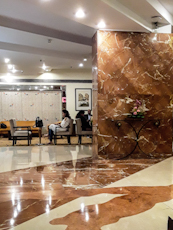
The coffee lounge at Calcutta’s Grand Hotel on Chowringee was closed for cleaning. So, we were advised that we could get coffee at the nearby ‘P.L.S’ café.

We walked in the direction of P.L.S but could not find it. We asked someone, who pointed at a large hotel called ‘Peerless Inn’. This, the locals pronounce ‘P.L.S’!

Pilots

I associate the word ‘pilot’ mainly with aeroplanes. Also, I think of small boats that help larger ones enter and leave ports. There is also, I believe, a creature called a ‘pilot fish’.

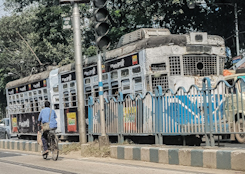
On arrival in Calcutta (now ‘Kolkata’) in West Bengal (India), I noticed that the local city buses have the word ‘pilot’ written on the doors that the bus drivers (i.e. pilots) use to enter their buses.

I am certain that I have never seen the word pilot used to describe a bus driver anywhere else I have visited.

I wonder if you know…

I do not know how many millions of people live in Calcutta, but I know it is well in excess of 14 million.

One day, a friend, M, met us in London. He told us that a mutual friend, D, was married to a woman born in Calcutta. As my wife went to school in that city, M said to her: ” You might know D’s wife.”

My wife replied: “Do you realise how many people live in Calcutta, M?”

Then after a moment, she asked; “What is her name?”

M mentioned a name. Hearing this, my wife answered: “She was a year junior to me at school.”

I thought it was amazing how small the world can seem even when a city as huge as Calcutta is being discussed.

Dinner dates

A few days ago, some friends invited us to visit them one evening. We sat with them for several hours, drinking and eating light snacks. As time passed, my stomach began rumbling and I wondered when we were going to eat dinner. This reminded me of an evening many years ago when I lived in Kent (UK).

Some Americans invited me to dinner. To reach them, I had to drive through the countryside for two hours. When I arrived at about 7 pm, I was offered a sandwich. I refused this, muttering that I would wait for dinner.

Another guest arrived. We sat talking and the time passed pleasurably. However, there was no mention of dinner or any food at all during the rest of the evening. At 10 pm, I began my two hour return journey without having eaten. As I drove home, it dawned on me that the sandwich I had been offered was actually the only evening meal that my hosts were planning to serve.

When I reached home at midnight, starving, I prepared a hasty snack.

On reflection, on the recent occasion, we had visited our friends assuming that we would have a pre-dinner drink before going out to dinner. In reality, they had only invited us for a drink; they had not mentioned dinner.

Moral: don’t assume anything!

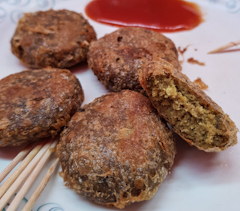
Photo of shaami kebabs

DisCONCERTing

I have attended concerts at BBC recording studios. Before the performance begins, the audience, members of the public, are asked to be very still and silent, so as not to spoil the recording or live broadcast. The audience is politely requested to be so silent that one feels that even the sound of breathing might disturb the event.

With the exception of one western classical music concert in Bombay, audience disturbance is well tolerated at concerts I have attended in India. Pepole arrive and leave the auditorium whenever they feel like. They chat and take photos and often mover from one part of the auditorium to another.

Once, I attended a musical performance that was being relayed ‘live’ on All India Radio. Unlike the BBC recordings and live broadcasts, the audience was far from placid. Throughout the event, there were disturbances as described above, but no one seemed in the slightest disconcerted .

But, all is no longer well with British audiences. Recently, I have been to a few classical music performances in London, at which there has been applause at inappropriate places in the music. An example of this is clapping at the end of a movement of a symphony, rather than at its ending. Maybe, orchestras are getting used to this, but I find it a bit disconcerting.