Unknown's avatar

About yamey

Active author and retired dentist. You can discover my books by visiting my website www.adamyamey.co.uk .

A hidden gem

SOMETIMES, IT PAYS TO BE “ECONOMICAL WITH THE TRUTH”, to rephrase the words used by Edmund Burke in his book “Letters on a Regicide Peace”, published in 1796, in which he wrote:

“Falsehood and delusion are allowed in no case whatever: But, as in the exercise of all the virtues, there is an œconomy of truth.”
HYD 4 real

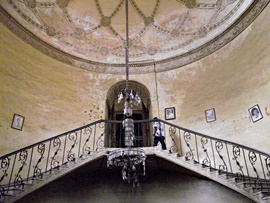
The Residency in Hyderabad was built for the British Resident (for the Princely State of Hyderabad) James Achilles Kirkpatrick (1764-1805) in the style of a Palladian villa in about 1798. As described in an excellent book, the “White Mughals” by William Dalrymple, Kirkpatrick, like many other pre-Victorian Europeans in India, adopted local Indian ways of life. This Resident went so far as to marry (not too publicly) a local aristocratic woman from Hyderabad, Khair-un-Nissa (1786-1813). She remained in purdah and lived in a zenana, a ladies’ quarter, in the garden of the Residency but quite separate from it.  

The Residency was used for its original purpose by British Residents of Hyderabad until India became independent in 1947. In 1949, it became a building within the confines of the Osmania University College for Women (founded 1924).

Having read Dalrymple’s book back in 2011 just before visiting Hyderabad, I was keen to see the Palladian style Residency. With great difficulty our driver (from Bangalore) managed to discover the whereabouts of the Osmania university. We drove up to the gate and were stopped by a security guard, who would not admit us until we revealed (somewhat deviously) that the Director was expecting us. We entered the grounds and found the Director’s office. We suggested to her that I might be a relative of Dalrymple’s and that I was keen to see the building he had written about.


The Director assigned a member of her office team to take us to the old building, adding that it was not wise to enter it as it was in a perilous condition. What we saw, although in a very poor state of repair, was a magnificent, elegant neo-classical building. If it had been in the UK and restored considerably, it would have outshined many of the great houses built in the same era, which are open to the public. Ignoring the advice of the Director, we entered the crumbling structure and viewed its wonderful twin curving staircases and glamorous rooms. Although the place was in a parlous condition, its former glory was still very evident.

We left the former Residency without any of it collapsing on to our heads and feeling very pleased that we had ‘blagged’ our way into seeing this gem hidden from the public.

Foot and mouth

Wales 1 SMALL

Before she died in 2012, we used to make annual visits to a dear friend, whom I had known since my childhood, in South Wales. She used to live in London, but when she retired, she moved to a village in the Brecon Beacons, near the River Usk. We stayed in her cottage but were encouraged to leave her in peace from after breakfast until about four in the afternoon. We did not mind this because there is plenty to explore in the area and often the weather was good at the times of the year that we visited her.

In 2001, disaster hit Wales in the form of a vicious outbreak of foot and mouth disease. In order to prevent its spread, all footpaths and many open spaces were closed to visitors. This and the appalling rain that fell relentlessly during our visit, restricted what we could do while we were allowing our guest a few hours relief from her guests. We drove around the countryside not particularly having much fun.

One day, we arrived at a small town with a name I am unable to pronounce correctly:  Llanwrtyd Wells. It was lunch time. We parked outside a hotel near the town centre. The floor of the lobby was covered with a grubby, well-worn carpet. We were shown into an unattractive dining room. Our hopes for having a decent meal fell as we surveyed the room’s dingy uninviting décor. The sight of incessant rain falling outside did little to enhance the dreary mood that this unappealing room was inducing.

The hotel’s owner brought us menus. We asked what he recommended. He said “steaks” and showed us the large range of meats listed in the menu. We asked his advice about which steak to choose. Then, he did something that transformed the dingy place for us.

He gave us a ‘tutorial’ about the relative merits of different kinds of beefsteak and their tastes. The least tasty, in his opinion, was the costliest cut, fillet steak. Sirloin steak was, he advised us, tastier and cheaper than fillet. However, he considered that the tastiest cut was rib-eye. He explained that the latter was marbled with fine streaks of fat, and it was this that gives it its superior taste. We ordered it and discovered he was right. He regretted that he was unable to serve the local, and in his view far superior, Black Mountain beef. This was because of the problems connected with the foot and mouth outbreak.

Whenever I buy steak, I look for rib-eye first, and if this is not available, I go for sirloin. Whenever I think of beefsteak, I always remember that dreary eatery in Llanwrtyd Wells and its helpful landlord. For a long time, I could not remember in which town in Wales, we were given our tutorial about steaks. Recently, I discovered some photographs I had taken there almost twenty years ago. In one of them, there was a pub sign that read “Neuadd Arms Hotel”. Seeing this helped me discover where we had been.

Onion on top

ONION DOME SMALL

This piece, which is about onion shaped domes on some churches, was inspired by a chance discovery of a photograph of a church (see illustration) that I took somewhere in Slovenia about twenty years ago.

In the summer of 1975, I accompanied my PhD supervisor, Robert Harkness, and his wife, Margaret, both now no longer living, on their annual drive from Buckinghamshire in the UK to Platamon on the Aegean coast of northern Greece. It took about nine days in their Land Rover, which was towing a caravan that was to become their home in Greece for up to two months. Robert, a well-regarded physiologist, was also a keen naturalist as well as being interested in many other things. This excerpt from an unfinished biography of the Harkness’s that I began writing over a decade ago illustrate one of the varied interests that kept Robert happy.

Soon after we left our camping site on the following morning, we crossed the River Rhine and entered West Germany, where we began driving along its Autobahns. After some hours, we spotted the first of the many onion-domed church towers typical of southern Germany.

Robert speculated that there must be a line of places north and west of which it is almost impossible to find onion domed church towers. This idea made him think that there must also be an olive line north of which no olive trees grew, and a ‘karpousi’ (καρπούζι: Greek for watermelon) line below which watermelons grew. Original as this might seem, Robert’s concept of boundaries based on the presence of this or that particular item was apparently proposed earlier by a French author – it might have been Stendhal – who was writing about those nations whose inhabitants favour eating Brussels sprouts.

The leaning tree

LATE 18 leaf

“A PICTURE IS WORTH A THOUSAND WORDS” It is not known exactly when this well-known sentence was first used, but an article in Wikipedia suggests that one of the first times it appeared in print was in an advertisement for a Texan newspaper, the “San Antonio Light”, in 1918. I do not know whether I can write a thousand words to put the attached picture in context, so you will have to make do with what I am able muster.

Just over a year ago, my wife and I were ‘wintering’ in India. We left our daughter looking after our flat in Kensington. One day, she sent us a message informing us that one of the old trees in our street had toppled over in the middle of the night.

The tree that fell always looked precarious as its trunk leaned over the road at quite a sharp angle, making it tricky to park a car next to it. A neighbour told us that it had done so for well over a century. His evidence was that the very same tree can be seen leaning over the road in an old photograph of our street taken about 150 years ago. So, the tree was not inherently unstable.

Many years ago, while walking through woods with my old PhD supervisor (and by then a close friend), he pointed out the variety of shapes and inclinations of the tree trunks around us. He wondered how a tree ‘knew’ how to grow in various directions whilst maintaining a centre of gravity that stopped it toppling over. Clearly, our late lamented leaning tree ‘knew what it was doing as it had been leaning seemingly precariously for at least a century and a half.

After we returned from India, there was a bare patch where the tree had stood for so long. A neighbour, who makes it his business to find out in detail what happens in our small street told us what befell our tree. The local council decided to move the position of the curb and so to widen the pavement around the tree, the idea being to narrow the road at that point and thereby prevent parking next to the tree.

Unfortunately, the workmen assigned to carry out this job managed to cut through part of the tree’s root system. This destabilised the tree, which then fell over across the street. While falling, the tree damaged a first-floor balustrade and terrace on a building across the street. Luckily, there were no human casualties.

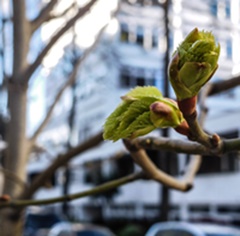
For some months, the site of the fallen tree remained treeless. Then, a small tree with a slender trunk, a sapling, was planted by the council. Day by day, we watched it producing leaves. These changed colour in the autumn, looked sickly, and fell off, leaving a sad looking spindly tree. Then, we spent another winter in India.

When we returned in late February this year (2020), the young tree was still standing and still looking lifeless. As the weeks passed, we were very pleased to see buds forming on its slender branches. These buds have grown in size and are, at last, unfurling to reveal the tiny leaves seen in the photograph.

It is pleasing to see that even in these troubled times, nature has something positive to lift our spirits.

Well, I have reached about 580 words, not quite a thousand. However, as the saying goes, I hope my photo is worth at least a thousand words and is something to enjoy.

Death of an automobile

It is odd how an old photograph can trigger a whole lot of memories, which you thought were long forgotten. This photograph brings back memories of the last hours of one of our motor cars.

I had just had our old Saab car serviced and I asked the dealer how much it would beworth as part exchange for a newer model. I was told £400 would be generous. I was horrified, and said:
“Really? You’re kidding”
“No, Sir, yesterday I was shown a ten year old Jaguar in good nick. I only offered the owner £400.”

I paid for the service, having been told that several quite costly repairs might be needed soon if wanted to keep our Saab on the road. The first of these, and this was a legal requirement, was to replace the four tyres.

We bought four new tyres a couple of days later and set iff to attend a wedding anniversary in Kent. On the way, we stopped at a bonsai tree nursery to see an old acquaintance.

When we returned to the nursery’s car park, our car would not start. All that happened when I turned the ignition key was a whining noise followed by smoke seeping out of the engine.

We called the AA, the emergency breakdown service, and an agent arrived soon. He looked at the problem and came to a rapid diagnosis. I asked him how much it would cost to repair the major problem that had occurred. He said about £400. With that information and the knowledge that other major repairs might be needed in the near future, it was not a difficult decision to scrap our Saab.

That was back in late 2010. Prior to that date, we had used our car to make annual visits to France, where we enjoyed staying at ‘Gites rurales’, rented holiday homes often in picturesque rural spots. I took many photographs on these lovely holidays. The picture illustrating this piece was taken somewhere in France, but as I never bothered to label all of my photos at the time, I cannot tell you where I saw this fine set of doors.

A city reborn

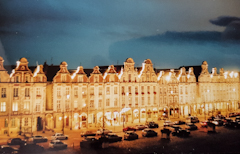
We used to spend a night in Arras in northern France when we made driving holidays to stay in rented houses on central and southern parts of the country.

To casual visitors, such as we were, the centre of Arras looks like a perfectly preserved old baroque city.

Yet, it is not.

During WW1, Arras, close to the front line fighting, was almost totally destroyed. Pictures of the city taken after the “War to End All Wars” resemble pictures of Hiroshima after the atomic bomb was dropped on it.

The reconstruction of the old centre of Arras was so successful that if you were ignorant of its history, you would believe that you are seeing the original city.

By the way, Arras is one of the few places in the rather bleak north of France really worth visiting.

Photo taken about 15 years ago.

What is in a name

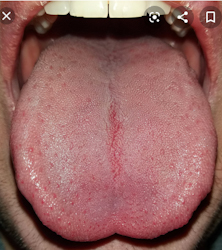
When I was a young child, I used to love eating slices of tongue. It was a cold meat that I really enjoyed. In those days, I never thought about the name of the meat, that is ‘tongue’.

When I was about 10 years old, I put ‘two and two together’ and realised that what I had been eating was once a living animal’s tongue. This realisation put me off eating tongue. I have hardly ever eaten tongue since that discover of what is in its name.

The curious thing is that, with plenty of knowledge of anatomy, I have no difficulties eating, say, liver or pancreas (‘sweetbreads’) or stomach (‘tripe’).

Picture from Wikipedia

Spare time

Now that many of us are being encouraged not to leave our homes unless it is strictly necessary, we have more time to enjoy our immediate surroundings and, maybe, do a little sorting out.

I have been looking through numerous photographs, scattered around our residence in albums or packets provided by the photographic shops that used to develop films and print the images on them. It is a fulfilling armchair journey of discovery.

Gradually, I am posting some of these photos, many of which were taken 20 plus years ago, on the internet. My only regret is that many of them are unlabelled, so that I am not always sure when and where I took them.

The photo attached to this short piece was taken somewhere in Hungary, probably in the late 1990s.

Long lasting

A bunch of flowers

Brings endless happiness

And plenty of  good cheer


Back in the early 1990s when I was practising as a dentist in Kent and owned a house in Gillingham, my future wife and I visited the local superstore, the Savacentre. Its name has nothing to do with the River Sava that meets the River Danube near Belgrade in Serbia. The shopping mall in Kent is pronounced “saver-centre”.

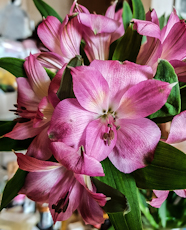
We wanted to buy some flowers and approached a florist within one of the wide corridors of the mall. He had some blooms of a kind we had never noticed before. We asked him what they were, and his answer sounded like “owlstromeriya”.

We bought a bunch of these attractive flowers and asked him how long we should expect them to survive in a vase. He answered:
“No worries there. They’re good lasters.”

And, he was right.

Alstroemeria, or Lily of the Incas, are native to South America but I guess many of those on sale in the UK are grown elsewhere.

A powerful smell

Years ago, before the Berlin Wall was breached in 1989, I was visiting Budapest in Hungary with my friend the author, the late Michael Jacobs (he wrote Budapest, A Cultural Guide, published in 1998). We decided to eat dinner in a large restaurant called the Kárpátia, which was founded in 1877 and is one of the city’s longest surviving eateries.

cheese

The dining hall was very spacious. Its decor is Victorian Gothic revival. Diners are serenaded by a small band. As far as I can remember we ate well, as was often the case in Communist Hungary. One could enjoy the restaurants in Budapest if you were a western tourist, but for most Hungarians, who were low paid, eating in fancy restaurants was way beyond their means.  I remember eating a magnificent lunch at another restaurant and paying less than £5 for a gargantuan spread. When I told my Hungarian hosts that I had been to that place to eat, they could not believe that I was able to afford it. I was going to tell them what good value it was, but held my tongue.

At the end of the meal at the Kárpátia , I decided to try a cheese, which I had never heard of  and was on the menu. It was called Pálpusztai. I ordered a portion, and waited. The doors to the kitchen were at the far end of the large room in which we were dining. Our table was as far from the kitchen as was possible. Before the waiter re-entered the dining hall, a strong pungent odour could be sensed. The smell filled the entire dining hall. It was my cheese. Michael was horrified that first, I was prepared to try it, and then, second, that I liked it. Actually, I like most pungent cheeses. 

Pálpusztai is a cow’s milk cheese, which was first made by Pál Heller of the Derby és Vajtermelő Cheese Company in the 1890s. According to Wikipedia, the bacterium, Brevibacterium linens, that gives the cheese its odour is the same as that found on human skin, which contributes to body odour. Maybe, it was lucky I did not know that when I was looking at the menu at the Kárpátia!