Unknown's avatar

About yamey

Active author and retired dentist. You can discover my books by visiting my website www.adamyamey.co.uk .

Late arrival in northern Greece

FOR SEVERAL YEARS, mainly in the 1970s and early 1980s, I used to join my former PhD supervisor, Robert, and his wife, Margaret, at their favourite camping spot on some rough ground a few yards south of the northern Greek seaside town of Platamon, a few miles south of Katerini. Robert favoured this spot because it contained colonies of a form of desert ant, whose behaviour and ecology he studied. Robert and Margaret followed a predictable daily routine.

After breakfast, which could only be eaten after all had taken a dip in the sea, Margaret usually set up a deckchair or a folding sunbed under the canopy attached to one end of the caravan and began reading one of the huge numbers of paperbacks that were stacked on shelves inside it. When not reading, she repaired Robert’s socks. Throughout the year, she collected his damaged socks, and saved them to mend. It helped fill the long hours at Platamon when there was no one apart from Robert with whom to chat. He was too busy watching and studying the ants to talk to her during the day. This was why she welcomed others, like me, to join them in Platamon. 

Lunch varied little at Platamon. Almost always we ate sliced tomatoes dressed with sweetish vinaigrette. The tomatoes, which were both large and delicious, were bought from the ‘tomato man’. He was a Greek fellow who wandered along the shore with his donkey laden with tomatoes and other vegetables. Robert used to practice speaking Greek with him while he weighed out tomatoes on a hand-held weighing machine. The ‘tomato man’ did not appear every day, but the ‘goat man’ did. He wandered along the shore with his heard of goats, and always stopped to greet Margaret and Robert, who appeared not to mind when the goats stepped all over the area in which he was trying to conduct observations.

After lunch, everyone did whatever they felt like. Margaret sheltered in the shade. Robert, bringing to life the words of the refrain of Noel Coward’s song “Mad dogs and Englishmen …”, continued watching his ants out in the noonday sun. It is curious that these ants, which are so active at the hottest time of the days are referred to by some as ‘Englishmen’.

At about tea-time, we all took another bathe in the sea, which was by then pleasantly warm. Often after bathing and when we had tea and biscuits (just as if we were still in England), we would set off for Platamon in the Land Rover. Our first stop was the level-crossing at the southern edge of the village. There was a water tap close to the road that crossed the tracks that linked Greece to the rest of Europe. We used this to fill the large jerry cans that stored our drinking and cooking water. The water was then ‘sterilised’ by adding generous, but unmeasured, handfuls of small white chlorine releasing water purification tablets to it. Some of these tablets looked quite old to me. I suppose that they must have been effective because none of us ever got sick after drinking this water. During the water collection, Robert practised his Greek with the railway workers who looked after this manually operated level-crossing.

From the railway crossing, we drove into Platamon – or ‘Plat’ as my two friends called it – and parked. Margaret used to make a beeline for the railway station where, if she was lucky, she might discover a single copy of an English newspaper that was usually 2 or 3 days out of date. Few English speakers visited this seaside resort; there was little demand for the English press. Most of Platamon’s numerous visitors came either from Thessaloniki or from towns like Skopje and Bitola in what was then land-locked Yugoslav Macedonia.

Margaret left Robert to do most of the shopping in ‘Plat’. He had his favourite shops in Platamon. Typically, his choice of shop was dictated by the friendliness of its salespeople, which he considered more important than the quality of their merchandise. The three shops that he usually visited in the Greek village were a butcher, a fishmonger, and a grocery store, whose walls were lined from floor to ceiling with what seemed like every conceivable food and household product. One or two of its owners had lived in Australia and spoke English well, but with an odd accent that was neither fully Australian nor fully Greek. Each shop provided Robert with an opportunity to chat in Greek, which he did fluently but with a less than perfect accent. His attempts were much appreciated.

After my first visit to Platamon, I used to join Robert and Margaret there often during my rambles around the Balkans. I used to arrive at Platamon by train, never sure whether they had either reached it safely and/or were still camping in their usual spot.

Once, I disembarked at Platamon station at about 11 pm, and began walking towards the place where I hoped to find my friends. The grocery that Robert patronised was still open at this late hour. Its owners recognised me as I approached and beckoned me to join them at the small table where they were drinking beer out of tiny (shot) glasses suitable for spirits. They offered me a glass, which was the same size as theirs and filled it with the smallest amount of beer that I have ever drunk. After we had imbibed together, I walked through and then beyond the town to the place a couple of hundred yards south of the Platamon Beach Hotel, where I hoped to find my friends. I reached the darkened camp site where Robert and Margaret were fast asleep under the canopy outside their caravan, protected only by mosquito netting. Without disturbing them, I pitched my tent and fell asleep.

Next, morning, they were genuinely surprised to discover my tent pitched close to them. It was lucky for them that I was not someone who was visiting them with ill intention. They slept quite unprotected under their canopy and used to leave the caravan unlocked while they were away from it. Rural Greece was truly a safe place in those days.

Robert and Margaret stopped visiting Greece as they approached the end of their lives in the first decade of this century. The vacant land upon which they camped was owned by the inhabitants of a small village, Pori, on the slopes of nearby Mount Olympus. For all the years that my friends camped there, nothing was ever built on the land and it was never fenced in. Today, where we camped and sat drinking Martini whilst the sun set is now built upon. It is the site of Nea Pori. After many years, the villagers of Pori decided to make use of their seaside plots. I believe it would have broken my friends’ hearts had they arrived to discover where they loved to camp had been built on, probably destroying the habitat of the ants that Robert studied and wrote about in learned publications.

Gray’s Anatomy

ON OUR WAY FROM Hyde Park Corner to Lowndes Square (in London’s Belgravia), we wandered along a thoroughfare that was new to us, Kinnerton Street. This gently winding road is lined with mainly picturesque buildings and is punctuated by narrow cul-de-sacs, such as Capeners Close and Ann’s Close. At its southern end, the buildings along Kinnerton Street look newer than the others.

The street was originally built for dwellings of those who serviced the far grander buildings that line Wilton Crescent and Wilton Street on the Grosvenor Estate, that began to be built on in earnest during the 18th and early 19th centuries.  Kinnerton is the name of a village in Cheshire associated with the Grosvenor family who developed the Estate that includes large parts of Belgravia and Mayfair. Until well after the middle of the 19th century, the street, which was occupied by servants, shopkeepers, tradesmen, and animals, was rather a slum. In more recent years, the street, once the home of the poorer classes, has become gentrified.

Although we were unaware of it when we visited Kinnerton Street, it occupies an important place in the history of medicine. St George’s Hospital was founded in 1733 and later located in a building designed by the architect of London’s National Gallery, William Wilkins (1778-1839). It now houses the upmarket Lanesborough Hotel, which is a few yards from Kinnerton Street.

From the start of 19th century, medical education in England became more structured than before. Pupils at St George’s Hospital were:

“… required to learn anatomy at either Hunter’s, Lane’s, Carpue’s or Brookes’ schools of anatomy, which were private academies set up for this purpose.” (https://archiveshub.jisc.ac.uk/search/archives/4c9f3048-475c-3201-9c0b-8a593ec59dc6).

After a dispute between the surgeon and anatomist Samuel Armstrong Lane (1802-1892), who had graduated at St George’s and ran one of the anatomy schools (at 1, Grosvenor place; https://livesonline.rcseng.ac.uk/), and the authorities at St George’s Hospital, the latter decided to set up its own dedicated school of anatomy, whose activities it could control.  This led to the physiologist and surgeon Sir Benjamin Brodie (1783-1862) buying a house on Kinnerton Street.

Brodie leased the house to St George’s Hospital for use as an anatomy school. It housed an anatomy theatre, a lecture room, and a museum. Until Lane’s school closed in 1863, it was one of two rival anatomy schools serving the students of St George’s. Even though students were taught medicine at St Georges from its inception, a medical school was not formally established until 1834. It was housed in the house on Kinnerton Street and inaugurated in 1835. During the opening ceremony, an Ancient Egyptian mummy was dissected. The school remained in Kinnerton Street until it was moved nearer to Hyde Park Corner in 1868.

Where exactly was the school? Ruth Richardson wrote in her “The Making of Mr Gray’s Anatomy” (published in 2008):

“In addition to its unostentatious frontage on Kinnerton Street, the medical school seems to have had its own discreet rear entrance. Old maps show there to have been an access way bridging the Serpentine River at the back of the building, by which deliveries and collections could unobtrusively be made. It connected to Williams Mews which still joins William Street via an alley … Today, though, this way across the old river has disappeared, entirely blocked by a high wall … The Kinnerton Street Medical School was a large, austere, functional place. Renamed, it still stands, dark and private, enclosed within its own solid walls.”

Based on this information, I looked at a map surveyed in 1869 and found College Place, which was located between Kinnerton Street and the short William Street. It does not appear on current detailed maps. The northern end of William Mews lay close to College Place. A modern description of Kinnerton Street (https://issuu.com/chestertonhumberts/docs/low_res_grosvenor/66) includes the following:

“Studio Place, renamed in 1931, was built as College Place in 1844. It contains Bradbrook House, which until the 1890s, was a series of schools of anatomy.”

In case you were wondering, the Serpentine River, mentioned above, was another name for the now subterranean River Westbourne, a tributary of the Thames. From the eastern end of the Serpentine Lake in Hyde Park, it flows south between William Street and William Mews.

All of this, interesting as it is, becomes more interesting to the general reader, who, even if not connected with medical science, will likely be aware of  the book, “Gray’s Anatomy”, whose title inspired that of a TV series. Written by Henry Gray (1827-1861), this famous textbook of anatomy, which is still used, was first published in 1858. The first edition was dedicated to Brodie, who established the anatomy school in Kinnerton Street. In 1842, Gray enrolled as a student at St George’s Hospital and it is highly likely that he honed his knowledge of anatomy at Kinnerton Street. By 1853, Gray had been appointed a lecturer of anatomy.

In a review of a book about Gray, Caroline Rance wrote that:

“Gray worked with Henry Vandyke Carter on ‘Anatomy Descriptive and Surgical’ for twenty months in 1855-7, dissecting cadavers at St George’s Dissecting Rooms in Kinnerton Street. Carter, struggling to finance his medical studies, was a talented artist who relied on commissions such as this to keep his own body and soul together.” (https://vulpeslibris.wordpress.com/2009/03/12/the-making-of-mr-grays-anatomy-bodies-books-fortune-fame-by-ruth-richardson/).

By walking down Kinnerton Street, as we did recently, maybe we were walking where once the famous anatomist, Henry Gray, used to enjoy a spot of fresh air after hours of dissecting corpses or whilst walking to his home on nearby Wilton Street.

Henry the Eighth and Chelsea

CHEYNE WALK RUNS along the left bank of the River Thames from midway between the Battersea and Albert Bridges to 245 yards downstream of the Albert Bridge. Before 1866, Cheyne Walk ran along the shoreline, but after the construction of Chelsea Embankment it became separated from the waterfront. Today, while walking along this lane east from the Albert Bridge, we spotted the narrow Cheyne Mews. A sign at its entrance intrigued me. It reads:

“King Henry VIII’s manor house stood here until 1753 when it was demolished after the death of its last occupant, Sir Hans Sloane. Nos. 19 to 26 Cheyne Walk were built on its site in 1759-65. The old manor house garden still lies beyond the end wall of Cheyne Mews and contains some mulberry trees said to have been planted by Queen Elizabeth I.”

The manor and village of Chelsea was already in existence in the Anglo-Saxon era (between the departure of the Romans and 1066), when a document records it as ‘Cealchylle’. The 11th century Domesday book names it ‘Cercehede’ and ‘Chelched’. The manor was owned by the Abbey at Westminster until the reign of King Henry VII, when it was in the hands of Sir Reginald Bray (c1440-1503), a highly influential figure during the king’s reign. Next, it changed hands a couple of times before being possessed by William, Lord Sandys (1470-1540), a diplomat, Lord Chamberlain, and a favourite of King Henry VIII (ruled 1509-1547). Sandys, who disapproved of Henry’s marriage to Anne Boleyn (c 1501/07 – 1536), accompanied the unfortunate Anne to the Tower of London, where she was imprisoned.

In 1536, Sandys gave the manor to King Henry VIII. The much-married king gave it to his last spouse, Katherine Parr (1512-1548) as part of her dowry.  She lived in the manor house after the coronation of King Edward VI in January 1547 until she died. After her death, the manor was owned by the soldier and politician John Dudley, Duke of Northumberland (1504-1553). Then the manor passed through many owners until the physician and founder of the British Museum Sir Hans Sloane (1660-1753) bought it in 1712 from the Tory politician Lord William Cheyne (1657-1728).

There were two manor houses in Chelsea, an old one and a new one. The old one, which was given to the Lawrence family by Henry VIII was close to Chelsea Old Church that stands to the west of the Albert Bridge. The New Manor House stood on Cheyne Walk where we saw the sign. It stood near a coffee house that was flourishing when Sloane bought the manor, Don Saltero’s Coffee House, founded in 1695 by James Salter. Saltero’s was originally a barber’s shop until Sloane began donating unwanted specimens to his former servant and travelling companion, the owner of Saltero’s. Salter displayed these specimens (botanical, zoological, and other), collected on Sloane’s travels, in cabinets and gradually the barber shop was transformed into ‘Don Saltero’s Coffee House and Curiosity Museum’. This establishment attracted local men to become its customers, including Sir Isaac Newton.

Sloane’s purchase was a shrewd investment because at the time London was expanding westwards. His biographer James Delbourgo wrote:

“The manor cost the considerable sum of £17,800 and included a total of eleven houses and the Manor House itself … As a suburban equivalent of a country seat, the manor grounded Sloane’s gentlemanly identity. It also bought him about 90 acres of land … as a freeholder, and an unknown number of tenements, on which he began to collect his own rents.”

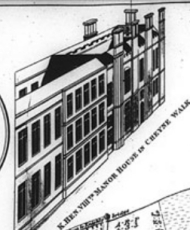
I have found an engraving of the appearance of the Chelsea manor house that stood on Cheyne Walk in a book published in the 1880s. The image resembles that included on a map of Chelsea surveyed in 1664 by James Hamilton and redrawn in 1717 (www.britishmuseum.org/collection/object/P_1880-1113-1221), but the exact location of the house is not marked on the map.

Apart from the commemorative sign at Cheyne Mews and the garden, to which we were unable to gain access, King Henry VIII’s manor house has completely disappeared. I wondered whether Chelsea’s Kings Road had any links to Henry VIII’s ownership of the manor, but it does not. It began as a private road used by King Charles II, who came to the throne long after Henry VIII, when travelling from London to Kew, and was only made a public thoroughfare in 1830. The site of the former manor house owned by Sloane is but a few minutes’ walk from the Chelsea Physic Garden, some of whose land was leased to the Society of Apothecaries for a small amount by Sloane when he acquired the manor.

Finding small things of great interest like the sign on Cheyne Mews is one of many things that increases my ever-growing fascination with London.

An almost secret garden

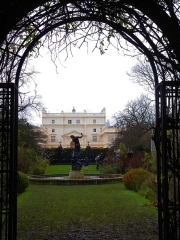
ONE COULD EASILY MISS it whilst walking around the Inner Circle at London’s Regent’s Park. Had I not noticed a couple of people emerging from the discreet gap in a fence, I would have dismissed this as one of the numerous private entrances on the outer circumference of the Inner Circle. The gap in the fencing is near the northernmost point on the circular road. A small notice, framed by vegetation, within the gap in the fencing gives a short history of The Garden of St John’s Lodge. Follow the pathway away from the road, take a left turn and walk between two manicured hedges and then turn right, and you enter a lovely formal garden replete with a pond, several sculptures, and a lawn that gives a fine view of one side of St John’s Lodge. Brave the slippery mud and explore the various separate parts of this almost secret garden. You will not be disappointed.

St John’s Lodge was the first ‘villa’ to be built in Regent’s Park. Completed between 1817 and 1818 (https://historicengland.org.uk/listing/the-list/list-entry/1277478), it was designed by John Raffield (1749-1828), who had worked for the Adam brothers before setting up his own architectural practice. It was later modified and enlarged both by Decimus Burton and Charles Barry. The house was built for the politician Charles Augustus Tulk (1786-1849).  Subsequent owners of the private residence have included Lord Arthur Wellesley, Duke of Wellington (1769-1852) who served in India; John Crichton-Stuart, 3rd Marquess of Bute (‘Bute’;1847-1900), whose heart was buried at The Mount of Olives in Jerusalem; and Baron Sir Isaac Lyon Goldsmid (1778-1859). It was Wellesley who employed Decimus Burton to enlarge the house in 1831-32.

Goldsmid was a philanthropist and one of the leading personalities in the emancipation of British Jews. He made his fortune as a partner in the bullion brokers firm of Mocatta & Goldsmid (founded as ‘Mocatta Bullion’ in 1684), brokers for both The Bank of England and The East India Company. It was due partly to Goldsmid that my alma-mater, University College (London), was able to come into existence. Albert Hyamson, author of “A History of the Jews in England” wrote that:

“University College, London … was established in 1826, largely by the efforts and through the munificence of Isaac Lyon Goldsmid …”

Goldsmid paid for the land on which the university was later built.

In connection with Jewish emancipation, the online Jewish Encyclopaedia (www.jewishencyclopedia.com/articles/6765-goldsmid) writes of Goldsmid:

“The main effort of his life was made in the cause of Jewish emancipation. He was the first English Jew who took up the question, and he enlisted in its advocacy the leading Whig statesmen of the time. Soon after the passing of the Act of 1829, which removed the civil disabilities of the Roman Catholics, he secured the powerful aid of Lord Holland, the Marquis of Lansdowne, the Duke of Sussex, and other eminent members of the Liberal party, and then induced Robert Grant to introduce in the House of Commons a similar measure for the Jews. During more than two years from the time when Jewish emancipation was first debated in Parliament, Goldsmid gave little heed to his ordinary business, devoting himself almost exclusively to the advancement of the cause.”

In 1841, Goldsmid became the first Jewish person, who had not converted to Christianity, to become a Jewish baronet.  His son, Sir Francis Henry Goldsmid (1808-1878), worked with him for Jewish emancipation and was the first Jewish barrister in England, having been called to the Bar at Lincolns Inn.

Clearly, St John’s Lodge has had some noteworthy residents. Of these, it was Bute who commissioned the Scottish Arts and Crafts architect and landscape designer Robert Weir Schultz (1860-1951) create a garden “… fit for meditation”. Bute at St John’s Lodge, which he acquired in 1888, was one of Schultz’s first major clients (http://www.scottisharchitects.org.uk/architect_full.php?id=200199). Bute had taken an interest in Schultz’s studies, having financed his visit to the British School at Athens in the late 1880s. The garden was created in the early 1890s. It was refurbished and some of its original features restored in 1994, but it has been open to the public since 1928 (https://londongardenstrust.org/conservation/inventory/site-record/?ID=WST108).

Apart from its vegetation, the garden features sculptures, a pond, and a giant urn. The sculptures include “Goatherds daughter” by Charles L Hartwell (1873-1951); “Hylas and the Nymph” by Henry Pegram (1862-1937); an “Awakening” by Unus Safardiar (born 1968), commemorating Anne Lydia Evans (1929-99), a local medical practitioner. There are two stone piers, one on each side of a lawn, bordered by scalloped hedges,  leading up to the house. Each of these is topped with a stone cherub holding a fading painted stone shield, the coat-of-arms of Crichton-Stuart. These were made by William Goscombe John (1860-1952).

St John’s Lodge remained in private ownership until World War I, when it became a hospital for disabled officers and then became the HQ of St Dunstans (now known as ‘Blind Veterans UK’) with its workshops from 1921 to 1937. Then, it became the headquarters of the Institute of Archaeology from 1937 to 1959. In 1959 it was occupied by Bedford College (now ‘Regent’s University’).  It was vacated and since 1994, it has been leased for private residence to the Royal Family of Brunei.

Had I walked past the small passage leading off the Inner Circle,  I would have missed experiencing the almost hidden, delightful garden of St John’s Lodge, which is a building that has housed persons who have influenced the history of Britain significantly. We visited the garden in late December when few plants were in flower. We hope to return a few months later when not only the garden will be filled with blooms as will the nearby Queen Mary’s Rose Gardens within the Inner Circle.

Christmas at home this year

WILL BAXTER WAS a teacher at the University of Cape Town, whilst my late father was studying for a BComm degree before WW2. Will, recognising my father’s academic excellence, persuaded my father’s mother that she and her family would do well to subsidize my father continuing his studies in London. When he presented his case to Dad’s mother, my grandmother was at first surprised and said that my father’s siblings were even brighter than him. By all accounts, my father and his three siblings were well-endowed with brain power. My grandmother agreed, but before Dad was able to set off for London, there was another hurdle. Dad had become articled to an accountancy firm in Cape Town. Leaving this would have involved breaking a legal contract between him and the firm. Will spoke to the senior partners and managed to get Dad released from his contract. Then, the year before WW2 started, Dad sailed to England and enrolled for higher studies at the London School of Economics (‘LSE’). With the exception of a few of the war years and one year in Montreal (Canada), Dad spent the rest of his life in London, where I was born.

Will Baxter returned to the UK and taught at the LSE and became a firm family friend. My earliest reminiscences of him were at Christmas time. Until I was in my mid-teens, we used to visit Will and his wife at his home in the Ridgeway in Golders Green on Christmas morning. We used to have warm drinks in the living room in which there was always a large, decorated Christmas tree.  Will always had wrapped presents ready for my sister and me, always books. I cannot remember which books I was given, but I do recall that every year my sister always received a beautiful hardback edition of one of the classic British novels by authors such as Jane Austen or one of the Bronte sisters.

The Baxters’ front garden had a gate supported by brick pillars. When I was about 3 or 4, we visited the Baxters one morning (not on Christmas Day), soon after the mortar between the bricks had been renewed. It was still wet, and Will inscribed a small ‘A’ in the mortar to record how high I was on that day. Year after year when we visited the Baxters, the letter was there in the set mortar, but my height had increased considerably. After many years, several decades, it disappeared after Will and his second wife, his first having died many years previously, had had the pillars refurbished.

Always after our Christmas morning visit to the Baxters, we walked or drove over to my mother’s sisters’s home, where we ate a festive lunch, often featuring roast goose. In addition to my close family and my aunts, other people attended this party. These included my aunt’s in-laws, various people we knew who had no close family in London, and my uncle Felix, my mother’s brother.

Felix, more than many of the other adults, truly enjoyed our Christmas lunches. He entertained us kids, my two cousins, my sister, and me, by tales of ‘Turkey Lurky’, ‘Goosey Lucy’, ‘Ducky Lucky’, and similarly named fowl. However, as we grew older, he failed to realise that we had become a little more sophisticated and blasé to enjoy this type of entertainment. At the end of the main course, he used to interrupt the adults’ conversation by standing up, thumping the table, and singing a song about bringing us some ‘figgy pudding’. I noticed that it always annoyed the adults and especially my aunt who was already stressed enough already, having produced a magnificent meal for 15 or more people.

After lunch, we retired to the living room to open presents, and always enjoyed. Felix always felt it necessary to entertain us, his nieces, and nephews, after lunch. To this end, he brought along packets of coloured inflatable balloons. He inflated them and asked one of us to hold them at their necks whilst he knotted them. Next, he twisted and tied the balloons together to make sculptures of animals. I hated these balloons because I could not tolerate the goose-pimples that the squeaking of the balloons set off in me, and still do today. One of my cousins did not enjoy this balloon experience because of the risk that a balloon might pop noisily. It is probably to our credit that none of us, his nephews, ever told him how much we disliked the balloons that Felix always brought with him.

Christmas lunches at my aunt’s house ceased many years ago. For many years, I spent Christmas enjoyably with the family of my PhD supervisor and his wife, with whom I became close friends. Then later, we often spent Christmas in India, in Bangalore where my in-laws live. This year, we had planned to do the same, but, in common with everyone else, this plan had to be abandoned for reasons that need no explanation.

I have celebrated Christmas Day at my aunt’s house, in Paris, in Méribel-les-Allues, in Manhattan, in Bangalore, in Stoke Poges, in Belgrade, in Wrocław, on a ‘plane to Sri Lanka, in Cornwall,  and in Cochin, but until this year, never at home. So, this year is a first for me: Christmas at home.

Going green

HAPPY NEW YEAR

GREEN PARK IS close to being a right-angled triangle in shape. Its longest edge is the southern side that runs along Constitution Hill and close to the grounds of Buckingham Palace. The next longest edge runs alongside Piccadilly, and the shortest, the eastern edge runs south east from the Ritz Hotel to The Mall. The park slopes downhill from Piccadilly, but not uniformly.  The slope has undulations in the form of small hillocks, each a few feet high. Unlike many other Central London Parks, Green Park has no water features such as lakes or ponds, but this does not detract from its charm. Also, the park has no formal flower beds. One reason for this might be that:

“Rumour has it, back in the seventeenth century King Charles II’s wife demanded all the flowers be removed from The Green Park after she caught him picking flowers there for another woman.” (www.royalparks.org.uk/parks/green-park).

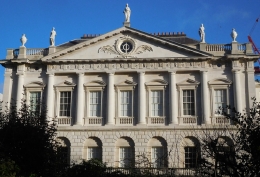
Spencer House seen from Green Park

 One of the attractions of the park for me is the line of buildings that face the Queens Walk, a pathway that runs along its eastern edge. But first, here is a little history.

In mediaeval times what is now Green Park was a swampy burial ground for lepers from the nearby St James Hospital. It was enclosed in the 16th century when it became part of the Poulteney Estate. Then and maybe earlier sand was excavated from the area for use in building materials. Maybe, these excavations account for the undulations and hillocks that characterise the park today. In 1668, the land now occupied by the park was surrendered to King Charles II, who:

“ …wanted to be able to walk all the way from Hyde Park to St James’s without leaving royal soil, so he acquired land between the two established parks, put a brick wall around it and called it Upper St James’s Park.” (www.royalparks.org.uk/parks/green-park/about-green-park/landscape-history).

The King also stocked deer in it.

In 1746, Upper St James’s Park was given its present name, Green Park. The Queen’s Walk (planted in 1730), of which I will write more shortly, was so named after the wife of George II, Queen Caroline (1683-1737), for whom the Serpentine lake was created in Hyde Park and Kensington Gardens. The walkway led from a reservoir called ‘The Queen’s Basin’ (created in the 1720s), which supplied water from Tyburn Pool to St James Palace and Buckingham House. Both the Basin and the Pool were demolished by 1855, as was Buckingham house. After its creation, The Queens Walk became highly fashionable, which is why it became lined with elegant mansions, some of which can be seen today. By 1826, when Green Park was opened to the public, many of the buildings, including a ‘Rangers House’ and a library, had already been demolished. The park (and its network of paths) as seen today was laid out afresh in the late 19th and early 20th centuries.

The western side of the Ritz Hotel overlooks the northern end of the Queens Walk and the nearby southern entrance to Green Park Underground Station. The hotel, opened in 1906 by the Swiss hotelier César Ritz (1850-1918), was designed in the French ‘Louis XVI’ style by Charles Mewès and Arthur Davis. If you cannot afford a hot beverage at the Ritz, help is at hand nearby in the form of an elegantly designed wood-clad park kiosk where decent coffee is available. Near this and facing the park entrance to the Underground station, there is a drinking fountain surmounted by a sculpture depicting the goddess Diana, naked with a hound. This was sculpted by Estcourt J Clack (1906-1973) and completed in about 1952. Until 2011 when it was moved to its present location, the statue and the fountain beneath it stood in the centre of the park. It was relocated to position it near the new entrance to the Underground Station, which was opened in 2011.  While considering sculpture, there is an abstract work in the western half of the park, ‘Watering Holes’ created by Mark Titman and Robin Menotti Architects in 2012. It adorns a drinking fountain. Now, let us return to Queen’s Walk, but noticing on our way a pair of ornamental cast-iron gates on the park side of Piccadilly. These were made in about 1735 in the Palladian style for the now long-since demolished house at Turnham Green belonging to Lord Heathfield (1717-1790), Governor of Londonderry and then of Gibraltar. The gate’s stone piers are surmounted by sphinxes, similar to those found in many 18th century settings including the Robert Adam bridge at Compton Verney in Warwickshire. The gates arrived in their present position in 1921.

The Ritz towers above its southern neighbour, a brick-built house called Wimborne House as well as William Kent House. It was designed for Henry Pelham (1694-1754) by William Kent (1685-1748) and then after Kent died by Stephen Wright. The house is now part of the Ritz Hotel. It was completed in 1754. Pelham, a Whig, was Prime Minister from 1743 to 1754. Amongst his many achievements was the passing of the Jewish Naturalisation Act 1753, which permitted Jewish people to be naturalized by applying to Parliament. This was a step towards the emancipation of Jewish people in Britain.

A little way down the queens walk, the rear of the building housing the Royal Overseas League comes into sight. It is Vernon House with its street entrance on Park Place. Heavily modified, its basis was Rutland house built in 1735-36 to the design of James Gibb (1682-1754).  One of its former residents was no stranger to being overseas. It was Lord William Bentinck (1774-1839), Governor-General of India from 1828 to 1835. Amongst his many actions in India were the abolition of sati (suicide of widows on the death of their husbands) and banning female infanticide.

After passing a narrow alleyway the leads to St James Place (see: https://adam-yamey-writes.com/2020/12/15/history-at-the-end-of-a-narrow-alley/), the garden facing façade of Spencer House can be admired. Its splendid neo-classical façade complete with pilasters topped with Doric capitals beneath a grand triangular pediment, is surmounted by three sculptures of human figures and two urns. Built between 1756 and 1766 for John Spencer, 1st Earl Spencer (1734-1783), its architects were a student of William Kent, John Vardy (1718-1756), and then James ‘Athenian’ Stuart (1713-1788), a Scottish archaeologist and architect. Spencer was a grandson of the First Duke of Marlborough. After gazing at this wonderful building, slip through a gateway and enter Cleveland Row that leads to Little St James’s Street.

The northern side of Cleveland Row is occupied by a large building, 9 Little St James’s Street, known as Bridgewater House, and built in the style of a Florentine palace in 1840 to the designs of Charles Barry (1795-1860) for the traveller and writer Francis Egerton, 1st Earl of Ellesmere (1800-1857), heir of the 3rd Duke of Bridgewater, after whom Ellesmere Island is named. Since 1980, it has been owned by the Greek Latsis family, with whom my family have been friends since the mid-1960s. There are three brass bellpulls by the entrance on Little St James’s Street. One of them is labelled ‘coachman’, another ‘groom’, and a third ‘picture gallery’. The latter is a reminder that the building contained ‘Stafford Gallery’, which was formed by Marquess of Stafford to house a collection of paintings, his and his relatives’ possessions, now housed as the ‘Sutherland Loan’ in the National Gallery of Scotland.

Near Bridgewater House, you should look out for Selwyn House and Stornoway House, both of which have facades looking out on to Green Park. Selwyn House, built either in about 1897 or, according to the architectural historian Nikolaus Pevsner, between 1850 and 1860, was designed by Richard Norman Shaw (1831-1912) and built as a residence.  It was the headquarters of the glassmakers Pilkington from the 1980s to 2010.

Stornoway House, with its lovely pediment decorated with vegetation sculpted in bas-relief, was designed by Samuel Wyatt (1737-1807), brother of the more widely known architect James Wyatt and an associate of Robert Adam.  It was built between 1794 and 1796 for the Whig politician William Wyndham, Baron Grenville (1759-1834), Prime Minister from February 1806 until March 1807.

A private road, heavily guarded and leading to St James’s Palace, separates Stornoway House from its southern neighbour Lancaster House, an ochre-coloured Bath stone neo-classical edifice, that faces both Green Park and The Mall. Formerly known as ‘York House’ and then ‘Stafford House’, it was built between 1825 and 1840. Its architects included Robert Smirke, Dean Wyatt, and Charles Barry. Its first owner was King George II’s son Prince Frederick, Duke of York and Albany (1763-1827). Next, it was owned by 2nd Marquess of Stafford (1758-1833), who became 1st Duke of Sutherland.   The house gained its present name after it was bought in 1912 by the soap-maker William Hesketh Lever (1851-1925), who was born in Lancashire. Currently, the building is managed by the Foreign and Commonwealth Office and apart from being used for official functions it has also been used as a filming location in several films including one I particularly enjoyed, “The King’s Speech” that appeared in 2010.

After viewing the impressive mansions that line the Queen’s Walk, you could stare at Buckingham Palace (built from 1703 onwards), or, more interestingly, you could wander through the trees to the lovely and visually intriguing Canadian war memorial designed by the Canadian Pierre Granche (born 1948) and unveiled by Queen Elizabeth II in 1994. Not far from this and facing the Palace there is a stone gate pillar on which the word ‘Canada’ is carved, this is next to another one bearing the word ‘Newfoundland’. These pillars were erected in 1905 as part of a memorial to Queen Victoria, long before Newfoundland united with Canada in 1949.

I hope that what I have described has whet your appetite to visit what at first sight does not seem to be one of London’s more spectacular open spaces but, on closer examination, is very much in touch with history.

Scottish reels

HAPPY NEW YEAR!

BOXING DAY IS the day after Christmas Day (25th of December), the 26th of December. Traditionally, it is the day on which money or gifts are given to persons in need or those offering services, for example servants.

For many years, I used to spend the Christmas Season with my old (and now sadly deceased) friends Robert and Margaret at their large country home outside London. The first time I was invited to do this, Margaret checked with my mother that she did not mind me being ‘dragged’ away from our family festivities. My mother had no objections because by then, in the late 1970s, we never celebrated Christmas ‘en-famille’.

Robert and Margaret celebrated Boxing Day on the 26th of December, whether it was a weekday or not, in an especially enjoyable way. They invited friends to their home for an evening of Scottish dancing. The living room at their home was large but filled with furniture. Beneath the carpets, there was a wooden parquet floor that my friends laid down as a dance floor when they moved into the house many years before I met them.

After breakfast on the 26th of December, everyone staying with Robert and Margaret over Christmas began working. In the kitchen, vast amounts of food were prepared for the evening:  goulash or curry and accompanying rice and vegetables; meringues; fruit trifles; peppermint creams and homemade fudge; mince pies; a cheese platter etc. Also, Robert spent hours at one of the stoves, stirring ingredients for concocting two different alcoholic punches, guided by the recipes scribbled in his almost illegible handwriting in one of his numerous notebooks. The kitchen was a hive of activity.

A few yards away from the kitchen, heavy physical work was underway. Almost every item of furniture had to be moved from the living room into either a room called ‘the library’ or into the long corridor between it and the living room. We used to shift heavy armchairs and even heavier sofas, smaller chairs (some of them quite fragile), occasional tables, oriental rugs, framed photographs, and ornament cases containing fragile objects including an ostrich egg. Fortunately, we did not have to carry the family’s upright pianoforte or the large decorated Christmas tree out of the room. After almost all the furniture had been removed, the two enormous floor carpets had to be rolled up tightly. One of them had to be carried into the library and the other was rolled up to remain in front of the huge Christmas tree at one end of the room.

With the floor cleared, the beautiful parquet floor became exposed to view. Floor polish was then sprinkled on to the wood and rubbed into it with an electric floor polisher, a job I often performed after helping to shift furniture. The floor had to be polished until it was shiny, which was easy to achieve with the machine.  

The dining room also required preparation. The heavy large antique wooden dining table that had been acquired from University College London when they were discarding it had to be shifted to one side of the room, where it would serve as the place on which the evening buffet was to be laid out. Dining room and other chairs were arranged for those who were sitting out from the dancing and for those who preferred being seated whilst eating. Also, cutlery, plates, various kinds of glasses, and coffee cups with saucers and spoons had to be placed in readiness for the evening.

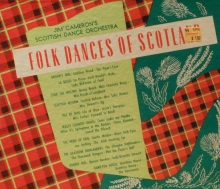
After lunch, there was a short period of ‘calm before the storm’. Afternoon tea was served as usual in the living room, but we took it seated on the floor instead of on the comfortable furniture which had been moved earlier. Margaret retrieved her two books of dance instructions, one of which made little sense to me. She also made sure that the records with Scottish dance music were near to the gramophone turntable and explained to me which record was suitable for each dance. For, usually I was to be responsible for finding the right tracks on the LPs (including music performed by Jimmy Shand and his band and by Jimmy Mc Cleod) and playing them on the turntable before dashing back to join the dance.

Guests began arriving in the early evening. Everyone was handed a glass of one of Robert’s special warmed punches on arrival and was invited to help themselves to mince pies and other confectionery. When there were sufficient people to perform at least one eightsome, the dancing commenced. The evening’s proceedings continued with dancing the ‘Dashing White Sergeant’, a good warm-up routine. It was not that people needed warming up because there would be a good fire burning in the hearth at one end of the living room.

For about an hour and a half, we danced the ‘Eightsome Reel’, The ‘Duke of Perth’, ‘The Reel of The 51st’, ‘Petronella’, and others whose names I cannot recall. The “Duke and Duchess of Edinburgh” was too complicated for us to master. The dancers varied in skill from expert to almost clueless. Margaret issued instructions, other guests contradicted her, but we all had much fun. As for me, I usually knew where I was supposed to be at any instant during a dance and got there, but without being able to execute my dance movements with any degree of elegance.

By 9 pm, everyone, up to thirty people, was exhausted and hungry, but feeling exhilarated. The hot food was brought from the kitchen to the dining room, which in true English tradition was further away from the kitchen than any other room in the house. It was wheeled on a rickety trolley held together in places with string. People helped themselves to servings of the meat dish and accompanying vegetables and washed this down with glasses of the second punch that Robert had mixed earlier. Then fresh plates were supplied for the trifles and pairs of meringues stuck together with whipped cream. Coffee was served.

Then, it was back to the dance floor. You would have thought after such a hearty supper that it would have been impossible to resume dancing, but this was not the case. However, by then the living room was getting quite warm and it was necessary to open a door that led to the draughty conservatory next to the living room. Dancing continued, sometimes as late as midnight. For me, the highlight of the second part of the evening was a riotous dance called ‘Strip the Willow’. Margaret was usually my partner in this potentially energetic dance. To see her in action either in this dance or on a tennis court, one would not be able to believe that she was as old as she was. In fact, until the last few years of her life, she was a perfect example of a ‘live wire’.

All too quickly, the evening drew to an end. The guests stumbled out into the darkness and retrieved their vehicles from the large gravelly car park. We, the house party, breathed a sigh of relief because the party had been successful; it always was. When I first attended these parties, we used to retire to bed and leave rearranging the furniture to the next morning. However, after a few years Margaret’s son-in-law and I agreed that it was dreadful waking up the next morning with the prospect of furniture shifting. So, we agreed that despite being tired, it was best to do this awful job before retiring for the night and while the excess adrenaline we had generated during the dancing was still flowing through our blood vessels. This proved to be a real improvement.

All of this was long ago. The house where it happened has been demolished and Robert and Margaret are no more than wonderfully warm memories. I am eternally grateful that I knew them and was able to partake in their memorable celebrations and other activities. I am pleased that they did not have to experience this covid19 pandemic, which we are enduring this year. I dread to think what their reaction would have been had they been around when the British Government had effectively ‘cancelled Christmas’ this year. Although they were not deeply religious, Christmas and the day following meant a great deal to them, as it does to many of us who have survived them.

Changing travel plans

WE ARRIVED BACK IN LONDON from several months in India on the 27th of February 2020. Since we retired, we have taken to spending a few of the winter months in my wife’s native land, India.

We have often spent Christmas in the south Indian city of Bangalore, where we stay at the long-established ex-colonial Bangalore Club, where the young Winston S Churchill once stayed and then left without settling an outstanding bill. To date, we have settled all our Club bills, you will be pleased to know. However, maybe this is one reason why none of us has ever been elected as Prime Minister of the UK or any other nation.

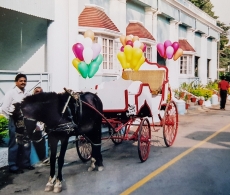
Christmas is celebrated in style at the Club. Strings of tiny lightbulbs are draped all over the establishment’s buildings and the many lovely trees in the Club’s extensive grounds. Shortly before Christmas, there is an outdoor evening carol singing concert that ends with the lighting of a huge bonfire. There is also a lively Christmas party for the members’ children that culminates with the arrival of Father Christmas on a horse-drawn carriage. I always feel a bit sorry for him as he must dress not only in a bushy white beard but also in clothing that is far too warm for the December temperatures in Bangalore, which can be in the high twenties Celsius. On Christmas Day, members and their families, who are not vegetarian as many are in India, queue up for servings of roast Turkey and a wealth of other foods available at a luncheon buffet. There is plenty available for those who prefer not to eat meat. Well, we will be missing all of this in 2020, and a lot more.

Usually, a day or so after we return to London, we visit our travel agent to book tickets for our next ‘Winterreise’ to borrow a title from the composer Franz Peter Schubert. Air tickets become available eleven months before a flight’s departure date. When we were seated at our travel agent’s desk, we told him the dates of our proposed trip. He looked on his system and told us that we could book the outbound flight, but the return flight tickets would not be available for purchase until early April. He advised us to return in April and then book both outward and inbound tickets together. That turned out to be extremely sound advice.

In the middle of March, the UK went into a total ‘lockdown’. It was no longer possible to return to our travel agent or to do much else. In addition, things were deteriorating all over the world as a result of the spreading of covid19 infections. As the weeks went past, it looked increasingly unlikely that we would be making a trip to India at the end of 2020. We were fortunate that we had been advised not to buy our outbound air tickets. Now, having reached December, travel abroad is not advised and currently travel from the UK is being curtailed. Many countries, including India, are banning travel from the UK.

In August, when restrictions on movement were being relaxed, we spent a pleasant week in a rented cottage in Kingsbridge, Devon. We liked the cottage so much that we asked its owner whether we could reserve it over the Christmas/New Year holiday period. She was happy with the idea providing that future ‘lockdown’ rules did not find her trapped there. A couple of months ago, she informed us that the cottage would not be available after all. This was not because of travel restrictions, but because a friend of hers needed temporary accommodation for a few months in winter.

Undismayed, we managed to find another self-catering cottage in the West Country to rent during the Festive Season. Then, London was cast into Tier 3 covid19 preventive measures, which discourage travel outside the Tier 3 restrictions area except between the 23rd and 28th of December. We rang our landlady in the West Country to explain that we would rather not drive so far to spend such a short time and she agreed to rebook us in March 2021.

With the West Country shelved, we decided to stay in a hotel near Cambridge and to spend some ‘socially distanced’ time with one of my cousins, who lives in the area. As the 23rd of December grew nearer, we began planning our festive feasting programme and buying mouth-watering supplies for it. Then, we all learned that the coronavirus had become highly creative and managed to mutate in more ways that most of these bugs can usually manage. This new viral creation is far more efficient at spreading from person to person than its awful ancestors. As a result, and surprisingly sensibly for our strange government, London and much of southeast England was put under stricter restrictions, Tier 4, which include a travel prohibition that forbids travel out of Tier 4 and no relaxation of restrictions during the period that we had planned to spend near Cambridge. So, that was Cambridge ‘out of the window’.

Soon after London was made subject to Tier 4 regulations, we learned that even with the arrival of new vaccines it was likely that the severe restrictions on travel might continue until Easter. So, we reached for the ‘phone and asked our future landlady in the West Country to shift our booking until May 2021. Now, we will make the most of Christmas and New Year without leaving London for any kind of winter journey, let alone India. I hope that all of this does not sound too depressing to you, because we subscribe to the idea that ‘all’s well that ends well’, and we hope that by following the rules, as ad hoc as they might be, we will all keep well.

While we munch our way through all of the festive ‘goodies’ we have accumulated, we will think of you, our friends all over the world, and wish you a prosperous and healthy future.

Pond life

WE MADE THE MOST of the shortest day of the year, 21st December 2020, by leaving our house before sunrise, which was supposed to happen at 8.05 am but did not do so visibly because of the grey skies and incessant rain. We drove to South End Green (Hampstead) and parked just above the largest of the Hampstead Ponds (Pond number 1).

Despite the sheets of rain and the sombre sky, the houses across the pond were reflected in the water  where swans and other waterfowl were taking a swim. We splashed along a waterlogged path to the next pond, Pond number 2, which is also overlooked by a few houses, whose inhabitants have an enviable view over the water and the slopes of Hampstead Heath beyond. We stood on a wooden viewing platform and heard a ‘splosh’ near us. It was a cormorant taking a dive. It emerged a few moments later further out in the pond. Several other cormorants could just about be seen through the rain, resting on a tiny island in the pond.

The Hampstead Ponds, three in number, are fed by streams that rise near the Vale of Health, which is about 440 yards northwest of the uppermost pond (number 3), which flows into the second pond and then into the first. These streams, along with those that flow into the Highgate Ponds, are sources of the water that flows in the now subterranean River Fleet, which empties into the Thames under Blackfriars Bridge.  

The idea of damming the streams to make the ponds might have been conceived as early as 1589 (https://guildhallhistoricalassociation.wordpress.com/2016/01/11/the-history-of-the-hampstead-heath-ponds/) but it was only in 1692 that the  Hampstead Water Company  leased the springs that now feed the ponds. The latter, which were used as freshwater reservoirs, were created by damming the streams in the early 18th century. The pond at the Vale of Health was created later, in 1777. Water from these ponds/reservoirs was supplied to users in north London via wooden pipes created by boring holes in elm tree trunks. The Highgate Ponds, which also supply water to the Fleet, were also created by the Hampstead Water Company.

In 1856, the New River Company acquired Hampstead Pond number 1 and the Vale of Health pond, which were by that time becoming less savoury as far as water quality was concerned. Four years later, the Hampstead Junction Railway Company opened what is now Hampstead Heath Overground Station. This was just south of a fourth pond, which was filled in in 1892. In addition, there was another pond in South End Green where a disused 19th century drinking fountain now stands. The pond was filled in in 1835.

Enough of the distant past. Let me tell you how South End Green fits in with my life so far. My mother’s brother, Felix, lived at number 130 Fleet Road. He bought it at an extremely reasonable price because it had a ‘sitting tenant’. Eventually, after the tenant died, my uncle lived on one of the building’s three floors and rented the other two to a couple of Nigerians, who became his close friends. He regarded them as if they were his sons and they looked after Felix as if he was their beloved father.  For a long time, Felix occupied the top flat. He used to visit our flat for dinner regularly and we used to drive him home at the end of the evening. On one occasion, we arrived at his house, and after fumbling in his pockets, he announced that he had left his house keys locked in his home. We asked him what he was going to do. He answered in his South African accent:

“Ag, I do this often. All I need to do is ring my neighbour’s doorbell and they will let me onto their roof. Then, I cross over on to my roof. I keep a stick there so that I can break open my window and climb into my house. So, you don’t need to worry.”

Felix was always creative and inventive. When he grew older and infirm, he moved into the ground floor flat. He began using a stick when out walking. Once, when I was visiting him in a ward in the Royal Free Hospital, which is across the road from his former home, I was present when a physiotherapist visited him. She asked him whether he had a walking stick. He said:

“It’s lying beneath my bed.”

The physiotherapist looked at the stick, and said:

“Well, I have never seen one quite like this before.”

“Ag,” said Felix, “I took a bleddy broomstick and glued an umbrella handle on to it.”

Felix died a few months ago. We miss him greatly.

Sadly, South End Green was  associated with other personal losses. Both my mother, and then many years later, her sister, ended their lives in the Royal Free Hospital.

The rear of Felix’s home once overlooked the LCC Tramway Depot. This was surrounded by the terraced houses on Fleet, Constantine, Agincourt, and Cressy Roads. The entrance to the depot was from the latter. This depot opened for horse-drawn trams in about 1887 and then the system was electrified in 1909. In 1938, trolley buses replaced trams travelling to South End Green and these were replaced by motor buses in about 1960 (www.british-history.ac.uk/vch/middx/vol9/pp3-8). Currently the route 24 bus terminates at South End Green, a route which I used when I was younger.

I used the 24, which passed near University College London where I studied between 1970 and 1982, for two main reasons. One was to visit my uncle Felix and the other to visit some friends, who lived in Constantine Road and others who lived in South Hill Park, part of which was built over the pond that was covered over in 1892.

Today, my wife and I enjoyed our visit to South End Green despite the relentless rain. After buying vegetables at a lovely open-air stall close to the station, we paid a visit to the Matchbox Café next to the cobbled area where the route 24 buses rest before setting off. As we waited for the barrista to prepare our hot drinks, we chatted with him through the hatch through which he serves the take-away drinks and snacks. Mirko was delighted to discover that we had visited his hometown Ptuj in Slovenia, which was once a part of the former Yugoslavia. He told us many things about his native place including that a castle north of the town, Borl (Ankenstein in German), was associated with Parsifal, one of the Knights of King Arthur’s Round Table (more information: https://blogs.bl.uk/european/2018/01/an-arthurian-castle-in-slovenia.html). Incidentally, Mirko prepares good quality coffee and richly flavoured hot chocolate. His café is one of many reasons for visiting South End Green, even on a rainy December day.

Amy and origami

OUR FRIENDS INTRODUCED us to a square in north London, which we had never visited before despite the fact it is near the pub where we meet them regularly, when covid19 regulations permit. The square, Camden Square, is about 1000 yards northeast of Camden Town Underground Station. The rectangular open space that comprises the ‘square’ was developed between 1830 and 1850 and formed the centrepiece of Marquis of Camden’s New Town development (https://londongardenstrust.org/). The square and Camden Town take their names from John Pratt (1759-1840), the First Marquis of Camden (https://en.wikisource.org/wiki/Dictionary_of_National_Biography,_1885-1900/Pratt,_John_Jeffreys). In 1736, he was called to the Middle Temple, where many years later my wife became a barrister. In 1795, he was appointed Lord Lieutenant of Ireland, and was not popular with the Irish. He was opposed to emancipation of the Catholics and to parliamentary reform. His attitude towards the Irish was repressive and he developed an intrusive intelligence network. In May 1798, insurrection broke out in Ireland and he appealed for more military personnel to be sent from England. Later that year, he was replaced by Lord Cornwallis (1738-1805). A remarkable soldier, Cornwallis was involved in attacking the formidable Tipu Sultan (1750-1799) and forcing him into signing an unfavourable treaty in 1792 at Seringapatnam near Bangalore and Mysore in India.

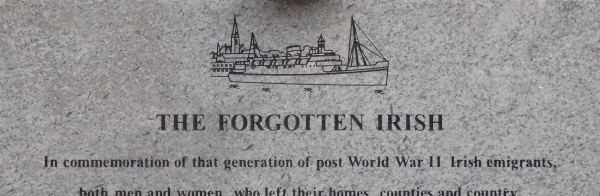
Given the Irish antipathy towards the Marquis of Camden when he was Lord Lieutenant of Ireland, it is ironic that at the southeast corner of the square, we find the building that houses the London Irish Centre (https://www.londonirishcentre.org/). It was founded in 1954 to provide assistance to Irish migrants arriving in London after WW2, often quite unprepared. Its present home, 50 Camden Square was bought in 1955. Its location was chosen because it is close to Euston Station, where many of the Irish arrived by train from Holyhead. A plaque placed on the outside of the Centre’s elegant neoclassical Victorian façade commemorates the ‘Forgotten Irish’. It reads:

“In commemoration of that generation of post-WW2 Irish emigrants, both men and women, who left their homes, counties, and country. They came to work and rebuild this city and country, ravaged and destroyed by war. Sometimes called ‘The Forgotten Irish’, many would never return to Ireland. This plaque recalls their contribution and their loss…”

The Centre contains many facilities including a good library, a bar, and a community café.

The Irish centre and almost all the houses on the eastern and southern sides of the square date back to long before WW2. However, some of the buildings on the western side of the square are post-WW2, most likely built on the sites of houses destroyed by bombing during the war.

Number 57 on the southern side of the square was home to the Indian politician Krishna Menon (1896-1974) between 1924 and 1947, when, after India won independence, he became Indian High Commissioner to the UK. Menon received much of his education in London, at the London School of Economics and University College. He was also admitted to the Middle Temple. Menon worked with the publisher Allen Lane at the time when Penguin Books was established and might have been the inspirer of the idea of producing cheap editions of quality titles, which was the principle adopted by Penguin.

As a member of the Labour Party, Menon was elected borough councillor of St Pancras, and was later given the Freedom of the Borough, an honour which had only one other recipient, George Bernard Shaw. A close friend of Jawaharlal Nehru, the Indian patriot and future Prime Minister of India,  Menon was President of the India League between 1928 and 1947. The League fought for the complete independence of India from the British. Once Menon was asked whether India would prefer to be ruled by the British Empire or the Nazis. He is supposed to have replied that one:

“ …might as well ask a fish if it prefers to be fried in butter or margarine.”

At Camden Square, Menon:

“… had a room and the use of the bath. His furnished room had a bed, a table, a couple of chairs, a wardrobe and a sideboard. Come hell or high water, he had to have his morning bath, and hell often broke loose when the Luftwaffe set out to put the torch to London. Krishna Menon’s landlady is still puzzled about this. Did he, she wonders, insist on his morning bath because of his religion? He paid a pound per week for rent, including the price of his breakfast tea and toast. The rent was modest even for Camden Town.

Krishna Menon used his room only for sleeping. He never gave any parties nor did he entertain guests. In the evening he returned at irregular hours, and if it was not late, he asked Mrs. Rouse for tea. While Krishna Menon was meticulous about his clothing, he left his room in Bohemian disarray. It is with some amusement that Mrs. Rouse recalls that his discarded clothing was scattered all over the room and that he seemed to be unable to fold his towels ‘neat-like’.”

(quoted from “Krishna Menon” by Emil Lengyel).

Almost across the road from Menon’s home, is number 1 Camden Square, home to Robert Harbin (1909-1978) in 1928. ‘Who he?’, I hear you ask. Born Edward Richard Charles Williams in Balfour (near Johannesburg in South Africa), he came to London, aged 20, and began working in the magic department of Gamages toy shop. An accomplished magician, he performed in music halls and later in television and in films. He became interested in Japanese paper folding and became the first President of the British Origami Society, founded in 1967.

Other famous persons have lived in Camden square, many of them artists. They include the Dutch-born painter Lawrence Alma-Tadema (1836-1912), who lived briefly at number 4, when he first arrived in London from Belgium. The sculptor William Turnbull (1922-2012) lived in the square nearer the end of his life. During the 1960s, my mother worked alongside him in the sculpture studios of St Martins School of Art, then in Charing Cross Road next door to the famous Foyles bookshop.

Before I mention the currently most famous resident of the square, I should record the fact that there are no houses along the space’s northern edge. The northern edge is the southern boundary of the grounds of St Paul’s church, Camden Square. The church is a non-descript structure completely devoid of architectural merit. It was built as a temporary replacement of an older church that was designed by Frederick Ordish and John Johnson and built in 1849, and then severely damaged by bombing during WW2.

Number 30 at the north east corner of the square faces three trees whose trunks are surrounded by screens made of bamboo rods, some of which have padlocks attached to them. For, number 30 was the home of the popular singer Amy Winehouse (1983-2011). Some of the padlocks have her name inscribed on them by the mourning fans, who attached them to the trees.

Now that the covid19 pandemic is forcing us to meet others outdoors, the weather has become of even more interest than in healthier times. This brings us to George James Symons (1838-1900), who lived at number 62 Camden square between 1868 and 1900. At the age of 17, he became a member of the Royal Meteorological Society, becoming elected its President twice. He was a pioneer in the scientific study of rainfall and founded The British Rainfall Organization as well as establishing a Climatological Station in the square.

Fortunately for us, there was no rainfall whilst we walked around the square and through the peaceful, well-maintained garden in its centre. I am grateful to our friends for introducing us to this square full of diverse historical associations, some of which were new to all of us.