BEAUFORT HOUSE IN CHELSEA was the home of Henry VIII’s ill-fated advisor, Thomas More (1478-1535), between 1521 and his arrest in 1535. After More’s death, the property passed through the hands of several owners, the last of which was the physician and founder of the British Museum Sir Hans Sloane (1660-1753). He bought the house and its grounds in 1737 (https://www.british-history.ac.uk/survey-london/vol4/pt2/pp18-27). During 1739 and 1740, Sloane demolished Beaufort House, and sold parts of it and its grounds to be used in other buildings. One of the items he sold was an elegant gateway designed by the British architect Inigo Jones (1573-1652), who introduced the neo-classical style to the UK. The gateway, which was constructed in 1621, used to serve as an entrance to the grounds of the house from Kings Road.
The gateway, which now stands near to Chiswick House in west London, bears a carved stone with the words:
“Given by Sir Hans Sloane, Baronet to the Earl of Burlington 1738.”
Richard Boyle, 3rd Earl of Burlington and 4th Earl of Cork (1694-1753), an architect. He built the present Palladian-style mansion at Chiswick in 1717. An admirer of Inigo Jones, he was happy to install the gateway from Beaufort House close to his recently constructed building in Chiswick. Contrary to what appears on the inscription, he paid for the gateway rather than receiving it as a gift from Sloane. A poem by the architect and landscape designer William Kent (c1685-1748) relates the story of this fine gateway (quoted from “The Palladian Revival. Lord Burlington, His Villa and Garden at Chiswick” by John Harris):
“Ho! Gate, how came ye here?
I came fro’ Chelsea the last yere
Inigo Jones there put me together
Then was I dropping by wind and weather
Sir Hannes Sloane
Let me alone
But Burlington brought me hither
This architecton-ical
Gate Inigo Jon-ical
Was late Hans Slon-ical
And now Burlington-ical”
Burlington was so keen to have the gate that he agreed to pay Sloane however much it was valued.
As far as I can see, the gateway serves no other function than as a decorative garden feature. Burlington was a keen collector of the architectural drawings of Inigo Jones and had seen the Beaufort House gateway amongst them. As an enthusiast, he must have been thrilled to have acquired an actual work by the architect he admired. So, apart from being a garden feature, it was a fine collector’s item. I feel that it is a pity that he did not rescue more from the house that Sloane demolished because old drawings and plans of it make it appear as if it was a remarkable edifice.
The gardens of Chiswick House, close to the busy A4 highway, are open to the public free of charge and apart from the fine gateway, there are many other lovely man-made garden features: statues, neo-classical buildings (apart from the main villa), bridges, and a fine waterfall that empties into a lake. The gardens are interestingly laid out, both formal layouts with hedges and also less manicured areas. Come rain or shine, a visit to these gardens is a worthwhile and refreshing experience.
IT WAS EERIE walking in Leicester Square today in early February 2021 at midday because we were almost alone. Normally, the square is full of people milling about and joining circles of folk watching street entertainers perform, sometimes with great skill. Apart from us, I saw no more than ten other people in this usually crowded popular focal point for Londoners and tourists alike. There was a sense of peace and calm that one customarily associates with spots deep in the countryside. I doubt that this square has been like this for many years, maybe since it was first laid out between 1630 and 1671, when it was then known as ‘Leicester Fields’.
At the north-east corner of the Square was Leicester House, which was named after Robert Sydney, 2nd Earl of Leicester (1595-1677), and was built in about 1635. It was home to members of some royal personages including, briefly, Elizabeth Stuart, Queen of Bohemia (1596-1662) whose life ended in the house, and later the huge natural history collection of Sir Ashton Lever (1729-1788), the last lessee of the house before it was demolished in 1791.
During the 18th century, the houses surrounding Leicester Square were occupied by several people, whom we still remember today. The artist William Hogarth (1697-1764) lived on the east side of the square on a site that was later occupied by the Sablonière Hotel, now demolished. The hotel’s plot is now the site of a twentieth century building housing the offices of several radio stations including LBC and Classic FM and a branch of TGI Friday. The famous surgeon and scientist John Hunter (1728-1793) lived in the house next to Hogarth’s from 1785 until his death. He kept his collection of specimens there as well as giving lessons in anatomy and dissection in rooms he added to the rear of his home. Hunter was buried in the nearby church of St Martin in the Fields. Across the square on its west side, the artist Sir Joshua Reynolds (1723-1792) lived and worked from 1761 until his death. His studio was an octagonal room. According to John Timbs, writing in 1867:
“… the sticks of his brushes were 18 inches long; he held his palettes by handle …”
In addition to his residence and studio, Reynolds built a gallery for his works. The row of houses that included that of Reynolds has long since been demolished. When I first knew Leicester Square, the east side of the square was occupied by a large office building, Fanum House, that housed the Automobile Association. Its appearance has been modified and is known as ‘Communications House’.
Other artists, who lived in the square, include Hans Huyssing (1678-1753/53), a Swedish painter; Jacques Christophe Le Blon (1667-1741); Michael Dahl (1659-1743), a fashionable Swedish portrait painter; and William Martin (1753-c1836), an English painter. Apart from artists, other notable people, several military and medical celebrities, lived around the square.
The square has a garden, in the centre of which there is a statue of William Shakespeare. This is a copy of an original made in 1741 by the Flemish sculptor Peter Scheemakers the Younger (1691-1781) who spent most of his working life in London. It was placed in the square in 1874 when the financier and member of Parliament Albert Grant (1831-1899), who was born ‘Abraham Gottheimer’, bought the garden and opened it to the public. During the 18th century, there was another statue in the square: a metal equestrian sculpture of King George I, sculpted by C Buchard.
The large Odeon Cinema on the west side of the square has a black tiled façade. It was built in the art-deco style in 1937, designed by Harry Weedon (1887-1970), who designed many other cinemas in the 1930s. It was built on the site of the big Alhambra Theatre, which opened as a music hall in 1858 and survived until its demolition in 1936. Today, there is a bar next to the Odeon. It bears the name ‘Lost Alhambra’.
The Empire Theatre, now a casino and a cinema, is on the north side of the square. With its neo-classical façade, it was built in 1884 as a variety theatre. Its architects were Thomas Verity (1837-1891 and Thomas Lamb (1871-1942). This stands roughly on the western side of the land occupied by the former Leicester House. To the east of this plot, there stands another cinema, a fine example of the art-deco style, the Vue Cinema, which was built in 1938 and opened as the ‘Warner Theatre’. Its architects were Thomas Somerford (1881-1948) and EA Stone. The façade includes two bas-relief sculptures, one representing the spirit of sight and the other of sound, which were created by Edward Bainbridge Copnall (1903-1973), who was born in Cape Town in South Africa.
The Swiss Centre that used to stand at the northwest corner of the square was demolished a few years ago and was replaced by a newer building. The Centre contained a couple of expensive but good restaurants where Swiss specialities were served. The steak tartare and cheese fondue, which were served at the Centre, were particularly good. A clock with a carillon adorned with the crests of the Swiss Cantons is all that remains of that fine Swiss establishment.
At the south side of the square, facing the cheap theatre tickets booth, stands the Hampshire Hotel, currently devoid of guests. Before it became a hotel, this building housed the former Royal Dental Hospital. Opened in 1858 in Soho Square (number 22), it moved to the premises in Leicester Square in 1874 (https://ezitis.myzen.co.uk/royaldental.html). In those days, the once fashionable Square had become a run-down part of London. In 1983, The Royal Dental Hospital was merged with Guys Hospital Dental School. When this happened, a dental friend of mine, who worked at Guys, suggested to me that the merged hospital should be renamed as ‘Roys’. In 1985, the Leicester Square hospital was closed. Soon after this, the former hospital was reconditioned to become a hotel.
Being the centre of London’s theatre and entertainment district, it is appropriate that recently the square has been adorned with life-size sculptures of famous entertainers such as Charlie Chaplin, Rowan Atkinson (with whom you can share a bench), Laurel & Hardy, Mary Poppins, and other familiar actors. I cannot decide whether these frozen figures enhance the square, but as they are fairly discreetly positioned, they do add something to a place that has been home to well-known people since the beginning of the 18th century.
Had Leicester Square not been as empty as it was today, I would not have spent so long there to take photographs. I realised that this square, through which I have always preferred to hurry, has some interesting architecture and such a lovely statue. Although I enjoyed Leicester Square without the crowds, I look forward to healthier times when people can mix there, freely and happily.
MY MOTHER-IN-LAW STUDIED medicine at the Grant Medical School in Bombay. One of her fellow students, Perin, was her good friend. Perin, a member of Bombay’s Parsi religious community, was related to the Readymoney family, Parsis, who were prominent and successful in Bombay. You might be wondering why I am telling you this and what it has to do with anything of greater interest. Well, bear with me and join me in Regents Park.
Cowasji Jehangir Readymoney
The Broad Walk is a long straight promenade that stretches from the Outer Circle near Marylebone Road at the south of Regents Park northwards through the park to Outer Circle next to the London Zoo. Near the south eastern corner of the Zoo, there is a gothic revival style Victorian water fountain on the Broad Walk. Well-restored recently, it is no longer working. The structure, which is made of pink granite and white stone, looks like a typical flamboyant 19thy century public drinking fountain that can be found in towns all over England, but closer examination reveals that this is not so typical. Amongst its many decorative features there is a cow standing in front of a palm tree; a lion walking past a palm tree; the head of Queen Victoria looking young; and the head of a moustachioed man wearing a cap of oriental design.
The man portrayed on the drinking fountain was its donor, Sir Cowasji Jehangir Readymoney (1812-1878), who was related to my mother-in-law’s friend from medical school. Readymoney was born into a wealthy family that had moved to Bombay from the Parsi town of Navsari (in present-day Gujarat), close to where the first Parsis might have landed in India many centuries earlier. Cowasji began working as a warehouse clerk at the age of 15. Ten years later, he had become a ‘guarantee broker’ in two leading British-owned firms in Bombay, a lucrative position. By the age of 34, he was trading on his own account. In 1866, he was appointed a Commissioner for Income Tax. This form of taxation was new and unpopular in Bombay, but Cowasji made a success of its collection.
In recognition for his services to the British rulers of India, Cowasji became a Justice of the Peace for Bombay and, soon after, was made a Companion of The Most Exalted Order of the Star of India. He was a great philanthropist, providing money for building in Bombay: hospitals; educational establishments; a refuge for the destitute; insane asylums; and decorative public drinking fountains. In addition to these good causes in Bombay, he made donations to the Indian Institute in London. In recognition of his philanthropic works, he was made a Knight Bachelor of the United Kingdom in 1872.
Three years before being knighted, Readymoney financed the construction of the drinking fountain in Regents Park. It is his face that appears on it. It was, as a noticed affixed to it reveals, his:
“… token of gratitude to the people of England for the protection enjoyed by him and his Parsee fellow countrymen under British rule in India.”
The Parsi community in India, like the Jewish people in that country, was and still is a tiny proportion of the Indian population as a whole. It felt that its survival would be ensured by showing allegiance to whomever was ruling India, the British in Readymoney’s lifetime. The fountain was inaugurated by Princess Mary of Teck (1833-1897), a granddaughter of King George III, under whose watch the USA was detached from the British Empire.
The fountain, which makes for an eye-catching garden feature, was designed by Robert Keirle (1837-1914; https://borthcat.york.ac.uk/index.php/keirle-robert-1837-1914-architect?sf_culture=en), architect of The Metropolitan Free Drinking Fountain and Cattle Trough Association. Keirle also designed a drinking fountain for another Indian, The Maharajah of Vizianagram. This was erected in 1867 at the northern edge of Hyde Park, close to Marble Arch, but it was removed in 1964 (https://theindiantrip.com/uk/vizianagaram-city/info). All that remains of it today is a small stone memorial, which I have walked past several times.
Usually, we spend several months in India, the country where my wife was born, but because of the current pandemic we will have to delay our next trip, for goodness knows how long. Seeing things in London with Indian association, like the Readymoney Fountain in Regents Parks helps us, in a strange way, to maintain out ties with a country for which both of us have great affection.
AT THE FOOT OF PRIMROSE Hill, there is a lovely street called Regents Park Road, which we have visited many times before, but it was only today in late January 2020 that we spotted the former residences of two famous people and one less well-known in this country, but very important in his own country.
Chalcot Crescent
The highly regarded American poet Sylvia Plath (1932-1963) lived briefly in picturesque Chalcot Square, which is a few yards south of Regents Park Road. There is a plaque on number three that records that the poet lived there between 1960 and 1961. Married to the poet Ted Hughes (1930-1998), the couple moved in to the top floor flat, somewhat cramped accommodation, in January 1960. It was here that their daughter Frieda was born a few months later. Plath described the square as:
“…overlooking a little green with benches and fences for mothers and children … five minutes’ walking distance from Primrose Hill and beautiful Regent’s Park”
It is still an attractive square, made even more appealing by the variety of colours of the 19th century houses surrounding it. The Hughes’s moved to larger accommodation in nearby Fitzroy Road where she took her own life. Although Sylvia lived longer at Fitzroy Road than in Chalcot Square, her children decided it would be best to commemorate her time in the square. When the plaque was placed on the house on Chalcot Square in 2000, her daughter Frieda was asked why it was not placed on the house in Fitzroy Road. She replied:
Plath lived for about a year in Chalcot Square, but the Filipino national hero Dr Jose Rizal (1861-1896) spent even less time in the neighbourhood in number 37 Chalcot Crescent, a sinuous thoroughfare. He stayed in London from May 1888 to March 1889. He came to the metropolis to improve his English; to study and annotate a work by Antonia de Morga (1559-1636) about the early Spanish colonisation of the Philippines; and because London was a safe place to carry out his struggle against the Spanish, who were occupying his country (www.slideshare.net/superekaa/rizal-in-london-52133406). At Chalcott Crescent, he was a guest of the Beckett family. While lodging with the Becketts, Jose had a brief romantic affair with Gertrude, the oldest of the three Beckett daughters. When her love for him became serious, Jose left London for Paris. Before he left, he gave the Beckett girls three sculptures he had made in London.
Rizal was a remarkable man with many skills. Born in the Philippines, he was an ophthalmologist by profession and fought vigorously for reform of Spanish rule in the Philippines. Amongst his other abilities were novel and poetry writing; philosophy; law; art including drawing, painting, and sculpting; ethnology and anthropology; architecture and cartography; history; martial arts; and magic tricks. Apart from his brief fling with Miss Beckett, he had numerous other affairs all over the world. After staying in many places in different continents, he returned to the Philippines, where his involvement in activities against the Spanish rulers caused him to be arrested and executed by Filippino soldiers in the Spanish army on the 30th of December 1896.
Well, if you, like me, have never heard of the remarkable Jose Rizal, it is likely that the German born Friedrich Engels (1820-1895) is familiar. This father of Marxism and socialism came to Britain in 1842 to work in his father’s textile business in Salford. Friedrich’s father had hoped that by sending him to England, his son might abandon some of his radical political views. The opposite happened. With his partner, Mary Burns (1821-1863), with whom he lived until she died, he completed his research for his work “The Condition of the Working Class in England.”
After spells in Prussia, Paris, and Brussels, Engels arrived in London in November 1849. He re-joined his father’s company near Manchester in order to make money to help finance Karl Marx whilst he laboured in London on his important work “Das Kapital”. Engels in Manchester corresponded daily with Marx in London. By early 1853, Engels was already predicting that there would be revolution and civil war in Russia. He did not live long enough to see his predictions fulfilled. In 1869, Engels retired from his father’s firm and moved to London in the following year.
Unlike his friend and colleague Marx, who lived in modest accommodation in London, Engels, who was well able to afford it, lived in a lovely house facing Primrose Hill. He moved into 122 Regents Park Road in 1870 with Mary Burn’s sister Lizzie, with whom he lived until she died in 1878. Marx lived not far away, in Kentish Town (at Grafton Terrace) until 1875, then even closer in Belsize Park (at Maitland Road) until his death in 1883. With the Marx family living close by:
“… Marx now living in Kentish Town and Engels based in Primrose Hill, the two concentrated their efforts on various groundbreaking works such as German Ideology (1846) and Capital (three volumes: 1867, 1884, 1893 – the latter two were edited and published by Engels after Marx’s death).” (www.hamhigh.co.uk/news/the-history-of-karl-marx-and-friedrich-engels-in-primrose-3435968).
I find it ironic that two men, Marx and Engels, whose ideas were to bring about the downfall of the bourgeoisie and plutocracy in many countries of the world, lived in an area that was and is, even more now than before, prized by members of those classes, who seem to ignore the examples of history by continuing to espouse these ideas whilst simultaneously enjoying the rewards that money and privilege bring. I wonder what Engels would be thinking if he were to tread the pavements of Regents Park Road today.
Politics aside, there is no escaping the fact that Primrose Hill and its surroundings are fine examples of what makes London such a wonderful place to live and enjoy.
THE LONDON UNDERGROUND used to be a good place for me to read. If I were lucky enough to find a seat, I could be assured of a good 25 to 30 minutes of reading whilst I commuted between Golders Green and Warren Street during my 12 years as a student at University College London. It was not twelve years because I kept on failing examinations (which I did not) but because I was lucky enough to have parents who did not mind me being a ‘perpetual student’. One of the many books that I enjoyed on the train was “Gothic Revival. An Essay in the History of Taste”, first published in 1928 by the art historian Kenneth Clark (1903-1983), who is not to be confused with a Tory politician with a similar name. One thing that struck me whilst reading the book was that the author suggested that unlike in many other countries, in Great Britain the use of the gothic style of architecture never died out. In other words, mine to be exact, gothic style was never truly abandoned and that we call ‘Gothic revival’ is simply a continuation of a style that never died in this part of the world. That said, there is little doubt that architects, particularly during the 19th century, made a conscious effort to recreate what their predecessors had created during the heyday of gothic architecture in mediaeval times. Recently, we have seen two small but attractive structures by one of England’s leading Gothic Revival architects, Samuel Sanders Teulon (1812-1873). One of them is in a prominent site near to the Houses of Parliament and the other is less easy to find, in Hampstead.
Buxton Memorial
Teulon, born in Greenwich, was of French Huguenot extraction. Although trained mostly in the neo-Classical style, it was not long before he became interested in first Tudor and Elizabethan styles, and then in the Gothic Revival style for which he is best known (https://en.wikipedia.org/wiki/Samuel_Sanders_Teulon). Teulon died at his home near Pond Square in Hampstead, which stood where today the Royal Free Hospital stands. The hospital’s neighbour is St Stephens Parish Church, which Teulon designed. It was built between 1869 and ’70. This magnificent edifice built on a corner plot overlooks the hospital, the construction of which unfortunately undermined the church causing it to become unstable and largely unusable. The celebrated Victorian writer, John Ruskin considered the church to have been:
Far less well-known and much more modest than St Stephens, but still within Hampstead, is the small Gatehouse Lodge at the entrance to the Branch Hill Estate near to the top of Frognal. Built in 1868, it is a delightful mix of brickwork and carved white masonry and several features in the gothic style. Its tiled roof is complex with one part of it in the shape of a pyramid and displaying several gables. Overlooking a large field of public allotments, today the lodge serves as a private dwelling. The Gatehouse stands at the entrance to the grounds of an Edwardian building that was built after it. The Edwardian building replaced an earlier mansion, Branch Hill Lodge, in the grounds where it stands. Lord Byron’s wife, Anne Isabella Noel Byron (1792-1860), lived in one of the earlier ‘incarnations’ of the Lodge after her separation from her husband, probably in a building constructed in the 18th century (www.british-history.ac.uk/vch/middx/vol9/pp33-42). Lady Byron was involved in the abolition of slavery and was one of the few women to have attended 1840 World Anti-Slavery Convention. JakeSpangler of De Paul University (Chicago, Illinois) noted (https://via.library.depaul.edu/cgi/viewcontent.cgi?article=1274&context=etd):
“Anne Isabella Noel Milbanke, the Lady Byron, was a major proponent of anti-slavery legislation in her lifetime, and as such, her union with Lord Byron may have stoked his views on the matter.”
The proximity of one of Teulon’s buildings to the former residence of an anti-slavery abolitionist brings us neatly to another of Teulon’s creations. This is the Buxton Memorial Fountain, which is close to both the Houses of Parliament and the River Thames, in Victoria Tower Gardens South.
The Slave Trade Act of 1807 abolished slave trade in the British Empire but did not legislate against it elsewhere. Sir Thomas Fowell Buxton, 1st Baronet (1786 –1845), a Quaker who was involved with the Truman brewery and a politician, was engaged actively in a campaign to stop slavery elsewhere in the world, outside the British Empire. The escaped slave and important American anti-slavery campaigner Frederick Douglass (c1818-1895) wrote in an appendix to his autobiography: “The friends of freedom in England saw in the negro a man, a moral responsible being. Having settled this in their own minds, they … denounced the crime of his enslavement. It was the faithful, persistent, and enduring enthusiasm of Thomas Clarkson, William Wilberforce, …, Thomas Fowell Buxton, …, and their noble co-workers, that finally thawed the British heart into sympathy for the slave, and moved the strong arm of that government in mercy to put an end to his bondage.”
Buxton was important in the fight against slavery. In 1825, William Wilberforce retired, and Buxton succeeded him as leader of the abolitionist movement in the House of Commons. In 1833, Parliament passed the Slavery Abolition Act.
Buxton’s third son, Charles Buxton (1822-1871), a brewer and a Liberal Member of Parliament, decided to erect a monument to his father. An amateur architect, it is believed that he might have had some influence on its design, which was mainly the work of SS Teulon (https://historicengland.org.uk/listing/the-list/list-entry/1066151). Completed at the same time as the American Civil War ended and the abolition of slavery in the USA, it was initially placed in Parliament Square. It was moved to its present location in 1957.
The Buxton Memorial Fountain is a small but colourful, exuberant, firework-like example of the Gothic Revival style. Standing on an octagonal stone base, it is made with a large variety of materials. Its pyramidical roof is covered with patterned tiles in many colours. Four red coloured stone drinking fountains, which no longer function, surround a central speckled granite column that supports a fan-vaulted ceiling, which any cathedral would be pleased to include in its structure. From the memorial there is a fine view of the Houses of Parliament, another superb example of Gothic Revival, but somewhat less flamboyant than Teulon’s much smaller structure.
Charles Buxton dedicated the memorial to his father as well as others involved in the abolition of slavery including William Wilberforce, Thomas Clarkson, Thomas Babington Macaulay, Henry Brougham and Stephen Lushington. Charles was responsible for designing several buildings including his own home, Foxwarren Park in Surrey, which was a florid example of Victorian Gothic Revival. This might explain why he chose Teulon to help design the memorial to the abolitionists.
Both the small buildings I have described are well worth seeing. However, when I saw them, I did not realise that they both had one thing, not architectural, in common: connections with the ending of slavery during the 19th century. Looking at them, I feel that despite what Kenneth Clark suggested, they both borrow from the gothic tradition rather than represent a natural evolution from the gothic style that flourished during mediaeval times.
I ENJOY THE OBSCURE, or, at least, what is new and unknown to me. I am also interested in Hungary and the Hungarians. So, recently, when we were walking along Branch Hill, a road beneath and west of Hampstead’s Whitestone Pond, I spotted a circular blue commemorative plaque that I had not noticed before. Close to a house where the singer Paul Robeson lived for one year, it commemorates a celebrated Hungarian, whom I had never come across before. The plaque reads: “Alfred Reynolds, Hungarian poet and philosopher lived here 1980-1993”
Sadly, the two most knowledgeable Hungarians I knew, who could have told me something about him, the philosopher Imre Lakatos (1922-1974) and one of my father’s co-authors, the economist Peter Bauer (1915-2002), are no longer in the land of the living. So, I have had to resort to that font of all knowledge, Wikipedia, for information about Reynolds, a name that hardly sounds Hungarian to me. Searches of the internet reveal little other biographical information in English apart from what is noted on Wikipedia.
Alfred Reynolds (1907-1993) was born Reinhold Alfréd in Budapest, Hungary (the Hungarians put their surnames before their first names). His mother was Jewish and his father Roman Catholic. After graduating from the University of Leipzig in 1931, he founded a magazine called ‘Haladás’ (‘Progress’), which published the works of various Hungarian poets and was closed by the police soon after it began. Next, he founded another journal, a monthly with leftish tendencies called ‘Névtelen Jegyző’ (‘Anonymous Chronicler’), which was also soon closed by the police. After a brief spell as a member of the Communist Party of Hungary and a spell of imprisonment in Hungary, Alfred moved to the UK, to London, in 1936.
During WW2, Alfred served in the British Army, joining the Intelligence Corps in 1944. When the war was over, he became a leading light in the Bridge Circle, a group of libertarians. The group produced a journal called “London Letter”, some of whose articles were published in a book called “Pilate’s question: Articles from ‘The London Letter’,1948-1963”, which was released in 1964 and contains articles by Reynolds. In 1988, he published another book in English, “Jesus Versus Christianity”. The aim of this book was:
“…to redefine the prevailing image of Jesus of Nazareth. The author considers that Jesus remains a living figure reminding us of our humanity – the kingdom of Heaven within us. He argues that we should free the image of doctrinal encumbrance.” (https://www.goodreads.com/book/show/4932942-jesus-versus-christianity).
Prior to his arrival in England, Reynolds published his writings in Hungarian and those of other Hungarian poets, mostly in the journals he founded. Many of his papers, publications, and other memorabilia are currently on display at the Petőfi Literary Museum in Budapest.
And that is about all I can tell you about Reynolds who spent the last years of his life in a fine house that affords good views over Hampstead Heath. I wonder whether he ever frequented Louis on Hampstead’s Heath Street. Louis was opened as a Hungarian patisserie and café in 1963 by the Hungarian Louis Permayer (died 2017), who fled from Communist Hungary during the Uprising in 1956 (http://budapesttimes-archiv.bzt.hu/2014/10/04/louis-patisserie-a-hungarian-tea-temple-in-the-heart-of-north-london/). Louis still exists and has maintained its original wood-panelled interior décor that owes a lot to traditional Central European taste. It was where my wife and I had our first ‘date’. Today, the café is under different management from what it was when Reynolds moved to Hampstead.
Yet again, whilst walking for pleasure and exercise, I have spotted something that intrigued me because it seemed so unfamiliar and made me want to investigate it. Having discovered that there is not much information easily available about Alfred Reynolds, I am not surprised that I had never heard of him. The plaque commemorating his residence is unusual in that it does not state the name of the organisation or whoever it was that placed it. That adds to the mystery that partially shrouds this Hungarian refugee’s life and his relative obscurity that appeals to me.
WALKING ALONG THE ALBERT Embankment upstream from Lambeth Bridge, most people’s eyes will probably be focussed on the River Thames and the lovely views of the Houses of Parliament, Millbank Tower, and the Tate Britain. However, it is worth turning your eyes inland in order not to miss a wonderful example of, in my uninformed opinion, art-deco or, if you are fussy about distinctions, art-moderne architecture, whose decorative façade faces the river. Just in case you were wondering how these styles of architecture from the same time period differ, deco lays emphasis on ‘verticality’ and moderne on ‘horizontality’ (http://theantiquesalmanac.com/chicvssleek.htm). Important as this distinction might be to connoisseurs, the building on Albert Embankment is worth at least a few minutes’ examination.
The building in question is the former London Fire Brigade Headquarters, still a functioning fire station. The structure is built of bands of bricks separated by thin horizontal lines of white stone that form the top and bottom frames of the lines of windows, each consisting of lattices of rectangular windowpanes which are wider than they are tall. These design features help define the building’s horizontal sleekness, which is why it is considered by at least one authority (https://historicengland.org.uk/listing/the-list/list-entry/1392337) to be ‘moderne’ rather than ‘deco’. However, it was not this that first attracted us to the building but its decorative panels at various levels and dramatic doorways at ground level.
The doorways, which are wide enough to admit the passage of vehicles are closed with sets of folding doors, consisting of four panels, each of which has a brass window covering (grille) with a geometric design. Some of the building’s decorative panels depict firefighters at work. These are in bas-relief and made of a white coloured stone. These were made by Nicholas Babb (probably Stanley Nicholson Babb; 1873-1957). Other panels, at a higher level, adorn the central section of the façade. These are also bas-relief in white stone but have backgrounds formed of gold coloured mosaic tiles. Created by Gilbert Bayes (1872-1953), who studied alongside Babb at the Royal Academy, their subject matter is borrowed from ancient mythology.
The building itself was designed by EP Wheeler, architect to the London County Council. He was assisted by G Weald. Wheeler also designed the ‘horizontalist’ building on Charing Cross Road in 1939, which was the former home of St Martins School of Art (www.designcurial.com/news/foyles-war-4354398), where my mother worked as a sculptor during the 1960s. The Fire Brigade building was opened by King George VI and his wife on the 21st of July 1937, not a moment too soon, given what was in store for London soon afterwards: the WW2 Blitz, which put great strain on the Fire Brigade.
To the left of the façade, there is a yard in which stands a tall brick tower. This is the so-called ‘drill tower’, used for training firefighters. The building, in addition to having been the Brigade’s headquarters, was also a training centre. The rear of the building, which I have not yet seen, has three layers of balconies, from which members of the public used to be able to observe parades and displays of firefighting skills. Today, the edifice is still used as a fire station but not as the HQ of the Brigade, which is now in Union Street, Southwark.
I enjoy seeing art-deco (and ‘moderne’) architecture. While there are plenty of examples of this in London, which you can spot if you keep your ‘eyes peeled’, the greatest concentration of this style of building that I have seen is in central Bombay in India. Both the Marine Drive and the Oval Maidan in south Bombay are treasure troves for lovers of this style. So, as a lover of this style that broke away from traditional architectural styles in the 1920s and 1930s, I was delighted to have stumbled across the wonderful Brigade building on the Albert Embankment.
BEFORE THE COVID19 PANDEMIC gripped the world, many Londoners made outings to pleasure grounds such as Legoland, Thorpe Park, and further afield to Disneyland near Paris. During the late 18th century, Londoners seeking entertainment headed for places such as Vauxhall Gardens, Ranelagh (now, the grounds of Royal Hospital Chelsea, site of the Chelsea Flower Show), and Cuper’s (across the Thames opposite Somerset House). These pleasure gardens began to decline, some before and others during the 19th century. However, in their wake, another such place came into existence in Chelsea, Cremorne Gardens.
Thomas Dawson, 1st Viscount Cremorne (1725-1813), an Irish landowner, possessed a plot of land on the north side of the Thames, just west of Battersea Bridge. There he had a mansion, Chelsea Farm, which was often visited by King George III, his wife Queen Charlotte, and the future George IV. In 1825, the property came into the possession of Granville Penn (1761-1844), a cousin of Cremorne’s widow. Penn’s claim to fame is that he was involved in the establishment of what is now The Royal Veterinary College in London (www.rvc.ac.uk/about/the-rvc/history). Penn did much to improve the grounds of the estate, but later sold it. The house and grounds were bought in 1831 by Charles Random De Berenger, Baron De Beaufain (www.rbkc.gov.uk/leisure-and-culture/parks/), who created the Cremorne Pleasure Gardens.
The great beauty of the grounds led it to being opened by De Berenger as a public pleasure ground known at first as ‘The Stadium’. De Berenger was:
“… a sportsman and in the grounds opened Cremorne Stadium. Members who paid their two or three guineas could, under the Baron’s instruction, shoot, box, and practise “manly exercises generally” in the grounds.” (https://www.rbkc.gov.uk/pdf/CRA_Historical_Survey.pdf).
Today, there is a Stadium Street located in what would have once been part of Cremorne’s estate.
The Baron died in 1845 and the estate grounds were sold. They were laid out tastefully and the place, opened as a public pleasure ground that attracted large crowds of people seeking pleasure and entertainment, who were willing to pay modest fees for it. The gardens flourished between 1845 and 1877. In 1850, they came under the ownership of Thomas Bartlett Simpson, who also purchased Ashburnham House (an 18th century edifice) on the west side of the estate, which he used to house some of his visitor attractions. The grounds offered visitors many attractions including dancing; meals; secluded areas; firework displays; theatres for farce and vaudeville; ballets; puppet shows; trapeze artists; tight-rope walkers; a maze; and balloon ascents.
In his 1880’s “Old and New London”, Edward Walford describes some of the exploits with balloons, which were not without excitement. In 1839, whilst the gardens were owned by De Berenger, a Mr Hampton equipped with a parachute ascended two miles above the ground with a balloon and then descended to the ground with his parachute. Some years later, Vincent De Groof ascended from Cremorne Gardens in a contraption, designed to help him fly, suspended from a balloon. After reaching a high altitude, something went wrong and poor De Groof fell to his death.
By the 1870s, the Cremorne Gardens were becoming disreputable, especially becoming notorious for prostitution. After they closed (for financial reasons), the land became used for building houses and other buildings including the Lots Road Power Station.
In about 1846, the artist JMW Turner (1775-1851) moved into a house by the river on what is now Cremorne Road, close to Cremorne Gardens and to the Cremorne Pier. He constructed a kind of gallery on its roof, from which he could sit and observe the changing light on the river. According to a biography by Peter Ackroyd, Turner was unwell whilst he lived there, suffering from dental problems that caused him to lose all of his teeth, and consequent dietary-related illness. He remained in Cremorne Road until the last year of his life and died there.
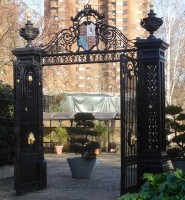
Today, little remains of Cremorne Gardens except a few street names and a small park close named Cremorne Gardens next to the river. This delightful, small open space has a paved section as well as a lawn. It is a tiny fragment of the original Cremorne Gardens but a fitting memorial to a place that provided entertainment for Londoners over many years. A couple of piers project into the river. These were originally landing stages for visitors arriving at the Gardens by river boat. Another souvenir of the heyday of the Gardens is a pair of wrought iron gates that stand in the present plot, but not in their original position, now built over. Small though it is, with its superb views of the Thames, the present Cremorne Gardens is a pleasant place to visit, within a short distance from the fashionable Kings Road.
TEARING DOWN STATUES or defacing them is nothing new, as some might believe after hearing about dunking Edward Colston’s toppled statue into a river in Bristol.
Violette Szabo
When I visited Albania in 1984, I saw statues of Josef Stalin and the Albanian dictator Enver Hoxha prominently placed in public spaces. Neither of these two gentlemen can be seriously considered to be God’s best gifts to humanity. Many of their actions caused great fear and suffering in both the former USSR and in Albania.
In 1991, Albania’s long (1944-1991) Communist regime crumbled ignominiously. In February 1991, citizens of Albania’s capital, Tirana, attached cables to a huge statue of Enver Hoxha, an admirer of Stalin, and pulled it down. Many of the police guarding the huge monument to repression assisted the people to cause this bronze statue to topple to the ground.
Years later, in 2016, we visited Albania. In the centre of Tirana, there is a national museum of art, which was present when I visited the city in 1984. Back then, and even in 2016, there was a good collection of fine works created in the Social Realism style, so popular amongst Communist regimes. After seeing the gallery in 2016, we happened to bump into one of the museum’s curators. I showed him a picture of a sculpture I had taken in 1984 and asked him if he recognised it. Without answering, he invited us to follow him to a yard at the rear of the gallery.
There, in the yard, stood the sculpture I had photographed in 1984. More interestingly, it was not alone. It stood next to a giant statue of Lenin and another one of Stalin and another large object wrapped in cloth tied down with ropes. The curator explained that these statues, although they depicted people whose ideas and actions had done much harm to the Albanian people, were valuable works of art, not simply because of their great scrap metal value but, more importantly, they helped record the country’s history. In addition, he explained that they were fine examples of their genre. The bundled-up object standing in that yard was, he explained, too sensitive to uncover as it would upset many people viewing it. It was part of an enormous statue of Enver Hoxha, who had not yet been forgiven by many Albanians. Clearly, Lenin and Stalin were thought to be less disturbing as they were not covered up, but sufficiently upsetting to be confined to a relatively unvisited yard behind the gallery open to the public.
Both Trafalgar and Parliament Squares in London contain statues that might cause offense to those whose knowledge of history is more than superficial, yet their actions have not always been 100% reprehensible. Fortunately for these monuments, many of the kind of people who might be inclined to topple statues do not usually read much detailed history.
There are some statues or monuments, which remember people, whose actions cannot rationally be called into question. One of these is that of Edward Jenner (1749-1823), whose work formed the foundation of something on which we are currently becoming extremely dependent: vaccination. Only someone out of his or her mind would consider pulling down or defacing his statue.
Recently, when strolling along an embankment, I spotted a monument close to the River Thames outside Lambeth Palace. Erected in 2009, it commemorates the Special Operations Executive (‘SOE’), whose covert activities in no little way helped to bring about the defeat of Nazi Germany’s forces during WW2. The plinth with metal commemorative plaques is topped with the head of a woman with high cheekbones, a serious, determined face, and luxuriant curly hair, tied back. She stares out across the River Thames toward the Houses of Parliament. The bust depicts Violette Reine Elizabeth Szabo (1921-1945), whose actions behind enemy lines in France were designed to sabotage German military activity. She was one of many women including Noor Inayat Khan (1914-1944), of Indian aristocratic heritage, who risked and lost their lives to assist in the defeat of a repressive regime.
SOE was staffed by both men and women of many nationalities, and their bravery is recorded on this simple memorial outside Lambeth Palace. Although simple in design, the expression depicted in the face of Violette Szabo gave me a feeling of the great determination of those brave souls who gave up their lives in horrific circumstances. They did so in the hope, fulfilled, that we could enjoy life in Britain and elsewhere without having to bear the burden of inhumane dictatorial rule.
Unlike Stalin and Hoxha, statues of the purely benevolent such as Jenner and Szabo should be allowed to stand undisturbed for ever, well, at least, so long as they can survive London’s ever-changing weather conditions and pollution.
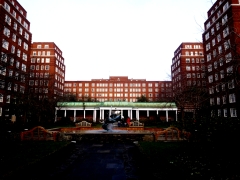
I HAVE NEVER VISITED MOSCOW, but I imagine that the huge, rather forbidding looking apartment block on Grosvenor Road facing the River Thames, would not look out of place in the Russian city. Covering seven and a half acres of land, built with twelve million bricks and almost seven thousand external window units, and containing at least twelve hundred flats, this mammoth building complex, which has been home to many of the famous and infamous, was completed in late 1936. This enormous residential complex is called Dolphin Square.
Maps surveyed in 1869 and 1913 reveal that the land on which Dolphin Square was built, which is west of St Georges Square, used to be the site of the several long buildings that together made up the Royal Army Clothing Department and its storage depots. Before that, the land was occupied by the work premises of the developer and builder Thomas Cubitt (1788-1855), who built much of Belgravia and Pimlico. A few years after his death, the army leased the site and the depot stood there until 1933, when the lease reverted to the Duke of Westminster (https://en.wikipedia.org/wiki/Royal_Army_Clothing_Depot).
An American firm, Fred F French Companies, bought the freehold of the former army clothing compound, and then, discovering it had insufficient funds to develop it, sold it on to Richard Costain Ltd. Costain commissioned the architect Stanley Gordon Jeeves (1888-1964), whose other works include the now demolished Earls Court Exhibition Centre and the still standing large, art-deco Latimer Court at Hammersmith, to design the residential complex that exists today. Writing soon after it opened, the writer AP Herbert (1890-1971) wrote a book extolling the virtues of Dolphin Square. He wrote that it is:
“…a city of 1,250 flats, each enjoying at the same time most of the advantages of the separate house and the big communal dwelling place …”
Commenting on the fact that the complex included a restaurant, he wrote:
“…fortunate wives will not have enough to do. A little drudgery is good for wives, perhaps. The Dolphin lady may be spoiled.” (quotes from www.theundergroundmap.com/article.html?id=2792)
From outside the building, Dolphin Square looks monolithic and forbidding. However, on entering the huge courtyard within it, this impression changes. For, the courtyard contains a lovely garden, which was designed by Robert Sudell in about 1937 (https://historicengland.org.uk/listing/the-list/list-entry/1455668). Though much modified since then, the formal garden retains much of the original design concept including an axial avenue lined with chestnut trees. Appropriately, the middle of the garden is adorned with a fountain with three sculpted dolphins. Created by the sculptor James Butler (born 1931), this was placed in 1987 to replace an earlier fountain. This pleasant garden would be one good reason to entice me to live in this extraordinarily massive complex.
As mentioned already, Dolphin Square offers its residents a restaurant. It also contains an arcade of shops, a café, a gymnasium, a swimming pool, a laundrette, underground parking, a bar, a brasserie, a hotel, a tennis court, and more. And all of this is within a short walk of Westminster and the Houses of Parliament. This proximity to the centre of government means that many MPs have made use of Dolphin Square as their London ‘pads’.
Apart from politicians, including Harold Wilson, William Hague, David Steele, and many others, Dolphin Square has been home to people of fame and notoriety. According to an article in Wikipedia, some of these include Oswald Mosley and his wife Diana Mitford; the novelist Radclyffe Hall; Christine Keeler and Mandy Rice-Davies; the comedian Bud Flanagan; the spy John Vassall; and the tennis player Rod Laver. Princess Anne lived in Dolphin Square briefly in 1993, General de Gaulle based his Free French Government in part of the Square in WW2, and Sarah, daughter of Sir Winston Churchill, was:
It seems that a fascinating book about the residents of Dolphin Square is waiting to be written.
I had passed Dolphin Square plenty of times before entering its garden recently, but until now I had no idea that this far from attractive building was home to such a fascinating range of people nor that it contained such a fine garden. Just as one should not judge a book by its cover, it is a mistake to judge Dolphin Square from its exterior.






 yamey
yamey 