Unknown's avatar

About yamey

Active author and retired dentist. You can discover my books by visiting my website www.adamyamey.co.uk .

What’s in a name?

THE NAME MOLESWORTH immediately recalls a naughty schoolboy who cannot spell properly.  Nigel Molesworth, a pupil in St Custards, a preparatory school, appears as a character in books by Geoffrey Willans (1911-1958) such as “Down with Skool”, “How to be Topp”, and “Whizz for Atomms”. However, for the Cornish town of Wadebridge, the name Molesworth has other significance.
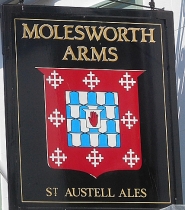
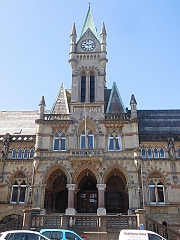
One of the main shopping thoroughfares in Wadebridge is called Molesworth Street. The Town Hall was opened in 1888 by Sir Paul Molesworth (1821-1889). A pub called The Molesworth Hotel, a former coaching inn housed in a building that dates back to the 16th century, is located on the street named after Molesworth. The pub was only named as it is today in 1817. Previously, it had various names including The Fox, The King’s Arms, and The Fountain.

Wikipedia informs us that:

“The Molesworth, later Molesworth-St Aubyn Baronetcy, of Pencarrow near St Mabyn in Cornwall, is a title in the Baronetage of England. It was created on 19 July 1689 for Hender Molesworth.”

Hender Molesworth (c1638-1689) was a Governor of Jamaica from 1684 to 1687 and from 1688 to 1689. Pencarrow House is just under 4 miles southeast of Wadebridge. Each of the 2nd, 4th,6th, and 8th Baronets represented Cornwall or parts of the county in Parliament. The Molesworths were (are?) major landlords in the area around Wadebridge.

Sir William Molesworth, 8th Baronet (1810–1855), was the grandfather of Sir Paul, who opened the Town Hall in 1888. This edifice bears a weathervane in the form of a steam railway locomotive. After undertaking a ‘Grand Tour’ of Europe, which lasted from 1828 to 1831, William made his way to Pencarrow, where he:

“…devoted time to establishing the Wadebridge-Bodmin Railway company. He engaged Hopkins the civil engineer to survey the land for the route with the prospectus for the formation of the Railway Company drawn up by Mr Woollcombe, from the family’s firm of solicitors.” (www.pencarrow.co.uk/story/sir-william-molesworth/)

This railway opened in 1834, was the first steam railway in Cornwall.  It continued in service until 1979. The tracks have been removed but some of Wadebridge’s station buildings have been preserved,

William became interested in radical politics. In 1832, he was elected Member for East Cornwall, and re-elected in 1835. As an MP, he:

“…had joined a group named the ‘Philosophical Radicals’ who advocated various reforms such as universal education, disestablishment of the church and universal suffrage.”

Between 1837 and 1841, William, having alienated his Cornish electorate, sat in the House of Commons, representing Leeds. After falling out with his Leeds constituents on account of his views on foreign policy, he retired to Pencarrow, where he dedicated his time to improving the gardens.

In 1844, William married a widow, an opera singer Andalusia (née Carstairs), who died in 1888. The year after his marriage, William was elected MP for London’s Southwark constituency, a seat he held until his death. Amongst his positions whilst representing Southwark, he was Secretary for The Colonies during the last few months of his life. He had wished to be buried in his grounds in Pencarrow, but instead he was buried in London’s Kensal Green Cemetery.

Sir William and his family are deeply involved in the history of Wadebridge and it is right that the Molesworth name is so prominent in the town. From now onwards when I hear or read the name Molesworth, a naughty schoolboy with spelling problems will not be the only thing that springs to mind.
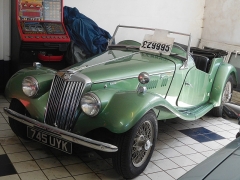
A filling station in rural Cornwall

THE LAST TIME that a person other than me put petrol into a car that I was driving was in August 2003 in South Africa, where self-service petrol pumps were then a rarity. In India, where I do not drive, vehicles are often filled by the garage attendants. Today (24th June 2021), we were driving along the A394 road in Cornwall when we spotted a petrol station, the modest-looking Double S Garage at Ashton, selling lower than average priced petrol. It was charging £1.26 per litre (currently the price of a litre in Cornwall ranges from £1.24 to £1.36).

I stopped by a pump and got out of the car, ready to operate the pump when an elderly man came out of the garage and on to the forecourt. Instead of having to fill the car myself, he filled it. While he was putting petrol into our car’s tank, I looked around and noticed that his small garage was filled with about five used cars, all with prices attached.

The most prominent car on sale was an aged Bentley, which the garage owner told me he had been driving for the past 15 years. The other cars in the small showroom-cum-garage included a vintage MG convertible; an old Jaguar sports car with a soft top; an Austin Seven complete with engine crank; and a very old looking Morris Minor. The owner, who had filled our car, allowed me to take photographs of his collection of old vehicles and appeared pleased when I told him that his garage was like a small motor car museum.

The Double-S is across the road from a small Victorian gothic chapel built with granite walls and a tiled roof. This is The Annunciation. It is the parish church of Breage with Godolphin and Ashton and is contained within the C of E diocese of Truro. The edifice was designed by the prolific church architect James Piers St Aubyn (1815-1895) and dedicated in 1884. The church is small but seen from outside, it is lacks architectural distinction.

We could have filled up at a superstore, where petrol prices are often not unreasonable, but I am glad that we patronised The Double S Garage, which must be amongst a diminishing number of fuelling places in England where the customer does not need to serve himself or herself. Also, it was fun finding the fascinating collection of vintage or almost vintage cars being stored close to the pumps. It is idiosyncratic experiences such as visiting this garage that help to make Cornwall a delightful place to visit.

A saint, a hermit on high, and a cousin

I HAVE OFTEN VISITED my cousin, Peter, who lives near Bodmin in Cornwall. On my way to see him, I have always noticed signs pointing to roads leading to Roche. It was this year, only on our most recent visit to the area, that we first visited the small village about 6 miles southwest of Bodmin.  Roche, pronounced as in ‘poach’, and is French for ‘rock’, is known as ‘Tregarrek’ in the Cornish language, which means ‘homestead on the rock’, which is a suitable name for the place, as I will explain.

Hermitage at St Roche, Cornwall

Unfortunately, the parish church was closed when we stopped in Roche. It is dedicated to St Gomonda, one of the many saints barely known outside Cornwall. Robert Meller, who is compiling a fascinating multi-volume, encyclopaedic account of Cornwall, wrote of Gomonda:

“Precisely nothing is known about this female-sounding saint and in reality, she might have been Saint Gonand, a male saint.”

Nothing is known about St Gonand. It is also possible that the church was dedicated to Bishop Conan, the first bishop of St Germans, appointed in the 10th century. The church itself has a Norman font (which we were unable to see) and a mediaeval tower (15th century). The rest of the church was rebuilt between 1820 and 1822 in a style typical of older churches in the area.

St Gomonda’s churchyard, which we entered by crossing over a stile made of granite slabs, contains a weathered Cornish cross, a primitive-looking monolith about six feet in height. The stone is covered with man-made indentations or carvings. One of these depicts a sword, which according to Meller, is an unusual image to be found on a Cornish cross. There have been standing stones, menhirs, such as the cross at St Gomonda, since before Christianity arrived in Cornwall. The crosses with Christian symbolism date from the 5th century onwards. It is therefore possible that the one we saw at Roche was pre-Christian with later Christian carvings, but here I am merely guessing.

About 420 yards southeast of the parish church, there is a ruined early 15th century, two-storied hermit’s chapel. Like many holy Hindu shrines in India and the monasteries in Greece’s Meteora district, the chapel perches high above the land around it. It can be seen 60 feet above its surroundings on the top of Roche Rock, whose presence inspired the naming of the village near it. Built in 1409 and dedicated to St Michael, the chapel used to be accessed by an iron ladder. At some stage, the cell beneath the chapel (on the upper floor) was occupied by a leper, expelled from his village because of his illness. He survived because every day, his daughter, Gundred, carried him water from a well about a mile and a half away. For her compassion and kindness, she was sanctified, becoming yet another of the saints of Cornwall.

Roche Rock and its chapel figure in various folk legends, including “Tristan and Isolde”. Meller wrote that when King Mark was chasing the lovers, Tristan and Isolde:

“… they took refuge in Roche Chapel to escape capture …To escape capture from the soldiers, Tristan jumped out of the chapel window – referred to as ‘Tristan’s Leap’”

Putting aside legends, the Roche Rock is an exceptional geological feature. Geologists consider it to be the finest example of quartz-tourmaline rock in Britain. It is composed of quartz and black tourmaline, which is a type of granite also known as ‘schorl’. Schorl is extremely hard and resistant to being worn away by the weather. Over the millions of years since this large lump of stone was formed, the surrounding terrain has been worn away, leaving the prominent rock that we see today.

I doubt that I would have thought twice about visiting the place had my cousin not lived nearby. I first met Peter in the early 1980s or late 1970s. Then, I got to know him and his family as friends. In the late 1990s, I began researching my family history, a process that included filling in gaps on family trees. A relative in New Zealand provided me with much information about a branch of my mother’s extended family. You might be able to imagine my surprise when I discovered from this information what Peter and I never knew before – that we are related; we have a common ancestor. We found out that apart from being friends, we are also members of the same family. Peter and I are doubly related because my mother’s parents were second cousins once removed. Peter and I are not only 4th cousins but also 5th cousins.

Our first visit to Roche proved interesting. Small as it is, Roche contains several things to see, which are some of the many features that help to make Cornwall attractive for visitors. Although one might not want to stay there, it is worth making a small detour from the main A30 road to explore the place briefly.

Packed with art in St Ives, Cornwall

THE TATE GALLERY has two branches in the picturesque fishing port of St Ives in Cornwall. The artworks displayed at Tate St Ives are contained in a building overlooking Porthmeor Beach, constructed between 1983 and 1993. It replaced a disused gasworks, but I feel that the gallery’s almost fascistic architecture neither does anything to enhance the town or to match the beauty of many of the items displayed within it. The other part of The Tate in St Ives is house and gardens of the sculptor Barbara Hepworth (1903-1975). A visit to her former home and its garden, filled with her sculptures, is a delightful experience.


Barbara Hepworth and her sculpture in the Penwith Gallery

Not far from the Tate St Ives, there is another ‘must-see’ attraction for lovers of modern and contemporary art. This is the Penwith Gallery on Back Road East. Less visited than the two Tate institutions in St Ives, the Penwith is the home of the Penwith Society of Arts, one of whose founders was Barbara Hepworth. The gallery contains one of the loveliest Hepworth sculptures that I have seen to date. Maybe I like it because it recalls the works of the Romanian born sculptor Constantin Brancusi (1876-1957), a sculptor whose works are much to my taste. To be frank, I am not a great lover of Hepworth’s sculpture and this piece in the Penwith is less typical of what I do not like about her work.

Returning to the gallery itself, its website reveals (https://penwithgallery.com/):

“The society was founded in 1949 by Barbara Hepworth,Ben Nicholson, Peter Lanyon, Bernard Leach, Sven Berlin and Wilhelmina Barns– Graham, amongst others. Later members have included Patrick Heron, Terry Frost and Henry Moore (honorary member). This association with so many progressive and influential artists has given the Penwith Society a unique place in British art history.

Today the society continues to play a central role in the thriving and vibrant St. Ives art community, exhibiting contemporary art from Cornwall and beyond.”

The gallery is housed in a former pilchard packing factory. Its ceiling is supported with roughly hewn granite pillars, painted white. Part of the ceiling is glass-covered, allowing natural light into the largest of the three main display areas. The rest of the ceiling does not transmit light.

The gallery displays an ever-changing collection of artworks, which are on sale. Created by members of the Society or artists, who have worked in the Society’s studios, they include sculptures, prints, paintings, and ceramics. Some of the works are figurative and many of them are abstract. Some are halfway between the two extremes. I have enjoyed abstract art since my childhood. This is probably because my mother, who was a sculptor who enjoyed creating abstract pieces. The lovely Hepworth piece that stands next to a fine photograph of its sculptor, and several other works, form part of the Penwith’s permanent collection. A small range of books and cards are available for visitors to purchase.

Every time I visit the Penwith, I enjoy the gallery’s spaces and the works displayed within them.  Instead of being packed with pilchards, as it was in the past, and other tourists, as are the two Tate establishments, the Penwith is comfortably packed with pleasing works of art, which you can take home if you can afford them, and some of them are not excessively costly.

Crossing the Camel

THE CONSERVATIVE CLUB in Cornwall’s Wadebridge has opened its doors to the general public. Visitors to the club of any political persuasion can enjoy superbly cooked food in its bar and dining room, which bears the name ‘Winstons’. The club, which is located at the higher end of Molesworth Street, is housed in a building that is far more than 100 years old. The street runs gently downhill towards a multi-arched stone bridge that crosses the River Camel.

Before there was a bridge across the river, the town now known as Wadebridge was called ‘Wade’ and stood beside a ford across the Camel, whose name probably means ‘crooked one’. Crossing the river by means of the ford was perilous. Before the bridge was built, a ferry became available as an additional means of traversing the wide stream. Becoming distressed by the number of people and animals that died whilst attempting to cross the river, the Reverend Thomas Lovibond, Vicar of Egloshayle, had the idea of building a bridge. This bridge was constructed between 1468 and 1485. It is said that its supporting piers rested on packs of wool. With the arrival of the bridge, the town of Wade became renamed ‘Wadebridge’. The chronicler and topographer William of Worcester (1415-c1482) mentioned the bridge as ‘Wade-brygge’ in 1478’.

 The bridge was widened in 1853 and again in 1963. It was refurbished in 1994. Although the stonework of the arches looks old, I am not sure how much of it is part of what was constructed in the late 15th century.

During the Civil War (1642-1651), Cornwall was a Royalist stronghold. Much of the rest of the southwest of England supported the Royalist’s opponents, the Parliamentarians. Wadebridge’s bridge was an important strategic location. In 1646, the Parliamentarian Oliver Cromwell (1599-1658) led 500 dragoons and 1000 horsemen successfully to take control of the bridge. The story goes as follows (www.cornwalllive.com/news/history/oliver-cromwell-came-person-take-511634):

“After losing the decisive Battle of Torrington in Devon on February 16, 1646, the Royalists escaped into Cornwall … [the] Parliamentarians, led by Thomas Fairfax, hunted them down and reached Launceston on February 25 and Bodmin on March 2 … On March 5 the Cornish Royalist leaders realised they were fighting a losing battle and surrendered the east of Cornwall to the Parliamentarians at Millbrook … A day later, as the battle moved westwards, Parliamentarian commander Oliver Cromwell and 1,500 of his soldiers descended onto Wadebridge to take control of the bridge and prevent its use by the Royalist army. The route across the bridge was considered to be of such strategic importance that Cromwell, who had been spending months mopping up resistance in Devon and Cornwall, personally led his troops there to capture it.”

The huge forces brought by Cromwell were either unnecessary or an effective deterrent because the Royalists withdrew without putting up a fight (www.wadebridgemuseum.co.uk/bridge.html).

The first motor car to cross the bridge did so in 1901. The crossing continues to play an important role in the transport network of Cornwall. The town is a charming small centre, well supplied with pubs, independent shops, and branches of supermarket chains. It is a part of the Parliamentary constituency of North Cornwall. Diners at, and members of, Wadebridge Conservative Club might (or might not) be pleased to know that the local MP since 2015 is Scott Mann, a Conservative. He was born in Wadebridge and attended its local state secondary school. I suppose that he must have dined or drunk at the Conservative Club where we enjoyed first class food. So, next time you are in Wadebridge, sweep aside any political prejudices you might harbour and head for Winstons at the Conservative Club and enjoy a great meal.

Image recalling lines of a verse

This photograph I took in Cornwall reminds me of lines from the first verse of a poem, “Elegy Written in a Country Churchyard”, written by Thomas Gray (1716–1771). The lines are:

The curfew tolls the knell of parting day,

The lowing herd wind slowly o’er the lea …”

Imitating the great: gothic in Winchester

THE CITY OF WINCHESTER has one of the longest gothic cathedrals in the continent of Europe. Built from 1091 onwards under the auspices of Bishop Walkelin, a relative of William the Conqueror, the bulk of the gothic part of the edifice was erected in the 14th century in the Perpendicular style of gothic. What was created, is exceedingly beautiful and gives a great sense of space. It is a masterpiece of gothic stone masonry. The cathedral stands not far from another large building, also built in a style of gothic inspired by what was achieved during mediaeval times.

This near neighbour is far younger than the cathedral. It is the 19th century Winchester Guildhall, which was constructed between 1871 and 1873. It stands on the site of St Marys Abbey, which was taken over by Henry VIII in the late 1530s during the Dissolution of the Monasteries. The remains of the abbey, which was known as ‘Nunnaminster’, persisted until the 17th century, after which they were removed. Today, some excavated remnants can be seen behind the Guildhall.

Guildhall, Winchester

The Guildhall was built in the gothic revival style to the designs of the architects Albert William Jeffery (1840-1915) and William Skiller (1838-1901), who also submitted a design for a town hall for Hastings in Sussex. Tragically, Skiller committed suicide in 1901 (http://hastingschronicle.net/archives/architect-hangs-himself/). The Guildhall was later extended by J. B. Colson (1820-1895), who was the surveyor of Winchester Cathedral.  The original building is rich is features borrowed from mediaeval gothic, but it is topped by roofing styles that remind the viewer of French ‘chateaux’. One source summarises the Guildhall’s appearance as:

“ Gothic, symmetrical, with a middle tower and this as well as the angle pavilions provided with French pavilion roofs”; and as having a “deeply vaulted porch” at the entrance — for all this part “[t]he style is Second Pointed,” while Colson’s long extension is “much plainer”” (https://victorianweb.org/art/architecture/winchester/1.html).

Without doubt, the cathedral is a far finer building than the Guildhall, but both are impressive in their own ways. The cathedral’s integrity depends on its gothic features that have both structural and aesthetic functions, whereas in the case of the Guildhall these features have a greater decorative than structural purposes.

The Guildhall is an example of so-called ‘gothic revival, which lovers of London’s St Pancras Station and Bombay’s Victoria Terminus (Chhatrapati Shivaji Maharaj Terminus) will appreciate’. Years ago, I read “The Gothic Revival: An Essay in the History of Taste”, written by the art historian Kenneth Clark (1903-1983) in 1928. One thing that impressed me was, if I recall correctly, that the author queried whether the gothic style of architecture ever really died out in England, as it did elsewhere in Europe. Clark suggested that the gothic style continued to be used. In other words, what is described as ‘gothic revival’ is simply a continuation of the early use of this style. It is my impression that by the 19th century, when, for example, the Winchester Guildhall was built, architects were often simply borrowing features of earlier gothic buildings, as, for example Winchester Cathedral, and applying them often more mechanically than artistically. Often when the gothic style was being used structurally, as is the case in many churches built during the Victorian era, it tends to be imitative rather than creative, as is the case in the great mediaeval cathedrals and other churches. There are a few exceptions, where the 19th century architect manages to use the gothic style both structurally and artistically, as for example in the Church of St Augustine in London’s Kilburn.   Be that as it might be, The Guildhall does not lack in good aesthetic features and adds positively to the rich tapestry of the architectural scene in the historic centre of the city. I recommend visitors to Winchester not to concentrate all their time at the Cathedral but to spare some to view the Guildhall before seeing the other sights of the city.

King Alfred gazes over Winchester

KING ALFRED RULED the West Saxons from 871 to c886 and king of the Anglo-Saxons from c886 to 899. He was known as ‘Alfred the Great’. Amongst his many achievements was encouraging education and proposing that primary education was taught in (Old) English, rather than Latin. Winchester was Alfred’s capital and the place where he was buried there for a while. After the Norman Conquest in 1066, his remains were removed to Hyde Abbey near Winchester. This was destroyed in 1538 during the Reformation. Despite this, his grave remained intact until 1788, when the land where he was interred was redeveloped to build a jail. Since then, the whereabouts of his remains is unknown.

Despite, the disappearance of his bones, King Alfred dominates the centre of Winchester in the form of a huge statue near to the city’s cathedral, rich in gothic features, and its Guildhall, which is richly adorned by Victorian gothic features. The statue was erected in 1899. A plaque at its base reads:

“To the founder of the kingdom and nation D. October DCCCI. Winchester and the English name MDCCCI”

DCCCCI, being Roman for 901 and MDCCCCI, being Roman for 1901.

The tall bronze statue was designed by Sir William Hamo Thornycroft (1850-1925), a sculpto who might have been unknown to me had I not become aware of him whilst walking near London’s Holland Park back in 2017. He was an important figure in the New Sculpture movement, whose members’ oeuvres bridged the gap between the neo-classical tradition, popular during the 19th century, and early modernist trends at the end of the 19th century and beginning of the next.

I was roaming around Kensington taking photographs of buildings of interest prior to writing a piece about them when I spotted a plaque on a house in Melbury Road. Number 2a was Thornycroft’s studio, which was designed by his friend, the architect John Belcher (1841-1913).

Although I did not realise that they were created by Thornycroft before I wrote this today, I am familiar with two of his other creations: the statue of Oliver Cromwell outside The Houses of Parliament and “The Sower” at Kew Gardens. His Alfred statue is far larger than the other two.

I wonder what the great king would have thought if he knew that at his feet today, there is a short-term car park and that his capital’s cathedral now charges a fee for visitors to enter within it.