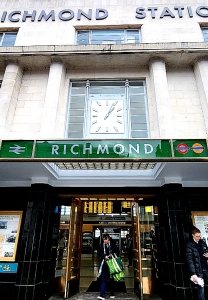
Art Deco Modernism greets the traveller at Richmond

WE VISIT RICHMOND-ON-THAMES often, frequently arriving on the District Line of the London Underground.  However, it was only yesterday, 31 October 2025, that, while waiting for a bus outside the station. I noticed that its façade is a fine example of the Art Deco style of Modernist architecture, which achieved popularity between the two world wars.

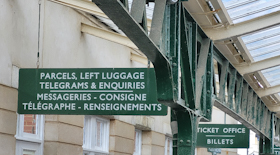
The first Richmond station was opened in 1846. The current station was built in 1937. It was designed by Southern Railway’s Chief Architect James Robb Scott (1882-1965), whose other works include the offices and Victory Arch at London’s Waterloo Station. Richmond station’s façade is mainly constructed with white Portland stone. The main entrance has black features constructed using polished black granite. Within the recently restored ticket hall, there is a green glass frieze that surrounds the hall and contains the original wording that indicates the various services offered within the large room. The walls of the hall are lined with travertine cladding and the light fittings hanging from the ceiling are of a Modernist design typical of the era during which the station was built.

Until 2025, many of the original Art Deco features of the station, both internal and external, were either hidden by modern panelling or were in poor condition. Between 2023 and 2025, the station was carefully restored to its original splendid state.

After catching our bus, I noticed that we passed several other Art Deco buildings near to the centre of Richmond. These were blocks of flats. Before returning to the station, we stopped outside one of these, Lichfield Court. This was designed in the Streamline Moderne style, a type of Art Deco, by George Bertram Carter (1896-1986), and completed in 1935. Incidentally, Carter had been a pupil in the office of Edwin Lutyens between 1919 and 1922. Apparently, this block of flats incorporates some innovative features, which we did not have time to see.

Until our most recent visit, I never associated Richmond with Art Deco architecture. On our next visit, I hope to wander around, examining the examples of this style in greater detail.

The station where Gandhi landed in England in 1931

WHEN MAHATMA GANDHI came to England in 1931, he disembarked at Folkestone in Kent. In those days there boats docked alongside a pier, and then boarded trains at a station on the pier. The pier has long since ceased to be used to service cross channel and other passenger boats, but it and the station have been preserved and converted into a tasteful leisure amenity.

A more detailed history of the pier and its station is available here: https://gujarat-travels.com/2021/10/24/where-mahatma-gandhi-set-foot-in-england-in-1931/

Lloyd George on the railway tracks at Paddington station

IT IS NOT UNCOMMON to find that transport vehicles such as trains, boats, and aeroplanes, are given names. They are often named to honour noteworthy people. While strolling along platform 1 at London’s Paddington station today (21st July 2024), I noticed a train bearing the name ‘Megan Lloyd George CH’. You will, I hope, excuse my ignorance when I tell you that although I have heard of David Lloyd George (1863-1945), a former Prime Minister, Megan Lloyd George was not a name with which I am familiar. I wondered why the Great Western Railway (‘GWR’) had chosen to put her name on one of its trains. When I got home, I found out why.

Megan Lloyd George (1902-1966) was the youngest child of the Prime Minister David Lloyd George. She was born in Criccieth, Wales. Until she was four years old, she could only speak in Welsh. Between the ages of 8 and 20, she spent much of her life in the Prime Minister’s residence, 10 Downing Street. It is not surprising that the young lady became interested in politics. With some help from her father, Megan became the Liberal party candidate for the Welsh constituency of Anglesey, and in May 1929, she was elected as its Member of Parliament (‘MP’). She became the first woman MP from Wales. She was re-elected in the general elections of 1931 and 1935.

According to a biography (https://liberalhistory.org.uk/history/lloyd-george-megan/), Megan accompanied her father:

“… on his visit to Hitler in 1936, and opposed the policy of appeasement, urging him to press for Chamberlain’s resignation in May 1940.”

She served in Parliament throughout WW2, and was re-elected in 1945 and 1950, but with greatly reduced majorities. In 1952, she lost her seat.

For various political reasons, Megan and several other members of her party left the Liberal Party and joined the Labour Party in April 1955. In 1957, she became the Labour MP for Carmarthenshire, with a majority of 3000 votes. Always a popular figure, she took Carmarthenshire again in 1966, with a majority of 9000. By then, she was suffering from cancer, and died soon after the election and a few days after having been awarded the Companion of Honour (‘CH’) by Prime Minister Harold Wilson. In 2016, she was nominated as one of the ‘50 Greatest Welsh Men and Women of All Time’ (www.walesonline.co.uk/news/wales-news/50-greatest-welsh-men-women-11431779).

GWR trains run from Paddington to the west of England and parts of Wales including its capital, Cardiff. So, we should not be surprised to find Megan’s name on one of them. Having said that, I am not sure where the train with her name on it was heading as it left platform 1.

A bell at Byculla railway station

THE RAILWAY LINE between Bombay(Mumbai) and Thane was opened in 1853. Byculla Station was one of its original stations when trains began running along this stretch of track. At first a wooden building, it was soon replaced by the present stone structure, which was ready for use in 1857. This historic station, the oldest surviving railway station in India. was beautifully restored recently.

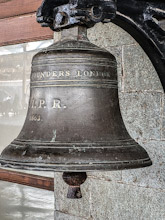
On platform 1, I spotted an old bell hanging close to one of the station’s offices. It is marked with the initials “GIPR”and the date 1863. The letters are the initials of the Great Indian Peninsula Railway company, which was incorporated in 1849. In contract with the British East India Company, its aim was to link the British Presidencies by rail. The first stretch to be built was that between Bombay and Thane.

The bell carries the name of its manufacture – “Mears & Co. Founders London”. This bell foundry, first established in the 16th century, moved to London’s Whitechapel Road in the very early 18th century. It was where one of the largest bells in St Paul’s Cathedral was made. The Mears family ran the foundry between 1784 until 1873.

The foundry ceased working in 2017. The bell at Byculla Station has by now long outlived the bell foundry in Whitechapel and the British Empire, during whose existence it was manufactured.

A strange notice in a railway station

BE THEY LARGE OR SMALL, I always enjoy railway stations. Today, the 7th of January 2023, we visited the Central Station in Chennai (Madras). This huge edifice is also known as ‘Puratchi Thalaivar Dr. M.G. Ramachandran Central Railway Station’. It is the busiest station in southern India. When we visited it at about 11 am, it seemed rather sleepy even though there were many people waiting for their trains.

The station was designed by a British architect George Harding. Its distinctive exterior has neo-Romanesque decorative features. It was first opened in 1873, but was rebuilt twice: in 1959 and 1998.

We bought coffees to drink in a canteen within the station. After paying at the cash desk we were given two small plastic discs, like counters used in board games. Each disc had the word “coffee” printed on one side of it. We handed these to a lady who prepared excellent South Indian filter coffee.

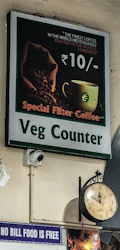
The walls of this small café-cum-restaurant are decorated with murals depicting Chennai and the Central Station. Numerous informative notices were also displayed in the walls. One informed customers that all of the water used had been filtered. Another forbids the eating of “outside food”, which means food not bought in the canteen. Yet another reassured customers that “medium refined” cooking oil was used in the kitchen. And another warned clients that they are under cctv surveillance.

One notice puzzled us. It reads: “NO BILL FOOD IS FREE”. Grammatically, it made no sense to us. We asked another customer, who was standing close to us, if she could explain. She smiled, revealing a set of teeth that would have benefitted from orthodontic treatment, and then, as quick as a flash, she explained that these words mean that without paying, no food will be served.

William Wordsworth and others in Golders Green

HAD YOU VISITED GOLDERS GREEN in 1876, you would have arrived at:
“… a little outlying cluster of cottages, with an inn, the White Swan, whose garden is in great favour with London holiday makers … from the village there are pleasant walks by lanes and footpaths …” So, wrote James Thorne in his “Handbook to the Environs of London”. Of these lanes, Hoop Lane still exists. The White Swan was in business until recently but has disappeared since I took a photograph of it about three years ago.. I do not think that I would recommend Golders Green as a holiday destination anymore. It is not unpleasant, but it is no longer rural and lacks the atmosphere of a resort. The poet and physician Mark Akenside (1721-1770), a friend of the politician Jeremiah Dyson (1722-1776), who had a house in Golders Green, and a frequent visitor to Dyson’s place, wrote, while recovering from an ailment:

“Thy verdant scenes, O Goulder’s Hill,

Once more I seek a languid guest;

With throbbing temples and with burden’d breast

Once more I climb thy steep aerial way,

O faithful cure of oft-returning ill …”

Another poet, now better known than Akenside, William Wordsworth (1770-1850) wrote:

“I am not unfrequently a visitor on Hampstead Heath, and seldom pass by the entrance of Mr Dyson’s villa, on Golder’s Hill, close by, without thinking of the pleasures which Akenside often had there.”

In those far-off days visitors from London could either reach Golders Green by crossing the range of hills north of Hampstead on a road that follows the path of the present North End Road or, after 1835, when it was completed, by travelling along Finchley Road. The end of Golders Green’s existence as a rural outpost of London and its development as a residential suburb began in June 1907, when the  Charing Cross, Euston & Hampstead Railway (now part of the Underground’s Northern Line) opened the above-ground Golders Green Station.

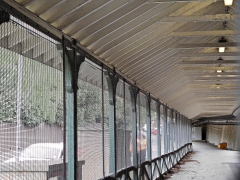
My family used Golders Green Station on an almost daily basis. During my childhood, there were two ways of entering it. One way, which still exists, is from the large station forecourt, the local bus and coach station. The other way, which was closed at least 35 years ago, was from Finchley Road. An entrance beneath the railway bridge led to a long, covered walkway (see the illustration above) under an elaborate wooden structure, open to the outside air on most of its two sides. The husband of one of my father’s secretaries once remarked that the wooden canopy reminded him of structures he had seen in India. Having visited India myself, I now know what made him think of that.  The walkway led to a ticket office, beyond which there was a corridor from which staircases provided access to the outdoor platforms. Our family favoured using the Finchley Road entrance because it was slightly closer to our home in Hampstead Garden Suburb than the other one next to the bus yard.

In the early 1960s, when I was still a young child, northbound Underground trains coming from the centre of London stopped on one of the two northbound tracks that ran through the station. In those days, the doors on both the left and right sides of the train opened in Golders Green. If the train entered on the left track, that closest to the bus yard side of the station, we used to leave the train by the right hand doors, which led to the platform whose access staircases were closest to the Finchley Road entrance. We did this almost like a reflex action, without thinking about it.

One day, after my father had taken me to spend time in town with him, probably at his workplace, the LSE, we returned to Golders Green by Underground. As usual, since the train had stopped at the platform closest to the bus yard, we waited for the opening of the doors on the right-hand side of the train. Standing facing these doors, we could hear the opening of the doors on the left-hand side. We waited and waited, and then the train began to continue its journey northwards towards the next station, Brent. We were astonished that ‘our’ doors had not opened. My father was mildly upset by this. We behaved like creatures of habit. I was really pleased because I had always wanted to travel beyond Golders Green Station to see what exciting scenery lay beyond it.  It was not, I remember, the rural scenes that visitors in the 19th century and earlier would have enjoyed.

Scene in a ticket office

BUDAPEST KEL PU 83 Farewell 2

I used to visit Budapest in Hungary frequently in the 1980s during the Communist era. I had many good Hungarian friends there. They were very hospitable to me.

One day, I happened to visit the advanced booking office at Budapest’s grand Keleti (Eastern) Station. I have no recollection of where I was planning to go, but that is not relevant to the true story that follows. The smallish rectangular room was lined with about ten (or more) counters at each of which there was a booking office official. 

A young Soviet Russian soldier entered the room. He was in an immaculately smart uniform and looked proud. He went up to the first counter and spoke to the person behind it. After about a minute, he was instructed to go to the next counter. Once again, he spoke to the official behind the window at the counter. And, after a few minutes, he was directed to the next counter. This went on until he had visited each counter in the room and reached the last one. At the last one, the official indicated that he should leave the room as he was in the wrong room for obtaining tickets for Soviet military personnel.

You might have thought that the official at the first counter he visited would have directed him to the correct place, but no. So great was the average Hungarian’s disdain for the Soviet soldiery that was keeping their country under the thumb of the Soviet Union that the officials in the booking office conspired together to waste the young Soviet soldier’s time and humiliate him. It was a beautiful example of passive resistance.