THY HAND, GREAT ANARCH BY NIRAD CHAUDHURI

HAVING BEEN BEFRIENDED by the author’s son Prithvi, and having seen some of his father’s belongings stored in the Calcutta Club (in Kolkata), I finally got around to reading a book that I bought almost 30 years ago. The 960-page volume by Prithvi’s father, Nirad C Chaudhuri (1897-1999), is called “Thy Hand, Great Anarch”, and was first published in1987. The title comes from a couplet in a poem by Alexander Pope (1688-1744):

“Thy hand, great Anarch! lets the curtain fall;

And universal Darkness buries All.”

This pessimism well summarises what Chaudhuri has written in his enormous tome.

The book is the second part of Chaudhuri’s autobiography. It covers the period from 1921 to 1952 – the years leading up to the end of British rule in India and the first few years after the country gained its independence. Chaudhuri was a keen observer of what was going on in India during this period. Without pulling any punches, he gives his often-critical opinions of what was going on in the country, and never fails to point out what he felt was being done wrong both by the British and also by the Indians fighting for the end of British rule. Although he wrote this book long after 1952, he quotes from things he wrote during the period he described. He did this, I believe, to prove to the reader that his frequently idiosyncratic opinions were not as a result of looking back with hindsight, but were what he thought at the time.

One of Nirad’s chief criticisms of the various different freedom fighters was that they all expressed their dislike of British rule but, according to him, none of them proposed plans for how India was to be ruled if or when independence was achieved. I have read several books about the history of India’s fight for freedom, and most of them portray leaders such as Gandhi, Nehru, Vallabhai Patel, and Subhash Chandra Bose as heroic figures. This was not how Nirad portrayed any of them. Having been the personal secretary of Bose’s brother Sarat Bose, Nirad was in a good position to observe many political events at close hand. As for Gandhi, he wrote (giving his reasons):

“To take the question of his contribution to Indian independence first. It is a blatant falsehood to say that he or his movements brought it about, whatever their moral effect.”

This was not an opinion I had come across before in histories of the struggle for India’s independence. It is his highly individual and original views that help to make his book so engaging. He writes very scornfully of Subhash Chandra Bose’s politics and his cooperation with the British Empire’s enemies during WW2. As for Jinnah – the ‘father’ of Pakistan – he showed less disdain, writing:

“I must set down at this point that Jinnah is the only man who came out with success and honour from the ignoble end of the British Empire in India.”

Unlike members of the Indian National Congress and their opponents – the British Government, Jinnah:

“… never made a secret of what he wanted, never prevaricated, never compromised, and yet succeeded in inflicting an unmitigated defeat on both the British Government and the Indian National Congress.”

Although I got the feeling that Chaudhuri admired the British and believed that Indians would fare better by being part of the British Empire than they would in an India ruled by Indians, his book is by no means short of criticism of the British as colonists, during the last years of empire, and after India became independent. Figures such as Attlee and Mountbatten get little or no praise from Nirad. At the beginning of a chapter called “Mount Batten Piled on Mount Attlee”, he wrote:

“As if Attlee single-handed was not enough to complete the work of demolition begun by the more cunning mediocrity. Baldwin, he piled on himself Lord Mountbatten to add greater work to his policy, which brought endless misfortunes to the Indian people.”

As the book’s title suggests, the text contains Nirad’s views on the anarchy he perceived developing as India approached independence, and then after having achieved it. It is not surprising, given what he wrote and thought about the country of his birth that Nirad chose to move to England (in about 1982) and lived there until he died. Many readers might be surprised or even horrified by what the author wrote, but he takes care to make whatever he thought sound reasonable to his readers. There are parts of the book which I found hard going – difficult to comprehend, but I ploughed on regardless, and was pleased that I did.

PHOTOGRAPHY, POLITICS, AND FEMINIST PROTEST IN PECKHAM

PHOTOGRAPHY HAS LONG been an artistic medium for expressing protest. This is well exemplified by photographic images on display at the excellent “Women in Revolt” exhibition, which is on at London’s Tate Britain until the 7th of April 2024, and is well worth seeing. Running concurrently with this. is an exhibition at the South London Gallery (in Peckham) – “Acts of resistance: photography, feminisms and the art of protest”, which is on until the 9th of June 2024.

As its title suggests, the show at Peckham consists mainly of exhibits that make use of photography. There are also several digital items.  The subject matter deals with matters that concern feminists (and ought to concern everyone) including rape, abortion, genital mutilation, other forms of violence against women, and so on. Unlike the exhibition at Tate Britain, which deals mainly with feminist activities in Britain during the 1960s to 1980s, this show was to coin a phrase ‘art sans frontières”, and bang up to date. The exhibition has as its inspiration the words that the artist Barbara Kruger used in 1989:

“Your body is a battleground”.

Incidentally, there is an exciting exhibition of Kruger’s work at the Serpentine South Gallery (in Kensington Gardens) until the 17th of March.

The exhibition at Peckham (to quote the gallery’s website):

“… explores feminism and activism from an international and contemporary perspective. Looking at different approaches to feminism from the past 10 years, the show highlights shared concerns including intersectionality, transnational solidarity, and the use of social media and digital technology as a tool for change.”

It includes works by at least 20 artists, some of them working as collaborators. Their creations are displayed well both in the gallery and its annexe nearby in a disused fire station. Put simply, the works on display at Peckham have a far more visceral impact than those being shown at Tate Britain, which in many cases appeal more to the brain than to the heart. Even if you ignore the messaging conveyed by the artists in the works at Peckham – and this is not easy to do – their visual impact is magnificent. They are works of art as well as being tools of protest. This is an exhibition well worth making the trek out to Peckham!

A twentieth century American artist who seemed to have lost his way

THE EARLY WORKS OF artists, who became famous for their successful experimentation in style and expression (such as Matisse, Picasso, Van Gogh, Miro, and Hockney), began by making quite conventional figurative pictures – always competently executed. Such was also the case with the artist Philip Guston (1913-1980), who was born in Canada, son of Jewish parents who had migrated from Czarist Russia. Born ‘Goldstein’, he later changed his surname to ‘Guston’. His family moved to Los Angeles (USA) in 1922. His childhood was filled with trauma: his father committed suicide, and soon after that his brother was killed in a motor accident. He began to be involved with art as a way of dealing with these sad events. In the 1930s, he engaged with political activity, fighting racism and anti-Semitism at a time when the Ku Klux Klan was enjoying some prominence. Several of his paintings depict hoods, such as were worn by the Klan.

There is a retrospective exhibition of Guston’s works at London’s Tate Modern until the 25th of February 2024. The paintings are exhibited chronologically on the walls of eleven interconnecting display areas. Like the artists listed at the beginning of this piece, Guston’s early works are figurative and very beautifully painted. Many of these powerful images reflect his concerns about the adverse political developments he observed during the 1930s. Later, in the 1940s, he became friends with artists like Mark Rothko and Willem de Kooning, and he moved successfully from figurative painting to abstraction. He became well-known as an abstract artist. After that, in the 1960s, his art seemed to my eyes to go downhill.

Guston’s later works, which are partly figurative and partly abstract, and created in and after the late 1960s, were undoubtedly created to send messages to the viewer. However, I found them to be crudely executed in comparison with his earlier abstract and much earlier figurative works. Whether this crudeness was deliberate or reflected a decline in the artist’s ability I cannot say. These later works express the artist’s personal crises and his reaction to injustices and other global catastrophes, but they did not do much for me from an aesthetic point of view. Had I left the exhibition without seeing them, my admiration for Guston would have been higher than it is having seen them.

Embroidering in Palestine past and present

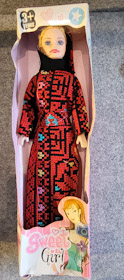
THERE IS A SUPERB exhibition at Cambridge’s Kettles Yard until the end of October 2023. The beautiful exhibits are mainly garments embroidered by Palestinian women before and after 1947. There are also a few other items including Palestinian propaganda posters depicting women wearing embroidered garments. The labels next to the exhibits are full of interesting information. Several of the topics particularly interested me.

Some of the garments were made using scraps of pre-used materials – for example bits of old clothes or even sacking and other packing materials. These old textiles were stitched together to create new clothes. This reminded me of a similar recycling of old materials which I saw at an exhibition of Japanese recycling at London’s Brunei Gallery.

I saw examples of Palestinian dresses which seemed very long. The length of these skirts was for a purpose. The cloth could be raised up to produce pocket like folds in which objects could be carried. These dresses were worn by Bedouins living in the Bethlehem and Jerusalem areas.

There was a widow’s dress. It was dark blue – the colour signifying grieving – and trimmed with red threads, which signified that the wearer was ready to be remarried.

One room was dedicated to embroidery and how the troubled situation in Palestine affected it. In refugee camps, some of the traditional materials were unavailable, and women had to embroider using whatever threads they could get hold of. There were several embroidered dresses adorned with decorations including the Palestinian flag and other patriotic motifs. These were displayed in the same room as the pro-Palestine propaganda posters that show women wearing embroidered garments.

I hope that what I have written gives you something of the flavour of this fascinating exhibition. Despite the intense reactions that discussing the plight of the Palestinians often arouses, the exhibition at Kettles Yard takes a reasonably balanced view of the situation. Its emphasis is on the skills of the Palestinian embroiderers rather than the politics of the part of the world where some of them still reside.

Seeing red

KAYAL ISLAND RETREAT is a small but tastefully luxurious resort on the east coast of the long thin Kakkathuruthu Island in the backwaters of Kerala, not far from Alappuzha (Aleppey). Our friend who owns it kindly invited us to spend an afternoon there. During our stay, we were taken on a delightful boat trip through the peaceful backwaters. After that, the resort’s manager took us on a walk through the rustic tropical landscape from the resort to a nearby small ferry landing stage on the west side of the island. We followed him along a winding path that threaded its way between small farmhouses, fields, fish farms, ponds, and reed beds.

All along the path, there was a series of concrete poles that supported overhead electricity cables. On almost every one of them there was red painted graffiti. Many of the poles were daubed with the initials ‘DYFI’, which stands for the Democratic Youth Federation of India, which is affiliated to the CPI(M) – the Communist Party of India (Marxist). Some of the poles also had depictions of the head of Che Guevara and five-pointed red stars or the letters ‘CPIM’. One pole had “Viva Revolution” on it and some others were daubed with the names of countries including Mexico and Bolivia, At least one house along our route had a large hammer and sickle painted on it. With the exception of the country names, all of these manifestations of Communism are frequently seen all over Kerala, which at times has been ruled by Communist governments,

At the small ferry landing stage, we watched some women and schoolchildren disembark from the ferry – a small boat with an outboard motor. Overlooking the simple wooden landing stage, there was a tall metal pole with the letters BJP on top of it. The pole supported two cords from which BJP flags were fluttering. The BJP (Bharatiya Janata Party) is currently in power as the Government of India.

I asked our guide how the locals tended to vote on the island. He believed that most of them would probably vote for the Communists or some other Socialist party, rather than for the BJP. As we walked along in the hot humid air, I mused upon the contrast between the wealthy holiday makers enjoying our friend’s resort and the relatively poor inhabitants of the island with leftward leaning political sympathies, who might, in theory at least, be antipathetic to the idea of outsiders relaxing luxuriously on their island whilst they slog away in the hot sun. Whatever they believe, the resort does bring additional employment opportunities close to their homes – almost all the staff are from the island.

Art and documentaries at the Kochi Muziris Art Biennale 2022

ASPINWALL HOUSE IN Fort Kochi is the epicentre and largest exhibition space of the Kochi Muziris Art Biennale. We have attended this event four times to date – 2014, 2016, 2018, and 2022. Outside the main entrance to Aspinwall House, there is a list of those companies, organisations, and individuals, who have donated money to the Biennale. The current (2022/23) list has the following heading “Principle supporters”. Is this wording an undetected typographical error, or is it intentional, or is it a Freudian slip? I ask this question because the sentiments expressed in many of the exhibits question the consequences of the activities of some of the donors.

Far too many of the exhibits in Aspinwall House are more like well-made documentaries than what has until recently been regarded as art. The documentary exhibits are mostly well put together with superb still photography and cinematography, and quite a few of them are highly informative – akin to, for example, National Geographic productions.

The majority of the documentary-like exhibits have elements of political protest, often leftward leaning. Now, I have no objection to political protest in art, but I wonder whether some of these exhibits have strayed too far from what used to be considered art, and have become more documentary than artistic. In the past, to mention but a few, artists such as Picasso, George Grosz, Otto Dix, Joan Miró, Subhi Tagore, Diego Riviera, and currently William Kentridge, have made artworks with political content. These artists and some of their contemporaries produced artworks which are not purely political or polemic, but can also be enjoyed as purely visual experiences; knowing the message is not important to the impact the works make on the viewer, but can add to that. Much of what is on display at Aspinwall House during the current Biennale simply thrusts political messages at the viewer. There is little else to appreciate but often depressing messages and images.

As for the abundance of photography it is mostly superb. Since the invention of photography, it has been used highly creatively by some photographers. Examples of these include Julia Margaret Cameron, Charles Dodgson, László Moholy-Nagy, Ansel Adams, and Alfred Stieglitz. Artists like these were competent photographers who exploited the camera to create original images that would have been difficult if not impossible to produce with other artistic materials. In contrast, many of the beautiful photographic works in the current Biennale seem to be aiming at documentary or archival accuracy rather than creative images – works of ‘pure’ art.


Having blasted at what I did not like about the Biennale, I must point out that there are many artworks that satisfied me purely visually. Some of them are in Aspinwall House, but many of them are elsewhere, notably in the Durbar Hall in Ernakulam. The works that impacted me positively because of their purely aesthetic 7characteristics might also be conveying political sentiments, but the nature of these did not impede my immediate, visceral rather than cerebral enjoyment of them.

Returning to the predominantly documentary exhibits, those that made most impact on me were housed in the TKM warehouse complex in Mattancherry. Some of the works there are not only political or polemical, but also highly creative and artistic (in the old sense of the word).

As for the odd use of “principle” on the list of donors mentioned above, I found this not only careless but ironic. Many of the artworks in the current Biennale question the principles of some of the donors, who funded the show.

Having read this, you can call me ‘old-fashioned’ or ‘politically incorrect ‘ if that makes you feel better. I might well be both, but I was brought up by my artistic parents to appreciate the works of both old masters and contemporary artists equally, be they works by Piero della Francesca or JMW Turner or Brancusi or Barbara Hepworth or Rachel Whitehead or Anish Kapoor.

Visit the Kochi Muziris Art Biennale if you can before it ends in early March 2023, and judge it for yourself. Almost all of the exhibits are housed in heritage buildings, which are alone worth seeing. I look forward to the next show in 2024/25.

Body Politics at the Barbican Gallery

AT THE TICKET desk of the Barbican Gallery we were hesitantly asked if we knew about the exhibition of Carolee Schneemann (1939-2019) because it contains some sexually explicit exhibits. We said we knew roughly what we were heading for.

The exhibition is laid out on two floors and visitors are given a suggested route that allows one to see the gradual development of Schneemann’s work from abstract and semi-abstract painting through to highly adventurous installations and happenings (to use a word that assumed a special meaning in the 1960s).

The artist’s earlier works are on the upper floor. Dissatisfied with the relative flatness of painting on canvas, she began adding a third dimension to her paintings. Soon she was producing collections of objects in boxes, rather like the kind of things produced by Joseph Cornell. Unlike Cornell, who filled his boxes and frames with intact objects, Schneemann filled hers with damaged objects, such as rusty musical boxes and fragments of broken glass.

Much of Schneemann’s work became involved with the human body and sexual experiences, as depicted from the female point of view. In many of her creations, she used her own body as a prop. For example, there is a film recording of a ‘happening’ during which she painted glue on her naked body and then applied scraps of paper to herself, creating a human collage. Many of her other works either defy description or if described might disturb the squeamish or prudish reader.

Later in her career, she moved from depicting the body and sexual matters to political comment and protest. Most of these often powerful works are in the form of videos and installations.

I much preferred the earlier works on the upper floor. They were created as timeless artworks that could be looked at whenever. The more adventurous and innovative works on the lower floor are mostly almost static records of events that would have been seen to full and maximum effect when they took place in real life so many years ago. That said, this exhibition was both exciting and interesting.

DEFACED TO DEFY: an exciting exhibition in Cambridge

POLITICAL PROTEST AND CONFLICT can be expressed in a wide variety of ways. Defacement of commonplace items is one of these. It forms the basis of a temporary exhibition, “Defaced!”, being held at the Fitzwilliam Museum in Cambridge (Cambridgeshire) until the 8th of January 2023.

Many of the exhibits on display are banknotes that have been defaced or altered in design to express a political message or protest.  One example of this is a five-dollar US banknote with the words “All Lives Can’t Matter until Black Lives Matter” embossed on its portrait of Abraham Lincoln. Another is a five hundred Indian rupee note with a coloured picture of an endangered rare bird printed over it. Yet another banknote is designed to look like a British £20 note at first sight, but it soon becomes apparent that it is not what it seems: it has been modified to include a portrait of ex-Prime Minister Boris Johnson and the words “The ruling class. We own you.” It also includes the words “We were born to lead, you were born to follow.” Other banknotes have been redesigned so that they appear to be valueless: e.g. zero Japanese Yen and zero US Dollars. The diversity of altered banknotes and parodies of actual banknotes on display is staggering.

Occasionally banknotes lose their value during periods of hyperinflation. The exhibition includes several examples of objects, such as wallets, made using trashed valueless notes. Particularly striking is a life-size sculpture of a hand grenade made using shredded PRC ten Yuan banknotes.

There are also many coins on show. They have all been altered to express protest and/or political sentiments. One dramatic example of this is a coin issued in France during the reign of Napoleon III. This was altered by carefully cutting around and removing the portrait of Napoleon III from the coin, leaving the rest of the coin intact. There are several coins and medals on display that depict political events such as the American Revolution and the Peterloo Massacre. A few coins relate to the unrest in Northern Ireland. One of them is a 1970 Republic of Ireland fifty pence coin with the words “Ulster is British” stamped on it.

The show at the Fitzwilliam does not confine itself to the defacement and parody of currency for political and protest purposes. It also includes currency either modified or specially created for special purposes. Simple examples of these are overprinting of low value notes during hyperinflation and modification of currency for use by the military or in POW camps. There are also coins, notes, and certificates created for specific purposes, for example for use in the Siege of Mafeking and for use by Boer prisoners imprisoned by the British in India.

Although most of the exhibits are related to currency (coins and notes), one room is dedicated to a spectacular sculptural exhibit, an installation called “Big Bang 2. Debt in transit”. A video is projected onto a wall. It shows a Ford Transit van being blown up by explosives. As it flies into pieces, bits of paper all marked with the word ‘debt’ float down like snowflakes. The film is projected in a room in which the fragments of the van are suspended from the ceiling so that the viewer appears to be seeing a still from the video but in three dimensions. The installation, which is a protest on the exorbitant interest on payday loans, makes a very powerful visual impact. (SEE my video of this posted on YouTube: https://youtu.be/7MgdDTfBivw)

Two empty pavilions at the Venice Biennale

THE BIENNALE IN Venice was first held in 1895. The original international bi-annual art exhibition was contained in public gardens at the Eastern end of the city of Venice in the Castello district.

Initially, there was a Central Pavilion, opened in 1894. Later, various participating countries built national pavilions, the first being Belgium in 1907. The latest is the Australian pavilion, built only a few years ago.

The national pavilions reflect both the politics and architectural styles prevailing at the time they were built. Therefore, they are at least as interesting as the artworks that take up temporary residence within them at each exhibition.

I will discuss two of the pavilions in this short essay, and hope to write about some of the others at a later date.

The Russian pavilion bears the date 1914 and several double-headed eagles. It was constructed before the 1917 Revolution, and has some traditional Russian architectural features.

Next to the Belgian pavilion, stands the Spanish one. First constructed in 1933, its facade was replaced by a modern brick one in 1952.

Both the Spanish and the Russian pavilions appear to be empty, but for quite different reasons. For the 2022 Biennale, the artist Ignasi Aballi (born 1958 in Barcelona) has left the pavilion empty but shifted its internal walls in an attempt to correct a discrepancy between its original architectural plan and what ended up being constructed. The result is an empty pavilion with a strange internal layout. It was at first disconcerting to discover a pavilion empty of artworks, but soon it became pleasurable to see the strange vistas and connections between neighbouring rooms.

The Russian pavilion, unlike the Spanish, is closed. But it is also devoid of exhibits. Russia was not invited to the Biennale this year. The reason for this was Mr Putin’s unwise decision to invade his neibour, Ukraine.

A foreign wind

THERE IS A HOUSE in Hampstead’s Downshire Hill, where John Heartfield (1891-1968) lived between 1938 and 1943. Born in Germany as Helmut Herzfeld, he was an artist who employed art, and in particular photomontage, as a political weapon. He was anti-Nazi and fled Germany in 1933, arriving in England in 1938, having spent some time in Czechoslovakia. Nearby, are houses where three other artistic creators lived: Roland Penrose and his wife Lee Miller; and the creator of The Muppets, Jim Henson.

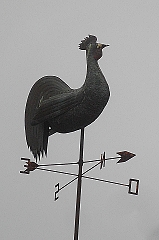
Heartfield’s home on Downshire Hill has a peculiar feature, which might have been added long after he lived there. It is a weathervane. That is not a particularly unusual embellishment, but on closer examination, it is not a run-of-the-mill British weathervane. Weathervanes in England often have the four points of the compass abbreviated as NSEW, that is, north, south, east, and west. The one on Heartfield’s former home has the letters NSOE. At first, I thought that the O was an abbreviation for the German for east, ‘Ost’. If the weathervane was German, it should have had the letters NSOW. Then, I thought that the O is probably an abbreviation for the Italian for west, ‘ovest’ or for ‘oeste’ the Portuguese and Spanish words for west. This makes sense because the other points of the compass in those languages are abbreviated as: N, S, and E. Short of ringing the doorbell to ask, the linguistic identity of the weathervane will have to remain a mystery to me for the present.