Safety first!

Experience learn’d

damages suffer’d

must consider safety first


My late mother was involved in a motor car accident near Cape Town in South Africa when she was a young girl in the 1930s.
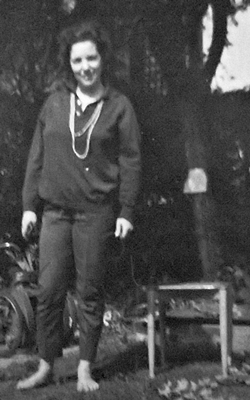
HBY 60s 36 HW

“Our family dentist, at least the first one who ever looked after me (during the 1950s and early 1960s), was Dr Samuels, an elderly Jewish refugee from Nazi Germany. This kindly man, who must have been in his late 60s or early 70s when he treated me, told my mother how he had to smuggle gold out of Germany. When he, and for that matter any other Jew, was fleeing from Germany in the 1930s, it was not permitted to carry anything of financial value out of the country. His resourceful wife prepared sandwiches for his journey. Instead of filling them with lettuce leaves, she filled them with sheets of gold leaf – a material that used to be used a great deal in dentistry. Thus, if he had encountered inquisitive Nazi officials on the train, he could have concealed the gold he was carrying by munching his precious sandwiches. I am not sure when he retired, but I remember him telling my mother that he would not cease practising until the last of his patients abandoned him. I do not know when this was, but I do know that he helped to conceal from us the fact that my mother was missing some teeth.


In all the 28 years that I knew her, I had no inkling that my mother had two missing front teeth. I knew that she had missing teeth because she often reminded us about the accident that she had suffered, but it was not until she was dead that I discovered, almost by chance, that it was two of her front teeth that she lost.
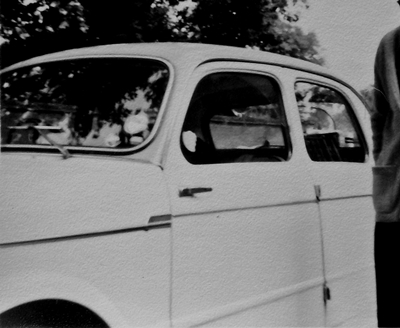
 

FIAT 1100 60s BSY

I am sure that it was having been involved in this accident that led to my mother having seat-belts installed in our Fiat Millecento. She arranged for this to be done at least 20 years before they became mandatory in the UK. I have no idea how and from where she got the idea of installing car seat-belts in 1960, but she did. And, with a little persistence she found somewhere where these items, which were almost unknown in cars, could be installed in our Fiat.


Seat-belts were not routinely fitted into cars before the 1980s, with the exception of some Swedish cars such as Saab and Volvo. There were very few of these on British roads in the early 1960s. Therefore, my mother’s idea of installing them into our Millecento in 1960 was little short of revolutionary. The two front seats of the car were fitted with complex harnesses. A strap went over each of the wearer’s shoulders and these were connected together by a waist strap. The people in the front ended up wearing what looked like the sort of safety harness worn by a jet pilot. These complicated straps were extremely difficult to adjust properly.


The rear of the car was fitted with two lap straps such as are found in aircraft passenger seats. My sister and I used one each except when there was a third person in the back. In this case, my sister and I had to share one strap. To avoid fighting, my mother separated us in the strapby placing a pillow between us.”


The passage written above is an extract from a book, “Charlie Chaplin Waved to Me”.  It does not mention the extra locks my mother had fitted in the rear doors of our car. These were to prevent my sister and me from opening the doors while were diving. Had we been in an accident, it would have made it very difficult for rescuers to open these doors as the keys were attched to the ring with the car keys.


I only learnt about my mother’s missing fron teeth when after her tragic demise, I found her partial denture lying around in our house.


Charlie Chaplin Waved to Me” is available by clicking : HERE

Also available on Kindle
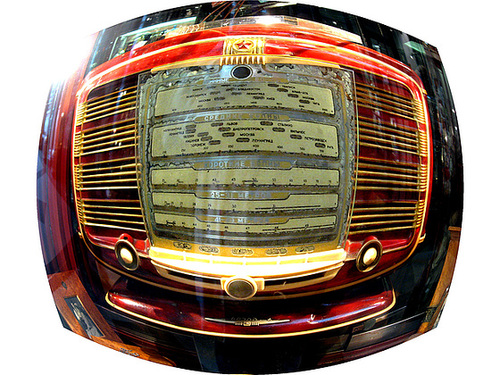
Switch it off, please

Over the airwaves,

messages of faith are heard,

evangelising


radio


‘Mark’, the owner of the first dental practice where I worked after qualifying, told me that it is important to have a good relationship with the dental nurse with whom you work. He pointed out that on working days, the dentist often spends more of his or her waking hours with the nurse than with his or her spouse. During the 35 years I practised as a dentist, I encountered very few dental nurses with whom I could not get on amicably. Let me tell you about ‘Maria’, who was kind, resourceful, and remarkable.

Maria fled to the UK after having had what sounded like a horrendous childhood and adolescence in a troubled part of the world. She worked with me for several years. Sometimes, when needed, she worked as a dental receptionist in our practice. When, as they often did, patients came storming up to the desk, impolitely demanding an appointment without even saying “please”, Maria would calmly reply: “Good morning, Mr X. How are you? And how is your family?” Her polite questioning in a soothing voice quickly ‘civilised’ the patient’s approach.

Once, I was running very late, and the patient I had kept waiting had only 15 minutes left out of the 60 minute appointment I had planned for him. I said to this patient: “I have run so late that I really don’t have enough time to do what we planned.” Before the patient could answer, Maria said to me: “Don’t be silly, Mr Yamey, you can do it in time. I know it.” And she was right. I could not have done a decent job so fast if Maria had not been my assistant. When it came to the time to prepare the dental impression (mould) for the crown (cap) I was preparing, she mixed the two elements – the firm base and the low-viscosity material that picks up fine detail – simultaneously. Ambidextrously, she mixed one constituent with one hand and the other with her other hand. We finished the job to my clinical satisfaction in a quarter of the time I usually needed. “See, you can do it,” she said, “I have faith in you.”

You might wonder why I did not speed up after that when working with Maria. During that curtailed appointment, fortunately everything went smoothly without hitches. I preferred longer appointments so that I would have sufficient time to deal with unexpected problems and to relax the often-anxious patients.

Maria was very practical. In the practice where we worked, equipment often broke down. When this happened, a repair man, ‘H’, would be called to do just enough to get the heavily-used, well-worn piece of equipment to work again. On one occasion, an essential piece of kit stopped working. I told Maria to ring H. She said: “He’s not needed.” I asked her why. “I watched what H did last time the drill broke down. Let me try.” Maria fiddled with the equipment for a few minutes, and successfully repaired it.

Maria was a devout Christian.  She kept a small volume of the New Testament in a drawer in the surgery. Some of the words in it were printed in red. I asked her why, and she explained that the words that Jesus spoke were printed in red. Every now and then, she used to say to me: “All you need to do, Mr Yamey, is to accept Jesus in your heart, and your soul will be saved.”  Out of politeness, not wishing to offend her by questioning her great faith, I would say: “I need more time to think about it.”

We had a radio playing continuously in the surgery. Maria had tuned it to a non-stop evangelical Christian station. Various people speaking with strong North American accents spent hours describing how they had discovered Jesus. Like quite a few of my patients at that practice, many of the speakers on the radio had been locked up in prison. During their long incarceration, the radio personalities had had time to contemplate life, and during this contemplation they had discovered Our Lord and taken Him into their hearts. I found this radio station quite fascinating and listened to it avidly in gaps between appointments. Maria seemed less interested in the broadcasts. She wandered in and out of the surgery when she was not needed to help with a patient’s treatment.

Mr ‘C’ was a regular attender. He had a barely discernible North American accent. On one occasion, just as I was about to begin treating his teeth, he raised a hand, and said: “There are two things I can’t stand. One is coming to the dentist. The other is having religion stuffed down my throat. Maria, please switch off the radio.”

Maria turned it off without argument – she never argued. From that moment onwards, Maria never ever tuned the radio to that evangelical station. She was not only a wonderful assistant, but also sensitive and thoughtful.