Art and documentaries at the Kochi Muziris Art Biennale 2022

ASPINWALL HOUSE IN Fort Kochi is the epicentre and largest exhibition space of the Kochi Muziris Art Biennale. We have attended this event four times to date – 2014, 2016, 2018, and 2022. Outside the main entrance to Aspinwall House, there is a list of those companies, organisations, and individuals, who have donated money to the Biennale. The current (2022/23) list has the following heading “Principle supporters”. Is this wording an undetected typographical error, or is it intentional, or is it a Freudian slip? I ask this question because the sentiments expressed in many of the exhibits question the consequences of the activities of some of the donors.

Far too many of the exhibits in Aspinwall House are more like well-made documentaries than what has until recently been regarded as art. The documentary exhibits are mostly well put together with superb still photography and cinematography, and quite a few of them are highly informative – akin to, for example, National Geographic productions.

The majority of the documentary-like exhibits have elements of political protest, often leftward leaning. Now, I have no objection to political protest in art, but I wonder whether some of these exhibits have strayed too far from what used to be considered art, and have become more documentary than artistic. In the past, to mention but a few, artists such as Picasso, George Grosz, Otto Dix, Joan Miró, Subhi Tagore, Diego Riviera, and currently William Kentridge, have made artworks with political content. These artists and some of their contemporaries produced artworks which are not purely political or polemic, but can also be enjoyed as purely visual experiences; knowing the message is not important to the impact the works make on the viewer, but can add to that. Much of what is on display at Aspinwall House during the current Biennale simply thrusts political messages at the viewer. There is little else to appreciate but often depressing messages and images.

As for the abundance of photography it is mostly superb. Since the invention of photography, it has been used highly creatively by some photographers. Examples of these include Julia Margaret Cameron, Charles Dodgson, László Moholy-Nagy, Ansel Adams, and Alfred Stieglitz. Artists like these were competent photographers who exploited the camera to create original images that would have been difficult if not impossible to produce with other artistic materials. In contrast, many of the beautiful photographic works in the current Biennale seem to be aiming at documentary or archival accuracy rather than creative images – works of ‘pure’ art.


Having blasted at what I did not like about the Biennale, I must point out that there are many artworks that satisfied me purely visually. Some of them are in Aspinwall House, but many of them are elsewhere, notably in the Durbar Hall in Ernakulam. The works that impacted me positively because of their purely aesthetic 7characteristics might also be conveying political sentiments, but the nature of these did not impede my immediate, visceral rather than cerebral enjoyment of them.

Returning to the predominantly documentary exhibits, those that made most impact on me were housed in the TKM warehouse complex in Mattancherry. Some of the works there are not only political or polemical, but also highly creative and artistic (in the old sense of the word).

As for the odd use of “principle” on the list of donors mentioned above, I found this not only careless but ironic. Many of the artworks in the current Biennale question the principles of some of the donors, who funded the show.

Having read this, you can call me ‘old-fashioned’ or ‘politically incorrect ‘ if that makes you feel better. I might well be both, but I was brought up by my artistic parents to appreciate the works of both old masters and contemporary artists equally, be they works by Piero della Francesca or JMW Turner or Brancusi or Barbara Hepworth or Rachel Whitehead or Anish Kapoor.

Visit the Kochi Muziris Art Biennale if you can before it ends in early March 2023, and judge it for yourself. Almost all of the exhibits are housed in heritage buildings, which are alone worth seeing. I look forward to the next show in 2024/25.

Faces of India for Queen Victoria

THE CORRIDORS LEADING to the spectacular Durbar Room in Osborne House on the Isle of Wight are lined with portraits of people born in pre-independence India, either painted or photographed during the 19th century. Most of these images depict members of the Indian aristocracy (e.g., rulers of Princely States). A few depict less exalted persons, such as craftsmen and the designer of the Durbar Room.

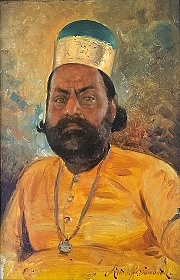
Maharajah Duleep Singh (1838-1893), who surrendered the Koh-i-Noor diamond to Queen Victoria, is portrayed in a few pictures, notably one by the famous German artist Franz Xaver Winterhalter (1805-1873). Many other paintings were created by the Austrian painter Rudolf Swoboda (1859-1914). Queen Victoria liked his painting style and commissioned him to create more than 40 portraits of Indian people. In 1886, the queen paid for him to travel to India, and gave him £300 in travelling expenses. Her instructions to the young artist were:

“The Sketches Her Majesty wishes to have – are of the various types of the different nationalities. They should consist of heads of the same size as those already done for The Queen, and also small full lengths, as well as sketches of landscapes, buildings, and other scenes. Her Majesty does not want any large pictures done at first, but thinks that perhaps you could bring away material for making them should they eventually be wished for.” (www.rct.uk/collection/403755/gulzar).

Many of these can be seen hanging in Osborne House. Amongst his many Indian portraits, there is at least one painted not in India but in England. Queen Victoria had several servants, who were born in British India and the Princely States associated with it. The best known of these ‘imported’ servants was her favourite Mohammed Abdul Karim (1863-1909), her ‘munshi’ (teacher), who helped her study Hindustani, which she learned to write competently in the Urdu script. Amongst Swoboda’s paintings of Indians hanging in Osborne House, there is one of a non-Indian, a lady from Cyprus, and another, a Cape Malay woman from  Cape Town (South Africa). Why they are there, I have not yet found out, but maybe Swoboda spotted them at the Colonial Exhibition held in London in 1886.

Not all the portraits of Indians are painted. Some of them are hand-coloured photographs. A few of these photos are signed by their creators, one of which was the photographic studio of Gobind Ram and Oodey Ram in Jaipur. Along with a studio in Calcutta the Ram brothers were pioneers in photography in 19th century India. One source (www.indiatoday.in/lifestyle/whats-hot/story/tryst-with-colonial-india-205124-2014-08-22) stated:

“Apparently, studio photography was practised by many Maharajas as a means of leisure, mostly using their courtesans as subjects. The Ravi Varma Studios of Calcutta and Gobind Ram-Oodey Ram Studio in Jaipur are just two examples.”

As can be seen at Osborne, these photographers also made portraits of the maharajahs and their families.

Although Queen Victoria loved Osborne House, I cannot see its appeal apart from the wonderful Durbar Room. For me, seeing this lavishly decorated hall and the collection portraits of the Indian people are the main delights of this otherwise rather gloomy residence.

Image recalling lines of a verse

This photograph I took in Cornwall reminds me of lines from the first verse of a poem, “Elegy Written in a Country Churchyard”, written by Thomas Gray (1716–1771). The lines are:

The curfew tolls the knell of parting day,

The lowing herd wind slowly o’er the lea …”

Photographic memories

THERE IS PHOTOGRAPHY IN MY GENES. My great-grandfather, Senator Franz Ginsberg (1862-1936) left his native Prussia to migrate to South Africa in 1880. He arrived in King Williams Town where he and his future bother-in-law Jakob Rindl established a photography studio, one of the first in southern Africa.

HAL 6

I became keen on photography as soon as an uncle, a keen amateur photographer who was closely related to Jakob Rindl and also Franz Ginsberg, had presented me with a simple Kodak Brownie camera when I was about seven years old. It was exciting taking photographs, waiting for the film to be developed at chemist or photography shops, and then opening the packet to discover whether the prints bore any decent looking images. In those early days, there were plenty of dud shots, but also a few decent ones. I graduated from the Brownie to another Kodak model, which had two lens and a viewfinder on top of the device. It was probably a version of the Brownie Reflex camera. It pleased me because it had a few things that could be adjusted whilst taking a picture.

As I got older, maybe over twelve years old, I began buying photography magazines. I soon realised that to achieve interesting results in photography, using a 35mm film camera was essential. I leafed through the issues, reading the reviews of cameras that sounded wonderful but were way beyond my budget. I was so fascinated by these sophisticated devices that I used to draw pictures, fantasising what I would have liked to have owned.

Eventually, there was a review of a camera that almost suited my pocket money budget, and which was likely to satisfy my desire to own a more complicated camera. The camera, which was given an excellent review was made by the Halina company and cost around £12.The Halina models were manufactured in Hong Kong by the Hakin Company. I cannot recall exactly which model was reviewed but it looked similar to the Halina 35x. I do remember that it did not have a built-in exposure meter.

Twelve pounds was a lot of money for me to find in the mid-1960s. I did not expect my parents to donate this sum to me for something they considered unnecessary because they never showed any interest in taking photographs. However, they did offer me a solution: I could earn the money by helping them. The task I was given was to mow the lawn in our garden once a fortnight. Please note that we only possessed a non-motorised human-powered mower. So, the £1 that I received for each quite arduous mowing was not easy money.

Eventually, I amassed the required sum to buy my Halina camera and it leather-like case. Then, I was faced with the problem of determining the appropriate shutter speed and diaphragm settings for my shots. My uncle, the one who had started off my interest in photography, gave me a circular plastic exposure calculator. By twisting the dial to three settings (weather condition, subject matter, film speed), the device produced a recommended combination of exposure time and diaphragm setting (‘f number’). At first, this was quite difficult to use. After a little practice, I became very adept. For example, I could use the calculator to work out the correct exposure settings when taking pictures of landscape from a moving car or bus, and the results were often more than acceptable.

A little more money saving allowed me to have sufficient to buy a highly recommended low-cost electronic exposure meter made by the Boots Company (the famous British pharmaceutical retailer). The meter was far easier to use, and much quicker than, the plastic calculator.

I used the Halina happily for several years until 1967. That year, my parents paid a visit to Japan, where they were hosted by various Japanese people and organizations. Moments before they were about to board the jet that would fly them back to London, their hosts handed them several generous gifts. One of these was a top of the range Canon Rangefinder camera. As mentioned already my parents had no interest in using cameras.

When my parents landed in London, they declared their gifts to a customs officer. Handing the camera to him, my mother said:

“We don’t want this. Take it so that we need not pay duty.”

The officer looked at the fine camera and said:

“The duty is only £3. Anyway, I can’t take it.”

As my parents paid the duty, the officer leant over and whispered to them:

“You’ll get at least £300 for this if you sell it to someone on Oxford Street.”

Fortunately, they did not follow the officer’s advice. Instead, they gave me the superb camera, which I used for many years until I decided to buy a Pentax single lens reflex (‘SLR’) camera. Its excellent lens and accurate built in exposure meter never let me down.

The Pentax was a disaster. I bought it to use during my first visit to what was then Czechoslovakia. A critical part of it broke two or three days into the trip. No one in Prague could fix the thing. So, I purchased another SLR camera. It was an Exacta, which had been made in Eastern Germany shortly before the Berlin Wall was demolished. The Exacta was heavy but solidly built; it was probably indestructible and produced lovely photographs.

That was all long ago. My interest in photography has continued, but it has been several years since I abandoned film cameras for digital devices, both ‘phones and actual cameras. The advent of digital photography and the editing software that can be employed to modify the images captured have eliminated the need for film developing and darkrooms. Modern digital software allows anyone to be able to do what was only possible in darkrooms and much more.

Spare time

Now that many of us are being encouraged not to leave our homes unless it is strictly necessary, we have more time to enjoy our immediate surroundings and, maybe, do a little sorting out.

I have been looking through numerous photographs, scattered around our residence in albums or packets provided by the photographic shops that used to develop films and print the images on them. It is a fulfilling armchair journey of discovery.

Gradually, I am posting some of these photos, many of which were taken 20 plus years ago, on the internet. My only regret is that many of them are unlabelled, so that I am not always sure when and where I took them.

The photo attached to this short piece was taken somewhere in Hungary, probably in the late 1990s.