Tipu Sultan on ceramic plates in London’s Mayfair

ADEELA SULEMAN IS an artist based in Karachi (Pakistan). She was born in 1970 and educated at the University of Karachi. In an exhibition at London’s Grosvenor Gallery, a collection of her works relating to the life of Tipu Sultan (the ‘Tiger of Mysore’: 1751-1799) is on display until the 25th of October 2024.

For those who are unaware of his fame, Tipu Sultan (son of Hyder Ali) ruled the independent kingdom of Mysore, and defended it against the attacks of the British. However, in the end, he was killed while defending his fortress at Srirangapatna. Before his demise, he was forced to deliver two of his sons to be held by the British as hostages. This happened in 1792. His death 7 years later was due to treachery within his court.

Adeela Suleyman has painted exquisite scenes depicting stages in Tipu’s life. The paintings have been created on vintage ceramic plates (platters). Each plate is surrounded by an elaborately carved timber picture frame. The paintings are rich in detail, and reminded me of Persian or Mughal miniatures. They portray episodes of Tipu’s story colourfully and vividly. Each of the images is a delight to see. What the artist has created is an attractive and respectful memorial to a great man. According to the gallery’s catalogue, the images can be sold separately, but it would be a shame to have this collection dispersed; it would be better to keep it intact.

In addition to the painted plates, there are some sculptural items (relating to Tipu) created by the artist. although they are eye-catching, it is the painted plates that appealed to me much more.

A horse trader from Persia and his life in Bangalore

MR HUSSAIN WAS a charming old gentleman full of ‘joie de vivre’, even when infirmity confined him to his bed. A retired businessman, we knew him as ‘Mahomet Uncle’. He was a Kutchi Memon (a Muslim whose ancestors had migrated from Kutch – now a part of Gujarat – to Karnataka). He was immensely popular. His many friends and relatives used to visit him to enjoy his company and to share their news. Once, near the end of his life, we went to his house to wish him ‘Eid Mubarak’ at the end of Ramazan. While we were in his bedroom, where he used to ‘hold court’, a seemingly endless stream of people passed through his front door to celebrate the occasion with him. His death was a great loss not only to his family but also to a vast number of people in Bangalore, who knew and loved him.

We were introduced to Mahomet Uncle by one of his sons who was studying in London at the same time as my then future wife, Lopa, and I were undertaking post-graduate courses. Mahomet Uncle lived in a house on Aly Asker Road Cross, a quiet lane close to the busy Cunningham Road. The Cross road is an offshoot of the larger Aly Asker Road. We have often travelled along this thoroughfare, not only to visit Mahomet Uncle but also other friends who live close by. In addition, when returning from the excellent Shezan Restaurant (on Cunningham Road) to the Bangalore Club, where we often stay, the best route is along Aly Asker Road.

For many years, I have wondered about Aly Asker and why a road should have been given his name. The answer was provided only recently, at the end of January 2024 just before we flew from Bangalore back to London. My friend Subhash Agarwal, with whom I often enjoy an afternoon cup of tea on the lawn in front of the main building of the Bangalore Club, knowing of my interest in the history of Bangalore, kindly presented me with a book, which has the title “Agha Aly Asker”.  Published in 2019, it was written by Syeda Mirza, the wife of Aly Asker’s great grandson. The book is well-researched and a pleasant, compelling read. Apart from detailing his life, the author gives many insights into the traditional Persian ways of life.

Aly Asker, a Persian, was born in Shiraz (Persia) in 1808. In 1824, along with his two brothers, he set off for India to sell horses to the British military. They travelled with 200 horses by sea to Mangalore, and then travelled overland to Bangalore. The brothers left him and the horses in Bangalore, where he began selling them to the army of the East India Company. The business was successful, and he imported more batches of horses to sell. Ali Asker became a successful businessman and was befriended by Sir Mark Cubbon (1775-1861), who was the Chief Commissioner of Mysore between 1834 and 1861. Amongst Cubbon’s many achievements were the introduction of Kannada and Marathi as the official state languages, instead of the formerly used Urdu, Hindi, and Persian.

Cubbon was very fond of horses, and is said to have had up to 60 in his stables. His equestrian interests helped develop his friendship with Aly Asker. As a result, Cubbon asked Aly Asker, who had already built himself a fine bungalow, to build 100 bungalows to accommodate the growing military establishment that was developing in Bangalore. Cubbon offered the land free of charge, but Aly Asker told him that he was happy to pay for it, which he did. The residences were constructed on land near today’s Palace Road, Sankey Road, Cunningham Road, and Richmond Road. Many of these houses no longer exist – Bangalorean property developers seem to value heritage far less than profit. One notable example that still stands is the Balabrooie State Guest House. Aly Asker also owned the land on which the luxurious Windsor Manor Hotel now stands.

Aly Asker’s interest in horses extended beyond trading, He was keen on horse-racing, and is said to have been important in putting Bangalore on the horse-racing map of India. His biographer, Syeda Mirza, includes an appendix in which the many victories of Aly Asker’s horses are listed. He was a frequent visitor to the racetrack in Bombay, and then later in Bangalore.

It was their interest in horses that drew together Aly Asker and another noteworthy person in Mysore State – Mummadi Krishnaraja Wodeyar III (1794-1868), the 22nd Maharajah of Mysore. It was through Aly Asker’s help that the British were encouraged to allow the Maharajah’s adopted son Chamarajendra Wadiyar X (1863 – 1894) to become his successor on the throne. Initially, the British, who effectively ruled the state, were reluctant to recognise him as the successor, and it was partly due to the gifts that Aly Asker chose for Queen Victoria that changed their mind in his favour.

Aly Asker died in Bangalore in 1891. He is buried in a cemetery near to the city’s Hosur Road. This is a Persian Cemetery that stands on land granted to Aly Asker and his heirs in 1865. His simple grave is beside that of his wife, and is shown in in a photograph in Mrs Mirza’s book. She noted that he established Bangalore’s first Shia Muslim community. It was when he married Sheher Bano that the first Muharram rituals were first observed in the city. In his will, Aly Asker left money to build the Masjid-e-Askari. It was built in 1909, and still remains as the city’s oldest Shia mosque.

So, having read Syeda Mirza’s book, I now know why there are roads in Bangalore named after Aly Asker. In addition to detailing his life in, and contributions to, the development of Bangalore, Mrs Mirza also described the exciting journey that Aly Asker made between his native land and India. Oddly, Aly Asker does not appear in the index of the authoritative history of Bangalore. “Bangalore Through The Centuries” by M Fazlul Hasan (publ. 1970). In a later (2014) comprehensive history of the city, Maya Jayapal makes one mention of Aly Asker Road, but gives no description of Aly Asker’s contribution to the story of Bangalore. It is therefore valuable that Syeda Mirza took the trouble to write about Aly Askar. As her book bears no ISBN number, and I could not find it either on Amazon or the much wider ranging bookfinder.com, it might well have been privately published, and is now probably quite a rare volume. I am very grateful to Subhash Agarwal for gifting me this informative book – a window on a hitherto poorly described aspect of Bangalore’s history.

A club founded for Indians in Bangalore

THE CENTURY CLUB in Bangalore is so-named because when it was founded in 1917 it was decided to limit its membership to one hundred. Today, the Club has about 6000 members. According to the Club’s website it was founded by the highly esteemed Sir M. Visvesvaraya (‘SMV’) who: “… was keen to promote what he felt was good in English society, particularly their orderly habits, punctuality, restraint in speech and social behaviour.”

The Club was founded during an era when Indians were not allowed to join or even enter the clubs (such as the Bangalore Club and the Madras Club), which were designed to be social clubs for the exclusive use of elite Britishers.

Shri Nalwadi Krishnaraja Wodeyar

SMV was inspired to establish a social club that admitted Indians after an unpleasant incident at the Bangalore Club. It occurred when SMV was the Diwan (Prime Minister) of the Kingdom of Mysore. When one day he was invited to the Bangalore Club he was wearing the royal turban of Mysore. The staff asked him to remove it and wear an ordinary cap instead. This insulting request upset him greatly, and led to him founding a club for ‘gentlemen’, which would accept Indians. Thus, the Century Club was born.

Shri Nalwadi Krishnaraja Wodeyar, the king of Mysore, allotted 7 acres of Cubbon Park for the use of the Century Club. Today, the Club is an oasis of peace and greenery in a city that is becoming increasingly less peaceful and disturbingly less green.

The Century Club began admitting Indians in 1917. Not far away, the Bangalore Club only began admitting Indians when India became independent (in 1947), or after that. And even worse, a few other Clubs (and other institutions) continued to admit only British (and other fair skinned Europeans) until the 1960s or later. This was quite remarkable in a country that had struggled for many years to free itself from foreign rule.

A battle scene under the hammer

SRIRANGAPATNA (SERINGAPATNAM) IS A town on an island in the River Kaveri in the state of Karnataka in southern India. I have been there several times as it is near a holy spot (the ‘sangam’, where three streams meet) where ashes of deceased Hindus, including those of my parents-in-law, are ceremoniously deposited in the waters of the Kaveri. The town near the sangam was the capital of the realm ruled by Tipu Sultan (1750-1799). This former capital of a great ruler is full of impressive architectural reminders of his era. One of these, which I have visited at least twice, is a Summer Palace, the Daria Daulat Mahal (literally, ‘Wealth of the Sea Palace’) built for Tipu in 1784. This lovely, large pavilion in the middle of a formal garden is decorated with huge painted murals depicting various subjects. Some of them show scenes of battles in which Tipu was involved, often with his enemy the British East India Company. Filled with fascinating details, these are well worth visiting.

On the 30th of March 2022, a wonderful artwork was auctioned at Sotheby’s auction house in London’s New Bond Street. Created in 1784, it is a painting measuring 31.6 feet by 6.6 feet. It is one of three copies of a work commissioned by Tipu for the Daria Daulat pavilion. It depicts the Battle of Pollilur fought on the 10th of September 1780 between the British troops of the East India Company and the Mysore Army led by Haider Ali (c1720-1782) and his son Tipu Sultan. Writing for the Sotheby’s website (https://www.sothebys.com/en/buy/auction/2022/arts-of-the-islamic-world-india-including-fine-rugs-and-carpets/the-battle-of-pollilur-india-seringapatam-early), the author and historian William Dalrymple explained:

“At Pollilur, Tipu Sultan inflicted on the East India Company the most crushing defeat the Company would ever receive, and one which nearly ended British rule in India.”

He added, referring to the British:

“Out of 86 officers, 36 were killed, 34 were wounded and taken prisoner; only 16 captured were unwounded. Baillie received a back and head wound, in addition to losing a leg. Baird received two sabre cuts on the head and a pike wound in the arm. His ADC and young cousin, James Dalrymple, received a severe back wound and “two cuts in my head”. Around two hundred prisoners were taken. Most of the rest of the force of 3,800 was annihilated.”

Of the painting being auctioned at Sotheby’s, he wrote:

“The painting extends over ten large sheets of paper, nearly thirty-two feet (978.5cm) long, and focuses in on the moment when the Company’s ammunition tumbril explodes, breaking the British square, while Tipu’s cavalry advances from left and right, “like waves of an angry sea,” according to the contemporary Mughal historian Ghulam Husain Khan. The pink-cheeked and rather effeminate-looking Company troops wait fearfully for the impact of the Mysore charge, as the gallant and thickly moustachioed Mysore lancers close in for the kill. To the right, the French commander Lally peers triumphantly through his telescope; but Haidar and Tipu look on majestically and impassively at their triumph, while Tipu, with magnificent sang-froid sniffs a single red rose as if on a pleasure outing to a garden to inspect his flowers.”

As with all other items to be auctioned at Sotheby’s, the painting was put on display to the public for several days before the auction. We were lucky to have been able to view it, as we arrived only a few minutes before the public viewing period ended. One of the technicians at the auction house let us get close to the painting so that we could examine it much better than is possible when visiting the Summer Palace at Srirangapatna. I took the opportunity to take close-up photographs of details of this incredible record of late 18th century warfare. [You can view my photographs on the following website: http://www.ipernity.com/doc/adam/album/1319222] Some of them are quite gory, including decapitated heads with blood issuing from their severed necks. Many of the British can be seen being impaled by what looked like very thin, needle-like spears. I spotted one Indian soldier being struck on his head by a bayonet wielded by a Britisher. Some of the Mysore Army soldiers brandish rifles fitted with bayonets.

The British soldiers are mainly dressed in red jackets. Their opponents are depicted wearing clothes in a variety of colours. Most of the Indian soldiers have dark-coloured eyes but, as my wife spotted, some of the British have pale coloured (blue?) eyes.  Many animals appear in the picture: horses, camels, elephants, and bullocks. In addition to rifles and spears, there are other weapons in the painting including: cannon, swords of various kinds, and archery bows. Seen as a whole and in detail, the painting portrays great activity and a sense of the confusion that reigns in a battle. Whereas the British appeared to be maintaining orderly formations, their opponents can be seen making a terrifyingly massive onslaught in an apparently less organised, but ultimately successful, way.

Although words are inadequate to convey the impression made on me by this painting, I am glad that I was able to see it before it is sold. It was last exhibited for a few months in 1999 in the National Gallery of Scotland (Edinburgh), and before that for a few months in London in 1990. If it is sold to a private individual, it might not be available for public viewing again for a long time.

Little Nell and the British Empire

Here’s poor lil’ Nell

  With a fresh fish under each arm

Crazed, scarred, and cracking

CAN YOU BELIEVE that although we have walked through London’s Hyde Park so many times (in order to take exercise as is recommended by our great leader, a biographer of Winston Churchill, and his government) that there are still many things in it for us to discover? Walking in the southwest corner of the park recently, we saw four man-made items that caught our interest.

An octagonal Victorian bandstand, which was built in 1869 and stood in Kensington Gardens, was moved to its current location in Hyde Park not far from Hyde Park Corner in 1886 (www.royalparks.org.uk/parks/hyde-park/). It is said that this bandstand has good acoustics; I have yet to hear music played here. In the 1890s, concerts were held at the bandstand three times a week. Currently, in normal times, that is when there is no pandemic, the bandstand is used occasionally for concerts and other events as well as becoming part of the annual Winter Wonderland fairground held in Hyde Park.

The bandstand, which was/is often used by military bands, is about 100 feet northwest of a black coloured bronze equestrian statue depicting St George slaying a mammoth dragon. Its coiled, scale covered body, my wife considered accurately, resembles a haphazard pile of discarded lorry tyres. The stone base is surrounded by a frieze depicting cavalrymen in action. The equestrian sculpture stands in front of a low wall which bears the names of cavalry regiments involved in WW1. The monument, though erected before WW2, also those involved those:

“… in the war / 1939-1945 / and on active service thereafter.”

The monument, The Cavalry Memorial, which used to stand nearer Park Lane was unveiled in 1924 by Field Marshal, The Earl of Ypres (formerly Sir John French; 1852-1925) and the Prince of Wales (the future Edward VIII, who reigned for 11 month). The knight on the horse was modelled on:

“…a 1454 effigy of the Earl of Warwick, mounted on horseback holding an uplifted sword, and the horse on a C15 century engraving by Albrecht Dürer.” (https://historicengland.org.uk/listing/the-list/list-entry/1278118).

The sculptor was Captain Adrian Jones (1845-1938). Jones was an army veterinary surgeon between 1867 and 1890. He took up painting and sculpting after he retired, specialising in depicting animals. His best-known work, created in 1912, is not far from the cavalry monument: it is the Quadriga that adorns the top of the Wellington Arch at Hyde Park Corner.

The cavalry monument is a mere 200 yards north by north-east of a modest memorial to a fairly recent tragedy that stands beside the South Carriage Drive. It remembers the eleven soldiers who were killed by a bomb planted by IRA terrorists near this spot on the 20th of July 1982.

Returning to a path that leads north from a spot between the Cavalry Memorial and the bandstand, you will quickly reach a small art-nouveau structure. Formerly a fountain, this is a depiction of an almost naked girl wearing a hat and holding a fish under each of her arms. We asked a gardener working nearby if he knew anything about this curious garden sculpture. He informed us that it was a sculpture of Little Nell, a character in “The Old Curiosity Shop” by Charles Dickens and that it used to stand in Hyde Park’s Rose Garden.

The sculpture, created by William Robert Colton (1867-1921) has been variously known as the ‘Memorial Fountain’, ‘The Mermaid Fountain’, ‘The Colton Memorial’, and, much later, as ‘Little Nell’ (www.victorianweb.org/sculpture/colton/7.html). It is not clear why Colton’s sculpture should be associated with Dicken’s character, Nell.  What we see today is a concrete cast of the original that was made in 1897. It looks as if it could do with a lot of tender love and care as it seems to be crazed, cracked and scarred.

Colton created various public sculptures in London, but his work is found further afield. I read (www.speel.me.uk/sculpt/coltonwr.htm) that:

“Important in his career was a series of Indian portraits in the mid-1900s, including statues and busts of the Maharajah of Mysore and the Dewan of Mysore, and a monument to J. Tata, including allegorical figures, for Bombay.”

I have probably seen some of his Indian works both in Mysore and Bangalore but took little notice of them. A website (http://mysore.ind.in/chamaraja-circle) extolling the virtues of Mysore reveals:

“The French born celebrated sculptor of the time, William Robert Colton was commissioned to execute a statue in memorial of the maharaja. He is the same sculptor who executed many famous sculpture in India including the statue of Sir K Seshadri Iyer, at Cubbon Park in Bangalore, who was the Dewan of Mysore State from 1883 to 1901. Also the 8 bronze tigers of Mysore Palace too are the works of Colton.

He spend[sic] some three months in Mysore during 1912 for the preliminary study for making the statue of Chamaraja Wodeyar. The statue was executed in white Italian marble in England … In the statue the maharaja is portrayed in standing posture in military uniform.

Though Colton was famous for executing lifelike sculptures, one glitch was the in the appearance of the face of the maharaja. There was not much resemblance between face of the maharaja and the face of the statue. When the statue finally arrived in Mysore in 1918, the queen the late maharaja Chamaraja Wodeyar was not happy with this aspect.”

Colton, whose father was an architect, was born in Paris, but was taken to England when he was three years old. He studied art first at the Lambeth School of Art and then at the Royal Academy.

Three of the items, which I have described, have connections with Britain’s former empire. Some of the cavalrymen remembered on the Cavalry Memorial, fought in not only in WW1 but also in Egypt, South Africa, and British India. Several major cavalry units were based in India and included soldiers of Indian origin. The other item with an association with part of the former British Empire is the small lady with two fishes, created by an artist who has sculpted some notable Indians. The bandstand near these two park features is typically Victorian and octagonal, and not markedly different in appearance from one that stands in Cubbon Park in Bangalore (India). And all of these are but a few minutes leisurely stroll from Apsley house, the former home of Arthur Wellesley (1769-1852), who fought in India in the late 18th century.

An empty grave

On one of my frequent visits to Bangalore in India, I was idly flicking through a street atlas of the city when I noticed a small green patch near to the Mysore Road. It was marked ‘Jewish Grave Yard’.

CEMY 1

I knew that there have been large Jewish communities in cities such as Bombay, Calcutta, Cochin, and Poona, but I had never associated Bangalore with a Jewish presence of any size. I visited the cemetery the next day. Surrounded by a huge Moslem cemetery on two sides and two roads, the well-maintained burial ground contains just over fifty graves, and the foundations of the hut which was used to prepare bodies for burial.

The land on which the cemetery is located was donated on the 9th September 1904 by Krishnaraja Wodeyar, the Maharaja of Mysore. On that day, Subedar Samuel Nagavkar died, and his is the earliest death recorded on the stones in the cemetery. A notice at the entrance informs us that the land was donated due to the “efforts of the late Mr Rubin Moses”. This might have been the case, but I have reason to believe that this man did not reach India until later.

CEMY 3

Rubin Moses Nahoum (‘Nahoum’ has been dropped by his descendants) left his birthplace, Iraq, to join the California Gold Rush. After the city of San Francisco was struck by an earthquake in April 1906, Rubin left for India in order to become involved in the Kolar goldfields near Bangalore. By 1910, he had opened a shoe store in Bangalore’s Commercial Street. It was to become the largest in southern Asia. The large premises still exist but in another reincarnation: it is now the home of ‘Woodies’ a vegetarian café popular with the numerous shoppers in what is Bangalore’s equivalent of London’s Oxford Street.  The Moses family, who still finance the maintenance of the cemetery, had a prayer hall in the now demolished Rubin House, a building which housed a shoe factory. Any Jew living in, or visiting, Bangalore was welcome to worship there. The most notable of these visitors was a future president of Israel, Ezer Weizman, who was stationed at an RAF base in Bangalore in 1946.

The majority of those buried in the cemetery were born in India and represent the various different types of Jews who lived there. Six of the graves commemorate Jews not born in India, five of them European. When Saida Abrovna Isako, a Russian Jewess, the wife of the proprietor of the Russian Circus, died in 1932, her coffin was brought to the cemetery on a bier drawn by white circus horses. Not far from her grave are those of a number of refugees from Nazi Europe. Siegfried Appel came from Bonn in Germany. His compatriots the dentist from Gleiwitz, Gunther Moritz Rahmer, and his mother Margarethe (née Schuller: the widow of Alfred Rahmer, a soap maker in Gleiwitz) lie close by, as does another German dentist, Carl Weinzweig, who had a practice in Bangalore’s MG Road.

Bangalore has been an important military base for several centuries. So, it was not surprising to discover some graves related to warfare. Yusuf Guetta died age 22 years in 1943. His grave records that he was an “evacuee” from Benghazi, the Libyan town evacuated by the British in April 1941. Yusuf lies next to the grave of Private Morris Minster of the South Wales Borderers Regiment. Morris passed away on the 4th of April 1942, aged 24. I looked up Private Minster on the Commonwealth Graves website and was surprised to find that he was recorded as being buried in the Madras War Cemetery, Chennai. Yet, I had seen and taken pictures of his grave in Bangalore.

CEMY 2

I wrote to the Royal Welch Regimental Museum.  Martin Everett replied, informing me that Morris, son of Solomon and Annie Minster of Salford, joined up maybe as early as 1931, and died in 1942, but not in action. He told me that at the time of his death there were no Welsh Borderers in India. They had all left for Iraq by November 1941. Morris was probably too ill to travel and remained in India. Mr Everett wrote that he believed that his remains had been moved to Chennai. He wrote also that:

“The Madras War Cemetery was created to receive Second World War graves from many civil and cantonment cemeteries in the south and east of India where their permanent maintenance could not be assured.”

Well, I can report that Morris Minster’s grave in Bangalore is certainly being well-maintained. When I enquired about the whereabouts of his body, a member of the Moses family, the last Bangalore born Jew still residing in the city, told me that a few years ago it had been disinterred and transferred to Chennai, as suggested by Martin Everett. My mind was set at rest.

I have published a photographic album showing all the graves in the cemetery, “Buried in Bangalore”.

It is available for purchase from:

http://www.blurb.com/bookstore/detail/1126091

Cucumber sandwiches

My late mother-in-law, an Indian living in Bangalore, made the best cucumber sandwiches that I have ever eaten. She used fresh slices of thin white bread with crusts removed. Each slice was spread with a small amount of butter mixed with freshly mixed English-style mustard. Then, finely sliced, peeled and de-seeded cucumber was inserted as the sandwich’s filling. The result was both delicate and refreshingly delicious. Having eaten these superb snacks on numerous occasions, I formed the idea in my head that India is THE place for cucumber sandwiches. This led to an amusing incident.

sliced cucumber on white table

Photo by Pixabay on Pexels.com

Some friends of ours from England were spending a few days in Mysore, which is not far from Bangalore, where we were based. So, we decided to drive to Mysore to spend a day with them.

Our friends were staying in an old palace that had been tastefully converted into a hotel. After we had roamed around Mysore with them, they invited us to have afternoon tea in the lovely garden of the hotel. When we had sat down at a table, I said:

“This is the ideal place to eat cucumber sandwiches. The best cucumber sandwiches in the world are made in India.”

Everyone was happy to order a plate of these. When we asked the waiter for the sandwiches, he asked:

“You want vegetable sandwiches, with capsicum and all?”

“No, just cucumber sandwiches, no capsicums,” we replied.

Some minutes later, the waiter returned with A plate of sandwiches oozing with a bright red paste filling.

“What’s that?”, we asked him.

“Miner’s sauce”, came the reply.

“Miner’s sauce? What on earth is that?” asked one of our friends.

The waiter simply repeated the words “miner’s sauce”.

After a minute or two, the penny dropped, and I said:

“He means mayonnaise.”

Now, many non-English people pronounce this word as ‘my-on-nays’, which is closer to ‘miner’s sauce’ than the English pronunciation.

“We don’t want that sauce,” one of our friends protested, “Only cucumber.”

The waiter looked confused.

“What, no bread?” he asked.

“Let me show you what I mean,” said one of our friends, standing up and accompanying the waiter to the kitchen.

The waiter returned after a while with a very sub-standard collection of cucumber sandwiches.

Later my wife pointed out that just because her mother made excellent cucumber sandwiches, this was not necessarily the case all over India, as I had foolishly assumed.

One body, two heads

A short reflection on the use and origin(s) of birds with two heads

DHE 2 Blore

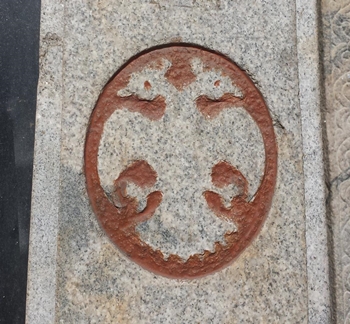
On a Hindu temple in Bangalore, Krnataka, India

The earliest archaelogical evidence of the existence of double-headed eagle (‘DHE’) or any other bird with two heads (each with its own neck) is in Bablylonian remains dating back to 3000-2000 BC.

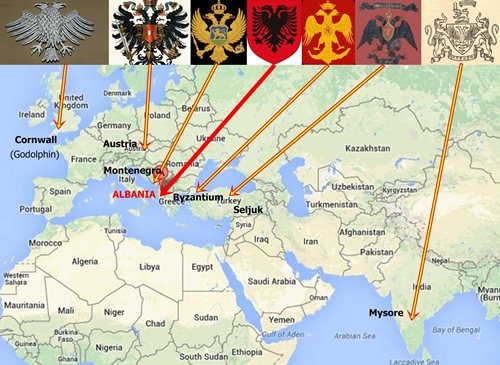
The DHE is and has been used as a heraldic symbol by, for example: the Scythians, the Hittites, the Seljuk Turks, the Kingdom of Mysore (in India), pre-Columbian America, Cormwall (UK), Byzantium, the Holy Roman Empire, the Russian Empire, and several states in the Balkans. The Balkan states that use the DHE include: Albania, Montenegro, and Serbia.

DHE 0

Map showing some of the many places where the double-headed eagle has been employed

I find the DHE to be a fascinating symbol because unlike, forexample,  the cross, Star of David, and swastika, it is not a simple geometric construction, which could be created by random ‘doodling’. Also, it is not naturalistic like the commonly used  such as a lion,  single headed eagle, bear, fish, and hound. 

There is a Hindu mythological creature, a bird with two heads, the Gandaberunda, which has been adopted by the Government of Karnatak (formerly Mysore) as its state emblem. The origins of this creature are obscure, but it has been described in the ancient Hindu texts, the Vedas.

The DHE is an imaginary creature, a product of human thought. The Babylonians not only portrayed the DHE, but also other double-headed creatures.

DHE 1

The Albanian double-headed eagle on the summit of the Llogara Pass in Southern Albania

I would like to SPECULATE that the origin of the DHE was Mesopotamia. From there, I imagine it spread through what is now Turkey to Europe, and across the Indian Ocean to India. If the DHE, or something similar appears in the Vedas, it would be interesting to know if this was by chance or as a result of some forgotten connection between Mesopotamia and the Indian sub-continent.