Around London’s Euston Station

AFTER EATING DELICIOUS KEBABS and a wonderful mutton biryani at Raavi Kebab, a Pakistani restaurant in Drummond Street close to Euston Station, we took a short post-prandial stroll around the area, a part of London that is home to University College London (‘UCL’), where my wife and I did our first degrees and we first met.

BLOG TAGORE

The west part of Drummond Street has become a desolate building site because of the works being undertaken to construct the HS2 railway. A building covered in tiles the colour of clotted blood stands in the midst of the building works. It looks like some of the entrances to older London Underground stations. It is located on the corner of Drummond and Melton Streets. It was the original entrance (opened between 1907 and 1914) to Euston station of the Charing Cross, Euston and Hampstead Railway, now part of the Northern Line, which is now accessed from within Euston railway station. The latter was built in the 1960s on the site of the demolished Euston Station (with its impressive Doric arch) built in the 19th century.

When the old Euston Station existed, Drummond Street stretched further east than it does today. It ran past the southern façade of the 19th century station and across the present Eversholt Street, ending at Churchway (not far from the current British Library).

All that remains of what must have been a splendid old station is a statue of the railway engineer Robert Stephenson (1803-1859) and two pavilions on Euston Road. These formed part of the entrance to the old station’s forecourt. Built of Portland stone in about 1870, they were designed by JB Stansby. The corners of these two buildings bear the names of the stations that were served by trains from Euston Station. Interestingly, these include cities such as Cork and Dublin, which are no longer within the United Kingdom. When the pavilions were constructed, the whole of Ireland was under British rule.

Strolling along Gordon Street, we passed the Ingold Chemistry building, part of UCL, where my wife and I spent many happy hours trying to synthesize various organic compounds, often ending up with tiny granules of non-descript materials, which might have been bits of broken glass rather than the desired product. Across the street, where there had once been an open-air entrance to the main campus of UCL there is a new building, glass-fronted at street level. Through the glass, we could see the mummified, clothed remains of the philosopher Jeremy Bentham (1748-1832) in a glass container, instead of the old wooden one in which he used to be housed. Bentham was strongly associated with the foundation of UCL in 1826.

As I stared at Bentham, an opponent of slavery, through the windows of the new building, I wondered what his views were, if any, on colonialism in India. Some of Bentham’s followers, such as John Stuart Mill, had been employees of the East India Company. Mill and Bentham, were not opponents of British colonialism, but did criticise it.

It was almost dark when we walked into the garden of Gordon Square, a place overlooked by the homes of some members of the famous Bloomsbury Group, a set of British intellectuals and artists, which thrived during the first half of the 20th century. We discovered something that had not been present when we last visited the square some years ago. This is a bust of the Bengali genius Rabindranath Tagore (1861-1941). Created by Shenda Amery, it was unveiled by the Prince of Wales in July 2011, seventy years after Tagore’s death and one hundred and fifty years after his birth.

Tagore coined the name ‘Mahatma’ for the Indian Nationalist and freedom fighter MK Gandhi and also composed (in 1911) both the words and music of the Indian national anthem, “Jana Gana Mana”. The eminent historian Ramchandra Guha explains in his “Makers of Modern India” that:

“Tagore was a patriot without quite being a nationalist. He was no apologist for colonial rule… he was dismayed by the xenophobic tendencies of the populist edge of the Indian nationalist movement. He thought that India had much to learn from other cultures, including (but not restricted to) the West.”

Following the horrendous massacre of innocent Indians by soldiers under the command of the British at Jallianwala Bagh in 1919, he returned his knighthood to King George V.

Tagore was sceptical about ‘non-cooperation’ as advocated, for example by Gandhi. He was also worried about the concept of nationalism as applied to India. In his book “Nationalism”, published in 1917, he wrote:

“When our nationalists talk about ideals they forget that the basis of nationalism is wanting. The very people who are upholding these ideals are themselves the most conservative in their social practice. Nationalists say, for example, look at Switzerland where, in spite of race differences, the peoples have solidified into a nation. Yet, remember that in Switzerland the races can mingle, they can intermarry, because they are of the same blood. In India there is no common birthright. And when we talk of Western Nationality we forget that the nations there do not have that physical repulsion, one for the other, that we have between different castes. Have we an instance in the whole world where a people who are not allowed to mingle their blood shed their blood for one another except by coercion or for mercenary purposes? And can we ever hope that these moral barriers against our race amalgamation will not stand in the way of our political unity?”

Tagore’s views on Indian independence were not as clear cut as many of the other advocates of freeing India from British rule, such as Gandhi, Jawaharlal Nehru, Subhas Chandra Bose, and Vinayak Savarkar. He was essentially in favour of it but as Radha Chakravarty wrote in “The Essential Tagore”:

“For Tagore, the view of nationalism and patriotism that the movement was taking on was too narrow. He disengaged with the movement but remained expressive on the issue of independence through his art and writings … Fundamental to his belief was that nationalism could not rise above humanity…”

We left Tagore as his bust began to become less visible in the deepening gloaming and walked along Torrington Place past Waterstones bookshop that is housed in the pinnacle-rich building that once housed Dillons, the university bookshop. Almost opposite the north eastern corner of the bookshop, a private roadway leads into the UCL campus and under a circular archway. This was a familiar landmark for us when we were undergraduate students because it allows the roadway to pass beneath the building that housed ‘our’ Department of Physiology. Being August and in the midst of both the university holidays and the coronavirus pandemic, this normally busy roadway was empty.

We walked north along the east side of Gower Street passing a door marked ‘Anatomy’. This used to be an entrance to the Physiology Department, where I spent six years studying. During the last three of these, I used to have a key to the door so that I could let myself in whenever I wanted to do laboratory work on my PhD project. In those far-off days, security was far laxer than it is nowadays.

After passing the main entrance to UCL, we reached the corner of Gower Street and Gower Place. This building, now a part of UCL, used to house the medical bookshop, HK Lewis & Co Ltd. This, according to a plaque on the wall, was founded in 1844 in Gower Street, soon after UCL’s medical school was established in 1834. HK Lewis had a useful second-hand department, where I bought a few of my textbooks at prices not much lower than they would have been if they had been new.

We returned to our car parked in Drummond Street. Our favourite Asian grocery and Ambala’s sweet shop were already closed for the day. Raavi Kebab, a haven for carnivores, and its neighbour, the long-established Diwana Bhel Poori House, a haven for vegetarians, were still serving diners. These restaurants and several others in the street serving foods from the Indian subcontinent are run by folk whose ancestors were subjects of the British Empire prior to 1947. The street is a fine example of the idea suggested by the French colonial writer Frantz Fanon (1925-1961), namely, that eventually the colonial chickens come home to roost. And, thank goodness they have because they help to give London the vibrancy that makes it such a great city.
What have we come to?

I FIRST MET MY FRIENDS, the brothers, ‘A’ and ‘B’, at the birthday party of another friend ‘C’. This meeting would have been in March 1965. I know this because the celebrations included watching a matinee performance of the film “Goldfinger”, which had been released in the UK a few months before (in September 1964). We saw the film in the now long-since demolished Odeon Cinema in Temple Fortune, which is on the edge of Hampstead Garden Suburb (‘HGS’), where we all lived. Sadly, one of the brothers died a few years ago, but the other two friends are still thriving.

BLOG PUT 3

Mutton Brook

Since the major London ‘lockdown’ ended and we have become more mobile, having acquired a motor car, we have made several visits to HGS to see ‘old haunts’. One of these places is the series of public gardens (Northway Gardens and Littleton Playing Fields) that run along either side of a stream called Mutton Brook (it is a tributary of the River Brent that flows into the Thames at Brentford in Middlesex). The Brook runs parallel to Falloden Way, a stretch of the A1 road. Flanking the road that separates HGS into two sections, there is a shopping area appropriately and unimaginatively called the Market Place. During my childhood, the section of HGS north of Falloden Way was affectionately known as ‘Across the Jordan’ because many Jewish people live(d) there. I suspect that today, there is a fairly equal distribution of Jewish households in both sections of HGS separated by the A1.

My friends, A, B, and C, and I used to visit the gardens alongside Mutton Brook in our spare time. In those days, but not now, the water in Mutton Brook had a rather unpleasant smell (sewage or something rotting). One of the attractions in the gardens was a putting green open to the public. For a small fee it was possible to hire a putting implement (a putter) and a golf ball. The brothers, A and B, were very competitive, and C was less so. The three of them managed to complete the course in a respectably low number of well-aimed shots. By the time I had reached the second hole, the others had putted their balls into all 18 of the holes on the course. What I have never been able to understand is why  when my ball was within inches of a hole, instead of falling into the hole, it spun around the circumference of the mouth of the hole without falling into the target area. Well, I was never skilled at any ball games, but I enjoyed the company of my friends.

Back in the 1960s, I believe that there were no refreshment areas in either Northway Gardens or Littleton Playing Fields. This has changed. There is a charming Café Toulous near one entrance to Northway Gardens and the Café Gaya in Littleton Playing Fields. Today, we sat at a table under trees near the latter and enjoyed drinking coffee in the shade. The ambient temperature was 31 degrees Celsius.  In one direction, we could see the spire of Lutyen’s St Jude on The Hill Church in the heart of HGS and in the other, a nursery school that shares the same building as houses the Gaya.

There were about twenty children’s push chairs (buggies) parked in front of the two-storey nursery. This came as no surprise because the school was in use. What was remarkable was the presence of three hefty looking security men, two in uniform and one in ‘mufti’. Each of these fellows had walkie-talkies and the two in uniform seemed to be wearing protective (bullet-proof?) vests over their jackets. They were keeping a very close watch on the kindergarten and unlocked its front door when ever there was something to be delivered.

After enjoying our drinks, we asked the Eastern-European lady working in the café about the security guards. In not brilliant English with a marked accent, she replied:

“Security”.

Flippantly, I asked:

“Are the kids dangerous?”

Not seeing the joke, she explained:

“Private Jewish school”,

And then added:

“All private Jewish schools have security.”

How sad it is that nowadays, even kindergartens filled with tiny tots are considered to be at risk from attack. This was never the case when my friends and I knocked golf balls around the now non-existent putting green on the bank of Mutton Brook. What have we come to?

Maxim and Ivy: to Russia with love

MEIR HENOCH WALLACH-FINKELSTEIN (1876-1951) is better known as Maxim Maximovich Litvinov. A Bolshevik revolutionary, he became an important Soviet diplomat. In 1930, Stalin appointed him People’s Commissar for Foreign Affairs. Earlier on, shortly after the 1917 Russian Revolution, Maxim was sent to London as the Soviet government’s plenipotentiary representative in Great Britain. While in London, he met and married the writer Ivy (née Low; 1889-1977). I have recently discovered that their lives partially overlapped with mine, not temporally but geographically.

BLOG IVY 5

Ivy was living in London’s Hampstead when she and Maxim were courting. They had met in about 1918 at the home of Dr David Eder (1865-1936), a Zionist socialist and a pioneer of psychoanalysis in Britain. David, whom Ivy regarded as a father figure, and his family lived in Golders Green (actually, in Hampstead Garden Suburb at 103 Hampstead Way, not far from our family home).  According to Ivy’s biographer John Carswell (in his book “The Exile: Ivy Litvinov”):

“Over tea in the Express Dairy in Heath Street where they often met, Ivy helped Maxim to improve his English – throughout her life she adored improving people’s English – and she did more: she guided him in reading English literature.”

Today, the building that used to house the Express Dairy in Heath Street is a branch of the Tesco supermarket empire. However, the building still bears the name ‘Express Dairy’ and the date 1889, the year that Ivy was born.

Ivy’s biographer John Carswell (1918-1997) was the son of one of Ivy’s closest friends, the writer and journalist Catherine Carswell (1879-1946). Ivy met Catherine, a close friend of the writer DH Lawrence who lived in Hampstead, after she had written a favourable review of Ivy’s novel “Growing Pains”, which was published in 1913. Catherine lived in Hampstead at Holly Mount. To be close to her friend, Ivy moved to Hampstead. John, who was born at Hollybush House in Holly Hill, met Ivy several times and has written a good account of her life. It reads well and is extremely informative not only about Ivy but also about her husband.

Ivy and Maxim moved to Russia with their two young children in about 1920 and lived there, with small occasional breaks, until the late 1950s. One of these breaks was when Maxim was appointed Soviet Ambassador to the USA between 1941 and 1943. Her stay in the USSR was also punctuated by short holidays abroad. Living in the USSR, Ivy continued her writing as well as teaching English. Long before he died, Maxim fell out of favour with Stalin and lived in fear of arrest and probable execution. However, he died of natural causes in 1951, just in time to miss Stalin’s last great, but unfulfilled, plan, the anti-Semitic ‘Doctors’ Plot’. On his deathbed, he said to Ivy:

“Englishwoman, go home”.

It was not until 1960 that Ivy did return to England.  But, in 1961, she returned to the USSR, where she remained a pensioned widow until July 1972, when she returned to the UK. She settled in Hove, where she lived the rest of her life. Until her dying day, Ivy wrote, published, and was actively involved with the literary world.

Long before her last visit to England, Ivy had made brief visits. In July 1930, Maxim was appointed People’s Commissar for Foreign Affairs. Soon after his promotion Ivy accompanied him to Geneva. That same winter, the Litvinovs paid a visit to London. John Carswell, then twelve years old, recalled:

“She took me to a Christmas show of which even the name now escapes me; but what is still vivid is the tall, dominating, fur-coated figure sweeping me across the wintry promenade outside the Golders Green Hippodrome, to a torrent of commentary.”

Reading about Carswell’s memory of Ivy taking him to a Christmas show at the Hippodrome reminded me of seeing pantomimes at this same theatre when I was about John’s age or maybe a year or two less. until the mid-1960s, the Hippodrome (built as a 3000-seat music hall in 1913) was a very active repertory theatre, where many plays that would eventually end up in the West End were premiered. In addition to plays, operas and Christmas pantomimes were staged there. In the 1960s, it became a BBC television studio, and lately it has become a venue for Islamic meetings. Like Carswell, I cannot remember what shows I saw there as a child, but I do remember being impressed by the size and fittings (seats arranged in galleries, boxes, and the vast stage) of the Hippodrome. It was as least as impressive as the grandest of West End theatres.

I enjoyed reading Carswell’s biography not only because it provided some insight into what life was like in the Soviet Union during Stalin’s rule but also because it introduced me to the life of an intriguing woman writer whose love for Maxim led her to spend a large part of her life in the USSR. Another thing that appealed to me is that Carswell provided me with new aspects of the history of Hampstead, a part of London which I know well and where I grew up. It is with some reluctance that I will return this enjoyable biography to our local public library.


Start right

MY MOTHER WAS ALWAYS CONCERNED that my sister and I had good shoes when we were children. We used to go to a shoe shop in the Market Place, which is in the heart of Hampstead Garden Suburb, where we lived. It was a store that sold the Start-Rite brand of footwear. What none of us knew in those far-off days was that the company was established in 1792 by James Smith in Norwich. His grandson, James Southall, gave the firm its name.

START RITE

Start-Rite shoes had a good reputation for making sure that shoes it sold fitted the wearers well. I remember having my feet measured both for length and width. The shoes were available in several different widths for each length.  For example, a size four shoe could be obtained in any of five widths, ranging from ‘a’ to e’. Thus, the shop assistant could ‘fine tune’ selecting the correct size shoe to fit a child’s feet. Also, the shoes were durable.

The shop in the Market Place had a machine that I was always dying to try. It was a tall box with two holes at its base and a viewing window at its top. The idea was that a child put on a pair of shoes, and then inserted his or her feet into the two holes. The shop assistant would then push a switch and look into the observation windoe at the top of the box. The machine produced x-rays which passed through the child’s shod feet and onto a fluorescing screen. By observing the image created by the radiation, the assistant could assess how well the shoes fitted. ‘Quel horreur’, you might be thinking if your mind operates in French.

Well, that is what my mother thought. Although not a scientist and having had little education in science, my mother knew very well that radiation was dangerous. After all, she knew all about Hiroshima and Nagasaki. What she might not have known is that the bone marrow cells in children’s skeletons are very sensitive to ionising radiation but being a cautious caring mother, she took no chances. Therefore, I was never able to see the bones of my feet in the device in that or any other shoe shop.

I outgrew Start-Rite shoes long ago. The shoe shop in the Market Place no longer exists, nor are those foot x-ray machines still in use. However, one thing endures. That is my memory of posters advertising Start-Rite shoes, which were pasted on the walls and hoardings of London’s Underground stations. They showed a couple of small children with arms interlinked walking towards infinity along a straight road bordered by fences and rows of trees. I still think that this is one of the most depressing adverts I have ever seen. The captions on the poster are “Children’s shoes have far to go” and “Start-Rite and they’ll walk happily ever after.”

I started ‘rite’ and since then, I  have been walking happily ever after, but cannot erase the depressing image on the poster from my mind.

Water music

I BELIEVE THAT SOUND travels well over water. I do not know if that is scientifically proven, but I like to think that it is the case.

BLOG KENWOOD 2

Yesterday, we visited Kenwood in north London. The neo-classical mansion, remodelled by Robert Adam (1728-1792) and completed in about 1780, contains a superb collection of fine art (the Iveagh Bequest), mostly paintings. Because of the Coronavirus pandemic, Kenwood House was closed, but its extensive grounds were open. Although the official car park was fully occupied, there was no sense of crowding in the grounds.

A wide terrace at the rear of the mansion overlooks a sweeping panorama including a lake at the bottom of the grassy slope that falls away from the terrace. From this vantage point, the viewer can see what looks like a fine bridge with balustrades and three arches at the eastern end of the body of water. However, what meets the eye is not a bridge, but a sham, a trompe-l’oeil, made in wood to produce a picturesque view. It was designed by Robert Adam and constructed in about 1767 and fully restored in the late 20th century.

The bridge has survived the progression of time, but another structure that was a notable feature on the side of the lake furthest from the House has not.  This was an edifice shaped like the quarter of a sphere. Within this shelter, a whole symphony orchestra could be comfortably seated with their instruments. On summer evenings, orchestras used to play music that travelled across the lake to huge audieces seated on the grassy slope leading down to the water.

I used to attend these concerts occasionally during my younger days. They were, as I can recall, often on Saturday evenings. Two kinds of tickets were available. The costlier ones allowed a person to sit on one of the deckchairs arranged in rows on the part of the slope closest to the lake. The cheaper ones permitted holders to sit on the grass above the rows of deckchairs. Many people, who sat on the grass, brought rugs and picnics, which they enjoyed whilst listening to the music. I have never liked sitting on the floor and always preferred to experience the concert in a comfortable deckchair.

It was delightful sitting outside hearing well-performed music whilst the sun set slowly, and the twilight enveloped us all. The acoustics were good, but the first halves of many concerts were subject to the frequent the competition from noisy aeroplanes passing overhead. Usually, by the second half of the performance, there were few interruptions by ‘planes.

When we returned to Kenwood yesterday, the orchestra ‘dome’ was not visible. Where it had been has been replaced by bushes and trees. There is not a trace of it left. It looks as if it had never existed and I worried that maybe my memory had played a trick on me. We stopped a couple of elderly women and asked them about the concerts. They remembered them well and told us that they had been stopped a few years ago because, incredibly, local residents had complained about being disturbed by the noise (and increased traffic) during the few events that occurred each summer.

The lakeside concerts were held every year between 1951 and 2006, the year the English Heritage was forced to put an end to what had been a lovely annual event and an important money-spinner for them. I remember those concerts with fondness and hope that the wealthy inhabitants who live around the area, quite distant from the lake, will one day relent to allow music lovers to enjoy fine music wafting across the water. Well, as often is the case, money has more clout than culture.

Why don’t trees fall down?

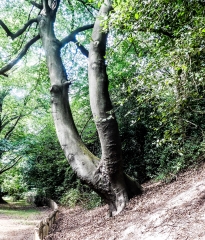
SOME YEARS AGO, I was walking in Stoke Common (just north of Slough) with my teacher and close friend, the late Professor Robert Harkness. The Common was a wooded area with a variety of trees. Some of them looked very awkward in that their curved or leaning trunks seemed to defy gravity. Yet, the trees did not fall over despite this.

TREE 3

Robert, who was a renowned physiologist, was also a naturalist. Everything natural aroused his interest. As we walked through the woods, he explained that the trees did not topple over because each of them maintained their own centres of gravity as they grew. These centres of gravity must, he considered change constantly during the long lifetimes of the trees. How, he wondered, did the trees grow in such a way that they never became unbalanced and always remained standing?

He never told me the answer. Maybe, he did not know, but ever since that damp grey afternoon with him on Stoke Common, I always look at trees and wonder whether anyone knows the answer to his question. This afternoon, I was walking along the lovely tree-lined path that leads to Kenwood House from its public car park, when I noticed some trees growing on a steep slope lining it. The trees’ roots seemed to be clinging to the slope, hanging on for dear life. Seeing them reminded me of Robert and his wondering about arboreal ‘assessment’ of centres of balance and a fine old friend, who passed away in June 2006.

EVERYONE NEEDS GOOD NEIGHBOURS

I HAVE BEEN ASSOCIATED WITH INDIA since my earliest days. This association was unconscious for the first 18 years of my life, that is before I met Indians, including my future wife, at university. During my childhood and until I was 30, I lived in Hampstead Garden Suburb (‘HGS’) in the shadow of the tall conical spire of St Judes Church. This brick edifice that can be seen from all around the HGS and many other places in northwest London was designed by Edwin Lutyens (1869-1944) the husband of Lady Emily Bulwer-Lytton (1874–1964), who was a daughter of the 1st Earl of Lytton, a former Viceroy of India. It was Lutyens who was given the task of designing New Delhi, the new capital of British India, between 1912 and 1930.


H0

St Judes Church by Edwin Lutyens

The construction of St Judes began in 1909, a year after our family home at 36 Hampstead Way was built. The church was consecrated in 1911, but not completed until 1935, after Lutyens had finished working on New Delhi. The north side of the church lines one side of the grassy Central Square, which was also laid out by Lutyens. The north side of the square is lined by the south side of the Free Church, a domed edifice designed by Lutyens. Its construction began in 1911 but was not fully completed until 1960.  As a child and for many years later, I had no idea that Lutyens had an important connection with India. In general,  I do not like the buildings designed by Lutyens in either HGS or in New Delhi. The only one of his buildings that appeals to me is Castle Drogo in Devon.

A recent visit to the HGS brought back several memories that I will share with you. Our house at 36 Hampstead Way looks much as it did when I was a child. In those days, and still today if you look carefully, the name ‘Inverugie’ can be discerned above the front porch beneath layers of whitewash. When my parents bought the house back in the early 1950s, they did not like the name and had it covered with paint. Despite many repaintings, it can still be seen if you know where to look.

When I was a child, our neighbour on Hampstead Way was the elderly spinster Miss Reinecke. Our other immediate neighbours on Hill Close were the very elderly Mr and Mrs Palmer. They sold the house to a young family, Mr and Mrs ‘S’. I used to babysit their children when I was a teenager. It was an easy way to make some pocket money because their children were always asleep when I arrived, and they never woke up while I was on duty. On one occasion, I was baby-sitting long enough to listen to the five long-playing records (LPs) that contained an entire performance of Wagner’s “Mastersingers of Nuremberg”. We rang on the doorbell the other day. Although Mr S could not recognise me at first, once he knew who I am, he remembered all sorts of things. He told me that all of the other houses in Hill Close have changed hands, sometimes several times, since we sold the house in the early 1990s.

A house at the top end of Hill Close used to be occupied by one of my father’s colleagues at the London School of Economics (‘LSE’), Professor Percy Cohen (1928-1999).  He was born in Durban, South Africa, and after obtaining a degree in social anthropology, he moved into the field of sociology. Occasionally, he used to stop his car and pick me up to give me a lift a part of the way to University College London, where I studied for many years.

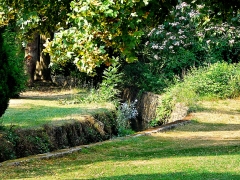
A few steps lead up from the Cohen’s end of Hill close to a footpath that runs between hedges. When I lived in HGS, there was a tennis court on the south side of the path. All of the houses on Hill Close, including ours, had access to this court. In the second half of the 1960s, I used to play tennis there after school with three of my friends. We used to play in the fading light of the late afternoon. What with poor light and the well-worn markings on the hard court, there were often arguments about whether a ball had landed inside or outside the lines. Today, the court has disappeared and has been replaced by a well-manicured lawn, which is used by residents of a block of flats on South Square.

The footpath that begins at the end of Hill Close disgorges at South Square. A house on the corner of the footpath and South Square was once occupied by the Zacharias family. Mr Zacharias was a US diplomat. My sister and his daughter, Missie, became good friends. I enjoyed spending time with Missie’s brother, and my parents got on well with his. Occasionally, we would be invited to parties at their house. At one of these, we were introduced to Patrick Gordon Walker (1907-1980), who was an important British Labour politician. I remember being impressed at the time. I realised he was a famous person but had no idea why he was. Eventually, the Zacharias family returned to the USA. Just before they left, they came to our house to give us many half empty bottles of liqueurs and spirits.  My parents stored them in a cupboard in my father’s study. They were not keen drinkers. The bottles remained untouched, gathering dust for many years. They were still there when my father sold the house. I hope someone managed to enjoy their contents rather than chucking them away.

Henrietta Barnett School and the HGS Institute line the eastern side of Central Square. Until our recent visit, I had never noticed a stone plaque inserted in the wall of the school building. It reads: “This stone was unveiled by Her Royal Highness The Princess Margaret on 2nd July 1957 to commemorate the jubilee of The Hampstead Garden Suburb, 1907-1957”.

I was 5 years and two months old on the 2nd of July 1957. I remember that day well. I was spending the day at my mother’s sisters house near Wildwood Road in HGS. Sometime that morning, she took me and my young cousin to Wildwood Road and seated me on a piece of street furniture, a metal cupboard fixed to the pavement, which contained equipment needed for telephones. She handed me a Union Jack flag attached to a blue wooden stick. When the fancy car carrying Princess Margaret drove past, I waved the flag. You might wonder how I remember so much about that flag. The reason is that it was stored in my aunt’s downstairs bathroom for many years afterwards and I saw it each time I used the room.

Southway leads east from the south-east corner of Central Square. Harold Wilson (1916-1995), Prime Minister between 1964 and 1970 then again from 1974 to 1976, lived in a semi-detached house on Southway until 1964, when he moved to 10 Downing Street, closer to his workplace. Unlike his minister Gordon Walker, I never met him. The brickwork on the former Prime Minister’s home in Southway includes three bricks inscribed with letters. One reads “HCP”, another “AEP”, and the third “1909”, which might be the year the house was built.

Bigwood Road intersects South Way and leads south to Meadway, crosses it,  and then becomes  Meadway Close. One of my father’s close colleagues at the LSE, Lionel Robbins (1898-1984), lived in a substantial semi-detached house on this cul-de-sac that ends close to the Hampstead Heath Extension. Lord Robbins was an important twentieth century British economist. I cannot tell you about his contributions to economics because I only knew him as a friend of our family.

Lionel was over six feet tall and his wife, Iris, was truly short. He drove a tiny Mini and Iris drove a far larger vehicle. My mother knew that Robbins was fond of spaghetti. My parents were fond of Italians, and often invited my father’s Italian postgraduate students, amongst which was the former Prime Minister of Italy, Romano Prodi, to our home for dinner. Almost always, they invited Lionel Robbins as well. This was because my parents knew that most of my father’s Italian students were in awe of the great Lionel Robbins. At these dinner parties, my mother served spaghetti which Robbins enjoyed, and the young Italian guests sat around the great man enjoying his presence and the opportunity to chat with such a famous economist.

Almost opposite the home of the Robbins was the home of my school friend at Highgate School, Timothy Clarke. Tim is the younger brother of Charles Clarke, who became head boy at Highgate School before studying at Cambridge University. A member of the Labour Party, Charles served as Home Secretary between 2004 and 2006 in Tony Blair’s government. Once a Head Boy, always a Head Boy! I lost contact with Tim after we left Highgate. Whenever I pass his childhood home, I remember that there was a stylised metal sailing ship attached to its front door. When I passed it recently, I noticed that the door was no longer decorated with a ship.

We had parked our car near the intersection of Hampstead Way and Meadway, opposite a house on the north-east corner of the intersection. The building is a kind of terrace containing three or four houses. I never knew anyone who lived there, but I do remember that whenever there was to be a general election, somebody in that group of houses always put up an orange poster promoting the Liberal Party. Despite this and Harold Wilson living in the Suburb, the majority  of voters in the Hendon South Constituency, in which HGS is located, always voted for the Conservatives. When I was young, our MP had a memorable name: Sir Hugh Lucas-Tooth (1903-1985). I wonder whether his name subconsciously inspired me to take up dentistry. He held Hendon South from 1945 until 1970, when he retired from politics.

We drove away from the Suburb, a place that I found dull in my youth, with many memories revived in my head. I hope that you have enjoyed the selection I have shared with you.


Shakespeare in the forest

BIG WOOD SEEMED large to me when I was a child. Although it does not live up to its name, it feels like a big wood once you enter it. Located in the heart of Hampstead Garden Suburb (‘HGS’), this woodland and the much smaller nearby Little Wood are quite ancient. They were part of a forest that was at least 1000 years old, part of land given to Wealdhere, who became Bishop of London late in the 7th century. The woods and surrounding land remained church possessions until 1911, when they were leased to the HGS Trust by the Ecclesiastical Commissioners. According to the londongardenstrust.org website:
“When Hampstead Garden Suburb was being planned in 1907, its instigator, Dame Henrietta Barnett, was committed to providing green spaces within the housing, planting trees and preserving those that existed. When additional land was acquired to extend the Suburb in 1911, Big Wood was leased from the Ecclesiastical Commissioners and preserved as woodland. In 1933 Finchley UDC took on the freehold.”

BIG 12

Stage and auditorium of Little Wood Theatre

There is a report that circus elephants used to be kept in a field that existed between Big and Little Woods before the construction of houses in this location (now Denman Drive North and South). Colin Gregory wrote (www.hgs.org.uk):

“Before leaving this story, we should pay our respects to one of the last occupiers of Park Farm: the circus proprietor Lord’ George Sanger … His descendants continued the circus in operation until the 1960s. It is said that when he owned Park Farm he allowed the circus animals to winter on his land. An elderly resident of Denman Drive – constructed in 1908 on what was once Westminster Abbey’s land – used to recall ‘elephants grazing’ in the field between Big Wood and Little Wood, before Denman Drive North and Denman Drive South – constructed in 1912 on what was once the Bishop’s land – were completed.”

We re-visited the woods recently on a hot sunny afternoon. We entered Big Wood from the end of Temple Fortune Hill. At this entrance to the tiny forest there is a wooden gate that was put up to commemorate the 29 residents of HGS who died during WW2.  I do not remember seeing this gate when I was a child in the 1960s. Often in those days, my friends and I used to play in the woods, which I recall as being dark and dingy.

Lopa and I walked leisurely from one end of Big Wood to the other along good paths in about five minutes. This made the wood seem far smaller than its name suggests. However, when we wandered off the main tarred paths onto the numerous dirt tracks, made uneven by semi-exposed roots, threading their way amongst the trees, tree stumps, broken branches, and clumps of stinging nettles, the wood seemed dense and dank despite the fine blue sky above the tree tops. Calls of hidden birds punctuated the silence.  On these small paths, we lost all sense of direction and managed to get lost within the tiny area of woodland.

We had asked some locals how we could reach Little Wood from Big Wood and they had told us to follow a certain path, which they pointed out. We set off along it, but it kept bifurcating every few yards and we were clueless as to which of the two branching paths was the one to follow to arrive at Little Wood. Eventually after going around in circles, we gave up and left Big Wood via Oakwood Road, which is appropriately named as many of the trees in the two woods are oaks. We entered Little Wood from Denman Drive North, the continuation of Denman Drive South. These differently named sections of the same stretch of road link the two woods and must pass close to the field where circus elephants once grazed.

Little Wood, whose history is the same as that of Big Wood, contains one of London’s lesser-known performance spaces, a small open-air theatre.  This was created in 1920 by the Play and Pageant Union, one of two drama groups that later merged to form the Garden Suburb Theatre. It was restored in 1997, and now looks like it would benefit from some more restoration. The stage is a clearing in the woods surrounded by trees and bushes. The audience sits on a circular stepped auditorium consisting of three layers of paving stones set in a curve around the stage.

The theatre in Little Wood occupies an important place in my memories of childhood. It was here when I was about ten years old, back in the early 1960s, that I first saw a performance of Shakespeare’s “A Midsummer Night’s Dream”. It must have been on a summer evening when I watched this with a sense of wonder that still lives with me. Apart from the odd logs, there were no other props. The actors and actresses appeared on, and disappeared from, the simple stage almost magically, popping through gaps between the trees and bushes surrounding the theatre.

I cannot begin to imagine what The Bard was thinking when he created The Dream, but I feel sure that he would have approved of its being acted out in on the sylvan stage in Little Wood. Furthermore, I think that he would have appreciated a play that contains six amateur actors in its plot being performed by a troupe of amateur actors such as we were watching that far-off evening. Since watching that play in Little Wood so many years ago, I have seen several other performances of “A Midsummer Night’s Dream”, and only one has given me as much pleasure as that. It was a recent staging of the play directed by Nicholas Hytner at the relatively new Bridge Theatre near London’s Tower Bridge. In that recent show, as the theatre’s publicity said:

“The theatre becomes the forest – a dream world of flying fairies, contagious fogs and moonlight revels.”

And, the result at the Bridge was more than wonderful, although seeing the play in a real forest (Little Wood, in my case) is hard to beat.

Returning to the little theatre in Little Wood the other day, though it was out of use during the Covid-19 pandemic, it kindled many happy memories. Although I had not visited that theatre for many decades, it looked just as I remembered it.

A river and a canal

THE GREAT BED of Ware is eleven feet long and ten feet wide. Constructed at the end of the 16th century, this four-poster bed dwarfs the modern king size bed (six and a half feet by five feet). The Great Bed was housed in various inns in the town of Ware in Hertfordshire until the early 1930s when it was acquired by the Victoria and Albert Museum in London. A few days ago, we visited Ware, not expecting to see its Great Bed but for other reasons. One of these was that it is a small town not far from Perry Green where the Henry Moore Foundation is located. Another was to see the upper reaches of the River Lea and the point along it where water enters the New River.


BLOG W 10

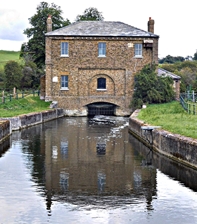
The Gauge House and the New River emerging from underneath it

The 42 mile long River Lea, a tributary of the River Thames, rises near Luton in the Chiltern Hills in Bedfordshire, flows through Hertfordshire, and then makes its way south through parts of  northeast then eastern Greater London, reaching the Thames at Bow Creek. The river flows through the centre of Ware. A short walk (1.3 miles) along the bank of the river westwards from Ware, brings one to the start of the New River, which is not actually a river. It a canal built to bring fresh water from the clean upper reaches of the Lea into London.

The history of the New River involves the London district of Islington, where the reservoir that used to collect water from the New River was located. To quote from something I wrote a couple of years ago (https://londonadam.travellerspoint.com/44/):

“At the triangular Islington Green, Essex Road branches off from Upper Street at an acute angle. At the apex of the triangle, there is a statue of Sir Hugh Myddelton (1560-1631) sculpted by John Thomas (1813–1862). He stands bare-footed, wearing a ruff and breeches, which stop short of his uncovered knees and lower legs. Below his plinth, two carved children sit or kneel with pitchers between their legs. Once, they issued water, but no longer. Myddelton, a Welsh entrepreneur, was the driving force behind the creation of the New River water supply project. The 38-mile-long canal, which he helped to finance, was constructed between 1608 and 1613 …”

Roseberry Avenue in London’s Islington is now best-known for the Saddlers Wells Theatre. However, one of its near neighbours was of great importance in connection with the New River. Quoting from my piece again:

“Across Roseberry Avenue, which flanks Spa Fields, there is a large brick building with white stone trimmings, now a block of flats. Completed in 1920, New River Head House was designed by Herbert Austen Hall (1881-1968) as the headquarters of the Metropolitan Water Board. Above two of its windows, there are carved inscriptions. One reads “Erected MDCXIII”, and the other “MDCCLXXXII”. These dates are 1623 and 1782 respectively, which are carved in archaic lettering. The inscribed stones must have been saved from an earlier building. The land on which the house stands was formerly the ‘New River Head’.

The New River, a canal constructed to bring fresh water from Hertfordshire into London ended at the reservoir called ‘New River Head’. It was high enough above what was the city of London in the 17th century to allow the flow of water from it to be ‘powered’ by gravity alone (see: http://www.british-history.ac.uk/survey-london/vol47/pp165-184). The brick-lined reservoir was constructed in 1623, when the first building at the reservoir, the ‘Water House’, was also built. The architect Robert Mylne (1733-1811), surveyor to the New River Company, repaired, enlarged, and refaced it in the 18th century. The refacing was done in 1782 … The old building, which had been enlarged many times, was demolished by 1915.”

Having seen the site of the destination of water carried by the New River, I was keen to see the point of its origin. Hence, our visit to Ware.

We parked near the centre of Ware in a car park (Burgage Lane) next to a footbridge that crosses the Lea. Then, we followed the riverside path after traversing the river. At first the path runs sinuously beneath trees that line both banks the stream. Their different coloured leaves are reflected in the water that ripples as waterfowl swim past. We met many other people enjoying their morning walks, but the path was never crowded.

After a short distance, the river flows around and between a network of islands and the path loses its lining of trees. Soon, there is open country on one side and on the other a series of modern industrial buildings partially hidden from view by occasional trees including lovely weeping willows. We reached the impressive weir of Ware. To enable boats to pass this hazardous waterfall, a lock exists. Ware Lock was first built in 1855 but looks as if it has been modernised since then.  Continuing west from the weir, we became aware of traffic noise as we approached the concrete bridge that carries the busy A10 dual-carriageway road over the river.

A third of a mile upstream from the road bridge, there is a tall brick house. It is not attractive and can be seen from afar in the flat landscape surrounding it. This building, The Gauge House, was built in 1856 to the design of William Chadwell Mylne (1781-1863), a son of Robert Mylne, who was involved with the terminal reservoir at New River Head in Islington (see above).  The building is constructed on an arch, a bridge that straddles the start of the New River at the point where water enters the canal from the River Lea. The ground floor of the building houses a mechanism for regulating the flow of water from the Lea into the New River. This is explained on the historicengland.org.uk website as follows:

“… [The] ground floor contains the gauge which measures the intake of water from the River Lee; it consists of 2 iron boats 5m long floating at Lee level which are joined by a chordal segmental iron beam 9m long, and the rise and fall with the level of the Lee controls the flow of water over the sluice which can be further adjusted by weights hung from the gate, the daily intake from the Lee being 22 1/2 million gallons.”

Another website, engineering-timelines.com, gives details of the predecessors of the Gauge House:

“At first, the flow from the river was monitored by a wooden ‘balance engine’ – a rocking beam-and-float device. It was later replaced with the Marble Gauge, built by Robert Mylne inside a Portland stone chest. Though now empty, this is still visible a little downstream.”

We were able to see the exterior of the Gauge House including the grille through which water leaves the Lea to flow under the building and that from which it flows from the House into the first stretch of the New River. The canal flows about 300 yards south before making a right angle beyond which it begins flowing east.  Having visited the London terminus of the New River and walked along attractive stretches of the canal lined by parkland in Canonbury, near Islington, I was very satisfied seeing where this historic waterway commences. We retraced our steps along the riverbank to Ware before driving to visit the Henry Moore Foundation at Perry Green.

Returning to the subject of beds, which is associated with the town of Ware, my mind leaps a quarter of the way around the world to Ootacamund (‘Ooty’) in the south Indian state of Tamil Nadu. In January 1994, we spent part of our honeymoon at St Margarets in Ooty, a guesthouse belonging to the ITC company. The room we occupied in this typical colonial style bungalow was huge. And it needed to be to accommodate the enormous bed that we occupied. This bed, whose width rivalled that of the Great Bed of Ware was not so long as the latter. Its sheets must have been specially made to fit this enormous bed.  Although there were only two of us sleeping in it, I think that that it would have been wide enough for four or five couples to sleep in it without it becoming overcrowded.

Both Ooty and Ware have their charms, but the latter is far more accessible from London especially in these times of restricted travel caused by the wholly unwanted presence of the Covid-19 microbe.  


Seated above a cow

I HAVE WALKED PAST IT OFTEN, noticed it, but had never examined it carefully until a few days ago. I am referring to the statue of Edward Jenner (1749-1823) that surveys the formally arranged pools and fountains in the Italian Gardens at the north end of the Serpentine Lake. This body of water was created in 1730 at the request of Queen Caroline (1683-1737), wife of King George II.  Originally it was fed by water from the now largely hidden River Westbourne and Tyburn Brook. Now its water is pumped from three bore-wells within the confines of Hyde Park.


BLOG JENNER LATE 286 

Jenner is depicted seated in what looks like an uncomfortable chair, resting his chin on his left hand, his left arm being supported on an armrest.  The bronze statue was created by the Scottish sculptor William Calder Marshall (1813-1894). He also created the sculptural group representing ‘Agriculture’ on the nearby Albert Memorial. The Jenner sculpture was originally located in Trafalgar Square, where it was inaugurated in 1858 by Prince Albert, the Queen’s Consort three years before his demise. In 1862, the sculpture was moved to its present location in the Italian Gardens. Incidentally, the design of the gardens was based on those at Osborne House on the Isle of Wight and were created in 1860 to the design of the architect and planner James Pennethorne (1801-1871).

Jenner, a qualified medical doctor, is best known for his pioneering work in developing protection against smallpox. This derived from his experimentation based on his (and other people’s) observation that the pus from blisters that milkmaids received from cowpox protected them against the far more serious disease smallpox. Justifiably, Jenner has been dubbed the ‘father of immunology’. So great was his achievement that Napoleon, who was at war with Britain at the time, awarded Jenner a medal in 1803, the year Napoleon was planning to invade Britain with his recently formed Armée d’Angleterre. The French leader said:

“The Sciences are never at war… Jenner! Ah, we can refuse nothing to this man.” (see: https://www.nature.com/articles/144278a0).

Maybe, these words of the great Napoleon can still teach us something about international cooperation generosity of spirit.

His fame in the field of vaccination overshadows Jenner’s other achievements in science and medicine. He was a first-rate zoologist. For example, his observations, dissections, and experiment established for the first time that the baby cuckoo is born with a depression in its back that allows it to displace the eggs of the  bird whose nest the cuckoo has colonised. The baby cuckoo ejects his or her host’s eggs without the help of the adult cuckoo, which has deposited her eggs in the nest of another species. Jenner published his findings in 1788. This was a few years before he established the effectiveness of vaccination in the late 1890s. He self-published his results in 1898 after his most important paper was turned down by The Royal Society.

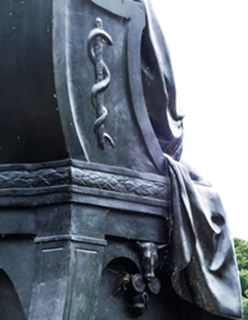
Getting back to his statue in the Italian Gardens, there are two features that I had not noticed before examining it carefully recently. One of these is a depiction of the Rod of Asclepius on the backrest of Jenner’s seat.  The serpent entwined helically about a rod is traditionally associated with medicine and healing. Beneath the seat, there is a depiction of a cow’s head. This is appropriate symbolism given the importance of cows in the discovery of smallpox vaccination. The word vaccine is derived from the Latin word ‘vaccinus’, which in turn is derived from ‘vacca’, the Latin for ‘cow’. There is an object depicted below the cow’s head, which I fancy, using a little imagination, might be a stylised depiction milk maid’s cloth hat.

Jenner was not the only person experimenting with inoculation against smallpox, but he is the person best remembered for it because his results and reasoning convinced the world of the concept’s validity and applicability.

Although I do not find the monument to Jenner to be particularly attractive, it is one of London’s statues least likely to arouse anger as its subject had nothing to do with slavery. In contrast to many other well-known figures of his era, Jenner should be remembered for his important involvement in a development that has benefitted mankind for well over two centuries. I hope that his scientific descendants currently working around the world in laboratories will be able to create a vaccine to counter the Covid-19 virus as soon as possible.