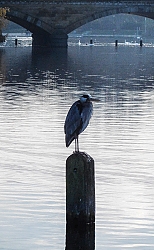
Waiting silently
By the Serpentine lake
Stands a serene heron

Waiting silently
By the Serpentine lake
Stands a serene heron
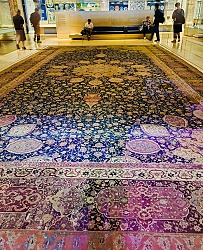
The Victoria and Albert Museum houses a huge, antique carpet from Ardibil (in Persia).It was made in about AD 1539, and is one of the oldest accurately dated carpets.
You will need to read my book “Beyond Marylebone and Mayfair: Exploring West London” to discover the link between this carpet and a Socialist activist, who lived in Hammersmith.
Buy your copy of my book at Lutyens & Rubinstein (Kensington Park Road) OR from Amazon (https://www.amazon.co.uk/BEYOND-MARYLEBONE…/dp/B0B7CR679W/)
IN THE EARLY 1960s, the first proper self-service supermarket opened on the corner of Golders Green Road and a small service road called Broadwalk Lane. I cannot recall the name of this store, but it was soon taken over by the Macfisheries company. Later, it became a supermarket where many imported foods, especially products from Israel, were sold. Now, it has become a Tesco Express.
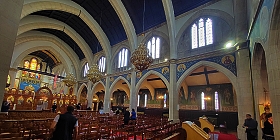
Facing the supermarket (across Golders Green Road) is a gothic revival style church. It has been used by a Greek Orthodox (Christian) congregation since 1968. Now, the The Greek Orthodox Cathedral of the Holy Cross & St. Michael, it was constructed as the Church of England’s ‘St Michael’s Church’ in 1914 to the design of JT Lee. A clock tower, surmounted by a delicate cupola supported by thin columns, was added to the church in 1960. On one of its walls, there is a bas-relief of St Michael with one foot on a serpent. On the northeast corner of the church, there is a plaque listing people who died in WW1. Near this, there is a crucifix standing in the garden next to the church. Its design, typical of C of E crucifixes, predates the arrival of the Greek congregation.
Although the interior of the church maintains some of its original Cof E fittings, such as stained-glass windows, the font designed in a mock mediaeval style, and some wall mounted memorials in English, a great deal of effort has been made to create the atmosphere of a Greek Orthodox place of worship. The walls of the side aisles have been painted with religious scenes. There is a decorated iconostasis and several framed icons. Elaborate chandeliers hang above the nave. Despite the additions to convert the church for Greek Orthodox worship, the original gothic revival features of the building’s interior are evident, but harmonise well with the later additions.
LONDON’S KENSINGTON GARDENS is bounded to the north by Bayswater Road and to the south by Kensington Gore (overlooked by the Royal Albert Hall and the Albert Memorial), which becomes Kensington Road. Within the park and running almost parallel with its southern boundary is the South Flower Walk (also known as The Flower Walk). The Northern Flower Walk, which runs near and parallel to Bayswater Road was once used by royalty. According to a document published on the Royal Parks website, this was:
“… a delicious and appealing place to stroll for the monarch on the way to … the site of the Bayswater ‘Breakfasting House’…”

The breakfasting house no longer exists. I am not sure whether the South Flower Walk can boast of such an illustrious past. However, when it is in full bloom, it outdoes its northern counterpart in colourfulness and variety of its flora.
Although the whole of Kensington Gardens makes for a pleasant place to stroll, a walk along the South Flower Walk provides and exceedingly pretty perambulation.
RAAVI KEBAB BEGAN serving Pakistani and Punjabi food in the mid-1970s. It is located on Drummond Street, close to London’s Euston Station. This unpretentious eatery with barely any internal decoration except some mirrors with Koranic verses engraved on them in Urdu script, is next door to the Diwana Bhel Poori House. It was at the latter that we used to enjoy Indian vegetarian dishes when we were undergraduate students at nearby University College London during the first years of the 1970s. In those days, Raavi, named after the river that flows through the now Pakistani city of Lahore, did not yet exist. It was only in the early 1990s that a friend visiting from Bombay suggested that we ate with him at Raavi’s. When the grilled kebabs arrived at our table, it was love at first bite. We have been returning to Raavi’s ever since.

Yesterday (1st of September 2022), we made yet another visit to Raavi’s. As we sat down, I noticed a thick wad of photocopies held together with a bulldog clip. They were resting on top of a neatly folded shawl. Out of curiosity, I looked at the top sheet, which was a page copied from a book with annotations added in red ink. I looked more carefully and noticed that the printed text was in Italian. The page was headed “<De ingratitudine> Joanni Folci Niccolaus Maclavellus”. It is a chapter (‘The ingratitude of Joanni Folci’) from a book by Niccolò Machiavelli (aka Maclavellus), who lived from 1469 to 1527. The rest of the text on the photocopied page appeared to be a learned commentary on Macchiavelli’s chapter.
I do not know why, but I felt that Raavi’s was the last place I would expect to find scholarly papers lying about so casually. I associate the place, as do most of its many customers, with grilled meat and spicy masalas. I asked the waiter about the papers. He shrugged his shoulders and said that someone must have left them behind after eating, and that he had no idea whether anyone would return to retrieve them.
HAMPSTEAD GARDEN SUBURB (‘HGS’) in north London, where I spent my childhood and early adulthood, is a conservation area containing residential buildings designed in a wide variety of architectural styles. It first buildings were finished in about 1904/5. Despite this, many of the suburb’s houses and blocks of flats were designed to evoke traditional village architecture. Much of HGS contains buildings that do not reflect the modern trends being developed during the early 20th century, However, there are a few exceptions. These include some houses built in the ‘moderne’ form of the Art Deco style, which had its heyday between the two World Wars.

A few Art Deco houses can be found in Kingsley Close near the Market Place (see https://adam-yamey-writes.com/2022/02/07/art-deco-in-a-north-london-suburb/), and there is a larger number of them in the area through which the following roads run: Neville Drive, Spencer Drive, Carlyle Close, Holne Chase, Rowan Walk, and Lytton Close. The part of HGS in which these roads run was developed from about 1927 onwards, mainly between 1935 and 1938. So, it is unsurprising that examples of what was then fashionable in architecture can be found in this part of the suburb. According to an informative document (www.hgstrust.org/documents/area-13-holne-chase-norrice-lea.pdf) about this part of HGS:
“… A relatively restricted group of established architects undertook much development such as M. De Metz, G. B. Drury and F. Reekie, Welch, Cachemaille-Day and Lander, and J. Oliphant. H. Meckhonik was a developer/builder and architects in his office may have designed houses attributed to him.”
Most of the Art Deco houses on Spencer Drive and Carlyle Close leading off from it are unexceptional buildings, whose principal Art Deco features are the metal framed windows (made by the Crittall company) with some curved panes of glass. Fitted with any other design of windows, these houses would lose their Art Deco appearances. Number 1, Neville Drive displays more features of the style than the houses in Spencer Drive and Carlyle Close. There is, however, one house on Spencer Drive that is unmistakably ‘moderne’: it is number 28 built in 1934 without reference to tradition. It is an adventurous design compared with the other buildings in the street.
Numbers 13 and 24 Rowan Walk, a pair of almost identical buildings which stand on either side of the northern end of the street, where it meets Linden Lea, stand out from the crowd. They have flat roofs and ‘moderne’ style Crittall Windows. Built in the 1930s, they are cubic in form: unusual rather than elegant.
I have saved the best for last: Lytton Close. This short cul-de-sac is a wonderful ensemble of Art Deco houses with balconies that resemble the deck railings of oceanic liners, flat roofs that serve as sun decks, curved Crittall windows, and glazed towers housing staircases. Built in 1935, they were designed by CG Winburne. I have to admit that although I lived for almost three decades in HGS, and used to walk around it a great deal, somehow I missed seeing Lytton Close (until August 2022) and what is surely one of London’s finer examples of modern domestic architecture constructed between the two world wars. Although most of the Art Deco buildings in HGS are not as spectacular as edifices made in this style in Lytton Close and further afield in, say, Bombay, the employment of this distinctive style injects a little modernity in an area populated with 20th century buildings that attempt to create a village atmosphere typical of earlier times. The architects, who adopted backward-looking styles, did this to create the illusion that dwellers in the HGS would not be living on the doorstep of a big city but instead far away in a rural arcadia.
MOUNT STREET GARDENS in London’s Mayfair was formerly the burial ground of St George’s Church in Hanover Square. Its name derives from Mount Field, where there had been some fortifications during the English Civil War. The burial ground was closed in 1854 for reasons of protecting public health. St George’s Church moved its burials to a location on Bayswater Road, St Georges Fields, which is described in my book “Beyond Marylebone and Mayfair: Exploring West London”. In 1889-90, part of the land in which the former burial garden was located became developed as the slender park known as Mount Street Gardens (‘MSG’- not to be confused with a certain food additive). Small as it is and almost entirely enclosed by nearby buildings, it is a lovely, peaceful open space with plenty of trees and other plants.

The garden is literally filled with wooden benches. Unlike in other London parks where there is often plenty of space between neighbouring benches, there are no gaps more than a few inches between the neighbouring benches in MSG. The ends of neighbouring benches almost touch each other. The result is that MSG contains an enormous number of benches given its small area. And they are much appreciated by the people who come into the park and rest upon them.
Each bench bears a memorial plaque. Many of these memorials commemorate people from the USA, who have enjoyed experiencing the MSG. And most of these having touching messages written on them. Here are just a few examples: “For my children Philippa and Richard, young Americans who may one day come to know this place. Richard L Feigen. 8th August 1987”; “Seymour Augenbraun – a New Yorker and artist for whom this spot in London is his oasis of beauty. From his wife Arlene and family on July 15th 1986”; “To honour a dear brother and sister Ira and Nancy Koger of Jacksonville Florida”; “This seat was given by Leonora Hornblow, an American, who loves this quiet garden”; “In memory of Frances Reiley Bochroch, a Philadelphia lady who found these gardens a pleasant pace”; and “In loving memory of Joe Bleich (1910-1990). An American who could not find a park like this in New York City,”
There are plenty of other similar memorials to Americans on the benches. All of them interested me, but one of them particularly stood out: “To commemorate Alfred Clark, pioneer of the development of the gramophone. A friend of Britain, who lived in Mount Street”. Clark (1873-1950) was a pioneer in both cinematography and sound recording. Eventually, he became Chairman of EMI. A keen collector of antique ceramics, he donated some of his pieces to London’s British Museum.
Not all of the benches are memorials to Americans. There are others to Brits and people from other countries, but the Americans outnumber the rest. Had it not been for the extraordinarily large number of benches in this tiny gem of a park, I doubt that my eye would have been drawn to the commemorative plaques, but having seen the one in memory of Joe Bleich, who was unable to find a park like it in NYC, I was drawn to examine many of the others.
MY UNCLE SVEN Rindl (1921-2007) was a structural engineer. He was involved in the construction of the building on the west side of Mayfair’s Grosvenor Square, which used to house the Embassy of the USA until recently. About yards south of the former embassy building, there is another place associated with the USA on South Audley Street. Far older than the embassy, this is the Grosvenor Chapel, whose foundation stone was laid in 1730 by Sir Richard Grosvenor (1689-1732), the local landowner. The relatively simple brick and stone church with some neo-classical features was ready for use in 1731. When the church’s 99-year lease ran out in 1829, it became adopted as a chapel-of-ease (i.e., a chapel or church within a parish, other than the parish church) to St George’s Hanover Square.

Until very recently, I had often passed the Grosvenor Chapel when going to and from The Nehru Centre, also on South Audley Street, but had never entered it. Yesterday (26th of August 2022), the doors were open and, being early for a dance performance at the Nehru Centre, I looked inside the chapel. Its interior is simply decorated. The wide nave lies below a barrel-vaulted, plastered ceiling. Galleries supported by columns with Ionic capitals flank the north and south sides of the nave. The chancel is separated from the nave by a screen with openings, each of which is flanked by pairs of Ionic columns. The screen was added by the architect John Ninian Comper (1864-1960) when he remodelled the church’s interior in 1912.Ionic columns with their bases on the gallery support the ceiling of the nave. Windows (with plain glass panes) on two levels, both below and above the galleries, give the chapel good natural illumination. In summary, the simple, white-painted chapel, though not large, feels spacious. Its simplicity is a complete contrast to its neighbour, the flamboyant Gothic Revival style Catholic Church of the Immaculate Conception.
An inscribed stone plaque on the west front of the chapel records its American connection. The words on it are:
“In this chapel the Armed Forces of the United States of America held Divine Service during the Great War of 1939 to 1945 and gave thanks to God for the Victory of the Allies”
The American General Dwight David Eisenhower (1890-1969) was amongst those who worshipped there during WW2. Many years before that, another person connected with the USA, John Wilkes (1725-1797) was buried in the chapel. Wilkes, a radical journalist and politician, was a supporter of the American rebels during the American War of Independence.
America (i.e., the USA) has been associated with Mayfair since it gained independence from the British. Its first embassy was in a house in Mayfair belonging to John Adams (1735-1786), who was the first US Minister to the Court of St James (between 1785 and 1788). The embassy’s Chancery moved several times before 1938, when it was housed in 1 Grosvenor Square, now the home of the Canadian High Commission. Thus, during WW2, it was close to the Grosvenor Chapel. The embassy building, in whose construction my uncle was involved, was designed by the architect Eero Saarinen (1910-1961), and completed in 1960. By January 2018, the embassy had shifted from Grosvenor Square to a newly constructed edifice across the Thames at Nine Elms.
Returning to the small chapel, a small note about its name. The place’s website (www.grosvenorchapel.org.uk) explained:
“It retains its title of Chapel because it is not, and never has been a parish church, and its continuing existence is entirely dependent upon the generosity of those who worship here regularly or visit from time to time.”

See fruits aplenty
And market fresh veg to browse
The stall overflows
I DOUBT THAT Auguste Rodin (1840-1917) would have ever imagined that a copy of his sculpture “The Kiss” (created 1901-1904) could have ended up being displayed bound up in one mile of string. Situated in the lower ground floor foyer of London’s Tate Britain gallery, that is what can be seen currently (August 2022). The British artist Cornelia Parker (born 1956) decided to wrap-up/tie-up a replica of “The Kiss” as described. You might wonder why. I cannot tell you, but make the observation that we all perceive things differently. And one of the skills that has united artists over the centuries is that they can express to other people the way they perceive and understand the world they observe. Rodin’s bound sculpture stands close to the entrance of an exhibition dedicated to works by Ms Parker, which runs until the 16th of October 2022.
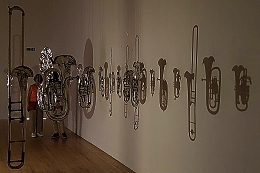
The exhibition consists of artworks of varying sizes including visually dramatic installations, each large enough to fill a spacious room in the gallery. All the works are labelled. These labels explain how they were created and the concepts, some of them with political aspects, that the artist intended to express. When I look at works of art, I am primarily stimulated by their appearance and the visceral emotions they evoke in me. I am less interested in the concepts being portrayed and the artist’s explanations. Therefore, amongst the exhibits in the Parker exhibition, it was the installations that both interested me and excited me most.
The installation “Thirty Pieces of Silver” consists of domestic silver plate items that were squashed beneath a steam roller. Each piece is suspended above the ground by fine threads attached to the ceiling. They are arranged in thirty separate groups and lit from above. The shadows of the silver objects are projected on the floor below them. This delicate-looking installation’s name is taken from the 30 pieces of silver, which Judas received for betraying Jesus.
A spectacular installation, “Cold Dark Matter: An Exploded View”, is housed in another room. Parker arranged with the Army School of Ammunition to use Semtex (as used by terrorists) to blow-up her garden shed (filled with tools and other stored objects). Then, all the fragments were recovered, and one by one they were suspended from the ceiling of the gallery in such a way that the ensemble resembles a still from a film made whilst the shed was exploding. In the middle of all the suspended debris, there is a single light bulb shining. This throws the distorted shadows of the blackened fragments onto the gallery’s walls.
In another room, there was an installation, which also made effective use of reflections projected on to its walls. “Perpetual Canon” consists of a collection of silvered brass instruments, which have been flattened. Each of them is suspended from the ceiling by a fine thread, and they are arranged in a circle which surrounds a centrally located light. The light throws shadows of the instruments onto the four walls surrounding them. Like the two previously described works, this provides a very effective and intriguing visual experience.
Another installation, “The War Room”, impressed me least amongst this category of Parker’s works on display. One of the last rooms in the exhibition houses an installation called “Island”. This consists of a common design of garden greenhouse. Its floor consists of worn floor tiles that used to line the corridors of The House of Commons. The glass panes are covered with white dots made from cliff chalk. They are related to Parker’s reaction to Brexit. Contained within the glasshouse, there is a light whose brightness pulses like that of a lighthouse: increasing gradually, and the slowly diminishing. This causes the shadows of the dots and the frame of the greenhouse to be projected on to the walls of the room containing it. Like the light producing them, the intensity of the shadows pulsates gradually.
As already mentioned, the exhibits’ labels explain what Parker is trying to express. Interesting as that is, it was the visual impact of these installations that impressed me most. Parker, like all great artists, has interesting ideas expresses them most imaginatively and effectively.
 yamey
yamey 